
A study finds that hospitals with more nurses per patient have lower patient mortality rates. A columnist concludes that hiring more nurses directly causes lower mortality. Which of the following, if true, would most weaken the columnist's conclusion?
Exam guide · Updated for 2027 admissions
Cattolica Medicine Admission Test 2027: Complete Preparation Guide
Everything you need to know about the Cattolica medicine admission test, Università Cattolica del Sacro Cuore's own entrance test for its English-taught Medicine and Surgery degree in Rome: 2027 dates and the call, format, scoring, syllabus, sample tests, results and rankings, fees and how to prepare, including the ethics and religious culture section unique to this exam.
Updated for 2027 admissions · Last updated: 14 October 2026
Cattolica Medicine Test at a glance
Overview
What is the Cattolica Medicine Admission Test?
Università Cattolica del Sacro Cuore is a private, Catholic-affiliated university, and, like Humanitas, San Raffaele or UniCamillus, it sets and marks its own admission test rather than using the national IMAT or the newer TOLC-MED. Its Faculty of Medicine and Surgery "A. Gemelli" sits in Rome, at the Gemelli University Hospital, and runs an English-taught Medicine and Surgery degree with its own entrance exam separate from the university's Italian-taught programmes.
The test itself is short and dense: 65 multiple-choice questions in 65 minutes, sat online from home under remote proctoring rather than at a test centre. What sets it apart from most other Italian medical-school entrance tests is its subject list. Alongside the four core sciences and a large logical-reasoning component, Cattolica tests general culture and, uniquely among the schools IvyTest covers, ethics and religious culture, reflecting the university's own Catholic identity rather than pre-medical science.
Admission is by ranking within two separate quotas, EU and non-EU, each with its own number of places, and offers go down each ranking until the places in that quota are filled. There is also a hard floor: score below a minimum threshold and you are not eligible for a place at all, regardless of rank.
Programmes that use the Cattolica Medicine Test
- Medicine and Surgery (English-taught, Rome, based at the Gemelli University Hospital campus)
- Not covered here: Medicine and Surgery – Technologically-oriented (MedTec, Rome, Italian-taught, run with Roma Tre University), which admits through the separate Italian-language competition, sat in person with a different question split
Timeline
Cattolica Medicine and Surgery call 2027/28: dates, places and how to apply
When to expect your exam · 2027 start
- March 202717 MarPublished
Applications are open until 17 Feb 2027.
Dates the university has published for this cycle. See every university on the calendar →
- Applications open14 October 2026
- Registration deadline17 February 2027
- Exam date17 March 2027
- Results published31 March 2027 (scores) · 7 April 2027 (EU ranking) · 14 April 2027 (non-EU ranking)
- Pre-enrolmentBy 23 April 2027
- Enrolment1 July to 6 September 2027
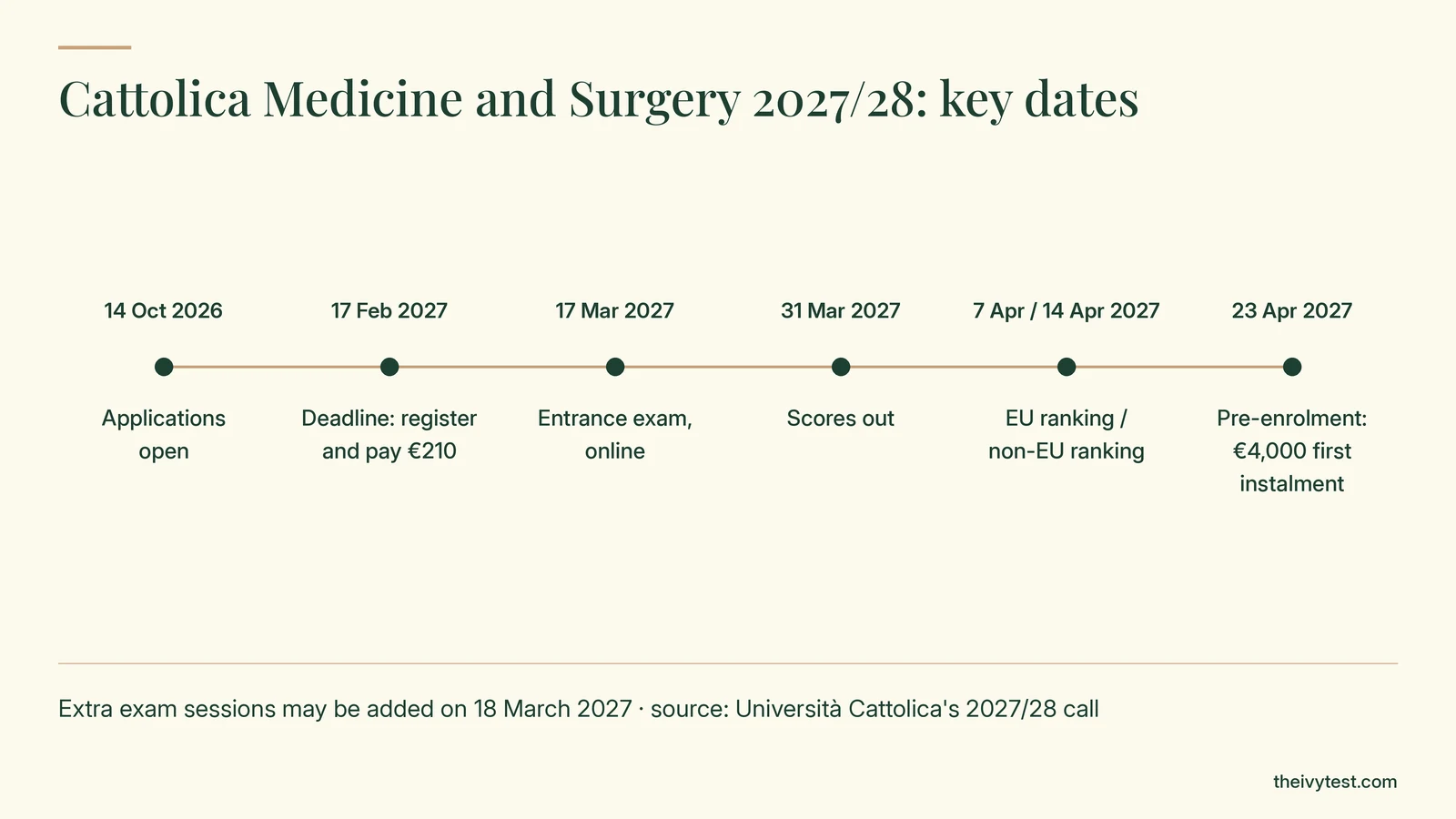
Every date above is from Università Cattolica's 2027/28 call for applications (D.R. 2883, in Italian and legally binding), published on 14 October 2026 and linked under Sources below; Cattolica International's timeline gives the same dates. The places can still change with the Italian Ministry's decree on places for 2027/28.
Structure
Cattolica Medicine Test format
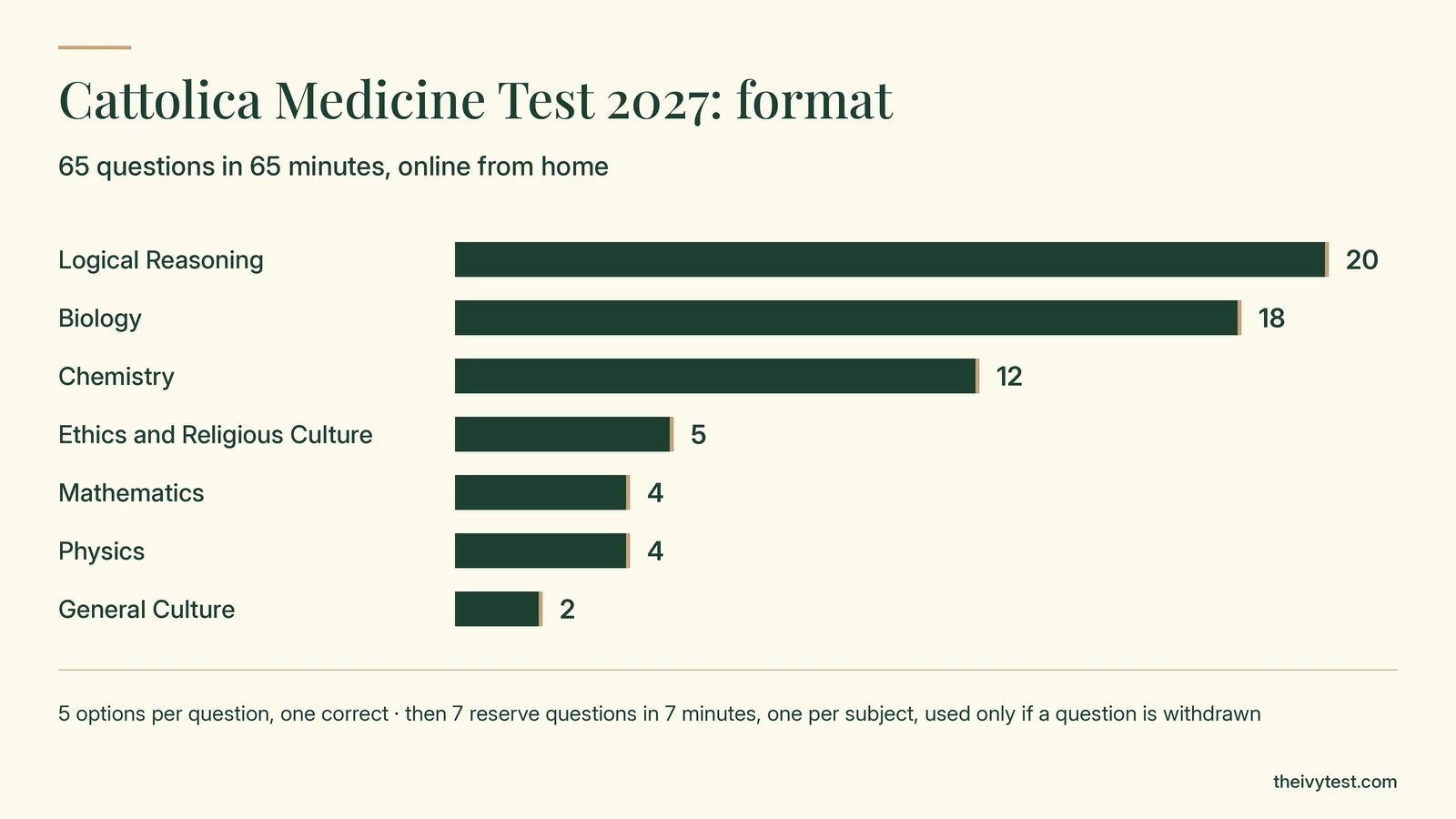
The Cattolica Medicine Test is a single, continuous 65-minute sitting: it is not split into separately timed sections. The table below shows how the 65 scored questions are divided across the exam's seven subject areas; each subject also contributes one further "reserve" question, answered in one shared seven-minute round at the end of the test (the reserve questions only count if an official question in that subject is later cancelled; see Scoring). Figures are from the 2027/28 call for applications (Art. 4), unchanged from 2026/27.
| Section | Questions | Weighting | Suggested time |
|---|---|---|---|
| Logical Reasoning | 20 | +1 correct / −0.25 incorrect | *see the note below the table |
| Biology | 18 | +1 correct / −0.25 incorrect | *see the note below the table |
| Chemistry | 12 | +1 correct / −0.25 incorrect | *see the note below the table |
| Ethics and Religious Culture | 5 | +1 correct / −0.25 incorrect | *see the note below the table |
| Mathematics | 4 | +1 correct / −0.25 incorrect | *see the note below the table |
| Physics | 4 | +1 correct / −0.25 incorrect | *see the note below the table |
| General Culture | 2 | +1 correct / −0.25 incorrect | *see the note below the table |
- No separate per-section timing: one continuous 65-minute sitting covers all seven subjects.
Content
Question and subject breakdown
Università Cattolica's test looks different from most Italian medical-school entrance exams because two of its seven areas (general culture and ethics and religious culture) reflect the university's own Catholic identity rather than pre-medical science. Together they are worth roughly a tenth of the test, and neither is covered by a generic science tutor.
Logical Reasoning
31% (20 of 65 questions)The single largest section. Argument analysis, deduction, identifying assumptions and drawing conclusions from short written passages, closer to critical-thinking practice than to a school subject.
Biology
28% (18 of 65 questions)Upper-secondary-level biology: cell structure, genetics, human physiology and general biological principles.
Chemistry
18% (12 of 65 questions)General and basic organic chemistry at school level: atomic structure, bonding, reactions, solutions.
Ethics and Religious Culture
8% (5 of 65 questions)Catholic doctrine, bioethics and Catholic social teaching: the foundations of Church teaching, the dignity of the person applied to medical bioethics, and the social-teaching themes of integral human development and human dignity in the age of artificial intelligence. Not tested by any other Italian medical school IvyTest covers. Università Cattolica publishes its own recommended reading list for this section on its admissions pages; this guide's syllabus map is general, not a substitute for that list.
Mathematics
6% (4 of 65 questions)School-level algebra, functions and quantitative problem-solving: a small but scoreable section.
Physics
6% (4 of 65 questions)Mechanics, fluids, thermodynamics and electromagnetism at school level, from the list the 2027/28 call rewrote; tested through a small number of questions.
General Culture
3% (2 of 65 questions)Broad current-affairs and general-knowledge questions, the smallest section by question count.
Marks
Cattolica Medicine Test scoring
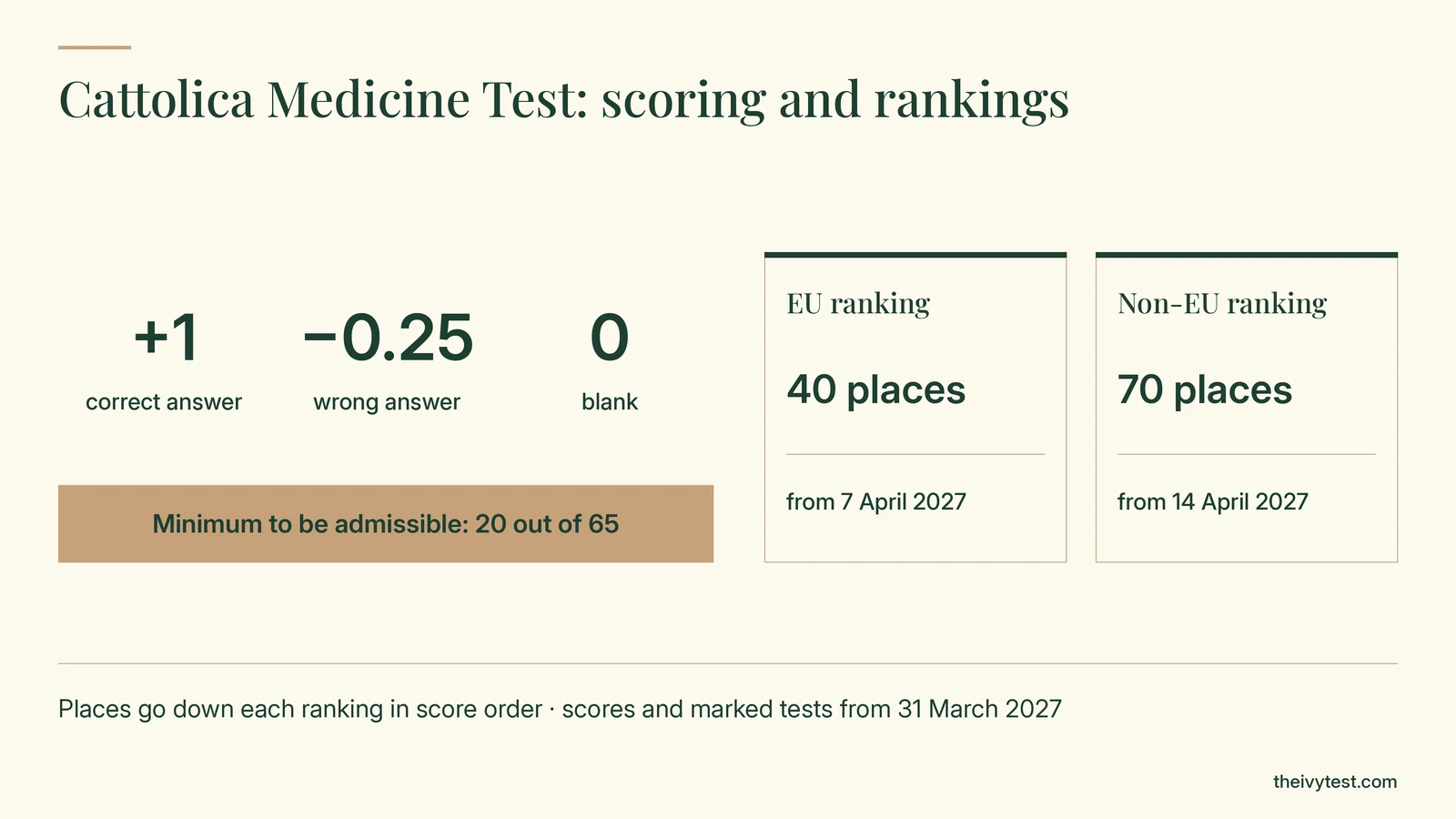
Every scored question is worth the same regardless of subject, and, unlike a purely rank-based test, there is a hard floor: score below it and you are not eligible for a place at all, whatever your rank within a quota. Figures below are from the 2027/28 call for applications (Art. 4), unchanged from 2026/27.
- Correct answer
- +1 point
- Incorrect answer
- −0.25 points
- Unanswered question
- 0 points
- Maximum score
- 65 points
- Minimum to be admissible
- 20 points out of 65; below this, no place is offered regardless of rank
- How rankings work
- Places are offered in score order within each quota (40 EU-quota, 70 non-EU-quota for 2027/28) until that quota's seats are filled.
Worked example
A candidate who answers 50 of the 65 questions correctly, gets 10 wrong and leaves 5 blank scores 50 × 1 − 10 × 0.25 + 5 × 0 = 50 − 2.5 = 47.5 out of 65, comfortably above the 20-point floor needed simply to be admissible, though that alone says nothing about where the competitive cutoff falls in a given cycle.
The IvyTest simulator scores every practice paper against these exact rules.
See the Cattolica Medicine Test simulatorSyllabus
Cattolica Medicine and Surgery admission test syllabus
Università Cattolica's official topic list for the science questions is Annex A of the call, also published as a PDF of topics to study on its Entrance exam page; for ethics and religious culture it names three texts: Dignitas personae, Caritas in veritate and Magnifica humanitas, Pope Leo XIV's encyclical. The topic lists below are a preparation map of that material, not a transcription of it: read the official documents alongside this guide.
Worth 20 of the 65 questions, the single most valuable section to train deliberately.
- Deductive and inductive reasoning
- Identifying assumptions and flaws in an argument
- Distinguishing correlation from causation
- Evaluating evidence and drawing valid conclusions
- Critical reading of short scientific or general-interest passages
- Numerical and spatial reasoning puzzles
- Cell structure and function
- Genetics: Mendelian inheritance and basic population genetics
- Molecular biology: DNA, gene expression at an introductory level
- Human physiology: circulation, respiration, digestion, the nervous and endocrine systems
- Evolution and biodiversity at school level
- Atomic structure and the periodic table
- Chemical bonding
- Stoichiometry and the mole concept
- Solutions and concentration
- Acids, bases and pH
- Basic organic chemistry: functional groups
A section unique to Cattolica among the schools IvyTest covers. The five areas below follow Università Cattolica's own published breakdown for this section; they are a general orientation, not a substitute for the university's own recommended reading list.
- Foundations of Catholic teaching: core Christian doctrine and the key events, figures and texts of the Old and New Testament
- Bioethics and the dignity of the person: Catholic teaching on human dignity as it bears on medical ethics
- Medical bioethics in practice: applying Catholic bioethical principles to clinical and biomedical scenarios
- Charity in truth and integral human development: Catholic social teaching on solidarity, the common good and human development
- Human dignity in the age of artificial intelligence: Magnifica humanitas, Pope Leo XIV's encyclical of 2026, on the reading list in place of Laudato si' (care for our common home)
Magnifica Humanitas: summary and 10 practice questions
- Algebra: equations and basic functions
- Proportion, percentages and ratio
- Basic probability
- Reading and interpreting quantitative data
Updated for the 2027/28 call (Allegato A), which rewrote the physics list: fluid dynamics (flow rate, the continuity equation, Bernoulli, viscosity), angular momentum, centripetal acceleration, friction and the magnetic field of a current are now named, and universal gravitation no longer is. Still 4 questions.
- Measurement: fundamental and derived quantities; the International and Technical systems of units, multiples and submultiples; scientific notation and conversions between units; scalar and vector quantities, vector operations
- Kinematics: velocity and angular velocity, acceleration and centripetal acceleration; uniform and uniformly accelerated straight-line motion, uniform circular motion, harmonic motion
- Dynamics: force as an interaction, the principles of inertia, of mass (the 2nd) and of action and reaction; weight, elastic force, static and dynamic friction; impulse, momentum and its conservation; moment of a force and angular momentum; work, kinetic energy, conservative forces and potential energy, conservation of mechanical energy, power
- Fluids: density and compressibility; pressure, Pascal, Stevino and Archimedes; flow rate and the continuity equation, Bernoulli's equation for ideal fluids, viscous forces in real fluids
- Thermodynamics: thermal equilibrium, temperature and thermometers; heat, calorimetry and heat transfer; heat capacity and specific heat; changes of state and latent heats; ideal gas laws; the first and second principles
- Electricity and magnetism: charges and Coulomb's law; electric field and potential, equipotential surfaces; dielectric constant, capacitors in series and parallel, electrostatic energy; generators, voltage, current, resistivity, Ohm's law, resistors in series and parallel, Kirchhoff's principles; work, power and the Joule effect; direct and alternating current, period and frequency; the magnetic field of a current, forces on currents, electromagnetic induction
- Current affairs and general knowledge
- Basic literacy in Italian and international institutions
- Broad cultural awareness beyond the core science subjects
Test your Cattolica Medicine Test knowledge
Take free diagnosticDifficulty
How difficult is the Cattolica Medicine Test?
The Cattolica Medicine Test is short, dense and structurally unusual. Most of what makes it hard is not any single subject's depth, but the breadth of seven areas, two of which most applicants have never formally studied, inside one 65-minute sitting.
Seven subjects, one 65-minute block
65 questions in 65 minutes leaves under a minute per question on average, and the exam is not divided into timed sections: a slow start in one subject eats directly into time for every other.
Two sections most candidates never train for
General culture and, especially, ethics and religious culture are not covered by a typical pre-medical science curriculum or a generic test-prep book. Together they are worth over a tenth of the test, and candidates who ignore them concede marks that biology or chemistry revision cannot recover.
Logical reasoning is the biggest single section
At 20 of 65 questions, logical reasoning outweighs any individual science subject. It rewards deliberate practice with argument-based questions far more than last-minute cramming.
A hard eligibility floor, then a ranking
Score under 20 out of 65 and no place is offered, however the rest of the applicant pool performs. Clear that floor and the real competition is the ranking within your quota (EU or non-EU), which depends on everyone else who sat the same cycle.
It is sat at home, not at a test centre
The exam runs online under remote proctoring rather than in person. That removes travel, but adds its own risk: an unreliable connection, an unfamiliar proctoring platform or a cluttered desk can cost time no differently than a hard question would.
Benchmarks
What is a good Cattolica Medicine Test score?
Università Cattolica publishes one hard number (20 out of 65 to be admissible at all), but that is a floor, not a competitive target. What actually earns an offer depends on the ranking within your quota that cycle, and any single number quoted out of context is misleading.
Places are offered in score order separately within the EU quota and the non-EU quota, so the score that earns an offer in one quota can differ meaningfully from the other, and both move from cycle to cycle depending on how many candidates apply and how they perform.
Because IvyTest has not yet verified a published history of competitive cutoffs above the 20-point floor, the safest benchmark during preparation is your own trajectory on full, timed mock exams built to the same 65-question, seven-subject format, including the logical reasoning and culture sections most other prep material skips.
Pending verification
- · Historical admission cutoffs by year (the score actually needed for an offer, above the 20/65 floor)
- · Competitive score ranges for the EU quota vs the non-EU quota
- · Number of applicants in cycles before 2026/27 (the 2026/27 rankings list 709 EU and 713 non-EU candidates)
- · How often the ethics and religious culture tie-break rule has actually decided a place
These specific numbers aren't public yet — an IvyTest simulator score is the closest benchmark you can get today.
Check your Cattolica Medicine Test scoreStrategy
How to prepare for the Cattolica Medicine Test
- Magnifica Humanitas: summary and practice questions
- Dignitas Personae: summary and practice questions
- Caritas in Veritate: summary and practice questions
12+ weeks
Build all seven subjects, not just the four familiar ones
Coverage first, including the sections a science tutor won't teach you.
- Sit a full diagnostic in week one, scored on all seven subjects, so the plan reflects evidence rather than which subjects feel comfortable.
- Start the ethics and religious culture reading list early; it cannot be crammed the way a formula can, and Università Cattolica publishes its own list to work from.
- Work through biology, chemistry, physics and mathematics subject by subject, finishing each topic with practice questions rather than notes.
- Add timed logical-reasoning sets from week two; it is worth more than any single science subject and responds directly to practice.
- Book a full mock, all seven subjects, every fortnight from week six onwards.
8 weeks
Prioritise by marks lost, protect the strong sections
Targeted repair with weekly full mocks across all seven subjects.
- Diagnostic first, then rank all seven subjects by marks lost, including general culture and ethics and religious culture, not just the sciences.
- Spend real time on the two culture sections even though they're unfamiliar: at 7 of 65 questions combined, they are cheaper to fix than an equivalent gain in biology or chemistry.
- One full timed mock a week from week two, always reviewed the same day, covering all seven subjects.
- Keep a running error log grouped by cause: knowledge, method, misreading, or time.
4 weeks
Exam-condition practice becomes the main activity
Volume of timed, full-format questions with tight review.
- Two full mocks a week, all 65 questions in 65 minutes, sat under the same home conditions (desk, device, connection) as the real remote-proctored exam.
- Review every mock in depth, including questions answered correctly by guesswork, and every ethics and religious culture or general culture question missed.
- Repair only the highest-frequency gaps; leave rare topics alone at this stage.
- Rehearse a fixed pacing plan across all seven subjects and the closing seven-minute reserve-question round, and stick to it in every mock.
Under 4 weeks
Maximise marks per remaining hour
Technique, triage and stamina under a hard time limit.
- Stop new content unless a gap is both large and common.
- Drill logical-reasoning question types specifically (argument analysis and assumption-spotting) since it is the single largest section and the most trainable in short bursts.
- Do a final, focused pass on the ethics and religious culture and general culture sections; even modest gains there are cheap relative to their question count.
- Sit at least two full mocks under real conditions (home-based, timed, remote-proctoring software installed and tested in advance) in the last ten days, then taper.
Get your personalised Cattolica Medicine Test study plan
Take free diagnosticExplore the full Cattolica Medicine Test planPractice
Free Cattolica Medicine Test practice questions
Three questions in the format the exam uses. Choose an answer to see the explanation — nothing is recorded.
In humans, brown eye colour (B) is dominant over blue eye colour (b). Two brown-eyed parents, each heterozygous (Bb), have a child. What is the probability that the child has blue eyes?
What is the molarity of a solution prepared by dissolving 0.5 moles of NaCl in enough water to make 250 mL of solution?
On the Cattolica Medicine Test, a correct answer scores +1, an incorrect answer scores −0.25, and an unanswered question scores 0. A candidate answers 52 questions correctly, 8 incorrectly, and leaves 5 unanswered. What is their total score?
Illustrative examples written by IvyTest to show the question style — not past Cattolica Medicine Test papers.
Past papers
Cattolica Medicine Test past papers
Università Cattolica publishes no past papers for its English-taught Medicine and Surgery test. Its Entrance exam page offers free PDFs instead: the topics to study for the science questions, a database of 3,000 logic-type questions compiled in 2015 by Selexi, its test partner, without answers by design, and a guide with worked solutions to a selection of them, written for the 2016 test. Paying the €210 application fee unlocks an online simulator of about 3,000 questions from previous years' tests; the real test draws none of its questions from it. The practice paper on this page is IvyTest's own.
University
Università Cattolica del Sacro Cuore medicine admissions
The test sits inside a wider application, and, because Università Cattolica is a private university, several of the rules that matter (the fee, the quotas, the ethics and religious culture reading list) are set and republished by the university itself with each admissions cycle rather than by the Italian Ministry alone.
- Degree
- Medicine and Surgery (6-year MD programme)
- Language
- English (a separate Italian-taught "Medicina e Chirurgia" programme also exists, with its own different entrance exam)
- Campus
- Università Cattolica del Sacro Cuore, Rome (Gemelli University Hospital)
- Tuition
- €18,150 per year (a fixed fee for all students, with no scholarships currently listed; Cattolica notes it may change in later years)
- Eligibility
- A secondary-school diploma after at least 12 years of schooling that gives university access in its own country (you can sit the test in your final school year). An English certificate at B2 or above (for example IELTS Academic 6.0, TOEFL iBT 80 or Cambridge First at grade B) is needed to enrol, not to sit the test, unless your school taught in English
- EU / non-EU rules
- 40 EU-quota and 70 non-EU-quota seats for 2027/28, each ranked and offered separately; the Italian Ministry's decree on places can still change them
- Seats available
- 110 total for 2027/28 (40 EU + 70 non-EU)
- Application process
- Online registration and the €210 participation fee by 17 February 2027 (through Cattolica International with a non-Italian diploma, through unicatt.it with an Italian one), then a home-based exam under remote proctoring
The campus
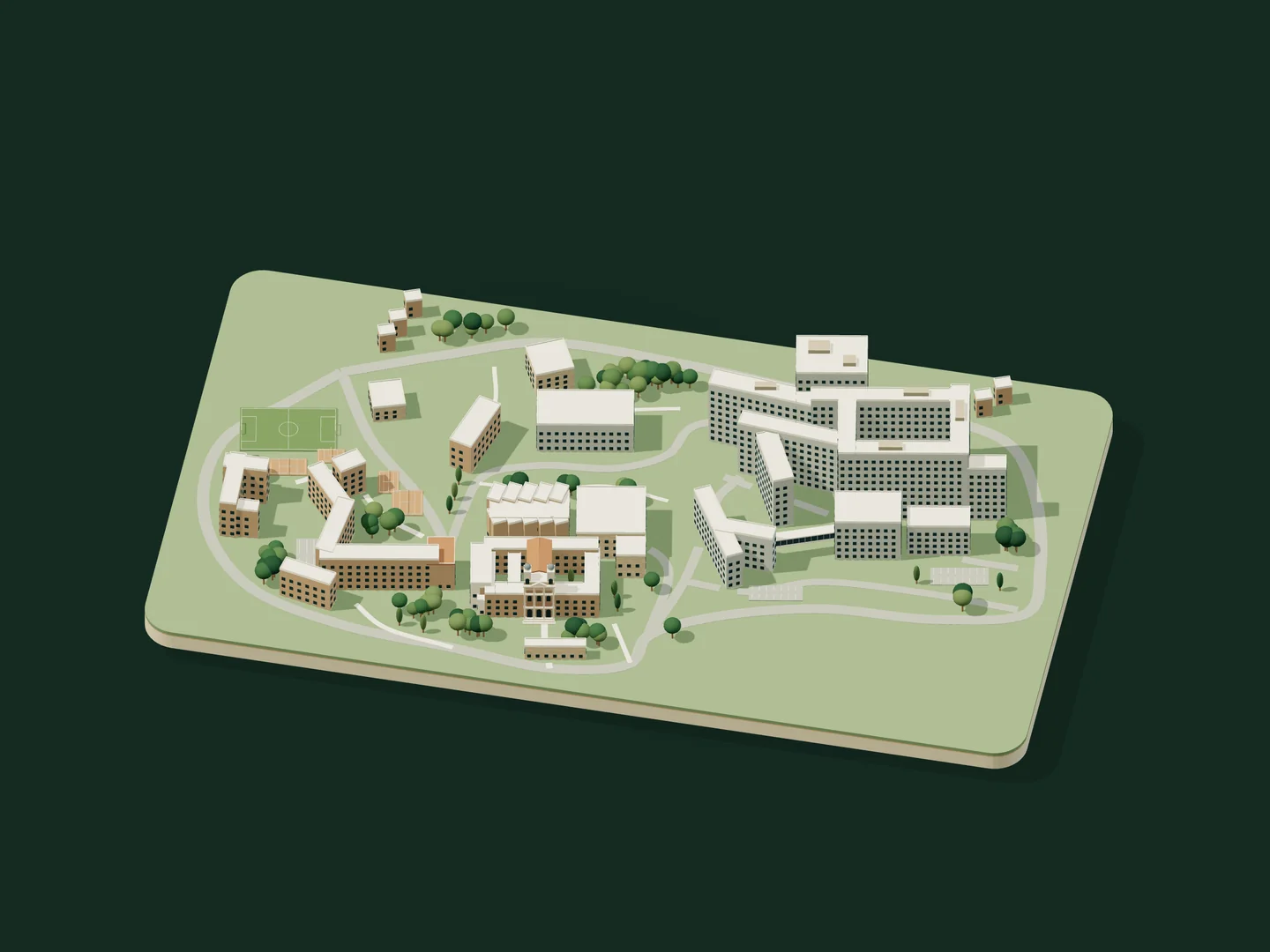
Cattolica's Rome campus
The English-taught Medicine and Surgery programme is taught at Cattolica's Rome campus, at Largo Francesco Vito 1 in the Monte Mario–Trionfale district, in the same area as the Fondazione Policlinico Universitario Agostino Gemelli IRCCS. Classes are held in the Biological Institutes, the Polo Giovanni XXIII, the Faculty of Economics and the Policlinico, and the campus has 75,000 m² of green space with its own sports grounds.
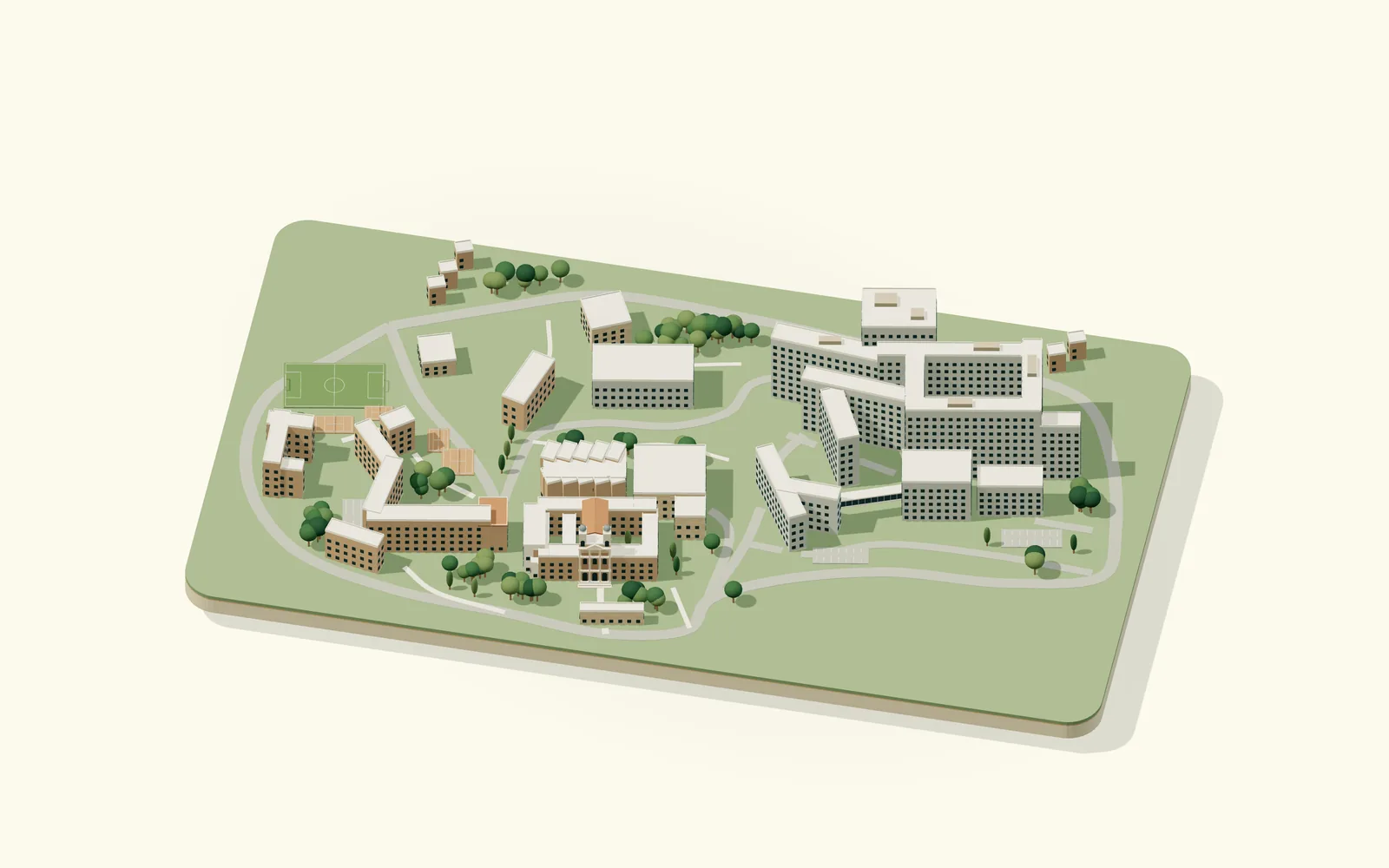
Explore the Cattolica campus.
Open it in 3D to turn it and see what each building holds.
Stylized campus illustration, not a map or to scale.
Rettorato e Uffici amministrativi
The Rector's office and the university's administrative offices.
Chiesa centrale
The campus's central church.
Centro Congressi Europa
The campus congress centre.
Facoltà di Economia
The Faculty of Economics, one of the buildings where classes are held.
Facoltà di Medicina e chirurgia · Istituti Biologici
The Faculty of Medicine and Surgery's Biological Institutes, where classes are held.
Polo Universitario Giovanni XXIII
A university teaching building where classes are held.
Auditorium
The campus auditorium.
Collegio Nuovo Joanneum
A residential college on the campus.
Impianti sportivi
Sports grounds: two tennis courts, an 11-a-side grass football pitch and a five-a-side pitch, within 75,000 m² of green space.
Edificio Vito
Orientation and recruitment, tutoring, and internships and placement.
Fondazione Policlinico Universitario A. Gemelli IRCCS
The teaching hospital, in the same area as the campus; classes are held here too.
Address: Largo Francesco Vito 1, 00168 Roma
IvyTest Cattolica Medicine Test preparation
Ready to prepare properly for the Cattolica Medicine Test?
Everything above is free and always will be. When you want structure (a syllabus-mapped book, a simulator that behaves like the real test, lessons for the gaps, and help with the application itself), that is what the IvyTest Cattolica package is.
Study guide
The full syllabus in one volume, mapped section by section, including the ethics and religious culture component most other resources skip entirely.
Exam simulator
Timed practice in Cattolica's own seven-subject format, with per-question explanations and topic analytics.
Video courses
Focused lessons in biology, chemistry, physics, mathematics and logical reasoning for the topics your results flag.
Application support
MedApply: deadlines, documents, legalisation and enrolment steps carried through to a confirmed place.
FAQ
Cattolica Medicine Test frequently asked questions
It is Università Cattolica del Sacro Cuore's own entrance exam for its English-taught Medicine and Surgery degree in Rome: 65 multiple-choice questions in 65 minutes, sat online from home under remote proctoring, covering logical reasoning, biology, chemistry, physics, mathematics, general culture and ethics and religious culture.
No. The IMAT is the national test used by Italian public universities; Cattolica is private and sets its own test, with its own subjects, scoring and quotas. It is also not the TOLC-MED used by some public medical faculties.
No. Università Cattolica also runs "Medicina e Chirurgia", an Italian-taught programme in Rome with its own separate test, in Italian and sat in person. In 2026/27 it had two rounds (27 and 28 February, 17 and 18 April 2026) at test centres in eight Italian cities, 65 questions split differently (15 logical reasoning, 45 science, 5 ethics and religious culture) and a €250 fee per round. Check Cattolica's own pages for that programme.
The content itself is school level, but 65 questions in 65 minutes leaves under a minute per question, and two of the seven sections (general culture and ethics and religious culture) are not covered by a typical science-focused prep course, so most candidates lose easy marks there rather than in biology or chemistry.
Seven areas: logical reasoning (20 of 65 questions), biology (18), chemistry (12), ethics and religious culture (5), mathematics (4), physics (4) and general culture (2), under the 2027/28 call for applications.
65 minutes for the 65 scored questions, plus a further shared 7 minutes at the end for one reserve question per subject (7 questions total), which only count if an official question in that subject is later cancelled.
A correct answer scores +1, an incorrect answer scores −0.25, and an unanswered question scores 0, for a maximum of 65 points. A score below 20 out of 65 makes a candidate ineligible for a place, regardless of rank.
There is a published floor (20 out of 65) below which no place is offered, but that is an eligibility minimum, not a competitive target. Because places are offered by ranking within separate EU and non-EU quotas, the score that actually earns an offer depends on the applicant pool that cycle, which is why your trajectory on full timed mocks is a better guide than any single number.
Yes. The 2027/28 call has 40 places on the EU list (EU citizens and equivalents, which includes non-EU citizens living in Italy with a permit of stay) and 70 on the non-EU list (non-EU citizens living abroad), each ranked separately. The Italian Ministry's decree on places can still change the numbers.
For the English-taught Medicine and Surgery programme, the exam is taken online, from home, under remote proctoring; for 2027/28 it runs through the Proctor Exam system, on 17 March 2027. (The separate Italian-taught track uses an in-person, multi-city format.)
Start with a diagnostic across all seven subjects, not just the four sciences, and begin the ethics and religious culture reading early, since it cannot be crammed the way a formula can. The four preparation tracks above set out what that looks like at 12, 8, 4 and fewer weeks.
Yes. The IvyTest simulator runs practice in Cattolica's seven-subject format, with explanations for every question and topic-level analytics. A free diagnostic is available without payment.
Not as papers: Cattolica publishes no past paper as a PDF, for 2025, 2026 or earlier. Its Entrance exam page offers free official PDFs: the topics to study for the science questions; a database of 3,000 logic-type questions (logic, numerical reasoning, problem solving, text comprehension, attention, visual-spatial reasoning and some religious culture) compiled in 2015 by Selexi, its test partner, without answers by design; and a guide with worked solutions to a selection of them, written for the January 2016 test. Both are linked under Sources below. Paying the €210 application fee unlocks an online simulator of about 3,000 practice questions; the real test uses none of them.
Two things in the content, and the calendar; the test itself is the same. The 2027/28 call (14 October 2026) rewrote the physics syllabus in Allegato A: fluid dynamics (flow rate, the continuity equation, Bernoulli, viscosity), angular momentum, angular velocity and centripetal acceleration, friction and elastic force, equipotential surfaces, electrostatic energy and the magnetic field of a current are now named, while universal gravitation no longer is; physics is still 4 questions. The ethics reading list now names Magnifica Humanitas, Pope Leo XIV's first encyclical (May 2026), on the human person in the age of artificial intelligence, in place of Laudato si', beside Dignitas personae and Caritas in veritate. The calendar is earlier: the exam is on 17 March 2027 (25 March in 2026), scores come out from 31 March, the rankings from 7 and 14 April, and a place must be secured by 23 April (6 May in 2026). Unchanged: 65 questions in 65 minutes, the same seven subjects and split, +1/−0.25/0, at least 20 points, the €210 fee and 40 EU and 70 non-EU places.
The 2027/28 call came out on 14 October 2026, and applications are open until 23:59 Italian time on 17 February 2027. The online exam is on 17 March 2027, with extra sessions on 18 March if too many candidates register. Scores are out from 31 March, the EU ranking from 7 April and the non-EU ranking from 14 April 2027. The call is in Italian (D.R. 2883) and legally binding; it is linked under Sources below.
Each candidate first sees their score and marked test online, from 31 March 2027 this cycle; the EU ranking follows from 7 April and the non-EU ranking from 14 April 2027. The lists show anonymous codes, not names. In 2026/27 they ranked 709 EU and 713 non-EU candidates; the 40th EU place scored 58.00 and the 70th non-EU place 54.25. Freed places then go down each list: by 2 October 2026, notices had called EU candidates down to position 115 (52.50).
Tuition for the English-taught Medicine and Surgery degree in Rome is €18,150 a year, a fixed fee for every nationality, and there are no scholarships or fee waivers for this programme. Applying costs €210, not refundable. For 2027/28, candidates placed within their list's places keep them by paying a first instalment of €4,000 by 23 April 2027.
Six years and 360 ECTS credits, 60 of them in professional training. Year 1 covers basic sciences, the functional architecture of the human body, gene regulation and cell metabolism, cells, tissues and microbes, Italian and scientific English. Clinical training in hospitals starts in year 4, and the degree ends with a thesis worth 18 credits. Theology courses are compulsory, and first-year students can apply for a double degree with Thomas Jefferson University.
Cattolica's programme page quotes subject rankings: top 150 in Clinical Medicine (ShanghaiRanking 2025), top 170 in Medicine (QS by Subject 2025), and 54th in Radiology, 67th in Gastroenterology and Hepatology and 70th in Surgery (US News 2025/26). It also cites Newsweek 2025 for the Gemelli hospital, where students train: the best university hospital in Italy and 44th worldwide. These are Cattolica's own statements.
Yes, a separate one: Medicine and Surgery in Bolzano, taught in English at the Claudiana campus, with clinical internships in Italian and German. It has its own admission test, sat remotely in May for 2026/27, and its own places: 60 (50 EU, 10 non-EU). Candidates can apply to both campuses and sit both tests. Everything else in this guide is about the Rome programme.
Yes: r/universitacattolica, where Università Cattolica del Sacro Cuore applicants ask each other about the Cattolica Medicine Test and share how their preparation is going. It is run by the IvyTest team. Dates, rules and results come only from the university's own pages, listed under Official sources on this page.
Verification
Official sources
- Bando di concorso, Medicine and Surgery (Rome), 2027/28, D.R. 2883 (Italian, legally binding text)Checked: 14 October 2026
Università Cattolica del Sacro Cuore
- Medicine and Surgery (Rome): admissions and applications, with the 2027/28 callChecked: 14 October 2026
Università Cattolica del Sacro Cuore
- Entrance exam, Cattolica InternationalChecked: 14 October 2026
Università Cattolica del Sacro Cuore (Cattolica International)
- Database of 3,000 logic items, Medicine and Surgery admission test (PDF, © Selexi, 2015)Checked: 14 October 2026
Università Cattolica del Sacro Cuore (Cattolica International)
- Guide to the logic items, with commented solutions (PDF, © Selexi, for the 2016 test)Checked: 14 October 2026
Università Cattolica del Sacro Cuore (Cattolica International)
- Admission Guidelines: Medicine and Surgery, Rome (English-taught programme), 2026/27Checked: 7 October 2026
Università Cattolica del Sacro Cuore (Cattolica International)
- Admission and tuition, Cattolica InternationalChecked: 14 October 2026
Università Cattolica del Sacro Cuore (Cattolica International)
- Bando di concorso, Medicine and Surgery (Rome), 2026/27 (Italian, legally binding text)Checked: 7 October 2026
Università Cattolica del Sacro Cuore
- Application timeline 2027/28, Cattolica InternationalChecked: 14 October 2026
Università Cattolica del Sacro Cuore (Cattolica International)
- Tuition fees and scholarships, Cattolica InternationalChecked: 14 October 2026
Università Cattolica del Sacro Cuore (Cattolica International)
- Entry requirements, Cattolica InternationalChecked: 7 October 2026
Università Cattolica del Sacro Cuore (Cattolica International)
- Medicine and Surgery (Rome), Cattolica International programme pageChecked: 7 October 2026
Università Cattolica del Sacro Cuore (Cattolica International)
- Course details: curriculum and professional training, Medicine and Surgery (Rome)Checked: 7 October 2026
Università Cattolica del Sacro Cuore (Cattolica International)
- Rankings and waiting lists 2026/27: final EU and non-EU rankings and ranking-update noticesChecked: 7 October 2026
Università Cattolica del Sacro Cuore
- Medicine and Surgery (Bolzano), programme pageChecked: 7 October 2026
Università Cattolica del Sacro Cuore
- Medicina e chirurgia (Rome, Italian-taught): admissions and the 2026/27 callChecked: 7 October 2026
Università Cattolica del Sacro Cuore
Last reviewed by IvyTest editorial team: 14 October 2026. Admission rules change every cycle — always confirm against the official Università Cattolica del Sacro Cuore call for applications before acting on a deadline.
Find out how ready you are for the Cattolica Medicine Test.
The diagnostic takes one sitting and returns a subject-by-subject picture of where you stand. No payment, no commitment.