
During which phase of mitosis do sister chromatids separate and move to opposite poles of the cell?
Exam guide · Updated for 2027 admissions
Campus Bio-Medico Admission Test 2027: Complete Preparation Guide
Everything you need to know about the Campus Bio-Medico admission test (the UCBM test, often searched as Campus Biomedico), Università Campus Bio-Medico di Roma's own test for its English-taught Medicine and Surgery and MedTech programmes: dates, the ranking list, format, syllabus, scoring, sample questions, fees, preparation strategy and practice.
Updated for 2027 admissions · Last updated: 12 October 2026
UCBM Admission Test at a glance
Overview
What is the Campus Bio-Medico Admission Test (the UCBM test)?
Università Campus Bio-Medico di Roma runs its own admission test (sometimes called the UCBM test) for its English-taught programmes: Medicine and Surgery, and a separate biomedical-engineering-focused track called MedTech. Both programmes sit the identical 60-question paper on the same day, but under separate registrations and separate rankings: a strong result doesn't transfer between the two, and you need to know which one you're actually registering for.
The format is pure science: 20 questions each in Biology, Chemistry and Physics, with no logic, reading comprehension or general-knowledge section at all; unlike Humanitas, San Raffaele or UniCamillus, there's no reasoning block to fall back on if one science is weaker than the others. There is also no Mathematics section as such; quantitative work is examined inside the Chemistry and Physics items instead.
Unlike San Raffaele's or UniCamillus's remote-proctored format, the CBM test for EU and equivalent candidates is sat in person in Rome (at the Nuova Fiera di Roma exhibition centre for the 2026/27 sitting, not on the Trigoria campus; non-EU candidates resident abroad sat their own call's test online on 6 February 2026), with no calculators, smartwatches, tablets, internet-enabled devices, books or notes permitted; the university's own Call notes that test pavilions may be frequency-shielded. This guide covers CBM's English-language Call only; the university also runs a separate Italian-language Call for its Italian-taught programmes, with a wider syllabus that adds ecology and optics content this paper doesn't test.
Programmes that use the UCBM Admission Test
- Medicine and Surgery (English-taught, Rome)
- MedTech: Medicine and Biomedical Engineering (English-taught, Rome)
Timeline
UCBM Admission Test 2027: dates and deadlines
When to expect your exam · 2027 start
- February 2027late FebExpected
Applications usually open 29 Oct 2026 (based on 2025).
Predicted from this university's past sittings until it publishes its own dates. See every university on the calendar →
- Applications open2027/28 dates not yet published; for 2026/27 the EU window opened 29 October 2025 and the non-EU window 1 December 2025
- EU and equivalent registration deadline2027/28 not published; 2026/27 closed 6 February 2026 (13:00)
- Non-EU (resident abroad) registration deadline2027/28 not published; 2026/27 closed 28 January 2026
- Exam date2027/28 not published; 2026/27 sitting was 19 February 2026, at the Nuova Fiera di Roma (non-EU candidates resident abroad: online, 6 February 2026)
- Results published2027/28 not published; in 2026/27 the EU provisional rankings were due by 27 February 2026 (the Medicine and Surgery one, D.R. 62/2026, is dated 25 February) and the final ranking by 3 July 2026 (D.R. 268/2026, dated 24 June); the non-EU ranking (D.R. 48/2026) is dated 12 February 2026
- MedTech residual places (2026/27)Confirmed on unicampus.it: 4 places at publication, applications from 15 September to 12 October 2026 (13:00), an in-person test in Rome on 16 October 2026 and the ranking by 20 October, for Italian, EU and equivalent candidates
- Enrolment deadline2027/28 not published; in 2026/27 EU winners enrolled (Phase I) from 2 to 10 March 2026
No 2027/2028 Call had been published as of a recheck of unicampus.it on 11 October 2026: its admissions page still lists only the 2026/2027 Medicine procedures, so the live cycle remains A.Y. 2026/2027 under Rector's Decree no. 505/2025. IvyTest reviews official Campus Bio-Medico announcements and updates this guide once the next Call is issued.
Structure
UCBM Admission Test format
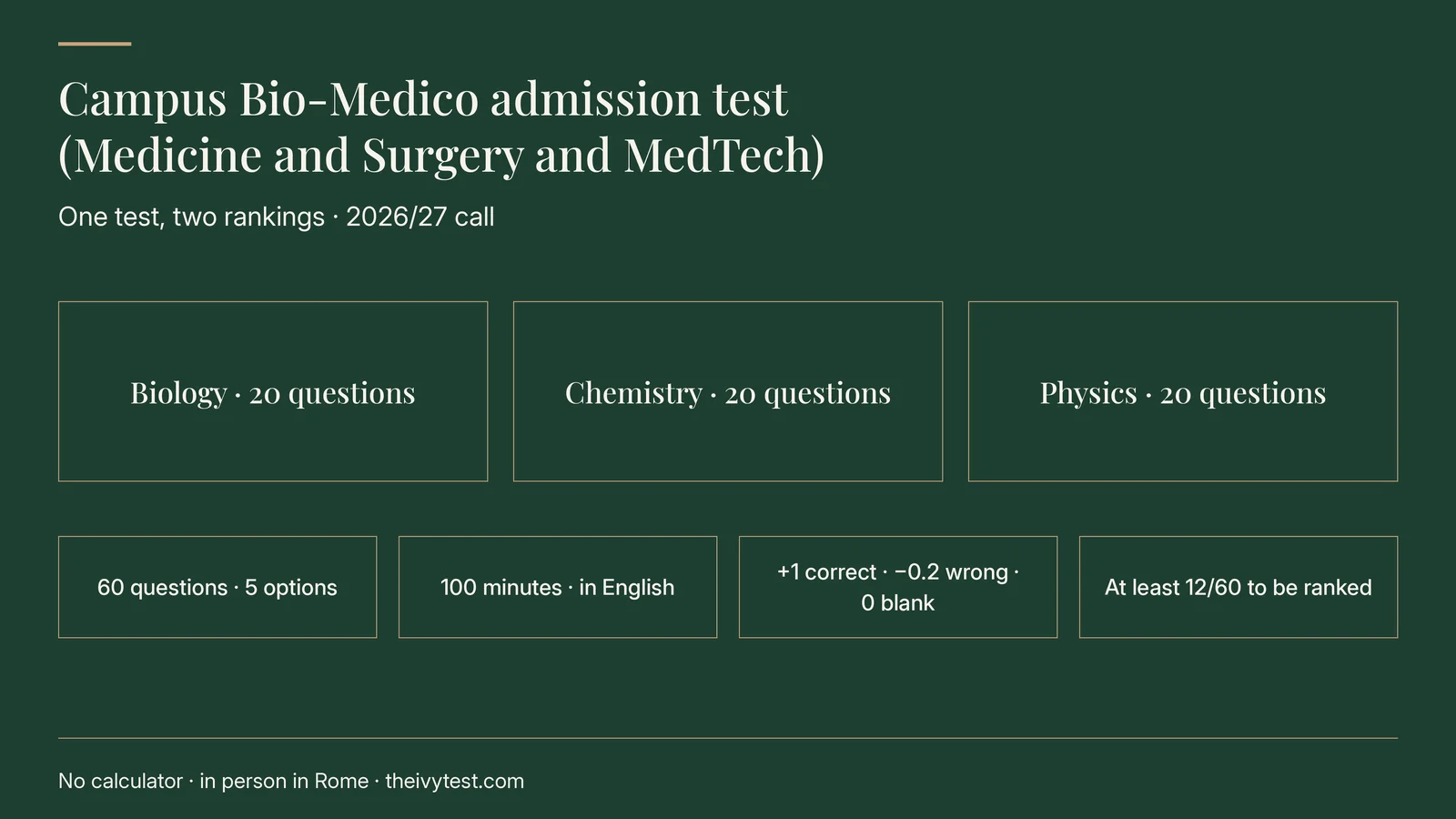
60 questions in 100 minutes, sat as one block with no official section breaks. Each of the three sciences carries exactly equal weight.
| Section | Questions | Weighting | Suggested time |
|---|---|---|---|
| Biology | 20 | 33% (20 of 60) | *see the note below the table |
| Chemistry | 20 | 33% (20 of 60) | *see the note below the table |
| Physics | 20 | 33% (20 of 60) | *see the note below the table |
- One continuous 100-minute sitting; CBM sets no per-section time limit
Content
Question and subject breakdown
Three equally weighted sections, and nothing else: CBM is one of the few schools in our catalogue whose admission test is pure science from end to end.
Biology
33%Cell biology, bioenergetics, Mendelian and molecular genetics, mutations and evolution, and human anatomy and physiology.
Chemistry
33%Atomic structure, chemical bonding, inorganic nomenclature, stoichiometry, solutions and equilibrium, acids/bases and redox, and organic chemistry.
Physics
33%Measurement, kinematics, dynamics, fluid mechanics, thermodynamics and electromagnetism; no optics, and no separate Mathematics section.
Marks
UCBM Admission Test scoring
CBM's scoring is more conventional than some peer schools': a smaller penalty than UniCamillus's, and a straightforward 60-point maximum, but it carries its own hard floor and its own distinct approach to remedial coursework.
- Correct answer
- +1 point
- Incorrect answer
- −0.2 points
- Unanswered question
- 0 points
- Maximum possible score
- 60 points (60 × 1)
- Minimum eligible score
- 12 points: score below this and you are not eligible for a place, regardless of rank (the call for non-EU candidates resident abroad sets 10)
- Tie-break order
- Biology, then Chemistry, then Physics, then the younger candidate (the Italian EU call; the non-EU call and the EU call's English translation name Mathematics as the third step)
- Additional Learning Obligations (OFA)
- Decided by a separate test in mathematics, physics and chemistry taken after enrolment, before classes start, not part of this admission test: below 60% in a subject assigns an OFA in it
Worked example
Suppose you answer 50 of the 60 questions and leave 10 blank. Of the 50 attempted, 40 are correct and 10 are wrong. Your score is (40 × 1) + (10 × −0.2) + (10 × 0) = 40 − 2 = 38 out of 60, comfortably above the 12-point minimum, so this result is eligible to be ranked. A purely random guess has an expected value of (1/5 × 1) + (4/5 × −0.2) = 0.20 − 0.16 = +0.04, a small positive number, though nowhere near as large as it would be without the penalty, and far smaller than the value of eliminating an option first.
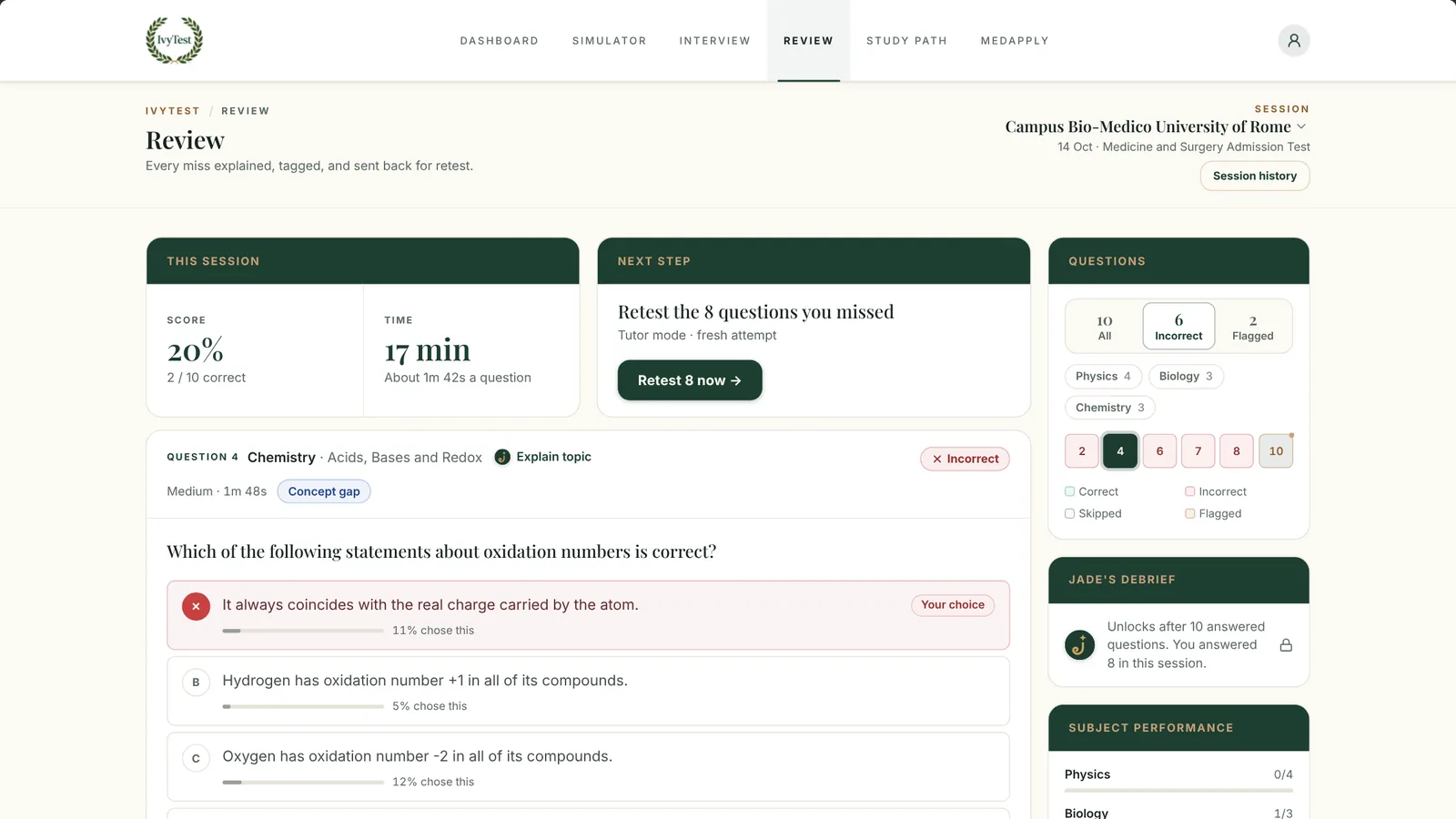
The IvyTest simulator scores every practice paper against these exact rules.
See the UCBM Admission Test simulatorSyllabus
Full UCBM Admission Test syllabus
The subject lists below follow Annex C of CBM's own English-language Call. Two gaps are worth knowing: there is no ecology or optics content on this paper (both appear only on the separate Italian-language Call), and there is no standalone Mathematics section despite the Call's preamble naming it as one of the sciences the test refers to.
- The chemistry of living organisms: water, organic molecules, enzymes
- Cell biology: cell theory, prokaryotic and eukaryotic cells, membrane transport
- Cell cycle and cell division: mitosis, meiosis, chromosomes and chromosome maps
- Bioenergetics: ATP, redox reactions, photosynthesis, glycolysis, respiration, fermentation
- Reproduction and Mendelian genetics: life cycles, Mendel's laws, classical genetics, patterns of heredity
- Molecular and human genetics: DNA structure and replication, protein synthesis, gene expression, inherited disease, recombinant DNA
- Mutations and evolution: natural and artificial selection, evolutionary theory
- Anatomy and physiology of man: tissues, organ systems and their interactions, homeostasis
- The constitution of matter: states of matter, homogeneous/heterogeneous systems, ideal gas laws
- Atomic structure and the periodic system: atomic and mass number, isotopes, periodic trends
- Chemical bonding: ionic, covalent and metallic bonds, bond polarity, electronegativity
- Inorganic compounds and nomenclature: oxides, hydroxides, acids and salts
- Reactions and stoichiometry: the mole concept, Avogadro's number, balancing reactions
- Solutions, equilibria and kinetics: solubility, concentration, aqueous equilibrium, catalysis
- Acids, bases and redox: pH, hydrolysis, buffers, oxidation number, balancing redox reactions
- Organic chemistry: isomerism, hydrocarbons, functional groups, basic nomenclature
- Measurement and units: SI and CGS systems, fundamental and derived quantities
- Kinematics: uniform and accelerated motion, circular and harmonic motion
- Dynamics, work and energy: Newton's laws, momentum, kinetic and potential energy
- Fluid mechanics: pressure, Archimedes' principle, Pascal's and Stevin's laws
- Thermology and thermodynamics: calorimetry, changes of state, laws of thermodynamics
- Electrostatics and electrodynamics: Coulomb's law, circuits, Ohm's law, electromagnetic induction
Test your UCBM Admission Test knowledge
Take free diagnosticDifficulty
How difficult is the UCBM Admission Test?
CBM's difficulty comes less from any one section and more from what the test doesn't give you: no reasoning block to lean on, and no advance warning about which of two programmes your score actually places you into.
One paper, two separate races
Medicine and Surgery and MedTech sit the identical test on the same day but are ranked completely separately, with different seat numbers for each. Doing well doesn't automatically mean admission to whichever programme you actually want: registration, not performance, decides which ranking you're in.
Pure science, no reasoning cushion
All 60 questions are Biology, Chemistry or Physics. Candidates coming from a school with a logic or reading section often build reasoning skills they can lean on when the science gets hard; that safety net doesn't exist here.
A hard floor, but the real remedial test comes later
Score below 12 out of 60 and you're not eligible for a place, whatever your rank. But the additional-learning-obligation mechanism most peer schools bake into the admission test itself is, at CBM, a separate exam in maths, physics and chemistry taken after you've already enrolled. Clearing this test comfortably doesn't mean that second check is a formality.
In-person, no devices, possibly shielded
Unlike San Raffaele's or UniCamillus's remote format, this test is sat in Rome with no calculators, smartwatches or internet-enabled devices allowed, and the university's own Call notes the test pavilions may be frequency-shielded, a real, sourced operational detail worth knowing about in advance.
Often the earliest test of the season
CBM typically falls in January or February, among the earliest sittings on the Italian private-university calendar. Candidates preparing for several schools often sit this one first, sometimes before their preparation for later exams is fully finished.
Benchmarks
What is a good UCBM Admission Test score?
Campus Bio-Medico does not publish an official acceptance rate for either programme, and admission above the 12-point minimum is decided purely by ranking against that cycle's applicant pool.
The two programmes have different, separately published seat counts (84 EU/equivalent plus 36 non-EU for Medicine and Surgery; 68 EU/equivalent plus 12 non-EU for MedTech, in the 2026/27 cycle), so a score that would rank well for one programme's pool says nothing about the other's.
What the university does publish is its ranking lists (graduatoria), anonymous by Unique ID, with every score. Medicine and Surgery, 2026/27: the provisional ranking (D.R. 62/2026) lists 476 EU and equivalent candidates, from 57.8/60 at the top to 48.2 at the 84th and last winning place; the final ranking (D.R. 268/2026), limited to candidates with a valid English certificate, lists 229, the 84th at 38.6. Notices (scorrimenti) then offer the places winners leave, in ranking order: the 28th, of 9 October 2026, reached position 143 at 32.8/60. The non-EU ranking (D.R. 48/2026) lists 214 candidates, the 36th and last winning place at 52.00, and its 23rd notice reached positions 127 and 128 (42.00).
One third-party ranking aggregator publishes a 30% acceptance-rate estimate, but it's explicitly the aggregator's own algorithmic model, not a Campus Bio-Medico figure; treat it as indicative at most, not as a target to plan around.
Pending verification
- · The score that will win a place in 2027/28: the last score offered depends on that cycle's candidates and on how many winners enrol
- · Applicants per cycle: the rankings list only candidates with a score
These specific numbers aren't public yet — an IvyTest simulator score is the closest benchmark you can get today.
Check your UCBM Admission Test scoreStrategy
How to prepare for the UCBM Admission Test
12+ weeks
Build all three sciences evenly: there's no fourth section to fall back on
Full coverage of Biology, Chemistry and Physics from the start.
- Sit a full diagnostic in week one, scored with the real +1/−0.2/0 rule, to see where each of the three sciences stands individually.
- Since there's no logic or reading section to offset a weak science, treat all three subjects as equally important from day one rather than leaving the weakest for later.
- Practise stoichiometry, genetics problems and mechanics calculations by hand throughout: no calculator is permitted on test day.
- Add full 100-minute timed sittings from week six onward.
8 weeks
Rank your three sciences and protect the weakest
Targeted repair with the 12-point floor as a hard check.
- Diagnostic first, then identify which of Biology, Chemistry or Physics is weakest. Remember Biology settles ties first, so it's worth particular attention if you're borderline.
- Spend proportionally more time on your weakest science, but keep practising all three weekly.
- One full timed mock a week from week two, reviewed the same day against the real scoring rule.
- Track your running total against the 12-point minimum explicitly, not just your percentage score.
4 weeks
Full 100-minute sittings, no calculator, exam conditions
Volume of timed practice under the real constraints.
- Two full mocks a week at the 100-minute limit, done entirely by hand with no calculator, mirroring the real test conditions.
- Review every mock for which science cost the most marks, not just the overall score.
- Drill elimination technique: with a small positive expected value on a blind guess, ruling out even one option is worth doing before answering rather than skipping.
- If you're also sitting other Italian medical school tests this season, check whether this one falls first on your calendar and plan your overall preparation schedule around that.
Under 4 weeks
Consolidate, don't expand
Protect the 12-point floor and your strongest science.
- Stop adding new content in your weakest area; focus on the highest-frequency question types across all three sciences instead.
- Sit at least two full, scored mocks in the final ten days, entirely by hand.
- Rehearse arriving at the Rome test venue with no prohibited devices (calculators, smartwatches and phones included) to avoid a last-minute problem on the day.
- Remember the registration you actually need: confirm you're registered for the programme (Medicine and Surgery or MedTech) you actually want before the deadline.
Get your personalised UCBM Admission Test study plan
Take free diagnosticExplore the full UCBM Admission Test planPractice
Free UCBM Admission Test practice questions
Three questions in the format the exam uses. Choose an answer to see the explanation — nothing is recorded.
What is the molarity of a solution made by dissolving 0.5 moles of NaCl in enough water to make 2 litres of solution?
A 2 kg object experiences a net force of 10 N. What is its acceleration?
Illustrative examples written by IvyTest to show the question style — not past UCBM Admission Test papers.
Past papers
UCBM Admission Test past papers
Campus Bio-Medico publishes no past papers and no sample test to download, as a PDF or otherwise: its EU call (D.R. 505/2025) says the questions are drawn at random from an archive of questions commissioned by the university. What it does give is a simulator. Registering for the test opens an online simulator of the written test on the registration platform, reached from the 'Link to the simulator' on the call's page and usable until test day (admissions FAQ). After the test each candidate can view their own paper with its score and the number of correct, wrong and blank answers. The paper's shape is in the call: 60 questions with five options, 20 each in Biology, Chemistry and Physics, in 100 minutes. IvyTest's free practice paper is a complete 60-question paper in the call's format, with every answer explained.
University
Campus Bio-Medico University of Rome medicine admissions
The test feeds into two separately ranked programmes from the same paper: check the figures below against whichever one you're actually applying to.
- Degree
- Medicine and Surgery (6-year MD) or MedTech (Medicine and Biomedical Engineering), separate registration and ranking, same paper
- Language
- English
- Campus
- Trigoria, Rome (south, edge of the Decima-Malafede Nature Reserve)
- Tuition
- €19,000 a year for 2026/27 entrants to either programme (€8,000 at enrolment, then €5,500 in January and €5,500 in April), plus the €140 regional tax
- Application fee
- €170 per programme, €100 for non-EU candidates resident abroad (2026/27 calls)
- Seats: Medicine and Surgery
- 84 EU/equivalent + 36 non-EU (2026/27 cycle)
- Seats: MedTech
- 68 EU/equivalent + 12 non-EU (2026/27 cycle), a separate programme from Medicine and Surgery
- Scholarship
- The top-ranked winner in each ranking (one for Medicine and Surgery, one for MedTech) with ISEE ≤ €28,000 receives a 50% tuition exemption for the full 6-year course, awarded from the admission ranking; Italian, EU and equivalent candidates only
- Application process
- Admission test registration, application form and documents via the university's own portal, with separate registration for Medicine and Surgery and for MedTech; no interview
The campus
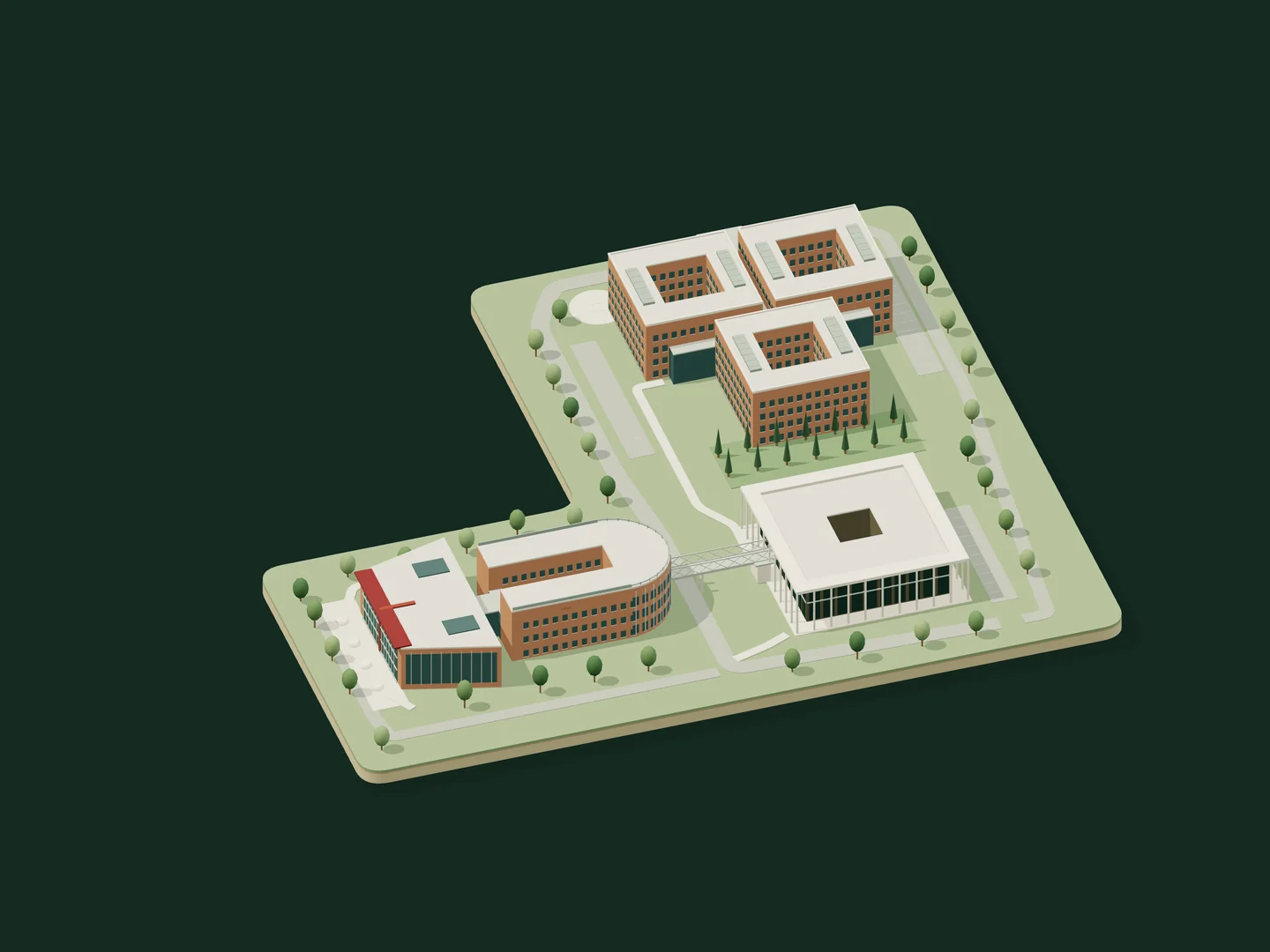
Campus Bio-Medico's campus in Rome
Campus Bio-Medico, founded in 1993, brings together Campus Bio-Medico University and its university hospital. At Via Álvaro del Portillo 21 in Rome, the university trains its Medicine and Engineering students in the same place: the Trapezio teaching building, the PRABB research centre and the Cu.Bo, with its simulation centre, new classrooms and 300-seat auditorium, beside the Policlinico Universitario and its emergency department.
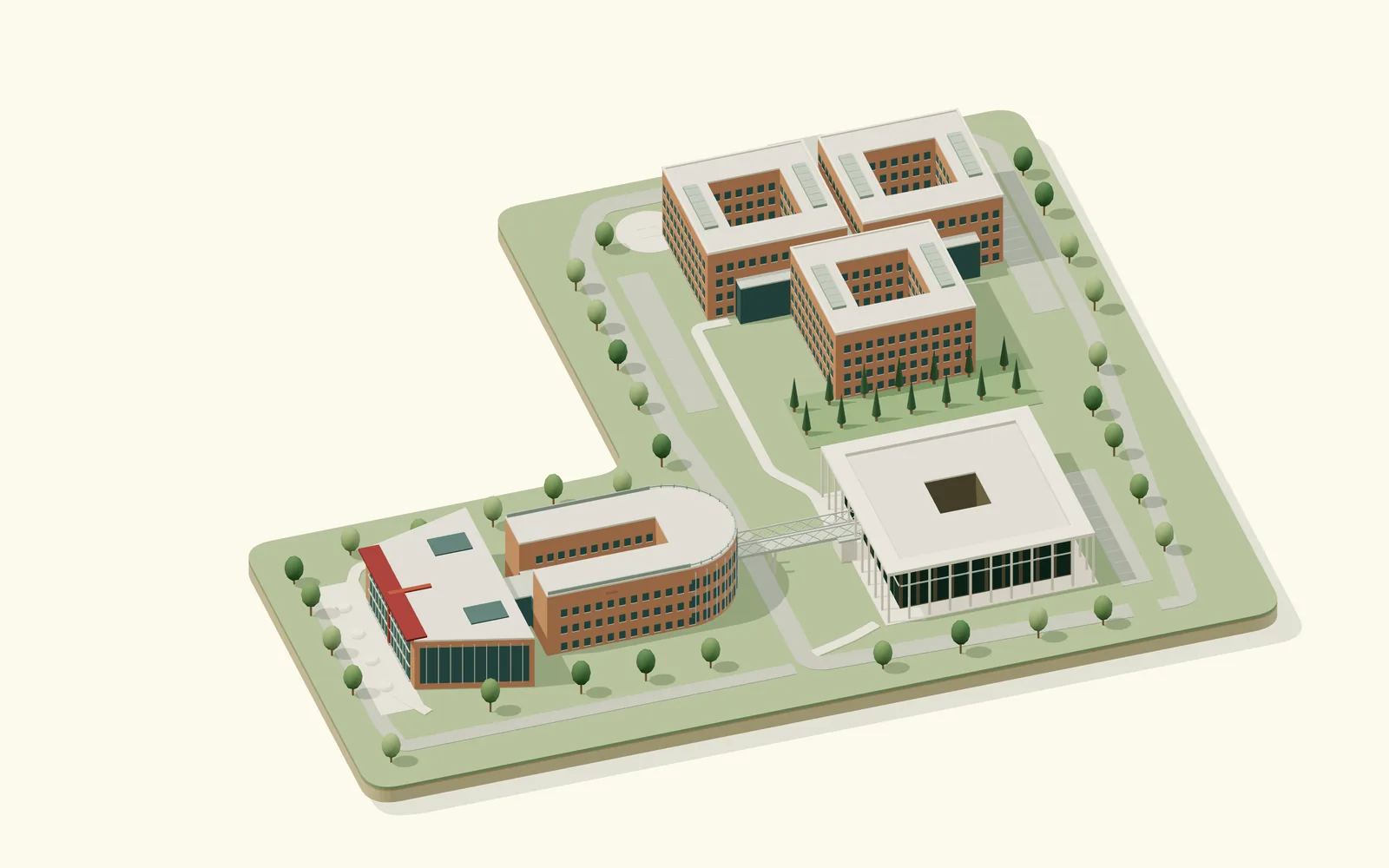
Explore the Campus Bio-Medico campus.
Open it in 3D to turn it and see what each building holds.
Stylized campus illustration, not a map or to scale.
Trapezio
The teaching building (Polo della Didattica) of the university's three faculties: Medicine and Surgery, Engineering, and Science and Technology for Sustainable Development and One Health.
PRABB
The Polo di Ricerca Avanzata in Biomedicina e Bioingegneria, the university's centre for advanced research in biomedicine and bioengineering.
Cu.Bo
The Cultural Box, the newest teaching building: a simulation centre, new classrooms and a 300-seat auditorium, over about 10,000 m².
Policlinico Universitario Campus Bio-Medico
The university hospital, with its emergency department.
Address: Via Álvaro del Portillo 21, 00128 Roma
IvyTest UCBM Admission Test preparation
Ready to prepare properly for the CBM test?
Everything above is free and always will be. When you want structure (a syllabus-mapped book covering all three sciences, a simulator that scores with the real +1/−0.2/0 rule, lessons for the gaps your results flag, and help with the application itself), that is what the IvyTest Campus Bio-Medico package is.
Study guide
The full syllabus across Biology, Chemistry and Physics, mapped to CBM's own Annex C, with no time wasted on a logic section that doesn't exist here.
Exam simulator
Timed 100-minute mocks in the real 5-option, +1/−0.2/0 format, with per-question explanations and topic analytics.
Video courses
Focused lessons in biology, chemistry and physics for the topics your results flag.
Application support
MedApply: deadlines, documents, legalisation and enrolment steps carried through to a confirmed place.
FAQ
UCBM Admission Test frequently asked questions
It's Università Campus Bio-Medico di Roma's own admission test for its English-taught Medicine and Surgery and MedTech programmes: 60 multiple-choice questions with five options each, 20 in Biology, 20 in Chemistry and 20 in Physics, in 100 minutes, sat in person in Rome by EU and equivalent candidates. The topics are those listed in Annex C of the call; there is no logic, reading or general-knowledge section.
The paper is identical, sat on the same day, but the two programmes register and rank candidates completely separately. A good score on the shared paper doesn't by itself tell you which programme you're admitted to: that depends on which one you registered for.
For EU and equivalent candidates, in person in Rome: the 2026/27 sitting was at the Nuova Fiera di Roma, not on the Trigoria campus. Non-EU candidates resident abroad have their own call, and in 2026/27 sat the test online under remote proctoring on 6 February 2026. No calculators, smartwatches, tablets, internet-enabled devices, books or notes are permitted, and the university's own Call notes that test pavilions may be frequency-shielded.
+1 point for a correct answer, −0.2 for an incorrect one, 0 for a blank, out of a maximum 60. A purely random guess works out to a small positive expected value (+0.04 points) rather than being exactly neutral, though eliminating an implausible option first is worth more than guessing blindly.
To be eligible (idoneo) for a place, 12 out of 60 overall (10 in the call for non-EU candidates resident abroad): below that you're not eligible for a place regardless of rank, and there's no separate per-subject floor. A place takes more. In 2026/27 the 84th and last winning Medicine and Surgery place on the provisional ranking scored 48.2/60, and after the scrolls the last place offered by 9 October 2026 went to position 143 of the final ranking, at 32.8/60.
No. At CBM, the OFA check is a separate test in mathematics, physics and chemistry taken after you've already enrolled, before classes start. Scoring below 60% in a subject on that test assigns an OFA in it. It's a different exam from the admission test this guide covers.
No. This guide covers the English-language Call for Medicine and Surgery and MedTech only. CBM also runs a separate Italian-language Call for Medicina e Chirurgia and Odontoiatria e Protesi Dentaria, with a wider syllabus that adds ecology and optics content this paper doesn't test. In 2026/27 the Medicina e Chirurgia test (D.R. 503/2025) was held on 20 February 2026 at the Nuova Fiera di Roma, in the same format (60 questions in 100 minutes, +1/−0.2/0, a 12-point minimum), for 154 EU and equivalent plus 6 non-EU places; its first-year tuition is €15,500 plus the €140 regional tax.
84 EU/equivalent seats plus 36 non-EU for Medicine and Surgery, and 68 EU/equivalent plus 12 non-EU for MedTech, in the 2026/27 cycle. For the 84 EU Medicine and Surgery seats, the provisional ranking listed 476 candidates. CBM doesn't publish an official acceptance rate; a 30% figure circulating from a third-party ranking aggregator is that aggregator's own model, not a university number.
Within the EU, yes: automatically, as a standard Italian medical degree (LM-41). Outside the EU recognition isn't automatic as a rule. For the UK, the Medical Act 1983 (sections 21B and 21C, as in force on 12 October 2026) spares holders of an Italian medical degree the knowledge test other international graduates take through PLAB/UKMLA, but the UK's list pairs the laurea with the Diploma di abilitazione all'esercizio della medicina e chirurgia, which Italy stopped issuing in March 2020, when the practical training moved inside the degree. The GMC's Italy page therefore offers graduates since then provisional registration on the laurea, for a UK Foundation Year 1 post, and asks for evidence of supervised practice, such as a 12-month internship, for full registration. Evidence of English is still required, and the rule is UK policy that can change. US-bound graduates need ECFMG certification via USMLE Step 1 and Step 2 CK, the same requirement every international medical graduate faces.
Yes. The IvyTest simulator runs CBM-format practice (60 questions across Biology, Chemistry and Physics, the real +1/−0.2/0 scoring) in timed, tutor and review modes, with a free diagnostic available without payment.
No. UCBM's admissions pages publish no past papers and no sample test to download, as a PDF or otherwise: the questions are drawn at random from an archive of questions commissioned by the university. What it does give: registering for the test opens an online simulator of the written test on the registration platform, reached from the 'Link to the simulator' on the call's page and usable until test day, and after the test each candidate can view their own paper with its score. The practice questions on this page are IvyTest's own.
Not yet published: on 11 October 2026 UCBM's admissions page still listed only the 2026/27 Medicine procedures. For 2026/27 the call came out on 28 October 2025 (D.R. 505/2025), registration ran from 29 October 2025 to 6 February 2026 (13:00 CET) and the test was on 19 February 2026 in Rome. Non-EU candidates resident abroad registered from 1 December 2025 to 28 January 2026 and sat their test online on 6 February 2026.
Each programme has its own ranking by total score, published by Unique ID. In 2026/27 the provisional Medicine and Surgery ranking (D.R. 62/2026) named the first 84 candidates winners, who enrolled from 2 to 10 March 2026; the final ranking (D.R. 268/2026) keeps only candidates with a valid English certificate. Places left free are then offered down the list by public notices, normally on Tuesdays and Fridays: the 28th, of 9 October 2026, reached position 143 (32.8/60).
For 2026/27 first-years, €19,000 a year in Medicine and Surgery and in MedTech, paid as €8,000 at enrolment, €5,500 by 25 January 2027 and €5,500 by 12 April 2027, plus the €140 regional tax; UCBM says its fees are subject to inflationary increases in future years. UCBM's fee regulation, which prevails over the call, dates the second and third instalments 23 January and 10 April 2027. Registering for the test costs €170 per programme (€100 for non-EU candidates resident abroad). The top-ranked winner of each ranking with an ISEE up to €28,000 gets a 50% fee exemption for six years (Italian, EU and equivalent candidates only), and students eligible for a DiscoLazio regional scholarship can apply for a total exemption. The Italian-taught Medicina e Chirurgia costs €15,500 a year.
A school-leaving qualification that gives access to university after at least 12 years of schooling (with 10 or 11, one or two years of university, or UCBM's Foundation Year, make up the difference); a foreign one needs a Declaration of Value or a CIMEA comparability certificate. English at B2, proven only by a certificate on the call's Annex B list. Italian and EU citizens and non-EU citizens resident in Italy apply under one call, non-EU candidates resident abroad under another, and you need at least 12/60 on the test (10 in the non-EU call).
Six years, 12 semesters and 360 ECTS, taught in English. The first two years cover the basic and preclinical sciences (biology, genetics, biochemistry, histology, anatomy, physiology) alongside medical humanities; clinical practice starts in the third year, and the sixth is full clinical activity. The 2026/27 study plan lists 36 exams, including Italian language in the first and second years, plus electives and 12 ECTS for the thesis.
Yes: r/campusbiomedico, where Campus Bio-Medico University of Rome applicants ask each other about the UCBM Admission Test and share how their preparation is going. It is run by the IvyTest team. Dates, rules and results come only from the university's own pages, listed under Official sources on this page.
Verification
Official sources
- Medicine and Surgery, A.Y. 2026/2027: Italian, European and equivalent citizensChecked: 11 October 2026
Università Campus Bio-Medico di Roma
- Admission for non-EU citizens not resident in Italy, Medicine and Surgery, A.Y. 2026/2027Checked: 11 October 2026
Università Campus Bio-Medico di Roma
- Call for Admission, A.Y. 2026/2027, Italian, European and equivalent citizens (English translation of Rector's Decree of 28 October 2025, no. 505)Checked: 11 October 2026
Università Campus Bio-Medico di Roma
- Bando di ammissione, A.Y. 2026/2027, non-EU citizens resident abroad (D.R. 612/2025, Italian)Checked: 11 October 2026
Università Campus Bio-Medico di Roma
- Notice of a test for the available MedTech places, A.Y. 2026/2027 (test of 16 October 2026)Checked: 11 October 2026
Università Campus Bio-Medico di Roma
- Contributo unico universitario, A.Y. 2026/2027 (fees decree, Annex A)Checked: 5 October 2026
Università Campus Bio-Medico di Roma
- Admissions, degree courses (open procedures; no 2027/2028 Medicine call yet)Checked: 11 October 2026
Università Campus Bio-Medico di Roma
- Tuition fees, first year, A.Y. 2026/2027Checked: 11 October 2026
Università Campus Bio-Medico di Roma
- Admissions FAQ (the written test simulator)Checked: 11 October 2026
Università Campus Bio-Medico di Roma
- Provisional merit ranking, Medicine and Surgery, A.Y. 2026/2027 (D.R. 62/2026)Checked: 11 October 2026
Università Campus Bio-Medico di Roma
- Final merit ranking, Medicine and Surgery, A.Y. 2026/2027 (D.R. 268/2026)Checked: 11 October 2026
Università Campus Bio-Medico di Roma
- Merit ranking, Medicine and Surgery, non-EU candidates resident abroad, A.Y. 2026/2027 (D.R. 48/2026)Checked: 11 October 2026
Università Campus Bio-Medico di Roma
- Medicine and Surgery (LM-41): the course in briefChecked: 11 October 2026
Università Campus Bio-Medico di Roma
- Study plan, Medicine and Surgery, cohort 2026/2027Checked: 11 October 2026
Università Campus Bio-Medico di Roma
- Medicina e Chirurgia (Italian-taught), A.Y. 2026/2027 admissions pageChecked: 11 October 2026
Università Campus Bio-Medico di Roma
- Medical Act 1983, section 21B: registration with a relevant European qualification, without the knowledge test, for applications made since IP completion day (Brexit)Checked: 12 October 2026
legislation.gov.uk (The National Archives)
- Medical Act 1983, section 21C: provisional registration, without the knowledge test, for those who have passed the exams for a relevant European qualificationChecked: 12 October 2026
legislation.gov.uk (The National Archives)
- Directive 2005/36/EC, Annex V point 5.1.1, as it stood on 31 December 2020 and is applied in the UK (Italy: the laurea in medicina e chirurgia with the Diploma di abilitazione all'esercizio della medicina e chirurgia)Checked: 12 October 2026
legislation.gov.uk (The National Archives)
- Evidence of qualifications from ItalyChecked: 12 October 2026
General Medical Council (GMC)
- Full registration for doctors who hold a relevant European qualification: evidence of your internship (an accompanying certificate, or else an acceptable pattern of experience)Checked: 12 October 2026
General Medical Council (GMC)
Last reviewed by IvyTest editorial team: 12 October 2026. Admission rules change every cycle — always confirm against the official Campus Bio-Medico University of Rome call for applications before acting on a deadline.
Find out how ready you are for the CBM test.
The diagnostic takes one sitting and returns a section-by-section picture of where you stand, no payment, no commitment.