
IvyTest research
Humanitas cut-off scores 2020–2026: Medicine and MEDTEC rankings
By Roberto Galasso, Founder of IvyTest · Published 18 October 2026 · Data as of 17 October 2026 · DOI 10.5281/zenodo.23443868
Lowest admitted score, 2026, out of 960 (17 October 2026)
- Medicine EU
- 450
- Medicine non-EU
- 640
- MEDTEC EU
- 347.5
- MEDTEC non-EU
- 533.5
The observed 2026 Humanitas cut-off scores were 450 for Medicine EU and 347.5 for MEDTEC EU, out of 960, as of 17 October 2026. Here, “observed cut-off” means the lowest score among entries marked Registered or Admitted on that date. It is not a verified final cutoff or a guaranteed score for admission.
In short
- Medicine EU 2026: the first round stopped at an estimated 592.5–593 out of 960; as places were given up, the list reached position 354 and a score of 450 by 17 October 2026.
- The non-EU lists stop much higher: 640 for Medicine and 533.5 for MEDTEC.
- MEDTEC EU went furthest down its list: from an estimated 616–621 in the first round to 347.5.
- Scores before 2026 are out of 180 (Medicine) or 999.99 (MEDTEC), so they can't be compared with 2026.
- These are observed cut-offs on 17 October 2026, not final thresholds or guaranteed scores.
- ranking lists
- 28
- entries
- 12,797
- admission years
- 2020–2026
- not recovered
- 2022 Medicine
The collection covers admission years 2020 to 2026, with one important gap: the 2022 Medicine EU and non-EU rankings were not recovered. The analysis contains 28 surviving lists with 12,797 entries. For the entry-count comparison, we show ≈1,498 EU and ≈332 non-EU as estimates from the midpoint of the 2021 and 2023 counts. They are not recovered observations and are excluded from the 12,797-entry total and all score or status statistics.
This analysis covers Humanitas University's Medicine and Surgery and MEDTEC School rankings only, not its Nursing, Physiotherapy or other health-profession degrees.
Humanitas ranking list 2026: lowest admitted scores
The table includes entries displaying Registered or Admitted. We call this group “admitted” in the student-facing tables and charts. It includes people already registered and those still carrying the portal's Admitted label. The four lists contain 322 registered and 13 admitted entries, with a combined total of 335.
| 2026 list | Lowest registered score | Lowest admitted score | Last admitted position | Status there |
|---|---|---|---|---|
| Medicine EU | 456 | 450 | 354 | Admitted |
| Medicine non-EU | 640 | 640 | 118 | Registered |
| MEDTEC EU | 376.5 | 347.5 | 260 | Admitted |
| MEDTEC non-EU | 533.5 | 533.5 | 122 | Registered |
All scores above are out of 960. Snapshot: 17 October 2026. These figures describe the statuses displayed then; they do not verify that an offer is still actionable. The lists may change after extraction.
Three different measures: the reconstructed first-round score describes the initial places listed in the call; the lowest admitted score describes the later Registered or Admitted group; registered-only scores describe the registered subset. None establishes a guaranteed score for a future applicant.
Why the same score can have different outcomes
At 450 in Medicine EU 2026, position 354 is Admitted and 355 is Not admitted. Article 8.1 of the call prioritises the Scientific Thinking and Academic Literacy section, then Biology and Chemistry, then the younger candidate. MEDTEC uses Mathematics and Physics first, then Biology and Chemistry, then age (Article 8.2). The extracts lack section scores and ages, so the criterion that separated this pair cannot be identified.
This is why a score should be quoted with its category, ranking position and observation date. A candidate tied on the headline score is not automatically in the same admission position.
First-round scores versus the lowest admitted scores in 2026
We matched the initial direct-admission ranks in the official calls to the retained ranking positions. These are conditional reconstructions, not verified first-day snapshots. Candidates invited only to enrol conditionally are excluded from the initial band.
| 2026 list | First-round rank | First-round score (reconstructed) | Lowest admitted score |
|---|---|---|---|
| Medicine EU | 150 | 592.5–593 (range) | 450 |
| Medicine non-EU | 50 | 742.5 (visible) | 640 |
| MEDTEC EU | 80 | 616–621 (range) | 347.5 |
| MEDTEC non-EU | 20 | 832.5 (visible) | 533.5 |
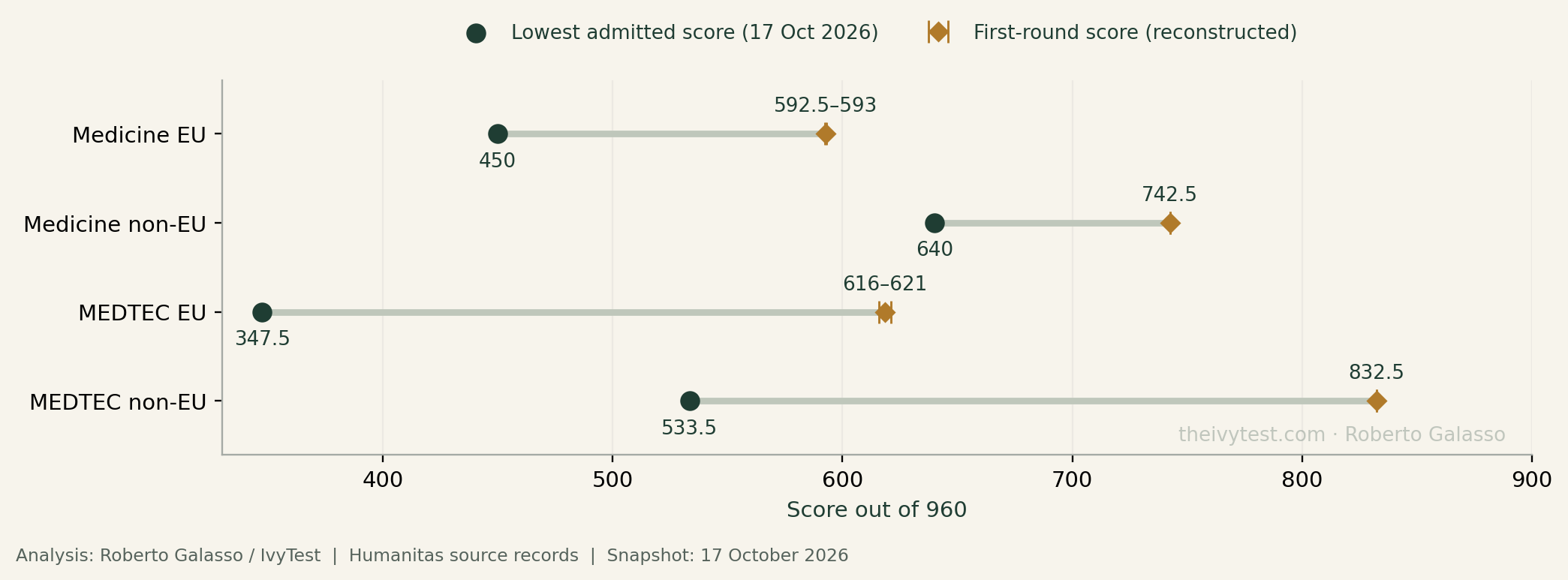
Reconstruction assumes the retained positions match the initial ranking and the reviewed call allocation applied. No dated first-day ranking or complete amendment history is available. Cancelled rows retain their positions. Tied scores alone do not establish eligibility.
The reviewed 2026 calls specify MEDTEC boundaries of 80 EU and 20 non-EU places. The current course page advertises 90 and 40; the timing of this increase is unverified. The table uses the original call boundaries, so later registration cannot all be attributed to waiting-list movement.
Humanitas 2026 admitted scores: minimum, median, maximum
These summaries use the same 335 entries marked Registered or Admitted as the opening table. The median is the middle score of this group. All values are out of 960.
| 2026 list | Registered or Admitted entries | Lowest score | Median | Highest score |
|---|---|---|---|---|
| Medicine EU | 157 | 450 | 592.5 | 840 |
| Medicine non-EU | 50 | 640 | 743.25 | 857.5 |
| MEDTEC EU | 90 | 347.5 | 496.5 | 922.5 |
| MEDTEC non-EU | 38 | 533.5 | 616.5 | 877.5 |
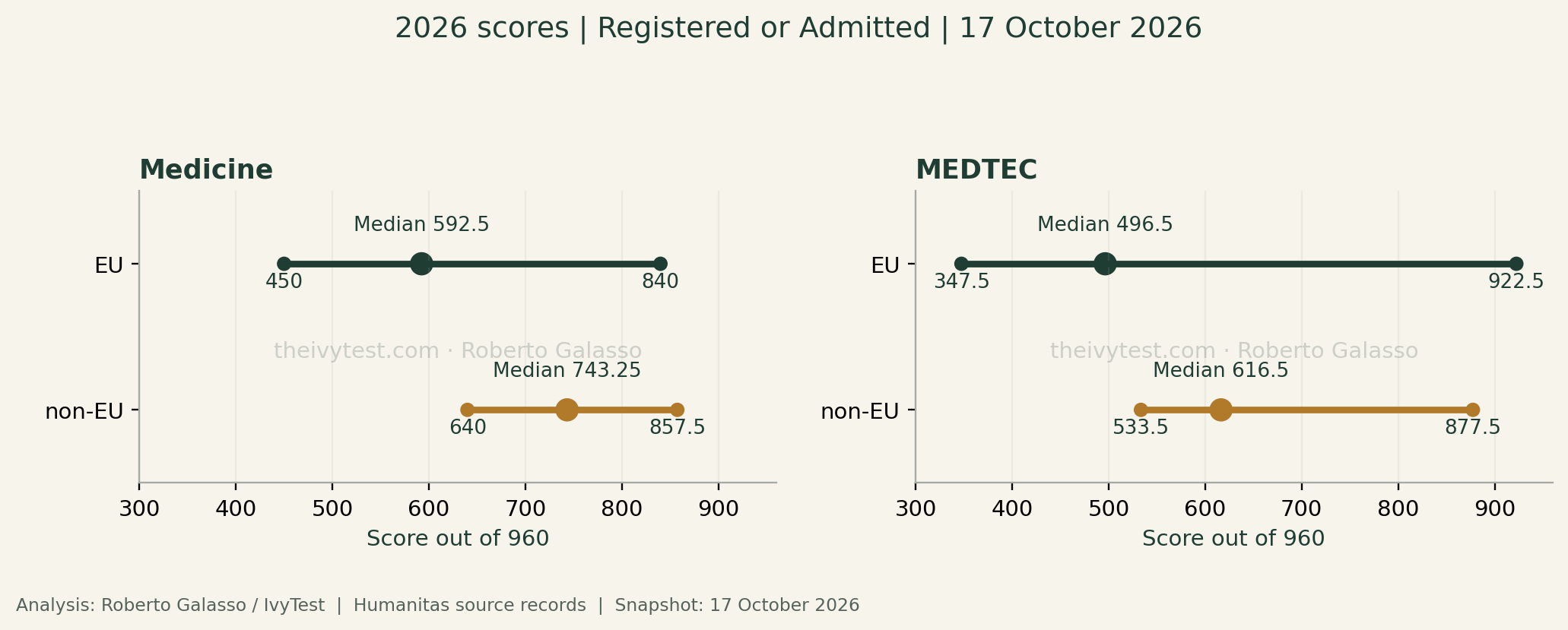
The separate registered-only minima in the opening table answer a narrower question: the lowest score among people already marked Registered. They do not include every admitted entry.
Humanitas cut-off scores by year: summary table
Every value below uses the same rule: the lowest score among entries marked Registered or Admitted in the saved ranking. These are observed cut-offs as defined above, not independently verified final thresholds.
| Year | Medicine EU | Medicine non-EU | MEDTEC EU | MEDTEC non-EU |
|---|---|---|---|---|
| 2020 | 77 | 47 | 465 | 401 |
| 2021 | 82 | 61 | 446 | 525 |
| 2022 | Unavailable | Unavailable | 461 | 435 |
| 2023 | 90 | 88 | 465 | 400 |
| 2024 | 62 | 77 | 400 | 403 |
| 2025 | 99 | 105 | 337 | 441 |
| 2026 | 450 | 640 | 347.5 | 533.5 |
Medicine scores use the source /180 scale through 2025 and /960 in 2026. MEDTEC source displays use /999.99 through 2025, with anomalous denominators in 2020 non-EU, then /960 in 2026. The scoring changed in 2026, so 2026 scores cannot be compared with earlier years. The ≈2022 estimates cover entry counts only; no Medicine scores have been estimated.
Humanitas Medicine ranking list by year (2020–2026)
The first-round rank is the last initial place listed in the reviewed call. The first-round score is reconstructed, subject to the assumptions below. The final columns use Registered and Admitted together, showing the lowest score and last position. Cancelled rows retain their original positions.
| Year | Category | First-round rank | First-round score (reconstructed) | Registered only: minimum | Lowest admitted score | Last admitted position |
|---|---|---|---|---|---|---|
| 2020 | EU | 100 | 97 (visible) | 77 | 77 | 360 |
| 2020 | non-EU | 50 | 80–82 (range) | 60 | 47 | 161 |
| 2021 | EU | 130 | 99–100 (range) | 82 | 82 | 308 |
| 2021 | non-EU | 50 | 92–98 (range) | 61 | 61 | 128 |
| 2022 | EU | – | Unavailable | Unavailable | Unavailable | Unavailable |
| 2022 | non-EU | – | Unavailable | Unavailable | Unavailable | Unavailable |
| 2023 | EU | 130 | 120 (visible) | 90 | 90 | 499 |
| 2023 | non-EU | 50 | 117 (visible) | 88 | 88 | 186 |
| 2024 | EU | 140 | 104 (inferred) | 62 | 62 | 503 |
| 2024 | non-EU | 50 | 106 (visible) | 77 | 77 | 156 |
| 2025 | EU | 150 | 119 (visible) | 99 | 99 | 365 |
| 2025 | non-EU | 50 | 131–135 (range) | 114 | 105 | 180 |
| 2026 | EU | 150 | 592.5–593 (range) | 456 | 450 | 354 |
| 2026 | non-EU | 50 | 742.5 (visible) | 640 | 640 | 118 |
Visible: score displayed at the boundary position. Range: bounds from the nearest visible scores above and below. Inferred: those neighbours have the same score. Upper bound: only a better-ranked visible neighbour is available. These are ordering bounds, not statistical confidence intervals. Medicine scores use /180 through 2025 and /960 in 2026. The 2022 entry-count estimates cannot recover admission scores.
MEDTEC ranking list and scores by year (2020–2026)
| Year | Category | First-round rank | First-round score (reconstructed) | Registered only: minimum | Lowest admitted score | Last admitted position |
|---|---|---|---|---|---|---|
| 2020 | EU * | 50 | 617–625 (range) | 465 | 465 | 205 |
| 2020 | EU * | 60 | 605–609 (range) | 465 | 465 | 205 |
| 2020 | non-EU | 10 | 401 (visible) | 401 | 401 | 10 |
| 2021 | EU | 60 | 572 (visible) | 446 | 446 | 158 |
| 2021 | non-EU | 10 | ≤525 (upper bound) | 525 | 525 | 6 |
| 2022 | EU | 60 | 548–552 (range) | 466 | 461 | 151 |
| 2022 | non-EU | 10 | 435–570 (range) | 435 | 435 | 11 |
| 2023 | EU | 60 | 572 (inferred) | 465 | 465 | 133 |
| 2023 | non-EU | 10 | 492–598 (range) | 400 | 400 | 30 |
| 2024 | EU | 70 | 478 (visible) | 400 | 400 | 114 |
| 2024 | non-EU | 10 | 528–532 (range) | 403 | 403 | 22 |
| 2025 | EU | 80 | 447–456 (range) | 337 | 337 | 152 |
| 2025 | non-EU * | 10 | 613 (visible) | 441 | 441 | 47 |
| 2025 | non-EU * | 20 | 543 (visible) | 441 | 441 | 47 |
| 2026 | EU | 80 | 616–621 (range) | 376.5 | 347.5 | 260 |
| 2026 | non-EU | 20 | 832.5 (visible) | 533.5 | 533.5 | 122 |
* MEDTEC EU 2020: the pre-postponement call specifies 50 places; the official page archived on 21 September advertises 60. The timing of the change is unverified. MEDTEC non-EU 2025: Article 1 declares 20 places, while Article 11 invites positions 1–10 directly and 11–15 conditionally. Both rank scenarios are retained.
The combined admitted group includes Registered and Admitted entries. Its minimum score and last position describe the saved ranking. It does not recover every past offer: cancelled entries may conceal earlier admissions. A displayed status also does not confirm that an offer is still actionable.
For example, the 2025 Medicine EU list has 70 registered entries beyond the initial rank-150 band, with a last registered position of 365. This supports a precise statement about the retained ranking, but cannot tell us how many offers were issued, declined or made in each round.
Reconstruction assumes the retained positions match the initial ranking and the reviewed call allocation applied. No dated first-day ranking or complete amendment history is available. Cancelled rows retain their positions. Tied scores alone do not establish eligibility.
Separate non-EU Medicine second calls
The second calls use the same Registered or Admitted rule but remain separate from the main rankings. In 2020, including Admitted lowers the minimum from the registered-only 110 to 109.
| Second call | Registered or Admitted entries | Lowest score | Median |
|---|---|---|---|
| 2020 | 12 | 109 | 118.5 |
| 2021 | 8 | 96 | 106 |
A larger score in a later year does not by itself mean a harder admissions process. Test content, scoring and the observed population can change. Even dividing by the maximum would not establish equivalence between different tests.
How many candidates appear in each Humanitas ranking?
The table below counts rows in the recovered main-call rankings. Separate non-EU Medicine second calls add 91 entries in 2020 and 83 in 2021. They are excluded from this comparison because they are separate calls and may overlap with other lists.
| Year | Medicine EU | Medicine non-EU | MEDTEC EU | MEDTEC non-EU |
|---|---|---|---|---|
| 2020 | 1,563 | 220 | 486 | 28 |
| 2021 | 1,430 | 210 | 394 | 23 |
| 2022 | ≈1,498* | ≈332* | 451 | 30 |
| 2023 | 1,566 | 454 | 392 | 54 |
| 2024 | 680 | 273 | 114 | 22 |
| 2025 | 774 | 409 | 258 | 107 |
| 2026 | 1,085 | 747 | 521 | 332 |
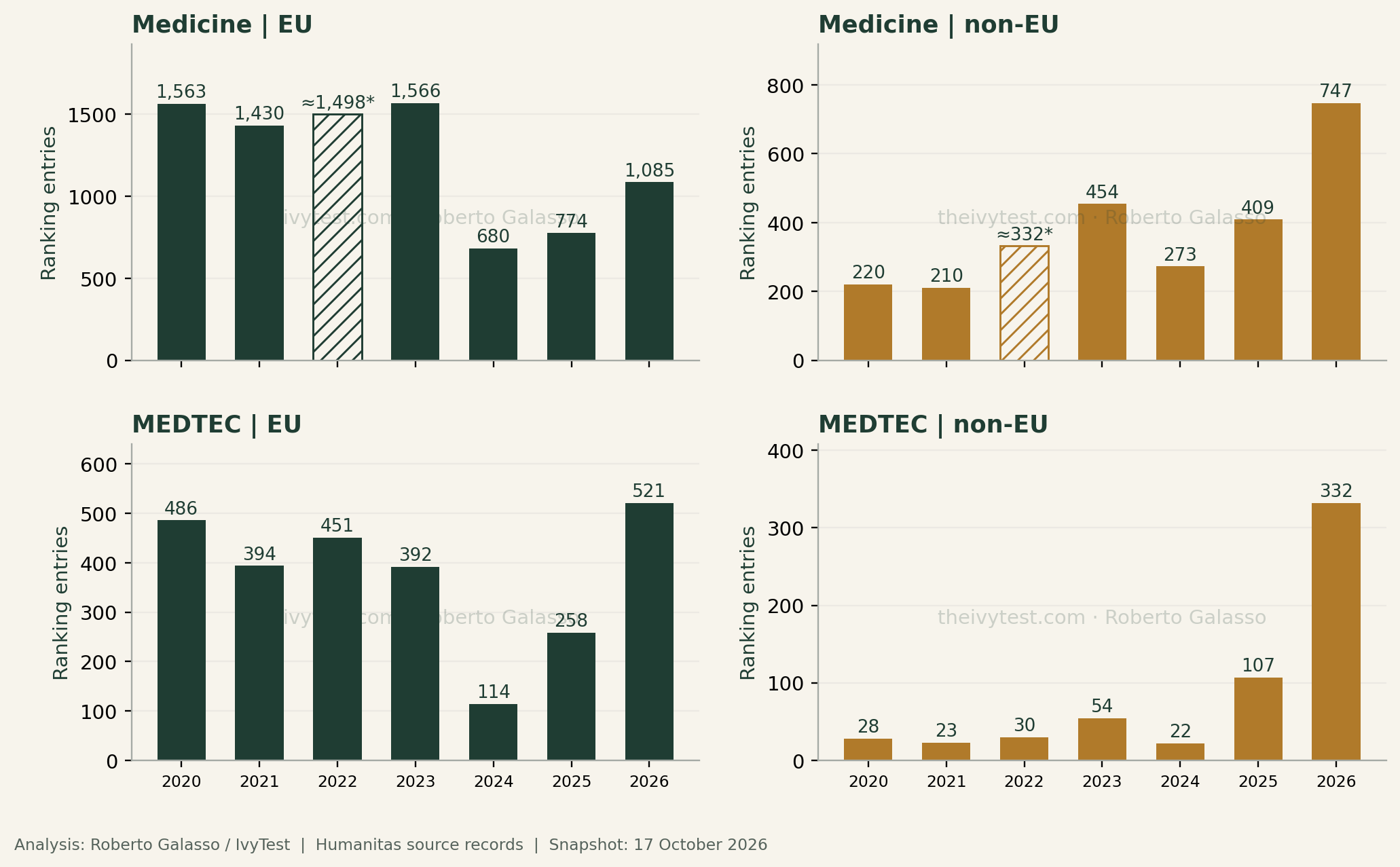
* ≈ means estimated. EU: (1,430 + 1,566) / 2 = 1,498. Non-EU: (210 + 454) / 2 = 332. This linear interpolation assumes a straight-line change between adjacent observed years; the true 2022 counts remain unknown.
These are ranking-entry counts. We have not established that every list includes every applicant or test taker, and we have not deduplicated people across courses, years or calls. For example, the recovered MEDTEC EU list has 392 entries in 2023 and 114 in 2024. That difference alone cannot prove that applications fell by the same amount.
Why are so many scores missing?
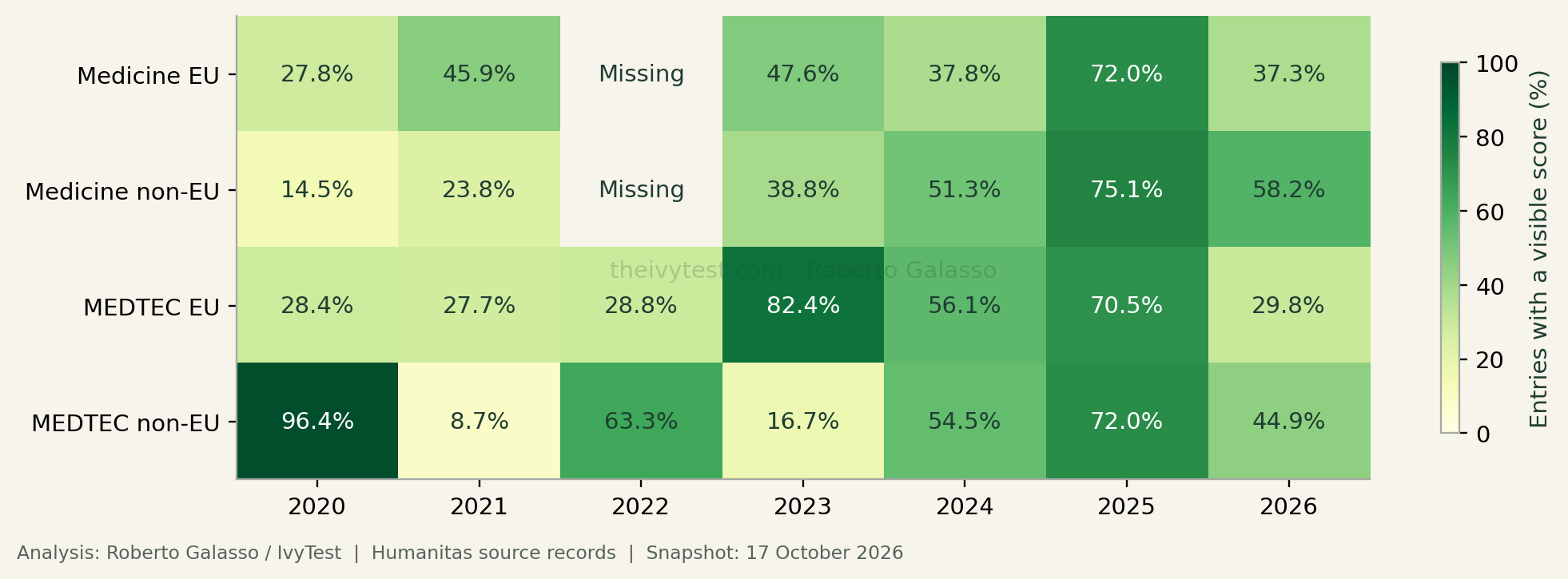
Across all 28 lists, 5,671 entries have scores and 7,126 do not. Score visibility follows the displayed status exactly: every registered, admitted, not-admitted and pre-registered entry has a score, while every cancelled or rejected entry has a blank. This describes these snapshots; it is not a claim about a universal portal rule.
Blank scores are not zero scores. They also cannot be assumed to be low scores. Without them, we cannot reconstruct the full score distribution or calculate a reliable percentile for all applicants. Registered entries offer a clearly defined subset: all 1,622 registered entries across the collection have visible scores.
Waiting list (scorrimento) and cancellations
Cancelled entries remain in the ranking-entry counts, because they are rows in the source lists. They are counted separately by status and excluded from both registered-only and combined admitted-score summaries. The portal label alone does not establish why an entry was cancelled, so it is not automatically treated as a declined offer or a released seat.
Waiting-list movements, or scorrimenti, are reflected only indirectly in the observed statuses. A registered entry may have joined through a later offer, but these snapshots do not identify the offer round or its date. Combining Registered and Admitted captures the broader observed reach, but not every historical offer: a subsequently cancelled entry may no longer retain its admission status. We cannot count every place released or reconstruct the threshold after each round.
Is the lowest registered score the Humanitas cutoff?
It is a useful historical observation, but this dataset does not establish a final cutoff. We do not have a dated sequence of every offer, withdrawal and waiting-list movement. The call-defined boundaries provide a conditional reconstruction of the initial band, with explicit assumptions. When quoting a registered minimum, label it lowest observed registered score and include the year, course, category and snapshot date. When quoting the combined admitted group, call it the lowest score among entries displaying Registered or Admitted as of the snapshot date. When quoting a reconstructed initial boundary, retain its range and qualification.
For example: “The lowest observed registered score in the 2026 Medicine non-EU list was 640, on the source /960 scale, in the snapshot extracted on 17 October 2026.” That wording describes the evidence without promising admission at that score.
What should an applicant take from this?
Start with your course, admission category and year. Read the lowest admitted score together with its position and date. Use the registered-only comparison if you specifically want the registered subset. Check the official call for the rules applying to your application. Avoid treating a past observed minimum as a target that guarantees a place, and avoid comparing raw scores across changed scoring systems.
The EU/non-EU labels are shorthand for the university's admission categories. The category described as EU can also include non-EU residents in Italy. Your applicable category should be determined from the official rules, rather than inferred from this article.
Questions
What is the Humanitas acceptance rate?
Humanitas publishes no acceptance rate. What its rankings show is how many entries each list had and how far it moved: in 2026 the Medicine EU ranking had 1,085 entries, its call listed 150 initial places, and by 17 October 2026 the list had reached position 354. Entries are not deduplicated people and not every applicant, so they don't make a probability.
What score do I need to get into Humanitas?
No past score guarantees a place. As of 17 October 2026, the lowest admitted scores in 2026 were 450 for Medicine EU (position 354), 640 for Medicine non-EU (position 118), 347.5 for MEDTEC EU (position 260) and 533.5 for MEDTEC non-EU (position 122), all out of 960. The cut-off changes every year with the candidates and the places.
Why are the 2026 scores so different from 2025?
The scoring changed. Medicine was scored out of 180 through 2025 and MEDTEC out of 999.99; both were scored out of 960 in 2026. A 2025 score and a 2026 score cannot be compared directly, and dividing by the maximum would not make different tests equivalent.
When are the Humanitas results and ranking list published?
Each year's call sets the dates. Humanitas says its Medicine and Surgery call usually comes out in October; the HUMAT guide has the 2027 dates as they are announced.
How does the Humanitas waiting list (scorrimento) work?
Places that candidates decline are offered to the next people on the list, so a list moves down after its first round. In 2026 the Medicine EU first round stopped at an estimated 592.5–593; by 17 October 2026 the list had reached 450. The snapshots don't show the date or round of each offer.
Does this cover Physiotherapy or Nursing?
No. It covers the Medicine and Surgery and MEDTEC School rankings only.
How we checked the data
We reconciled the 28 saved exports with 1,293 source pages. Every row's four original fields matched the saved extraction, and row totals, page totals, visible-score counts and status counts matched the stored validation records. The analysis counts rows, preserves missing values, and calculates statistics only within the stated subset. The admitted group is the exact English statuses Registered and Admitted, with minimum score and largest position computed separately. The same combined-status rule is used in every main-call and second-call summary. Second calls are shown separately so they are not treated as part of the main ranking.
For boundary reconstruction, we reviewed the official call allocations and direct-enrolment bands. If the boundary score is hidden, the closest visible scores on either side provide bounds only when the visible sequence is non-increasing. Equal neighbours identify the score under the ordering assumption. A one-sided value is labelled as an upper bound. Conflicting source allocations remain separate scenarios; they are not averaged.
All source extractions were made on 17 October 2026. These are surviving historical portal states, not snapshots captured on each ranking's original publication day.
Source anomalies are preserved: the 2023 MEDTEC EU list skips position 305 while containing 392 rows, and the 2020 MEDTEC non-EU list displays /0 for 25 of its 27 visible scores. The 2026 Medicine non-EU list also appends an out-of-order score of 742.5 at position 747; the rank-50 boundary is directly visible and does not require inference from that sequence. No row, position or denominator was silently repaired.
Sources
The numerical results come from Humanitas University's ESSE3 ranking pages, retrieved on 17 October 2026, and the official admission call of each year, used to reconstruct the initial boundaries. The table names the lists by their ranking ID on the portal. Candidate identifiers are left out of the article and the data.
| Year | List | Ranking ID |
|---|---|---|
| 2020 | Medicine EU | 257 |
| 2020 | Medicine non-EU | 258 |
| 2020 | Medicine non-EU (second call) | 306 |
| 2020 | MEDTEC EU | 260 |
| 2020 | MEDTEC non-EU | 302 |
| 2021 | Medicine EU | 406 |
| 2021 | Medicine non-EU | 407 |
| 2021 | Medicine non-EU (second call) | 410 |
| 2021 | MEDTEC EU | 408 |
| 2021 | MEDTEC non-EU | 409 |
| 2022 | MEDTEC EU | 451 |
| 2022 | MEDTEC non-EU | 452 |
| 2023 | Medicine EU | 501 |
| 2023 | Medicine non-EU | 502 |
| 2023 | MEDTEC EU | 509 |
| 2023 | MEDTEC non-EU | 510 |
| 2024 | Medicine EU | 505 |
| 2024 | Medicine non-EU | 580 |
| 2024 | MEDTEC EU | 582 |
| 2024 | MEDTEC non-EU | 583 |
| 2025 | Medicine EU | 649 |
| 2025 | Medicine non-EU | 650 |
| 2025 | MEDTEC EU | 651 |
| 2025 | MEDTEC non-EU | 652 |
| 2026 | Medicine EU | 747 |
| 2026 | Medicine non-EU | 748 |
| 2026 | MEDTEC EU | 749 |
| 2026 | MEDTEC non-EU | 750 |
Data, licence and citation
The full report (10 pages, with the method and the source register) and the aggregate numbers behind every table and chart: one row per list, with entry and status counts, score summaries and the reconstructed first-round scenarios. No candidate-level data.
The charts and the data are published under CC BY 4.0: you may reuse them, including commercially, with credit to Roberto Galasso / IvyTest and a link to this page. The article's text is © 2026 Roberto Galasso / IvyTest. CC BY 4.0
How to cite
Galasso, R. (2026). Humanitas admission rankings, 2020–2026: A descriptive audit of Medicine and MEDTEC ranking snapshots (Version 1.0). IvyTest. https://doi.org/10.5281/zenodo.23443868
About this analysis
Roberto Galasso is the founder of IvyTest, which provides admissions preparation. This commercial interest is disclosed so readers can assess the analysis in context. The work is independent of Humanitas University and is not a university publication or endorsement.
AI assisted the extraction, the calculation code and the drafting. The author reviewed and approved the analysis. It is not peer reviewed.