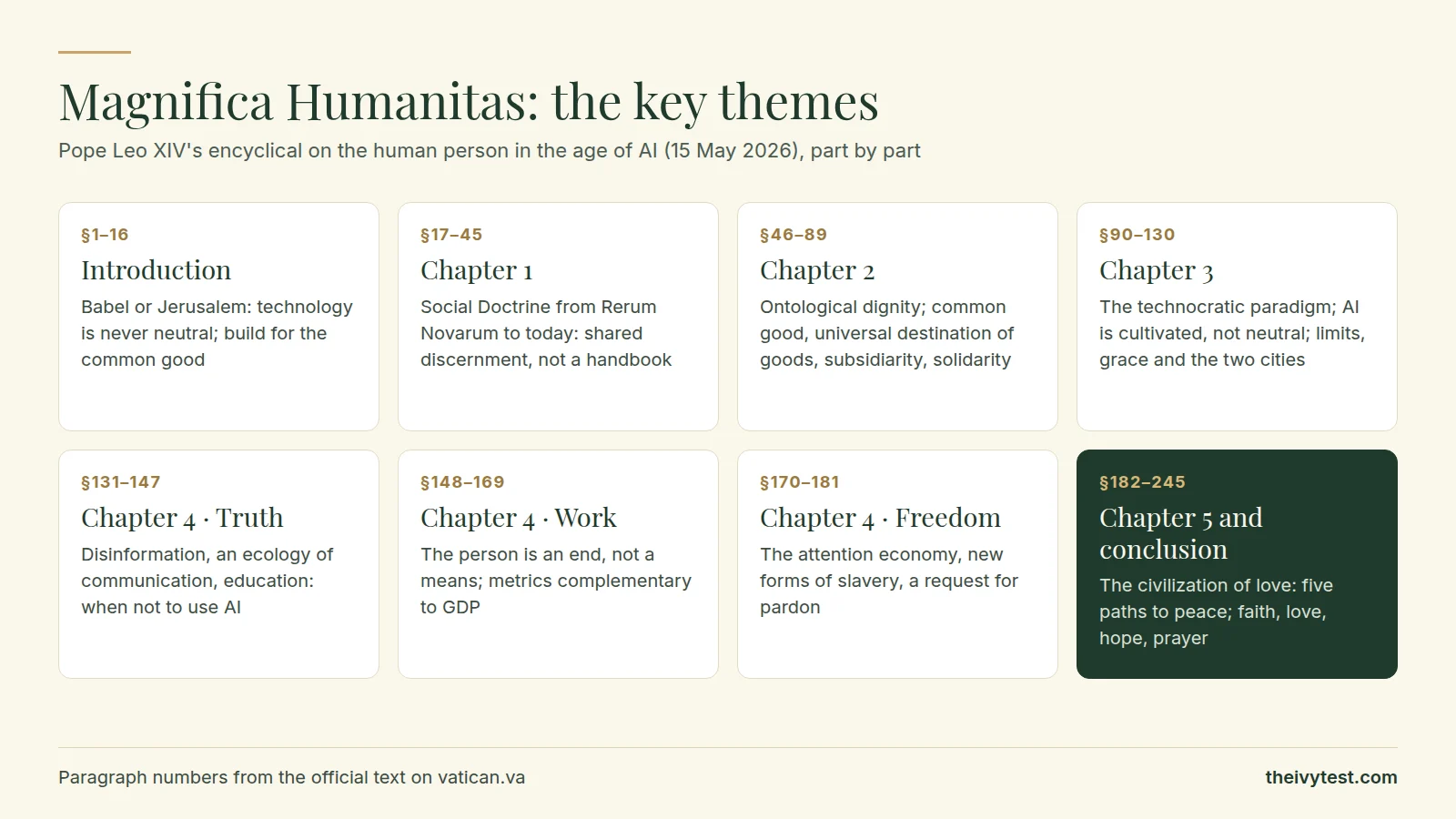
The technocratic paradigm denounced in Laudato Si', "the logic of efficiency, control and profit alone", spreads with AI (§92–93), and control over platforms, infrastructure, data and computing power lies with major economic actors rather than States (§95). AI systems are "more 'cultivated' than 'built'" (§98) and "merely imitate certain functions of human intelligence": they have no body, no experiences and no moral conscience, and their learning is statistical adaptation (§99).
AI is "a valuable tool" that needs vigilance: in personal use the encyclical names the ease of results, the impression of objectivity and the simulation of human communication (§100), and it counts AI's demands on energy and water (§101). AI is not morally neutral, because "every technical tool embodies choices and priorities" (§104); responsibility must be clearly defined (§105), and "a more moral AI is not enough if that morality is determined by a few" (§107). Data should be managed as a common good (§108), and AI must be "disarmed", freed from monopolistic control (§110), with a special appeal to its developers (§111).
Transhumanism and posthumanism treat the human being as something to be enhanced or surpassed (§115–117); the encyclical answers that "humanity flourishes not despite limitations, but often through them" (§118), and that the authentic "more than human" is grace (§127–128): "For an algorithm, an error is a flaw to be corrected; for a person, however, an error can be a catalyst for profound change" (§128). The test of AI is Saint John Paul II's question, whether it makes human life "more human" (§129), and the chapter closes with Augustine's two cities built by two loves (§130).