

"All doctors on the ward have completed emergency training. Some doctors on the ward specialise in paediatrics." Which conclusion follows with certainty?
Exam guide · Updated for 2027 admissions
UniCamillus Admission Test 2027: Complete Preparation Guide
Everything you need to know about the UniCamillus admission test for Medicine and Surgery, taught in English in Rome or in Italian at Venice Mestre, Rome and Cefalù: dates, results, format, syllabus, scoring, entrance exam questions with answers, fees, preparation strategy and practice.
Updated for 2027 admissions · Last updated: 16 October 2026
UniCamillus Admission Test at a glance
Overview
What is the UniCamillus Admission Test?
UniCamillus, formally Saint Camillus International University of Health Sciences, runs its own admission test for Medicine and Surgery, which it teaches in English in Rome and in Italian at Venice Mestre, Rome and Cefalù. It is set by the university itself, governed each round by its own Rector's Decree, and is a different exam from the national IMAT and from other Italian private schools' own tests. The two courses have separate calls and separate rankings, but the test is the same: same sections, same scoring, same date, set in English for the English course and in Italian for the Italian one.
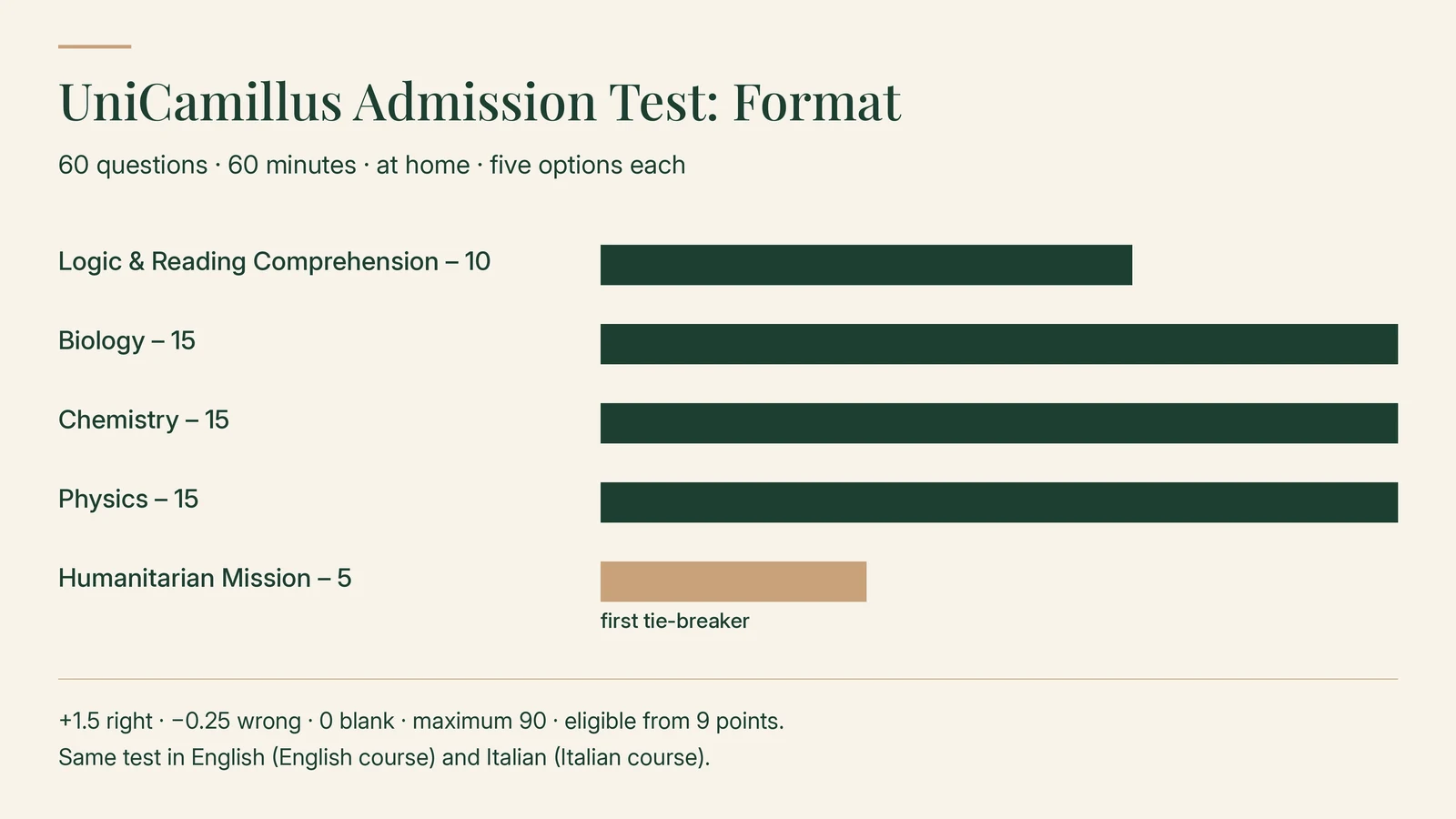
The format is 60 multiple-choice questions in a single continuous 60-minute sitting, each with five answer options. Four sections cover conventional pre-med content (logic and reading, biology, chemistry and physics), but a fifth, worth 5 of the 60 questions, is genuinely distinctive: Humanistic Culture & Humanitarian Mission, testing knowledge of global health, humanitarian organisations and the university's own founding mission (it is named for Camillo de Lellis, patron of the sick and of hospital workers). Under the university's own admission rules, this section is also the first tiebreaker used when two candidates' total scores are equal (ahead of age), which gives its five questions more practical weight than the raw count suggests.
Unlike some peer schools that admit purely by ranking, UniCamillus sets a hard floor: a minimum eligible score of 9 points overall, plus separate minimum thresholds in Biology, Chemistry and Physics individually. Falling short in even one science can trigger an additional learning requirement regardless of your overall rank. This guide covers both courses: where places, fees or campuses differ, it says which course it means.
Programmes that use the UniCamillus Admission Test
- Medicine and Surgery (English-taught, Rome campus)
- Medicine and Surgery (Italian-taught, Venice Mestre, Rome and Cefalù campuses)
Timeline
UniCamillus Admission Test 2027: dates and deadlines
When to expect your exam · 2027 start
- March 2027Expected
Predicted from this university's past sittings until it publishes its own dates. See every university on the calendar →
- Applications open2027/28 dates not yet published
- Registration deadline16 November 2026 (13:00)
- Exam date19 November 2026
- Results publishedBy 25 November 2026
- Enrolment deadline2 December 2026 (13:00)
| Round | English course (Rome) | Italian course (Venice Mestre · Rome · Cefalù) |
|---|---|---|
| 1st | RD 52 · 425 places · test 19 March 2026 | RD 53 · 560 places (320 · 160 · 80) · test 20 March 2026 |
| 2nd | RD 193 · 120 places · test 19 May 2026 | RD 192 · 299 places (241 · 33 · 25) · test 18 May 2026 |
| 3rd | RD 473 · 92 places · test 21 September 2026 | RD 390 · 319 places (214 · 90 · 15) · test 21 September 2026 |
| 4th (open) | RD 639 · 66 places · apply by 16 November · test 19 November 2026 | RD 640 · 334 places (213 · 115 · 6) · apply by 16 November · test 19 November 2026 |
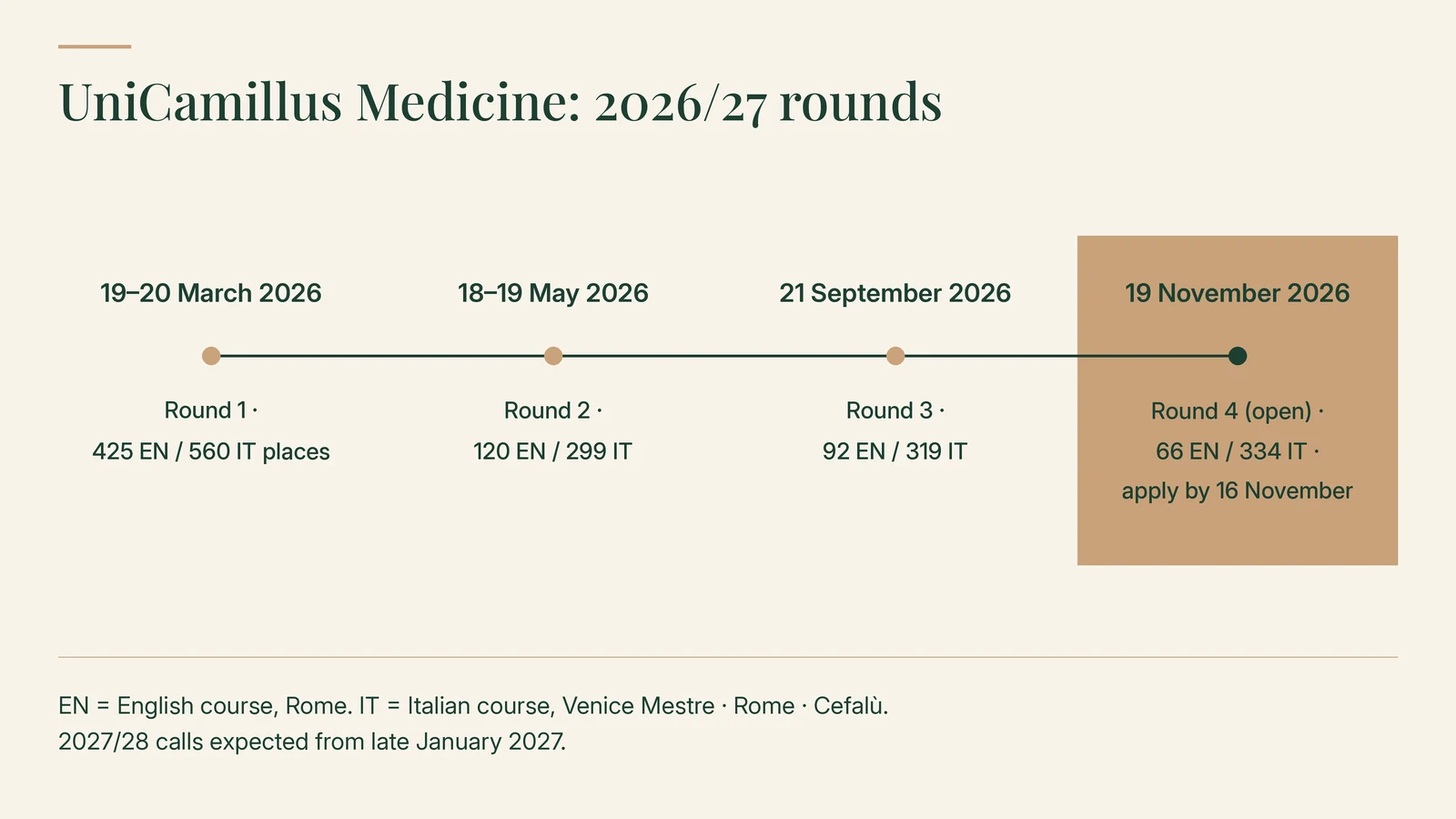
UniCamillus issues a fresh Rector's Decree for each admission round rather than one call a year, and each round offers the places the earlier ones left, so a round's places are not the year's total. The 2026/27 calls were first published on 30 January 2026; no 2027/2028 call was listed on 16 October 2026, and the first is likely around the end of January 2027. In 2025/26 the October round's deadline was extended by a later decree, so always check the Admission Calls page for the most recent decree before relying on a date here.
Structure
UniCamillus Admission Test format
60 questions in 60 minutes, sat as one continuous block with no section breaks. The split below is set out in Article 4 of the governing Rector's Decree.
| Section | Questions | Weighting | Suggested time |
|---|---|---|---|
| Logic, Problem-Solving & Reading Comprehension | 10 | 17% (10 of 60) | *see the note below the table |
| Biology | 15 | 25% (15 of 60) | *see the note below the table |
| Chemistry | 15 | 25% (15 of 60) | *see the note below the table |
| Physics | 15 | 25% (15 of 60) | *see the note below the table |
| Humanistic Culture & Humanitarian Mission | 5 | 8% (5 of 60) | *see the note below the table |
- One continuous 60-minute sitting; UniCamillus sets no per-section time limit
Content
Question and subject breakdown
Four sections are conventional pre-med content. The fifth (worth less on paper than in practice, since it settles ties before age does) is unique to UniCamillus among the schools in our catalogue.
Logic, Problem-Solving & Reading Comprehension
17%Constraint satisfaction, decision procedures, propositional logic, short reading comprehension and quantitative reasoning: self-contained items answerable from the text alone.
Biology
25%Cell biology, bioenergetics, genetics and heredity, evolution, and human anatomy and physiology.
Chemistry
25%Atomic structure and bonding, stoichiometry, solutions and equilibrium, acids/bases and redox, and organic chemistry.
Physics
25%Measurement, kinematics, dynamics, fluids, thermodynamics and electromagnetism; there is no separate Mathematics section, so quantitative work sits inside Physics and the Logic section instead.
Humanistic Culture & Humanitarian Mission
8%Global health, humanitarian organisations (WHO, UNICEF, the Red Cross, MSF), health systems and the university's own founding mission: general, non-clinical knowledge at an informed-newspaper-reader level.
Marks
UniCamillus Admission Test scoring
UniCamillus's scoring is unusual in two ways worth understanding before test day: it rewards a correct answer more than most peer schools (1.5 points, not 1), and, unlike a test where guessing is exactly neutral, a blind guess here has a small positive expected value.
- Correct answer
- +1.5 points
- Incorrect answer
- −0.25 points
- Unanswered question
- 0 points
- Maximum possible score
- 90 points (60 × 1.5)
- Minimum eligible score
- 9 points overall; score below this and you are not eligible for a place, regardless of rank
- OFA floors (Biology, Chemistry, Physics)
- 9 out of 15 in each; miss this in even one science and you're assigned extra coursework in that subject after enrolment, independent of your overall score
Worked example
Suppose you answer 50 of the 60 questions and leave 10 blank. Of the 50 attempted, 42 are correct and 8 are wrong. Your score is (42 × 1.5) + (8 × −0.25) + (10 × 0) = 63 − 2 = 61 out of a maximum 90, comfortably above the 9-point minimum, so this result is eligible to be ranked. A genuinely random guess with no elimination has an expected value of (1/5 × 1.5) + (4/5 × −0.25) = 0.30 − 0.20 = +0.10: slightly positive, unlike a test where guessing and leaving a question blank come out equal. That doesn't make guessing a strategy: eliminating even one implausible option before answering raises the expected value further, and the real value of your remaining minutes is in the questions you can actually work out.
The IvyTest simulator scores every practice paper against these exact rules.
See the UniCamillus Admission Test simulatorSyllabus
UniCamillus admission test syllabus
UniCamillus's Annex A names each section's content in varying detail: Biology, Chemistry and Physics list six macro-areas each in a fixed published order; Logic and Humanistic Culture describe their areas in prose only, so the groupings below follow how IvyTest's own material organises that content.
- Constraint satisfaction: scheduling, seating and assignment grids, elimination tables
- Decision rules and procedures: executing a flowchart, protocol or eligibility criteria in stated order
- Propositional logic: necessary conclusions, conditionals and contrapositives, necessary vs. sufficient conditions
- Short reading comprehension: main idea, author's stance, inference limited to the passage
- Quantitative reasoning: ratios, percentages, rates and unit conversion used as decision tools
- The chemistry of living things: water, organic macromolecules, enzymes
- The cell as the basis of life: prokaryotic and eukaryotic cells, membrane transport, mitosis and meiosis
- Bioenergetics: ATP, redox reactions, photosynthesis, glycolysis, respiration, fermentation
- Reproduction and heredity: Mendel's laws, DNA structure and protein synthesis, inheritance patterns, recombinant DNA
- Heredity and environment: mutations, natural and artificial selection, evolutionary theory
- Anatomy and physiology: tissues, organ systems and their interactions, homeostasis
- Matter and atomic structure: states of matter, perfect gas laws, atomic and mass number, electron configuration
- The periodic table and chemical bonding: periodic trends, ionic/covalent/metallic bonds, nomenclature of oxides, hydroxides, acids and salts
- Chemical reactions and stoichiometry: the mole concept, balancing equations, reaction types
- Solutions, kinetics and equilibrium: concentration, dilution, aqueous equilibrium, catalysis
- Acids, bases and redox: pH, hydrolysis, buffers, oxidation number, balancing redox reactions
- Organic chemistry: isomerism, hydrocarbons, functional groups, basic nomenclature
- Measurements and units: SI and CGS systems, fundamental and derived quantities
- Kinematics: uniform and accelerated motion, free fall, circular and harmonic motion
- Dynamics, work and energy: Newton's laws, momentum, kinetic and potential energy, conservation of energy
- Fluid mechanics: pressure, Stevin's law, Pascal's principle, Archimedes' principle
- Thermology and thermodynamics: calorimetry, changes of state, the laws of thermodynamics
- Electrostatics and electrodynamics: Coulomb's law, circuits, Ohm's law, electromagnetic induction
Non-specialist knowledge at the level of an informed newspaper reader, not clinical detail.
- Water, sanitation and disease: the global water crisis, waterborne epidemics, hygiene as a health determinant
- Major infectious diseases: tuberculosis, HIV/AIDS, malaria, neglected tropical diseases, child malnutrition
- Humanitarian organisations: the WHO and UN agencies, the Red Cross/Red Crescent movement, Médecins Sans Frontières
- Health systems and global goals: universal health coverage, primary health care, the health-related Sustainable Development Goals
- Conflict, displacement and climate: forced displacement, food insecurity, the links between climate, conflict and hunger
- Eminent figures in global health: historical and contemporary contributors to humanitarian medicine
- The UniCamillus mission and values: Camillo de Lellis and the university's founding commitment to training doctors for underserved regions
Test your UniCamillus Admission Test knowledge
Take free diagnosticDifficulty
How difficult is the UniCamillus Admission Test?
The UniCamillus test is demanding less because of any single hard section and more because of how its rules interact: a floor you must clear in four different places, not just one overall.
A floor, not just a ranking
Score below 9 points overall and you're not eligible for a place at all, whatever your rank. Score below 9 out of 15 in any single science, even with a strong overall total, and you pick up an additional learning requirement in that subject after enrolling. Four separate bars to clear, not one.
A section almost nobody prepares for
Humanistic Culture & Humanitarian Mission is only 5 of 60 questions, but it's the first tiebreaker under the university's own ranking rules, ahead of age. Most general medicine-admission preparation never touches global health organisations or humanitarian history at all.
The scoring rewards elimination over caution
At +1.5 for correct and −0.25 for incorrect, a genuinely random guess has a small positive expected value, unusual among Italian medical admission tests, most of which are built to make guessing exactly neutral. That still isn't a reason to guess blindly on questions you could instead work out.
No Mathematics section, but no calculator either
Quantitative work is folded into Physics and into the Logic section's own quantitative-reasoning items, and no calculator is permitted: only two sheets of blank paper. Numbers on this test are meant to stay tractable by hand.
It's sat at home, in one unbroken hour
Remote proctoring via Selexi (a Chrome plugin plus a phone or tablet camera) replaces travel to Rome, but the 60 minutes run as a single block with no section breaks; pacing across all five sections yourself is entirely on you.
Benchmarks
What is a good UniCamillus Admission Test score?
UniCamillus does not publish an official acceptance rate or year-by-year cutoffs above its stated 9-point minimum, and seat counts vary by round, by course and, on the Italian course, by campus (you are ranked only for the campuses you choose when you register), so no single number here should be treated as a fixed target.
The 9-point minimum and the per-science OFA floors are the only published thresholds; everything above them is decided by ranking against that cycle's applicant pool, which UniCamillus doesn't disclose in detail.
Because the university runs multiple sittings across a cycle rather than one fixed date, 'this year's cutoff' isn't a single figure even in principle: different sittings can rank differently sized and differently prepared applicant pools. Your own trajectory on full, timed mocks scored with the real +1.5/−0.25/0 rule is a more useful signal than any cutoff you might see quoted elsewhere.
Pending verification
- · Historical admission cutoffs by year, beyond the published 9-point minimum
- · Competitive score ranges by sitting
- · Applicants and seats per cycle
- · How many candidates sat each round, on either course
These specific numbers aren't public yet — an IvyTest simulator score is the closest benchmark you can get today.
Check your UniCamillus Admission Test scoreStrategy
How to prepare for the UniCamillus Admission Test
12+ weeks
Cover all five sections, including the one you've never studied for
Full syllabus coverage, humanitarian-mission content included from week one.
- Sit a full diagnostic in week one, scored with the real +1.5/−0.25/0 rule, so you can see where you stand against the 9-point floor as well as your overall total.
- Work through Biology, Chemistry and Physics in parallel rather than one at a time, since each has its own 9/15 OFA floor to clear independently.
- Start the Humanistic Culture & Humanitarian Mission content early: it's unfamiliar territory for most candidates and rewards steady exposure over time, not a last-minute cram.
- Add full 60-minute timed sittings from week six onward.
8 weeks
Protect every floor, not just the overall average
Targeted repair with each science tracked separately.
- Diagnostic first, then check each science against its own 9/15 floor individually: a strong overall score can hide a weak single subject.
- Give Humanistic Culture & Humanitarian Mission dedicated weekly time even though it's the shortest section; its tiebreak role makes it worth more than five questions.
- One full timed mock a week from week two, scored with the real rules and reviewed the same day.
- Log wrong and blank answers by section, watching specifically for any science trending near its 9/15 floor.
4 weeks
Full 60-minute sittings become the main activity
Volume of timed practice under the exact scoring rule.
- Two full mocks a week at the 60-minute limit, scored with +1.5/−0.25/0 applied exactly as on the day.
- Review each mock against both the overall score and each science's own 9/15 threshold.
- Drill elimination technique specifically: with a slightly positive expected value on a blind guess, ruling out even one option before answering is worth more here than on a strictly neutral-scoring test.
- Rehearse the remote-proctoring setup (device, camera, workspace, the two permitted sheets of paper) well before the real sitting.
Under 4 weeks
Shore up the weakest floor first
Triage by threshold, not just by comfort.
- Identify whichever science sits closest to its 9/15 floor and prioritise it: a strong overall score doesn't protect against an individual OFA.
- Spend at least one dedicated session on Humanistic Culture & Humanitarian Mission, even this late: it's a small, learnable body of content with outsized tiebreak value.
- Sit at least two full, scored mocks in the final ten days.
- On the day: with one continuous 60-minute block and no section breaks, decide your own pacing plan in advance rather than improvising it mid-test.
Get your personalised UniCamillus Admission Test study plan
Take free diagnosticExplore the full UniCamillus Admission Test planPractice
Free UniCamillus Admission Test practice questions
Three questions in the format the exam uses. Choose an answer to see the explanation — nothing is recorded.
How many grams of water are produced from the complete combustion of 2 moles of hydrogen gas (H2) with excess oxygen? (Molar mass of H2O ≈ 18 g/mol)
Which United Nations agency is primarily responsible for coordinating the international response to public health emergencies, including declaring a Public Health Emergency of International Concern?
Illustrative examples written by IvyTest to show the question style — not past UniCamillus Admission Test papers.
Past papers
UniCamillus Admission Test past papers
UniCamillus publishes no past papers and no official sample test. What it publishes is each round's call, a PDF on the Admission Calls page of www.unicamillus.org, whose Annex A is the official syllabus for every section. The practice questions on this page are IvyTest's own, written to that syllabus in the real format: 60 questions, five options, +1.5 / −0.25 / 0.
University
UniCamillus University medicine admissions
The test result feeds into a wider application. The English course (Rome) and the Italian course (Venice Mestre, Rome, Cefalù) have separate calls and rankings; the facts below give both.
- Degree
- Medicine and Surgery (6-year single-cycle degree, LM-41), taught in English or in Italian
- Language
- English or Italian: the same test, set in the language of the course you apply for
- Campus
- English course: Rebibbia, Rome (northeast, Metro B terminus). Italian course: Venice Mestre, Rome or Cefalù, ranked only for the campuses you choose
- Tuition
- English course: €21,000/year in 2026/27, in both the EU and the non-EU calls (first year: €2,000 + €6,000 at enrolment, then €6,500 by 30 November 2026 and €6,500 by 28 February 2027); the top 50 in the ranking with an ISEE up to €55,000 are exempt from €5,250 of it. Italian course: €16,500 in the first year, €18,000 a year from the second
- Application fee
- €180 (EU/equivalent) · €50 (non-EU resident abroad, under a separate call with its own written test and oral)
- International student body
- Over 40% non-EU students from 60+ nationalities (university-wide figure)
- Seats available
- In the open November round: 66 on the English course and 334 on the Italian course (213 Venice Mestre, 115 Rome, 6 Cefalù), the places earlier rounds left. The English course's first 2026/27 call offered 425; non-EU candidates resident abroad are admitted to the English course under a separate call (83 places under Rector's Decree No. 200) with a written reasoning test and an online oral instead of this test
- Application process
- Admission test registration, application form and documents via the UniCamillus portal; no interview on the EU route. Non-EU candidates resident abroad sit a written reasoning test plus an online oral interview in English (Rector's Decree No. 200)
The campus
UniCamillus's Rome campus
The English-taught Medicine and Surgery programme is taught at UniCamillus's Rome campus, at Via di Sant'Alessandro 8/30 in the north-east of the city, reached by Metro B to Rebibbia and then bus 040, 041 or 043. Its interconnected buildings hold the Rector's Office and student services, UniLabs with lecture halls for about 1,000 students, the UniCongress Hall with its 230-seat main lecture theatre, an Auditorium, and UniHall's library and study rooms.
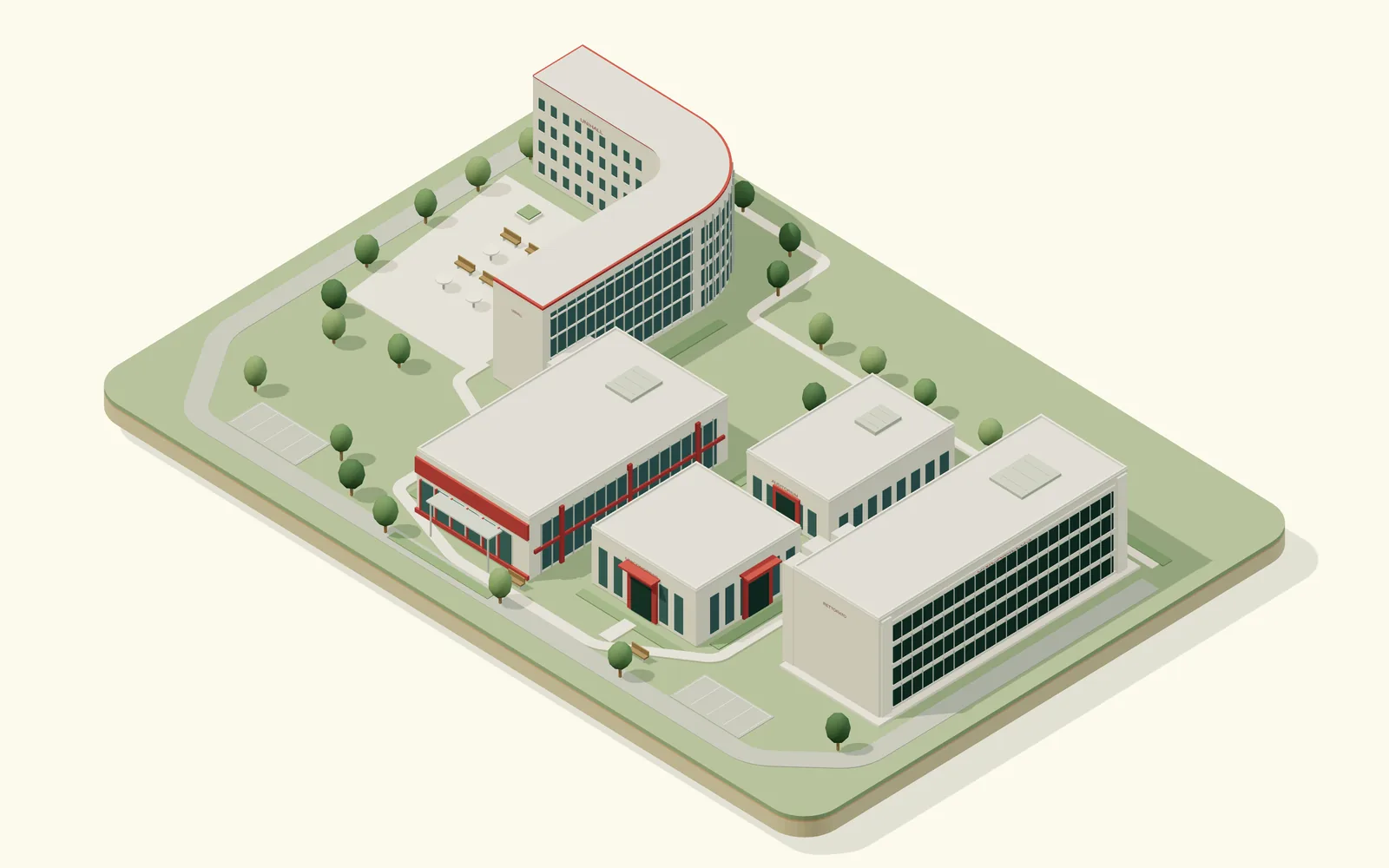
Explore the UniCamillus campus.
Open it in 3D to turn it and see what each building holds.
Stylized campus illustration, not a map or to scale.
Central building · Rector's Office
A basement garage and four floors with 12 classrooms and laboratories, the Rector's Office, reception and student services, study rooms and a café.
UniLabs
Lecture halls seating about 1,000 students, teaching and scientific laboratories, and faculty offices.
UniCongress Hall
Large auditoria seating about 620 people in all, including the 230-seat main lecture theatre.
Auditorium
A conference hall, a theatre for performances and concerts, a multimedia room and a classroom for about 230 people.
UniHall
Mainly for studying and relaxing: study rooms, the library, a printing centre, student association offices and a relaxation area.
Address: Via di Sant'Alessandro 8/30, Roma
IvyTest UniCamillus Admission Test preparation
Ready to prepare properly for the UniCamillus test?
Everything above is free and always will be. When you want structure (a syllabus-mapped book covering all five sections including Humanistic Culture & Humanitarian Mission, a simulator that scores with the real +1.5/−0.25/0 rule, lessons for the gaps your results flag, and help with the application itself), that is what the IvyTest UniCamillus package is.
Study guide
The full syllabus across all five sections, including the Humanistic Culture & Humanitarian Mission content most prep material skips entirely.
Exam simulator
Timed 60-minute mocks in the real 5-option, +1.5/−0.25/0 format, with per-question explanations and topic analytics.
Video courses
Focused lessons in biology, chemistry, physics and reasoning for the topics your results flag.
Application support
MedApply: deadlines, documents, legalisation and enrolment steps carried through to a confirmed place.
FAQ
UniCamillus Admission Test frequently asked questions
It's the test Saint Camillus International University of Health Sciences (UniCamillus) uses to select candidates for its English-taught Medicine and Surgery degree in Rome: 60 multiple-choice questions across five sections, in one continuous 60-minute sitting.
No. The IMAT is the national test used by Italian public universities; UniCamillus sets and administers its own test under its own Rector's Decree, with a different structure, option count and scoring.
Online, from home, remotely proctored by Selexi using a Chrome browser plugin plus a phone or tablet camera. No calculator is permitted, though two sheets of blank paper and a pen are allowed.
A 5-question section unique to UniCamillus, covering global health, humanitarian organisations (the WHO, UNICEF, the Red Cross, Médecins Sans Frontières) and the university's own founding mission. It's also the first tiebreaker used when two candidates' total scores are equal, ahead of age, so it carries more weight than its size suggests.
+1.5 points for a correct answer, −0.25 for an incorrect one, 0 for a blank, out of a maximum 90. A genuinely random guess works out to a small positive expected value (+0.1 points) rather than being exactly neutral, but eliminating even one implausible option before answering raises that further, and it's never better than actually knowing the answer.
Yes: two separate thresholds. Score below 9 points overall and you're not eligible for a place at all, regardless of rank. Separately, score below 9 out of 15 in Biology, Chemistry or Physics individually, and you're assigned an additional learning requirement in that subject after enrolling, even if your overall score is strong.
Yes. The English course is taught only in Rome; the Italian course is taught at Venice Mestre, Rome and Cefalù, and its candidates sit the same test, in Italian, and are ranked for the campuses they chose when they registered. Format, syllabus, scoring and dates here hold for both courses; where places or fees differ, the guide says which course it means.
For 2026/27 the English course's first call offered 425 places to Italian and EU candidates, and the Italian course's 560 (320 at Venice Mestre, 160 in Rome, 80 in Cefalù); each later round offered what was left, and the November round has 66 and 334. Non-EU candidates resident abroad are admitted to the English course under a separate call with a written reasoning test and an online oral. UniCamillus doesn't publish an official acceptance rate or applicant numbers.
Within the EU, yes: automatically, as a standard Italian medical degree (LM-41). Italy's medical schools, UniCamillus included, became eligible for ECFMG certification once the national system gained WFME accreditation in 2024, opening the standard USMLE/ECFMG path toward US practice. For the UK, the Medical Act 1983 (sections 21B and 21C, as in force on 12 October 2026) spares holders of an Italian medical degree the knowledge test other international graduates take through PLAB/UKMLA, but the UK's list pairs the laurea with the Diploma di abilitazione all'esercizio della medicina e chirurgia, which Italy stopped issuing in March 2020, when the practical training moved inside the degree. The GMC's Italy page therefore offers graduates since then provisional registration on the laurea, for a UK Foundation Year 1 post, and asks for evidence of supervised practice, such as a 12-month internship, for full registration. Evidence of English is still required, and the rule is UK policy that can change.
Yes. The IvyTest simulator runs UniCamillus-format practice (60 questions, five options, the real +1.5/−0.25/0 scoring) in timed, tutor and review modes, with a free demo of the simulator available without payment.
No. UniCamillus publishes no past papers and no official sample test, in PDF or otherwise. What it does publish is the call itself, a PDF free to download from the Admission Calls page on www.unicamillus.org, whose Annex A is the official syllabus for each section. The practice questions on this page and IvyTest's simulator are IvyTest's own, written to that syllabus and the real format.
The next sitting is on 19 November 2026, at home: the last round for a 2026/27 place, with 66 places left. Registration closes at 13:00 on 16 November 2026, results are on the university's website by 25 November and admitted candidates enrol by 2 December. The 2027/28 calls are not out yet; in 2026/27 the first test was on 19 March 2026.
Medicine and Surgery in English costs €21,000 a year for 2026/27, in both the EU and the non-EU calls. Candidates admitted in the November round pay €2,000 and €6,000 at enrolment, then €6,500 by 15 January 2027 and €6,500 by 28 February 2027. Applying costs €180. The Italian-taught programme costs €16,500 in the first year and €18,000 a year from the second year, and each campus's tuition fees regulations are on the Annual Tuition Fees page.
Medicine and Surgery is a six-year programme, and its study plan for each year of enrolment is on the course page, with every course's syllabus linked from it. Year 1 covers chemistry and introductory biochemistry, biology and genetics, physics and statistics, histology and embryology, and human anatomy. Laboratory Medicine is a 7-credit course in year 3. Internships total 60 credits, and the degree ends with a State examination built on a dissertation.
For first-year students, first-semester lectures run from 2 November 2026 to 31 January 2027, and the second semester from 1 March to 31 May 2027. Exam sessions run 1 to 27 February 2027 and 1 June to 31 July 2027, with extraordinary sessions in April, September and December. Christmas break is 23 December 2026 to 6 January 2027.
Yes, under a separate call: Medicine and Surgery in Italian, at the Venice Mestre, Rome and Cefalù campuses, has its own admission test (the test d'ingresso), with the same 60 questions in 60 minutes, sections and scoring, set in Italian. Its November round (Rector's Decree No. 640) has 334 places (213 at Venice Mestre, 115 in Rome, 6 in Cefalù) and the same 19 November 2026 test date. This guide and its practice paper cover it too; the practice paper's Italian page sets the questions in Italian.
Yes: r/unicamillus, where UniCamillus University applicants ask each other about the UniCamillus Admission Test and share how their preparation is going. It is run by the IvyTest team. Dates, rules and results come only from the university's own pages, listed under Official sources on this page.
Verification
Official sources
- MSc Medicine and MSc Dentistry 2026 admission tests: UniCamillus announcement (19 March 2026 test, 425 Rome places)Checked: 5 October 2026
Saint Camillus International University of Health Sciences
- Admission calls, A.Y. 2026/2027 (index of every Rector's Decree for the cycle)Checked: 16 October 2026
Saint Camillus International University of Health Sciences
- Rector's Decree No. 52 (30 January 2026): Call for Applications, Medicine and Surgery in English, EU, Rome, A.Y. 2026/2027Checked: 16 October 2026
Saint Camillus International University of Health Sciences
- Rector's Decree No. 473 (23 July 2026): Call for Applications, Medicine and Surgery in English, EU, Rome, A.Y. 2026/2027Checked: 16 October 2026
Saint Camillus International University of Health Sciences
- Rector's Decree No. 200 (16 April 2026): Call for Applications, Medicine and Surgery in English, non-EU, Rome, A.Y. 2026/2027Checked: 5 October 2026
Saint Camillus International University of Health Sciences
- Rector's Decree No. 639 (5 October 2026): Call for Applications, Medicine and Surgery in English, EU, Rome, A.Y. 2026/2027 (66 places, test 19 November 2026)Checked: 16 October 2026
Saint Camillus International University of Health Sciences
- Rector's Decree No. 640 (5 October 2026): Call for Applications, Medicine and Surgery in Italian, EU, Venice Mestre, Cefalù and Rome, A.Y. 2026/2027Checked: 16 October 2026
Saint Camillus International University of Health Sciences
- MSc Medicine and Surgery, Rome (taught in English): study plan, syllabuses and academic calendarChecked: 7 October 2026
Saint Camillus International University of Health Sciences
- Annual tuition fees, A.Y. 2026-2027 (tuition fees regulations per campus)Checked: 16 October 2026
Saint Camillus International University of Health Sciences
- Medical Act 1983, section 21B: registration with a relevant European qualification, without the knowledge test, for applications made since IP completion day (Brexit)Checked: 12 October 2026
legislation.gov.uk (The National Archives)
- Medical Act 1983, section 21C: provisional registration, without the knowledge test, for those who have passed the exams for a relevant European qualificationChecked: 12 October 2026
legislation.gov.uk (The National Archives)
- Directive 2005/36/EC, Annex V point 5.1.1, as it stood on 31 December 2020 and is applied in the UK (Italy: the laurea in medicina e chirurgia with the Diploma di abilitazione all'esercizio della medicina e chirurgia)Checked: 12 October 2026
legislation.gov.uk (The National Archives)
- Evidence of qualifications from ItalyChecked: 12 October 2026
General Medical Council (GMC)
- Full registration for doctors who hold a relevant European qualification: evidence of your internship (an accompanying certificate, or else an acceptable pattern of experience)Checked: 12 October 2026
General Medical Council (GMC)
Last reviewed by IvyTest editorial team: 16 October 2026. Admission rules change every cycle — always confirm against the official UniCamillus University call for applications before acting on a deadline.
Find out how ready you are for the UniCamillus test.
The diagnostic takes one sitting and returns a section-by-section picture of where you stand. No payment, no commitment.