
A cell is placed in a solution with a higher solute concentration than its cytoplasm. Assuming the membrane is permeable to water but not to the solute, what happens to the cell?
Exam guide · Updated for 2027 admissions
HUMAT Test 2027: Complete Preparation Guide
Everything you need to know about the HUMAT test, the Humanitas University admission test for Medicine and Surgery and MEDTEC: dates, format, syllabus, scoring, the past papers and a free practice paper, preparation strategy and sample questions.
Updated for 2027 admissions · Last updated: 14 October 2026
HUMAT Test at a glance
Overview
What is the HUMAT test?
The HUMAT is the admission test used by Humanitas University to select candidates for its English-taught medical degree in Milan. Humanitas's calls name it the HU Admission Test. It is taken online through Politecnico di Milano's portal and is not the Ministry's national IMAT, which is why it looks and feels different: Humanitas says its objective "is not to evaluate previous knowledge, but to measure the skills and abilities relevant to undertaking highly scientific courses of study".
In practice, that means the HUMAT leans heavily on reasoning applied to scientific material rather than on how many isolated facts a candidate can recall. Candidates work through problems under timed conditions, and the test rewards those who can read a passage or a data set quickly, interpret it correctly, and apply the science on the syllabus to it.
The test result is the decisive part of the application. Candidates are ranked on their performance, and places are offered down the ranking until the cohort is full, so once you have cleared the minimum in each section, the practical question is never 'did I pass' but 'where did I place against everyone else who sat it'.
Programmes that use the HUMAT Test
- Medicine and Surgery (English-taught, Milan)
- MEDTEC School: Medicine and Biomedical Engineering (with Politecnico di Milano)
Timeline
HUMAT Test 2027: dates and deadlines
When to expect your exam · 2027 start
- February 2027Expected
- March 2027Expected
Applications usually open 18 Nov 2026 (based on 2025).
Predicted from this university's past sittings until it publishes its own dates. See every university on the calendar →
- Applications open2027/28 not yet published; 2026/27 registration opened 18 November 2025
- Registration deadline2027/28 not yet published; 2026/27 registration closed 26 February 2026 (both rounds) or 12 March 2026 (round 2 only)
- Exam date2027/28 not yet published; 2026/27 tests were held on 5-6 March (round 1) and 18 and 20 March 2026 (round 2)
- Results published2027/28 not yet published; the 2026/27 ranking was published on 30 March 2026
- Enrolment deadline2027/28 not yet published; 2026/27 enrolment ran from 30 March to 8 April 2026
Admissions dates can change. IvyTest reviews official Humanitas announcements and updates this guide.
Structure
HUMAT Test format
The HUMAT is a multiple-choice test (five answer options per question, one correct) taken online from home under remote proctoring, in three timed sections that each pair two subjects. Score weighting per section differs between the Medicine and Surgery ranking and the MEDTEC ranking (see Scoring below), so it is shown there rather than as a single figure here. Calculators are not allowed. After the 60 questions come six reserve questions, one per subject, with 12 more minutes: they count only if one of the 60 has to be withdrawn, replacing it.
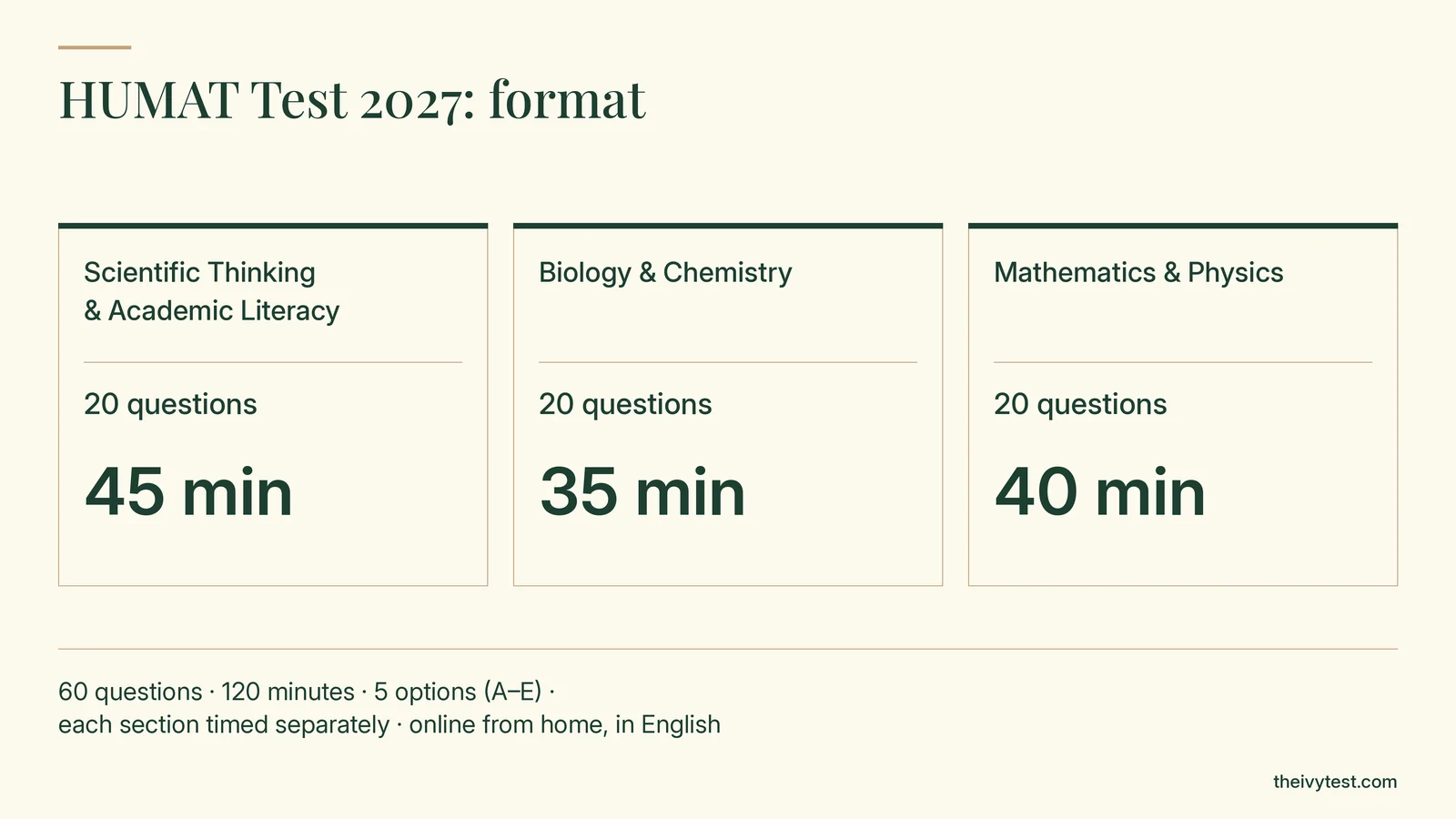
| Section | Questions | Weighting | Suggested time |
|---|---|---|---|
| Scientific Thinking & Academic Literacy | 20 | *see the note below the table | 45 minutes |
| Biology & Chemistry | 20 | *see the note below the table | 35 minutes |
| Mathematics & Physics | 20 | *see the note below the table | 40 minutes |
- Weighting differs by ranking; see Scoring
Content
Question and subject breakdown
Humanitas says the test is not meant to evaluate previous knowledge but the skills relevant to highly scientific courses of study; its syllabus lists the science topics each section draws on. What varies between candidates is not how advanced the content is, but how quickly it can be applied to unfamiliar material. All six subjects carry an equal 10 questions each; how much each section counts in points depends on the ranking (see Scoring).
Scientific Thinking
10 of 60 questionsMathematical, procedural and visual thinking applied to unfamiliar problems: reading graphs, using formulae, following a flow chart, recognising mirror images and three-dimensional shapes.
Academic Literacy
10 of 60 questionsReading scientific texts of about 700 words at CEFR level C1, adapted from real sources: critical thinking, scanning for a detail, skimming for the gist, careful reading across paragraphs, and word- and sentence-level precision.
Biology
10 of 60 questionsThe chemistry of living things, the cell, bioenergetics, inheritance and molecular genetics, and human anatomy and physiology. Humanitas describes the section as questions on fundamental concepts.
Chemistry
10 of 60 questionsAtomic structure, bonding, reactions and stoichiometry, equilibrium, acids and bases, redox and an introduction to organic chemistry.
Mathematics
10 of 60 questionsAlgebra and functions, analytic geometry and trigonometry, logic, probability and statistics, all without a calculator.
Physics
10 of 60 questionsKinematics and dynamics, fluids and optics, thermodynamics, electricity and magnetism. Humanitas describes the section as applying the most relevant principles for scientific study.
Marks
HUMAT Test scoring
How marks are awarded matters more on the HUMAT than on most school exams, because it decides whether guessing is worth anything. Correct and incorrect marks differ by section and by ranking rather than being a single flat number: the worked example below shows exactly how.
- Correct answer
- +10 to +22 points, depending on the section and the ranking (see the worked example below)
- Incorrect answer
- −2.5 to −5.5: a quarter of that section's correct-answer value (see the worked example below)
- Unanswered question
- 0 (no penalty for leaving a question blank)
- Maximum score
- 960
- Section minimums
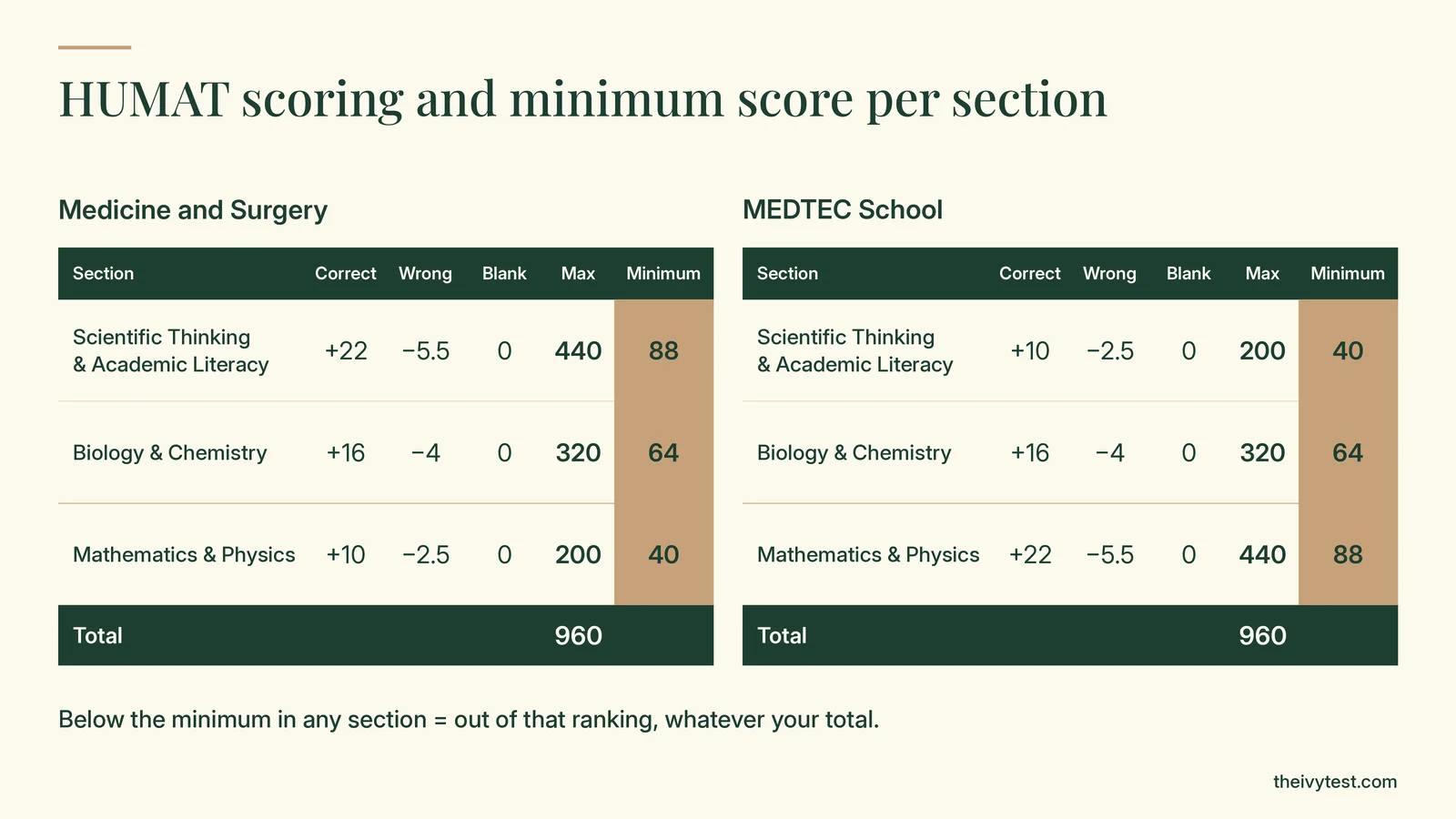
- There is no overall pass mark, but you must reach a minimum in every section to be ranked. Medicine and Surgery: 88 in Scientific Thinking & Academic Literacy, 64 in Biology & Chemistry and 40 in Mathematics & Physics. MEDTEC reverses the outer two: 40, 64 and 88. Missing any one of them keeps you off that ranking, whatever your total.
- How rankings work
- Places are offered down separate ranking lists built from the same 60 answers, one for Medicine and Surgery and one for the MEDTEC School, and EU and non-EU candidates rank separately. Humanitas's programme pages give the places available each year: 150 EU/EU-equated and 50 non-EU for Medicine and Surgery, and 90 EU and 40 non-EU for MEDTEC, each group in its own ranking (the 2026/27 calls had set 80 and 20 for MEDTEC, subject to the Ministry's decree). Scientific Thinking & Academic Literacy and Mathematics & Physics swap their point values between the Medicine and MEDTEC rankings; Biology & Chemistry is weighted the same for both.
- Ties
- On equal totals, Medicine and Surgery prefers the better Scientific Thinking & Academic Literacy score and MEDTEC the better Mathematics & Physics score; then the better Biology & Chemistry score, then the younger candidate.
Worked example
On the Medicine and Surgery ranking, a correct answer is worth +22 points in Scientific Thinking & Academic Literacy, +16 in Biology & Chemistry, and +10 in Mathematics & Physics; an incorrect answer costs a quarter of that (−5.5, −4 and −2.5), and a blank answer scores zero. The MEDTEC ranking marks the same 60 answers in reverse: +10 for Scientific Thinking & Academic Literacy, +16 for Biology & Chemistry, and +22 for Mathematics & Physics, again with incorrect answers costing a quarter of the section's per-question value. Both rankings share the same 960-point maximum, reached by a perfect score across all three sections.
The IvyTest simulator scores every practice paper against these exact rules.
See the HUMAT Test simulatorWork out your HUMAT scoreSyllabus
HUMAT test syllabus 2027: the Humanitas entrance exam topics
Humanitas publishes the HUMAT syllabus itself: Annex A of each call and, for the 2027 tests, a Syllabi 2027 PDF posted on its Apply page on 1 October 2026. The lists below follow that document module by module, shortened; the PDF has every line. Where the 2027 syllabus differs from the 2026 one, the subject's note says so.
New in 2027: the properties of water; karyotypes; the Krebs cycle, the electron transport chain and oxidative phosphorylation; anaerobic respiration; alcoholic and lactic fermentation; amino acids and lipids as energy sources; fertilisation; extensions to Mendel's laws (incomplete dominance, codominance, multiple alleles) and ABO and Rhesus blood groups. Gone from the 2026 list: photosynthesis and chromosome maps.
- The chemistry of living organisms: weak interactions, organic molecules (amino acids, proteins, enzymes, sugars, lipids, nucleic acids), the properties of water
- The cell: cell theory, prokaryotic and eukaryotic cells, viruses, the membrane and transport, organelles, mitosis and meiosis, chromosomes and karyotypes
- Bioenergetics: ATP, redox reactions, glycolysis, the Krebs cycle, the electron transport chain, aerobic and anaerobic respiration, fermentation
- Reproduction and inheritance: life cycles, Mendel's laws and their extensions, ABO and Rhesus blood groups, DNA replication, transcription and protein synthesis, gene regulation, human inheritance patterns, mutation, selection and evolution
- Anatomy and physiology: the four animal tissues, the human body systems, homeostasis (body temperature, blood glucose, blood pressure, acid-base balance and more)
New in 2027: dipole-induced dipole forces, Le Chatelier's principle, osmosis and osmolarity, the strength of acids and bases, and the Henderson-Hasselbalch equation. Gone from the 2026 list: Boyle's and Charles's laws (Physics keeps the ideal gas laws), empirical and molecular formulae, and in organic chemistry the classification and naming of hydrocarbons and the functional groups and their reactions, which leaves C-C bonds, structural formulae and isomerism.
- Structure of matter and the periodic table: atoms and isotopes, quantum numbers and electron configuration, periodic properties, states of matter, ideal gases
- Chemical bonding: ionic, covalent and metallic bonds, electronegativity, VSEPR geometry, hybridisation (sp, sp², sp³), intermolecular forces, the mole and molar mass
- Reactions and equilibrium: types of reaction, balancing equations, stoichiometry, molar concentration, Le Chatelier's principle, osmosis and osmolarity
- Acids and bases: Arrhenius and Brønsted-Lowry, pH, neutralisation, the strength of acids and bases, salt hydrolysis, buffers and the Henderson-Hasselbalch equation
- Redox and introductory organic chemistry: oxidation numbers, oxidising and reducing agents, balancing simple redox reactions, C-C bonds, structural formulae and isomerism
New in 2027: gauge and absolute pressure. Otherwise the same as the 2026 list.
- Measures and kinematics: SI and CGS units, physical dimensions, scalars and vectors, uniform, accelerated, circular and harmonic motion
- Dynamics: forces and moments, Newton's laws and gravitation, work, energy and friction, momentum and angular momentum
- Fluids and optics: density, gauge and absolute pressure, Pascal, Archimedes, Stevin and Bernoulli, reflection, refraction, mirrors and lenses, interference and diffraction
- Thermodynamics: calorimetry, heat transfer, changes of state, ideal gas laws, the first and second laws, entropy, heat engines
- Electricity and magnetism: Coulomb's and Gauss's laws, capacitors and resistors, Ohm's and Kirchhoff's laws, power and the Joule effect, magnetic fields, the Lorentz force, induction, electromagnetic waves
New in 2027: independent and mutually exclusive events, conditional probability, the law of total probability, Bayes' theorem, types of variable, cumulative frequencies, range and percentiles. Gone from the 2026 list: combinatorics (permutations and combinations), the areas, perimeters and volumes of polygons and solids, and isometries, similarities and equivalences.
- Arithmetic and algebra: number sets, percentages, powers, roots and logarithms, polynomials, algebraic fractions, equations and inequalities, functions and their graphs
- Analytic geometry and trigonometry: lines, the circle and the parabola, degrees and radians, sine, cosine and tangent, the main identities, solving triangles
- Logic: propositions and connectives, truth tables, quantifiers, rules of inference, proof by contradiction
- Probability: events, independent and mutually exclusive events, conditional probability, the law of total probability, Bayes' theorem
- Statistics: types of variable, frequencies and their charts, mean, mode and median, range, variance and standard deviation, percentiles
The same as the 2026 list.
- Mathematical thinking: interpreting graphs, predicting how variables in a formula change, substituting into formulae, simultaneous equations with symbols, ordering numbers, orders of magnitude and conversions
- Procedural thinking: following a protocol or flow chart, predicting the effect of a change in a connected system, combining sets, testing data against a theory, selecting relevant data, choosing the best concept map for a text
- Visual thinking: three-dimensional thinking, complementary shapes, mirror images, visual patterns, careful observation of positions, describing a picture
The same as the 2026 list.
- The texts: about 700 words, CEFR level C1 and above, adapted from real-world scientific sources
- Critical thinking: drawing reasoned conclusions and implications from data, statements and opinions
- Local expeditious reading: scanning for a specific detail
- Global expeditious reading: skimming for the gist and the key ideas
- Global careful reading: the main ideas and how the paragraphs relate to each other
- Word- and sentence-level processes: word recognition, the meaning of a preposition
Test your HUMAT Test knowledge
Take free diagnosticDifficulty
How difficult is the HUMAT Test?
'Hard' means something specific on the HUMAT. The content is what Humanitas's syllabus lists, nothing beyond it; the difficulty is in the breadth, the clock, and the fact that the other people in the room are also strong.
Breadth over depth
Six subject areas can appear in a single sitting. Candidates who prepared one subject thoroughly and skimmed the others tend to lose marks in the sections they never rehearsed, not in the one they know best.
Time pressure
Almost nobody finds a HUMAT question impossible given unlimited time. The exam is difficult because the time per question is short, so a method that works slowly is effectively a wrong method.
Reasoning, not recall
Questions typically wrap the science inside a scenario. Recognising which principle applies is often harder than applying it, and rote memorisation does not train that step.
The competition
Selection is by ranking. The threshold is set by the cohort that sits the test in the same year, which is why a raw score alone never tells you whether it was enough. The section minimums bite too: on the 2026/27 EU list for Medicine and Surgery, 483 of the 1,085 candidates listed were rejected for missing at least one.
Common preparation mistakes
Re-reading notes instead of answering questions, practising untimed, skipping the sections that feel uncomfortable, and leaving full mock exams until the final fortnight.
Benchmarks
What is a good HUMAT Test score?
What counts as a good HUMAT score is a moving target, and any single number quoted out of context is misleading.
Because places are allocated by ranking, the score that earns an offer depends on how the whole cohort performed that year and on how many places were available. A score that was comfortably inside the offers one cycle can sit outside them the next.
The useful benchmark during preparation is therefore your own trajectory: your score on full, timed mock exams, how it moves week to week, and how evenly it is spread across sections. A candidate scoring well overall but collapsing in one section is more fragile than the average suggests.
Humanitas publishes its full ranking lists on its admissions portal. On the 2026/27 Medicine and Surgery lists, read on 17 October 2026, the last EU candidate admitted stood at position 354 with 450 of 960, and the last non-EU candidate enrolled at position 118 with 640 of 960. The EU list's first round had stopped at an estimated 593; it moved down as candidates turned their places down, and can still move while places free up. These were the first lists under today's format, so there is no earlier cutoff to compare them with.
Pending verification
- · How many candidates sat each round
- · Where the 2027/28 cutoff will fall
These specific numbers aren't public yet — an IvyTest simulator score is the closest benchmark you can get today.
Check your HUMAT Test scoreStrategy
How to prepare for the HUMAT Test
12+ weeks
Build the content base, then convert it into speed
Coverage first, timing second.
- Sit a full diagnostic in week one so the plan is built on evidence, not on how each subject feels.
- Work through the syllabus subject by subject, finishing each topic with practice questions rather than notes.
- Add one timed section per week from week four so pace grows with knowledge.
- Book a full mock every fortnight from week six onwards.
8 weeks
Prioritise by weakness, protect the strong areas
Targeted repair with weekly full mocks.
- Diagnostic first, then rank subjects by marks lost rather than by comfort.
- Spend two thirds of study time on the bottom two subjects and keep the others alive with short weekly sets.
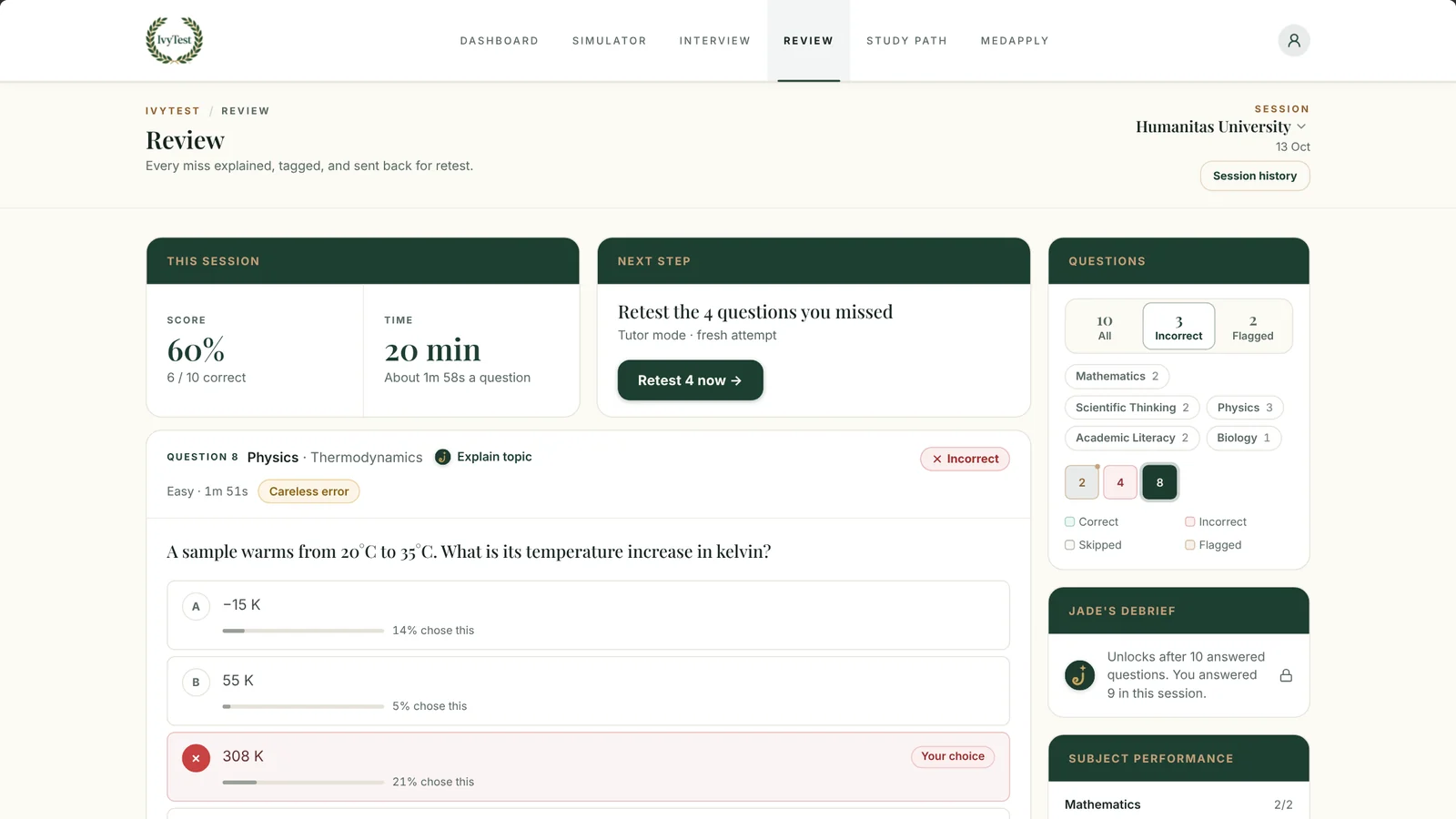
- One full timed mock a week from week two, always reviewed the same day.
- Keep a running error log grouped by cause: knowledge, method, misreading, or time.
4 weeks
Exam-condition practice becomes the main activity
Volume of timed questions, tight review.
- Two full mocks a week, sat at the time of day the real exam falls.
- Review every mock in depth, including questions answered correctly by guesswork.
- Repair only the highest-frequency gaps; leave rare topics alone at this stage.
- Rehearse a section-by-section timing plan and stick to it in every mock.
Under 4 weeks
Maximise marks per remaining hour
Technique, triage and stamina.
- Stop new content unless a gap is both large and common.
- Drill the question types you can fix quickly: stoichiometry, genetics crosses, ratio problems, argument analysis.
- Practise triage: recognising within seconds which questions to answer now, which to flag, which to leave.
- Sit at least two full mocks under real conditions in the last ten days, then taper.
Practice
Free HUMAT Test practice questions
Three questions in the format the exam uses. Choose an answer to see the explanation — nothing is recorded.
How many moles of oxygen are required for the complete combustion of 1 mole of methane (CH4)?
Study A found that students who sit mock exams score higher on the real test. A newspaper concludes that sitting mocks causes higher scores. Which assumption is the conclusion most dependent on?
Illustrative examples written by IvyTest to show the question style — not past HUMAT Test papers.
Past papers
HUMAT Test past papers
Humanitas's admissions pages publish no past papers or sample test. What Humanitas does publish: the official syllabus (Syllabi 2027, posted on its Apply page in October 2026), the points and section minimums for each ranking, and a technical guide; registered candidates also get a demo on Politecnico di Milano's portal to check their computer. Its archive of calls shows why old papers mislead: the EU calls for 2014/15 to 2017/18 describe a 100-minute paper test with general culture and logical reasoning, arranged with Cambridge Assessment (the non-EU calls differed: computer-based in 2015/16, the UKCAT in 2017/18), and the 2020/21 to 2025/26 calls a test of Scientific Thinking and Academic Literacy only, with four options. Today's six subjects in three timed sections date from the 2026 tests. The practice paper on this page is IvyTest's own, in that format.
University
Humanitas University medicine admissions
The test sits inside a wider application, and several of the deadlines that matter are not exam deadlines at all.
- Degree
- Medicine and Surgery (MD programme)
- Language
- English
- Campus
- Humanitas University, Pieve Emanuele, Milan
- Tuition
- €10,206–€23,206 / year (four income brackets set by Humanitas's own ISEP index, not the ISEE; non-EU pays the top of the band)
- Eligibility
- EU and non-EU applicants, with a secondary school diploma or in the last or penultimate year of school (a penultimate-year score counts for the following year); passing the HUMAT exempts you from a B2 English certificate at enrolment
- EU / non-EU rules
- Separate calls and rankings. Non-EU means a non-EU citizen not resident in Italy (UK citizens included), at least 17 by the start of the academic year; the test dates and deadlines are the same
- Seats available
- Medicine and Surgery: 200 (150 EU/EU-equated, 50 non-EU, ranked separately). MEDTEC: 130 (90 EU/EU-equated, 40 non-EU, ranked separately)
- Application process
- Register on the Humanitas Registration Portal, pay the €200 fee and finish on Politecnico di Milano's site; after the ranking, enrol on MyPORTAL and pay the €5,206 first instalment; no interview
The campus
The Humanitas University campus
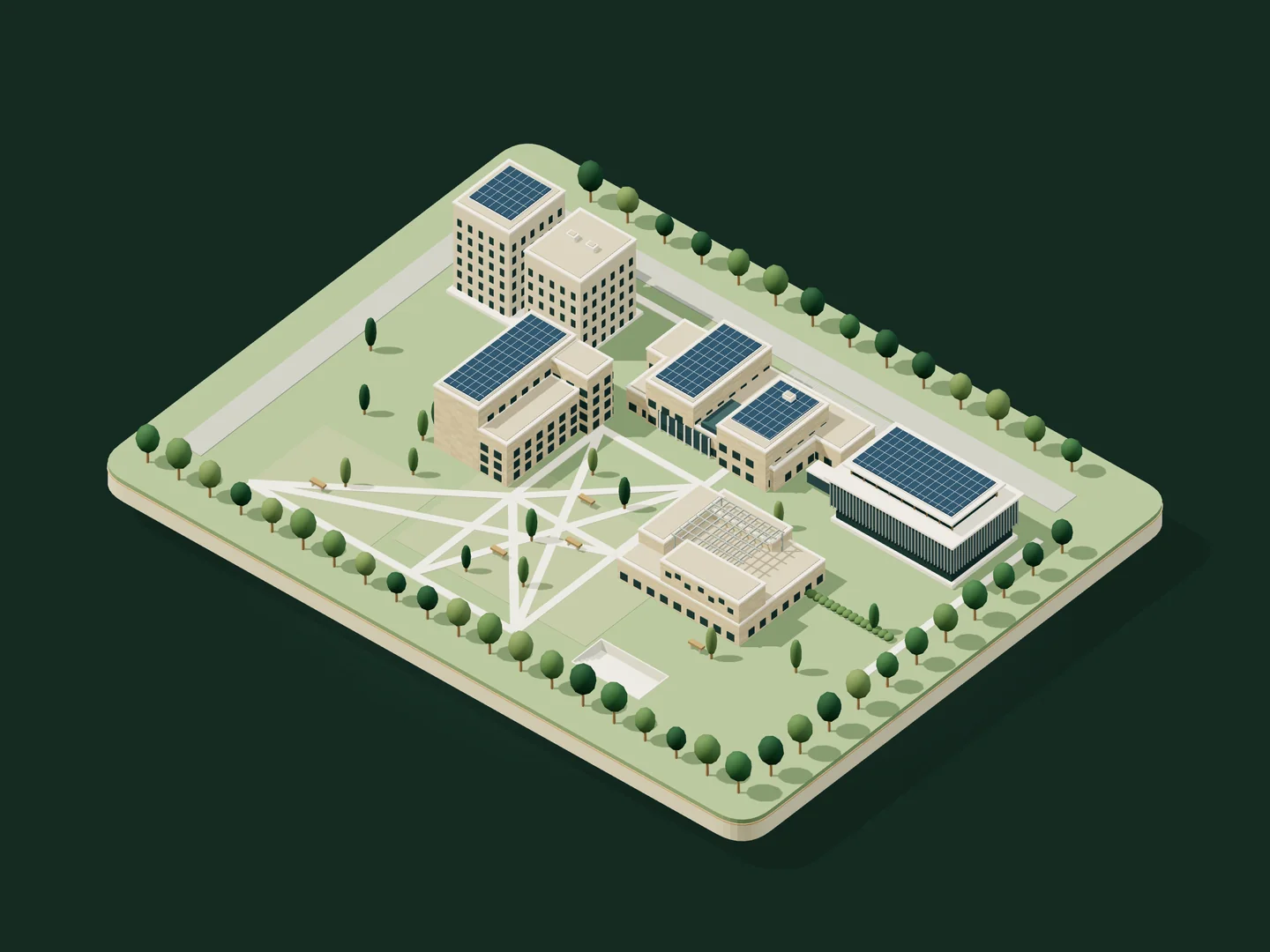
Humanitas University's campus is in Pieve Emanuele, on the edge of Milan, a short walk from Humanitas Research Hospital. Its 20,000 square metres hold classrooms and laboratories, student residences, sports areas and a Simulation Center of more than 3,000 m², the only one in Italy with full SESAM accreditation.
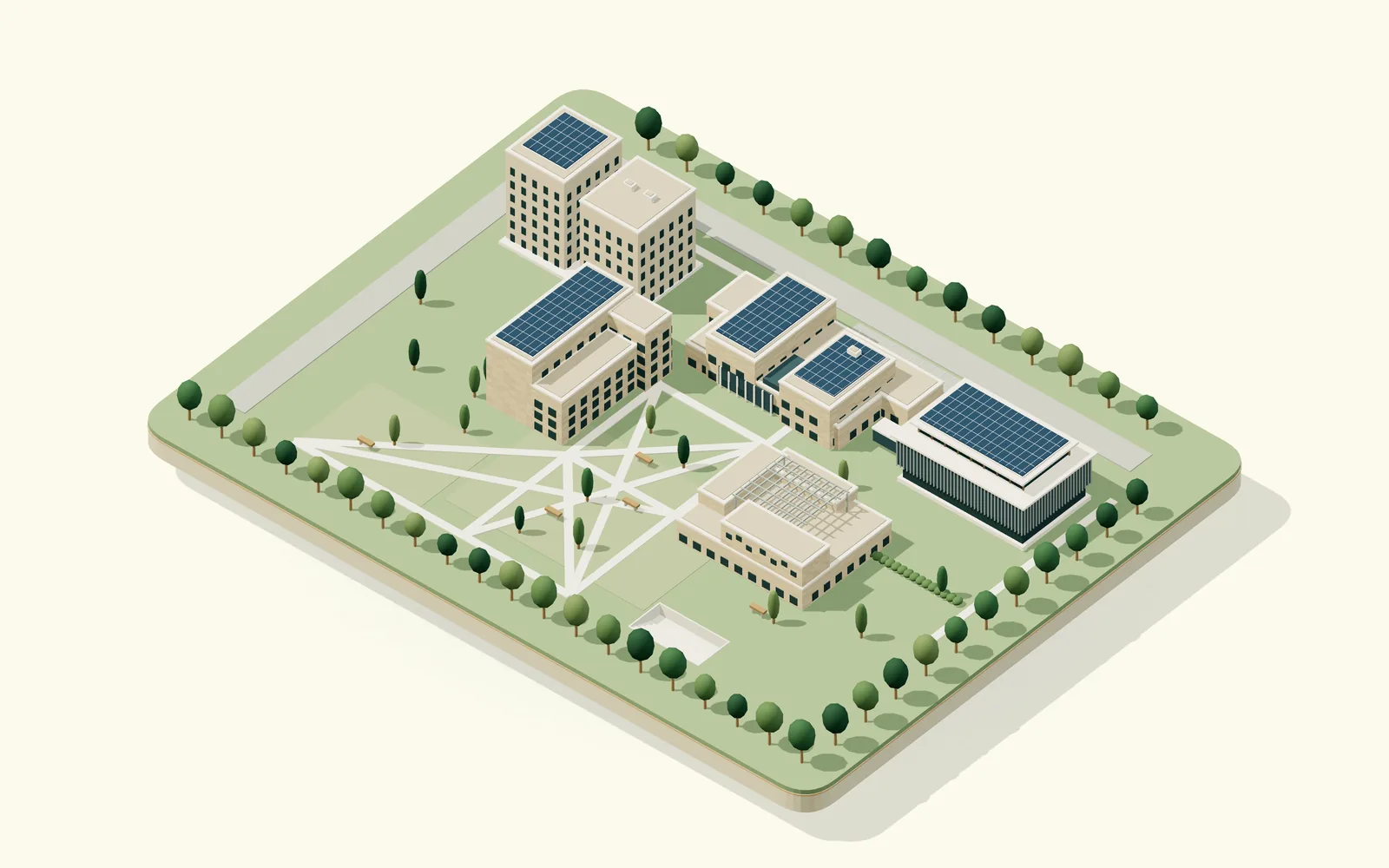
Explore the Humanitas campus.
Open it in 3D to turn it and see what each building holds.
Stylized campus illustration, not a map or to scale.
Teaching building
Building A · Classrooms and laboratories.
Campus hub
Building B · The campus's multifunctional hub.
Research building
Building C · Research laboratories and offices.
Mario Luzzatto Student House
The on-campus residence, opened in 2018, with 240 beds.
Roberto Rocca Innovation Building
Classrooms, labs for 3D printing, electron microscopy and AI, and the Humanitas AI Center.
Address: Via Rita Levi Montalcini 4, 20072 Pieve Emanuele (MI)
IvyTest HUMAT Test preparation
Ready to prepare properly for the HUMAT?
Everything above is free and always will be. When you want structure (a syllabus-mapped book, a simulator that behaves like the real test, lessons for the gaps, and help with the application itself), that is what the IvyTest Humanitas package is.
Study guide
The full HUMAT syllabus in one volume, mapped section by section to the official exam.
Exam simulator
Timed, tutor and review modes in HUMAT format, with per-question explanations and topic analytics.
Video courses
Focused lessons in biology, chemistry, physics and reasoning for the topics your results flag.
Application support
MedApply: deadlines, documents, legalisation and enrolment steps carried through to a confirmed place.
FAQ
HUMAT Test frequently asked questions
The HUMAT is Humanitas University's own admission test (the HU Admission Test in its calls) for its English-taught medical degrees in Milan, taken online through Politecnico di Milano's portal. It is a multiple-choice test focused on scientific reasoning and problem solving rather than on factual recall alone, sat from home under remote proctoring. You can sit it in up to two rounds a year, and only the higher score counts.
Humanitas has not published the 2027/28 call yet (checked 14 October 2026); its FAQ page says the Medicine and Surgery call usually comes out in October, and the 2027 syllabus went up on 1 October 2026. In the 2026/27 cycle registration opened on 18 November 2025, and the test ran online in two rounds, on 5 and 6 March and on 18 and 20 March 2026. Expect a similar pattern for a 2027 start, and confirm the dates once the call is out.
Humanitas's admissions pages publish no past papers or sample test. Its archive of calls shows earlier versions: the EU calls for 2014/15 to 2017/18 describe a 100-minute paper test with general culture, logical reasoning and only 8 Physics and Mathematics questions, arranged with Cambridge Assessment. The non-EU calls differed in two of those years: in 2015/16 the test was computer-based, and in 2017/18 non-EU candidates sat the UKCAT instead. The calls for 2020/21 to 2025/26 describe a test of Scientific Thinking and Academic Literacy only, 30 questions each with four options. Older papers show neither today's subjects nor its timing. This page has a free IvyTest practice paper in the current HUMAT format.
No. The IMAT is the Ministry of University and Research's national admission test for English-taught Medicine courses, through which the state universities admit (for 2026/27 it ran under Ministerial Decree 1005/2026, on 29 September 2026); Italian-taught courses at state universities now admit through the semestre filtro instead. Humanitas, a non-state university, uses its own test, the HUMAT, for its own programmes. They differ in structure, emphasis and scoring, so preparation aimed only at the IMAT is not a substitute.
Humanitas says the test is not meant to evaluate previous knowledge, and its syllabus sets the content, but the exam is demanding because it is broad, tightly timed and marked against a strong applicant pool. Most candidates find the reasoning under time pressure harder than the science itself.
Six subjects, each with 10 of the 60 questions: Scientific Thinking, Academic Literacy, Biology, Chemistry, Mathematics and Physics, generally applied to passages and data rather than asked as isolated facts. How each section is weighted in the final score differs between the Medicine and Surgery ranking and the MEDTEC ranking.
120 minutes across three 20-question sections: 45 minutes for Scientific Thinking & Academic Literacy, 35 for Biology & Chemistry, and 40 for Mathematics & Physics.
Correct answers score points, incorrect answers lose a quarter of that section's points, and blanks score zero. The exact points per section depend on which ranking you're scored against; see the Scoring section above for the full breakdown and a worked example.
There is no overall pass mark, but you must reach a minimum in every section: for Medicine and Surgery, 88 in Scientific Thinking & Academic Literacy, 64 in Biology & Chemistry and 40 in Mathematics & Physics (MEDTEC: 40, 64 and 88). In 2026/27 the last EU candidate admitted to Medicine and Surgery had 450 of 960 (read 17 October 2026). Above those minimums, places are allocated by ranking, so a competitive score depends on the cohort and the number of places in that year, which is why your trajectory on full timed mocks is a better guide than any single number.
Yes. Non-EU citizens not resident in Italy, UK citizens included, apply through their own call and ranking, for 50 Medicine and Surgery places and 40 at MEDTEC a year, per the programme pages. In 2026/27 the test dates, deadlines and €200 fee were the same as for EU candidates, and candidates must be at least 17 by the start of the academic year. Non-EU citizens living in Italy on certain permits count as EU-equated. Non-EU students pay the top fee, €23,206 a year.
Start with a diagnostic, cover the syllabus subject by subject while answering questions rather than only reading, then move to full timed mocks with same-day review. The four preparation tracks above set out what that looks like at 12, 8, 4 and fewer weeks.
Yes. The IvyTest simulator runs HUMAT-format practice in timed, tutor and review modes, with explanations for every question and topic-level analytics. A free diagnostic is available without payment.
Humanitas's admissions pages publish no HUMAT past papers or sample test as a PDF. Its PDFs are the call, the Syllabi 2027 (the official topic list), the scoring tables and the technical guide for the online test. The free IvyTest practice paper linked on this page has 60 questions in the current format with every answer explained, and its page has a button that saves it as a PDF with the answers: a free download, no account needed. Papers from before 2026 belong to older versions of the test.
Medicine and Surgery is a six-year course taught entirely in English, 360 CFU over 12 semesters. From the first year, interdisciplinary theory modules are combined with hands-on practice and simulation, and clerkships start in the third year. Students can also join the Virgilio Program, a research track with one month of laboratory work a year.
Yes, into a later year and without the admission test, if you are already enrolled in Medicine: you apply through Humanitas's transfer call. For 2026/27 there were 6 places in year 2, 7 in year 3 and 8 in year 4, subject to matching credits and content, an English interview and, from year 3, working Italian. Year 1 is open only through the admission test.
The HUMAT took its current shape with the 2026/27 call. Until 2025/26 it was 60 four-option questions in Scientific Thinking and Academic Literacy only, in two 60-minute parts. Since the March 2026 tests it has three sections of 20 five-option questions, with Biology, Chemistry, Mathematics and Physics added and separate weights for Medicine and MEDTEC. The Syllabi 2027 changes some science topics again (see the syllabus above).
Yes. Candidates in the penultimate year of secondary school can sit the HUMAT, and those scores count for the following year's admission: a score from the 2026 tests counts for 2027/28. In the final year they can sit two more rounds, and the best of the four scores counts. Candidates in the final year or with a diploma use that year's scores only.
Yes, the Preparation Week: an intensive online course of 40 hours, Saturday to Saturday, taught live in English and not recorded, for €700, with 50 places. The editions listed now run 17 to 24 October 2026, 21 to 28 November 2026 and 16 to 23 January 2027; registration is on MyPORTAL. It is Humanitas's own course, separate from IvyTest's preparation.
Tuition for 2026/27 entrants is €10,206, €15,206, €19,206 or €23,206 a year by Humanitas's ISEP income index; non-EU students pay €23,206. The first instalment, €5,206 including the €190 regional tax and €16 stamp duty, is paid at enrolment, the rest in three instalments up to 16 April 2027. The test fee is €200. Merit scholarships go to top-ranked candidates, for example three of €18,000 a year for the top 10 on the non-EU Medicine list.
A computer with webcam, microphone and speakers (Windows 10 or 11, or macOS 11 or later) with Safe Exam Browser installed, a phone or tablet for the virtual classroom, and a stable connection. You sit alone in a well-lit room; calculators, notes and earphones are banned, but up to five blank sheets and a pen are allowed. A demo on Politecnico di Milano's portal lets registered candidates check the setup beforehand.
Yes: r/humanitasuniversity and r/HUMAT, where Humanitas University applicants ask each other about the HUMAT Test and share how their preparation is going. They are run by the IvyTest team. Dates, rules and results come only from the university's own pages, listed under Official sources on this page.
Verification
Official sources
- Apply: Medicine and Surgery and MEDTEC School (HUMAT rounds, registration fee, online test)Checked: 8 October 2026
Humanitas University
- Admissions and calls for applications 2026/2027: Medicine and Surgery and MEDTEC SchoolChecked: 8 October 2026
Humanitas University
- Fees & Scholarships: Medicine and SurgeryChecked: 8 October 2026
Humanitas University
- MEDTEC SchoolChecked: 8 October 2026
Humanitas University & Politecnico di Milano
- Call for applications for EU and EU-equated citizens, A.Y. 2026/2027 (English summary)Checked: 8 October 2026
Humanitas University
- Call for applications for non-EU citizens not resident in Italy, A.Y. 2026/2027 (English summary)Checked: 8 October 2026
Humanitas University
- University Fee Regulation, A.Y. 2026/2027: summary for international studentsChecked: 8 October 2026
Humanitas University
- Syllabi 2027: the HUMAT topics for the 2027 testsChecked: 8 October 2026
Humanitas University
- Test evaluation: Medicine and Surgery (points and section thresholds)Checked: 8 October 2026
Humanitas University
- Calls for Applications Archive (calls from 2014/15 to 2025/26)Checked: 8 October 2026
Humanitas University
- Degree Course in Medicine and Surgery (places, curriculum)Checked: 8 October 2026
Humanitas University
- Preparation WeekChecked: 8 October 2026
Humanitas University
- FAQs: admission test and ranking listChecked: 8 October 2026
Humanitas University
Last reviewed by IvyTest editorial team: 14 October 2026. Admission rules change every cycle — always confirm against the official Humanitas University call for applications before acting on a deadline.
Find out how ready you are for the HUMAT.
The diagnostic takes one sitting and returns a subject-by-subject picture of where you stand, no payment, no commitment.