
Compare · Medicine and engineering in English
Humanitas MEDTEC vs Campus Bio-Medico MedTech: which medicine and engineering programme?
Italy has two English-taught medical degrees built around biomedical engineering at private universities: MEDTEC School at Humanitas University in Milan, run with Politecnico di Milano, and Medicine and Surgery – MedTech at Campus Bio-Medico in Rome. Both make you a doctor in six years and both offer an engineering degree on top. They differ in who teaches the engineering, in how you get in and in what they cost. Everything here was read on the universities' own pages on 15 October 2026.
MEDTEC vs MedTech
The short answer
- Engineering partner
- MEDTEC: Politecnico di Milano. MedTech: UCBM's own Biomedical Engineering degree
- Second degree
- Both: a Bachelor's in Biomedical Engineering for 30 extra credits
- Admission test
- MEDTEC: the HUMAT (reasoning, reading, sciences, maths). MedTech: UCBM's test (Biology, Chemistry, Physics only)
- Places 2026/27
- MEDTEC 90 EU + 40 non-EU. MedTech 68 EU + 12 non-EU
- First-year fees
- MEDTEC €10,206–23,206 by income band. MedTech €19,000 + €140 flat
- Can you sit both?
- Yes: the 2026 tests were on 19 February (UCBM) and in March (Humanitas)
Side by side
MEDTEC and MedTech, point by point
The table puts the two programmes on the same rows. Figures are for 2026/27, the latest year both universities have published; neither has published its 2027/28 call yet.
Humanitas MEDTEC School vs Campus Bio-Medico MedTech, 2026/27
| Humanitas MEDTEC School | Campus Bio-Medico MedTech | |
|---|---|---|
| City and campus | Milan area: Humanitas, Pieve Emanuele, and Politecnico's Milano Leonardo campus | Rome: Università Campus Bio-Medico |
| Engineering partner | Politecnico di Milano (agreement between the two universities) | UCBM itself, through its Biomedical Engineering degree |
| Degree(s) | Medicine and Surgery (LM-41, Humanitas); Bachelor's in Biomedical Engineering (Politecnico) after 360 + 30 credits | Medicine and Surgery 'MedTech' (LM-41); optional Bachelor's in Biomedical Engineering with 30 extra credits |
| Length and credits | 6 years, 360 + 30 credits | 6 years, 360 credits (+ 30 for the optional degree) |
| Language | English | English |
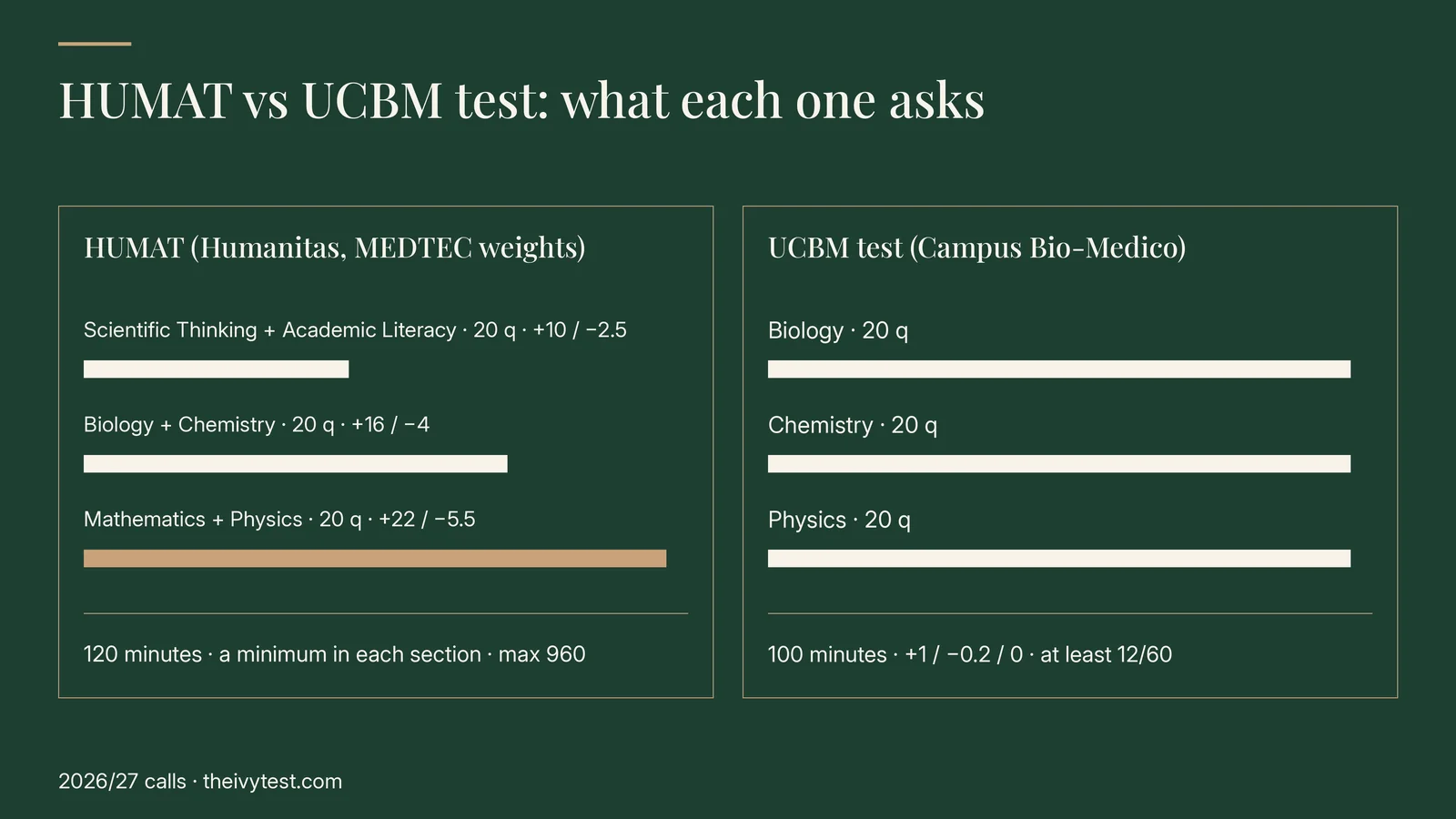
| Admission test | HUMAT: 60 questions in 120 minutes, three sections, online | UCBM test: 60 questions (20 Biology, 20 Chemistry, 20 Physics) in 100 minutes, in Rome |
| Scoring | MEDTEC weights: Maths and Physics +22 / −5.5, Biology and Chemistry +16 / −4, Scientific Thinking and Academic Literacy +10 / −2.5; a minimum in every section; max 960 | +1 / −0.2 / 0 per question; max 60; at least 12 to be ranked |
| Ranking | Its own MEDTEC list from the same HUMAT as Medicine | Its own MedTech list from the same test as Medicine and Surgery |
| Places | 90 EU + 40 non-EU | 68 EU + 12 non-EU |
| Test dates (2026, for reference) | 5–6 March and 18, 20 March 2026 | 19 February 2026 (non-EU online: 6 February) |
| Fees, first year | €10,206 / 15,206 / 19,206 / 23,206 by ISEP band; non-EU €23,206 | €19,000 + €140 regional tax for everyone |
| Scholarships | Merit tuition waivers: 1 full + 3 partial (EU resident in Italy), 2 partial (EU non-resident), 2 × €18,000 (non-EU) | 50% of the fee for six years to the first winner with ISEE ≤ €28,000; DiscoLazio exemption |
| Clinical training | Humanitas, with its Simulation Center and the Humanitas group's structures; Politecnico tutors in some clinical training | UCBM's elective traineeship and clinical courses from year 3 (the course pages read do not name the hospitals) |
| Engineering content | Physics, maths, statistics, computer science, circuits, mechatronics, electronics, biomechanics, biomaterials, machine learning, artificial organs, healthcare robotics | Maths, physics, computer science, statistics, signal and imaging processing, biomechatronics and biomaterials, AI and data mining, optional engineering courses |
| THE World University Rankings 2027 | Humanitas University: =267 | Campus Bio-Medico: 451–500 |
Degrees
One degree or two?
Both programmes are one medical degree (LM-41) that qualifies you as a doctor, and both let you add a Bachelor's in Biomedical Engineering for 30 credits beyond the 360. The difference is who awards it. At Humanitas the engineering degree comes from Politecnico di Milano, which teaches the first semester of each of the first three years on its own campus and approves the 30-credit path; Politecnico awards its Bachelor's straight after Humanitas awards the MD. At Campus Bio-Medico the extra 30 credits are taught within UCBM's own degree in Biomedical Engineering.
So MEDTEC is built around two universities and two campuses for its first three years, while MedTech stays on one campus in Rome throughout.
What you study
What you study
Both put mathematics and physics into the first year, and both pair clinical subjects with the technology they use. MEDTEC's first three years carry a full block of engineering courses taught at Politecnico (Basics of Circuit Theory, Automation and Mechatronics, Biomedical Electronics and Instrumentation, Biomechanics and Thermodynamics, Biocompatibility and Biomaterials, Machine Learning and AI) and at least one engineering course in every later year. MedTech builds the base with Mathematics, General Physics, Computer Science and Probability and Statistics, then Signal and Imaging Processing, Biomechatronics, Biomaterials and Telemedicine, and AI and Data Mining, with six optional engineering courses alongside.
Admission tests
How the two tests differ, and how to prepare for both
The tests are different papers. The HUMAT is 60 questions in 120 minutes in three timed sections: Scientific Thinking and Academic Literacy (reasoning and reading in English), Biology and Chemistry, and Mathematics and Physics. A wrong answer costs a quarter of a correct one, and every section has a minimum. For MEDTEC the Mathematics and Physics section is worth the most, 22 points a question against 10 for the reasoning section.
The UCBM test is 60 questions in 100 minutes on Biology, Chemistry and Physics only, 20 each, with no reasoning, reading or mathematics section. A wrong answer costs 0.2 and you need 12/60 to be ranked; ties go to Biology, then Chemistry.
Preparing for both is realistic: the sciences overlap, and in 2026 UCBM's test came first (19 February) and the HUMAT rounds followed in March. Drill Biology, Chemistry and Physics to UCBM's syllabus first, then add the HUMAT's mathematics and its reasoning and reading sections for the March rounds. For MEDTEC, time spent on Mathematics and Physics pays most.
Fees
Fees and scholarships
Humanitas charges by family income and assets: EU students pay €10,206, €15,206, €19,206 or €23,206 a year according to Humanitas's ISEP index, and non-EU students €23,206. Campus Bio-Medico charges a flat €19,000 for the first year, plus €140 regional tax, whatever the income. So MEDTEC is cheaper for EU families in the two lower bands and dearer in the top one.
Both reward rank. Humanitas offers merit waivers to the top of each MEDTEC list (a full Fondazione Rocca scholarship and partial ones down to €5,206 for EU students, two of €18,000 a year for non-EU students). UCBM gives a 50% fee exemption for six years to the first winner of the MedTech ranking with an ISEE of €28,000 or less, and a total exemption to students eligible for the Lazio region's DiscoLazio scholarship, within the funds available.
Which one
Who each programme suits
MEDTEC suits a candidate who wants a degree from Politecnico di Milano alongside the MD, is happy to move between two campuses in the first three years, and is strongest in mathematics and physics, which its ranking weighs most. Its income-based fees favour EU families with a lower ISEP.
MedTech suits a candidate who wants one campus in Rome and a science-only admission test, and who is stronger in Biology and Chemistry than in reasoning or mathematics under time pressure. With the same test as UCBM's Medicine and Surgery, registering for both of UCBM's English degrees gives two rankings for one sitting.
Many candidates will not have to choose before the results: the 2026 tests fell on different dates, so sitting both kept both open.
Elsewhere in Italy
Other medicine-and-engineering degrees in Italy
The University of Padua runs Medicine and Surgery – MedTech, in English, in Padua: six years and 360 credits, with extra credits for an additional degree in Biomedical Engineering or in Biology of Human and Environmental Health. It is a public university with its own admission route, not covered here.
Università Cattolica runs Medicina e chirurgia a indirizzo tecnologico (Medtec) in Rome with Roma Tre University: six years, 390 credits, 80 places, taught in Italian, at Cattolica's Rome campus, the Policlinico Gemelli and Roma Tre's engineering department.
Sources, read on 15 October 2026: Humanitas: MEDTEC School · Humanitas: MEDTEC Academic Regulations · Humanitas: 2026/27 Call for applications (EU) · Humanitas: Fees & Scholarships · Politecnico di Milano: MEDTEC School · UCBM: Medicine and Surgery 'MedTech' · UCBM: Call for applications 2026/27 (English) · UCBM: Tuition fees · University of Padua: Medicine and Surgery – MedTech · Università Cattolica: Medicine and Surgery, technologically oriented · Times Higher Education: Humanitas University · Times Higher Education: Campus Bio-Medico University of Rome