
Campus Bio-Medico University of Rome Admissions Guide
Everything you need to apply to Campus Bio-Medico University of Rome: entrance requirements, application deadlines, tuition and cost of living, and the UCBM Admission Test.
At a glance
Campus Bio-Medico in brief
- Entrance exam
- UCBM Admission Test
- Language of instruction
- English
- Interview required
- No
- Tuition
- €19,000 / year
- Cost of living
- €1,000–1,400 / month
- Application deadline
- Provisional for 2027/2028: mirrors the 2026/2027 cycle (EU registration closed 6 February 2026, test held 19 February 2026 in Rome; non-EU candidates resident abroad closed 28 January 2026 and sat online on 6 February 2026); official 2027/28 dates not yet published
- Subjects tested
- Biology, Chemistry, Physics
Source: Campus Bio-Medico University of Rome Admissions · Verified 11 Oct 2026
Admission test
UCBM Admission Test
Campus Bio-Medico University of Rome requires the UCBM Admission Test for admission. Here are the essential figures.
- Total Questions
- 60
- Test Duration
- 100 min
- Main Sections
- 3
- Maximum Score
- 60
Not sure you'd clear the cutoff?
Take the free Campus Bio-Medico diagnostic: real questions from its own question bank, scored against its cutoff. No account needed.
What the exam tests
- Biology
- Chemistry
- Physics
3 tested areas · UCBM Admission Test
Application
Application requirements
- Entrance exam
- Required
- Biology, Chemistry, Physics
- In-person · Rome; online for non-EU candidates resident abroad
- Interview
- Not required
- Scholarship
- Merit-based automatic
- Application fee
- €170
Programmes
Two English-taught medical degrees: Medicine and Surgery and MedTech
The Università Campus Bio-Medico di Roma (UCBM) teaches medicine in English on two degrees, both six-year single-cycle Master's degrees in class LM-41 that qualify you as a doctor: Medicine and Surgery, and Medicine and Surgery – MedTech, which builds mathematics, physics, computing and biomedical engineering into the same medical training and offers an optional Bachelor's in Biomedical Engineering for 30 extra credits. UCBM also runs an Italian-taught Medicina e Chirurgia on a separate call.
One written test admits to both English-taught degrees, and each has its own ranking. You can compete for one or both, but only by registering separately for each, with its own €170 fee.
Entry requirements
Entry requirements
The EU call is open to Italian and EU citizens and to non-EU citizens legally resident in Italy; non-EU citizens resident abroad apply through a separate call with its own places and an online test.
- A school-leaving qualification that gives access to university in your own country, after at least 12 years of schooling. With 10 or 11 years, one or two years of university must be added and passed (UCBM's own Foundation Year counts if its exams are passed). A foreign diploma needs a Declaration of Value or a CIMEA comparability certificate.
- English at B2 or above, proved only with a certificate the call lists, for example TOEFL iBT 46 or more, IELTS 5 or more, Cambridge B2 First, Linguaskill 160 or more, PTE Academic 37 or more, or Trinity ISE II. A full academic year at a school or university taught entirely in English exempts you.
- Upload the certificate before paying the test fee if you have it. If not, you can still sit the test but must upload it by the deadline (19 June in 2026), or you are left out of the final ranking.
Places
Places, for EU and non-EU candidates
Places for 2026/27, from the calls and the ministry's allocation:
UCBM English-taught Medicine: places for 2026/27
| Degree | EU and equivalent | Non-EU resident abroad |
|---|---|---|
| Medicine and Surgery | 84 | 36 |
| Medicine and Surgery – MedTech | 68 | 12 |
Places left free after enrolment are offered down each ranking in notices normally published on Tuesdays and Fridays (scorrimenti). In 2026/27 the MedTech list was scrolled to its last row, and UCBM then ran a further test on 16 October 2026 for MedTech's remaining places.
Fees
Fees (costo and retta) for each degree
Both English-taught degrees cost the same, and the fee does not depend on family income. For 2026/27 the first year is €19,000, plus the €140 Lazio regional tax, paid in three instalments; UCBM says its fees are subject to inflationary increases in later years.
UCBM Medicine: first-year fees, 2026/27
| Degree | At enrolment | Second instalment | Third instalment | Total |
|---|---|---|---|---|
| Medicine and Surgery (English) | €8,000 + €140 | €5,500 | €5,500 | €19,000 + €140 |
| Medicine and Surgery – MedTech (English) | €8,000 + €140 | €5,500 | €5,500 | €19,000 + €140 |
| Medicina e Chirurgia (Italian) | €7,500 + €140 | €4,000 | €4,000 | €15,500 + €140 |
The call and the fees page date the second and third instalments 25 January and 12 April 2027; the fee regulation, which the call says prevails, dates them 23 January and 10 April 2027. Registering for the test costs €170 per degree.
Curriculum
The Medicine and Surgery curriculum
Medicine and Surgery runs over 12 semesters and 360 credits. The 2026-27 study plan opens with Propaedeutics of Medicine (20 credits), Medical Humanities, anatomy and biochemistry, with Italian and English language courses in the first two years; the second year adds immunology and genetics, physiology, anatomy, microbiology and general pathology; clinical medicine, surgery, diagnostics and oncology start in the third year, followed by neurology and psychiatry, public health, maternal and child health, emergencies and critical care, and a final year of clinical practice, with 12 credits for the thesis.
MedTech's plan replaces the propaedeutics and Italian courses with mathematics, general physics, computer science and statistics, and adds signal and imaging processing, biomechatronics and AI and data mining to the clinical years.
Scholarships
Scholarships
The first winner of each English-taught ranking, among Italian, EU and equivalent candidates with an ISEE for the right to study of €28,000 or less, receives a 50% exemption from the university fee for all six years, kept with a set number of credits each year and a 27/30 average. Students eligible for a DiscoLazio regional scholarship can apply for a total exemption from the fee, within the state funds assigned to UCBM.
Rankings
Campus Bio-Medico in the rankings
Times Higher Education places Campus Bio-Medico University of Rome in the 451–500 band of its World University Rankings 2027. In THE's 2026 subject tables it is in the 301–400 band for Medical and Health, the table that covers medicine, 501–600 for Life Sciences and 801–1000 for Engineering. Only rankings read on their publisher's own site are shown.
Campus Bio-Medico in THE's World University Rankings
| Edition | World | Medical and Health |
|---|---|---|
| THE 2027 | 451–500 | not out yet |
Sources, read on 15 October 2026: Call for applications, Medicine and Surgery and MedTech 2026/27 (English) · Degree course admissions · Tuition fees · Medicine and Surgery (LM-41) · Piano degli studi Medicine and Surgery 2026-27 · Medicine and Surgery 'MedTech' (LM-41) · Times Higher Education: Campus Bio-Medico University of Rome
The campus
Campus Bio-Medico's campus in Rome
Campus Bio-Medico, founded in 1993, brings together Campus Bio-Medico University and its university hospital. At Via Álvaro del Portillo 21 in Rome, the university trains its Medicine and Engineering students in the same place: the Trapezio teaching building, the PRABB research centre and the Cu.Bo, with its simulation centre, new classrooms and 300-seat auditorium, beside the Policlinico Universitario and its emergency department.
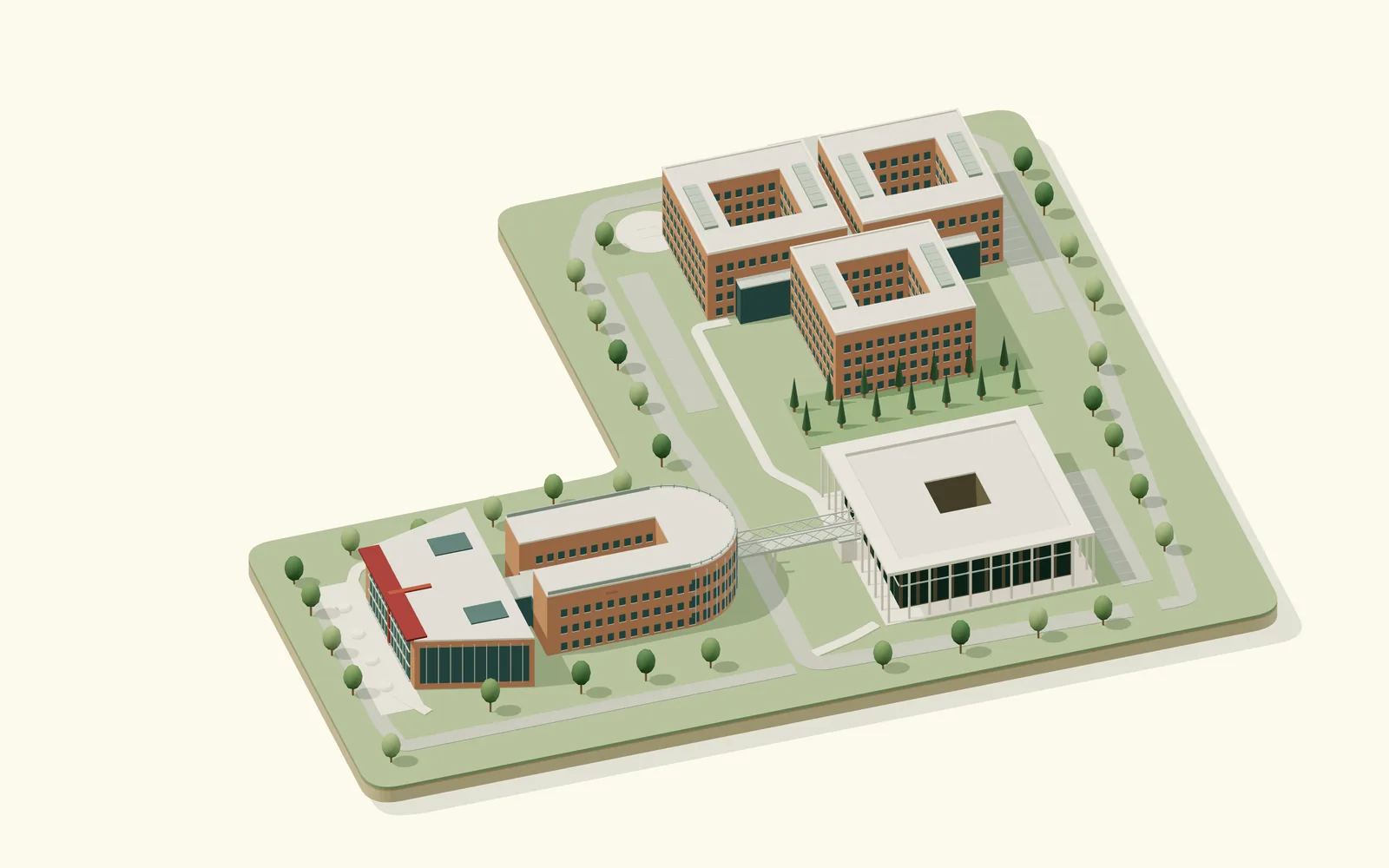
Trapezio
The teaching building (Polo della Didattica) of the university's three faculties: Medicine and Surgery, Engineering, and Science and Technology for Sustainable Development and One Health.
PRABB
The Polo di Ricerca Avanzata in Biomedicina e Bioingegneria, the university's centre for advanced research in biomedicine and bioengineering.
Cu.Bo
The Cultural Box, the newest teaching building: a simulation centre, new classrooms and a 300-seat auditorium, over about 10,000 m².
Policlinico Universitario Campus Bio-Medico
The university hospital, with its emergency department.
Student life
Living in Rome as a medical student
Campus Bio-Medico's campus is in Trigoria, a quieter, greener district south of central Rome on the edge of the Decima-Malafede Nature Reserve — a genuine trade-off against the international-student social scene concentrated in areas like Trastevere and San Lorenzo.
What's distinctive here is the integration: the university, its own teaching hospital (Fondazione Policlinico Universitario Campus Bio-Medico) and PRABB, a biomedical and bioengineering research centre, were inaugurated together on one site in 2008, giving Medicine students early, direct clinical and lab exposure most schools don't offer until later years.
On-campus housing exists but is small (21 places at Borgo Primo Centro); most students rent privately, and general Rome rental figures — rather than a Trigoria-specific number, which isn't published — are the best available guide to cost.
FAQ
Campus Bio-Medico admissions FAQ
For the 2026/27 cycle the test was sat in person in Rome, at the Nuova Fiera di Roma, on 19 February 2026. Registration closed on 6 February 2026 for EU and equivalent candidates and on 28 January 2026 for non-EU candidates resident abroad, which makes it one of the earliest in the Italian private medical school cycle. Non-EU candidates resident abroad have their own call and in 2026/27 sat the test online, under remote proctoring, on 6 February 2026. The 2027/28 dates hadn't been published as of this guide's last update.
60 five-option questions in 100 minutes, 20 each in Biology, Chemistry and Physics, sat as one block. A correct answer scores +1, a wrong one −0.2 and a blank 0, and you need at least 12 of 60 to be eligible for a place (10 in the call for non-EU candidates resident abroad). No calculator or electronic device is allowed. Medicine and Surgery and MedTech share the same paper but register and rank separately.
It's built on CBM's most recent call, for the 2026/27 cycle (Rector's Decree No. 505, 28 October 2025). The 2027/28 call hadn't been published as of this guide's last update, so check it for any changes once it's out.
Yes. The simulator includes CBM-specific question formats.
84 EU/equivalent seats and 36 reserved for non-EU applicants abroad (2026/27 cycle figures). The separate MedTech programme has its own 68/12 split, so don't confuse the two. Campus Bio-Medico doesn't publish an official acceptance rate; one ranking aggregator's algorithmic estimate of 30% is explicitly its own model rather than a university figure, so treat it as indicative at most.
Within the EU, yes. It's a standard Italian medical degree (LM-41), automatically recognised across the EU/EEA. The old separate Esame di Stato licensing exam no longer exists for this degree; a practical assessment built into the final year now confers the right to register and practice instead. For the UK, the Medical Act 1983 (sections 21B and 21C, as in force on 12 October 2026) spares holders of an Italian medical degree the knowledge test other international graduates take through PLAB/UKMLA, but the UK's list pairs the laurea with the Diploma di abilitazione all'esercizio della medicina e chirurgia, which Italy stopped issuing in March 2020, when the practical training moved inside the degree. The GMC's Italy page therefore offers graduates since then provisional registration on the laurea, for a UK Foundation Year 1 post, and asks for evidence of supervised practice, such as a 12-month internship, for full registration. US recognition goes through the standard international-graduate route (ECFMG/USMLE) rather than anything Campus Bio-Medico-specific.
Ready to prepare for the UCBM Admission Test?
The Campus Bio-Medico Complete Admissions System — study guide, exam simulator, video courses and application help, built from Campus Bio-Medico University of Rome's own syllabus.