
Humanitas University Admissions Guide
Everything you need to apply to Humanitas University: entrance requirements, application deadlines, tuition and cost of living, and the HUMAT.
At a glance
Humanitas in brief
- Entrance exam
- HUMAT
- Language of instruction
- English
- Interview required
- No
- Tuition
- €10,206–€23,206 / year
- Cost of living
- €950–1,500 / month
- Application deadline
- Provisional for 2027/2028: mirrors the 2026/2027 cycle (registration closed 26 February 2026, tests held March 2026); official 2027/28 dates not yet published
- Subjects tested
- Scientific Thinking, Academic Literacy, Biology, Chemistry, Mathematics, Physics
Source: Humanitas University Admissions · Verified 8 Oct 2026
Admission test
Humanitas admission test: HUMAT
Humanitas University requires the HUMAT for admission. Here are the essential figures.
- Total Questions
- 60
- Test Duration
- 120 min
- Main Sections
- 3
- Maximum Score
- 960
Not sure you'd clear the cutoff?
Take the free Humanitas diagnostic: real questions from its own question bank, scored against its cutoff. No account needed.
What the exam tests
- Scientific Thinking
- Academic Literacy
- Biology
- Chemistry
- Mathematics
- Physics
6 tested areas · HUMAT
Application
Application requirements
- Entrance exam
- Required
- Scientific Thinking, Academic Literacy, Biology, Chemistry, Mathematics, Physics
- Online, remotely proctored
- Interview
- Not required
- Scholarship
- Need to apply early
- Application fee
- €200
Fees
Humanitas fees and the ISEP: how your band is worked out
Humanitas sets an EU student's tuition by its own ISEP index (Index of the Economic and Property Situation), not by the state ISEE. Its ISEP handbook says so plainly: do not upload an ISEE, or the file is rejected. The one place Humanitas asks for an ISEE is the Fondazione Rocca scholarship, open to an ISEE 2026 of at most €50,000.
There are four bands. Non-EU students are placed in the fourth, and so is an EU student whose family earns and holds everything outside the EU. The bands below are for students enrolling in Medicine and Surgery or the MEDTEC School in 2026/27, and the regulation keeps them unchanged for the rest of the course. Each total includes the €250 enrolment fee, the €190 Lombardy regional tax and €16 stamp duty.
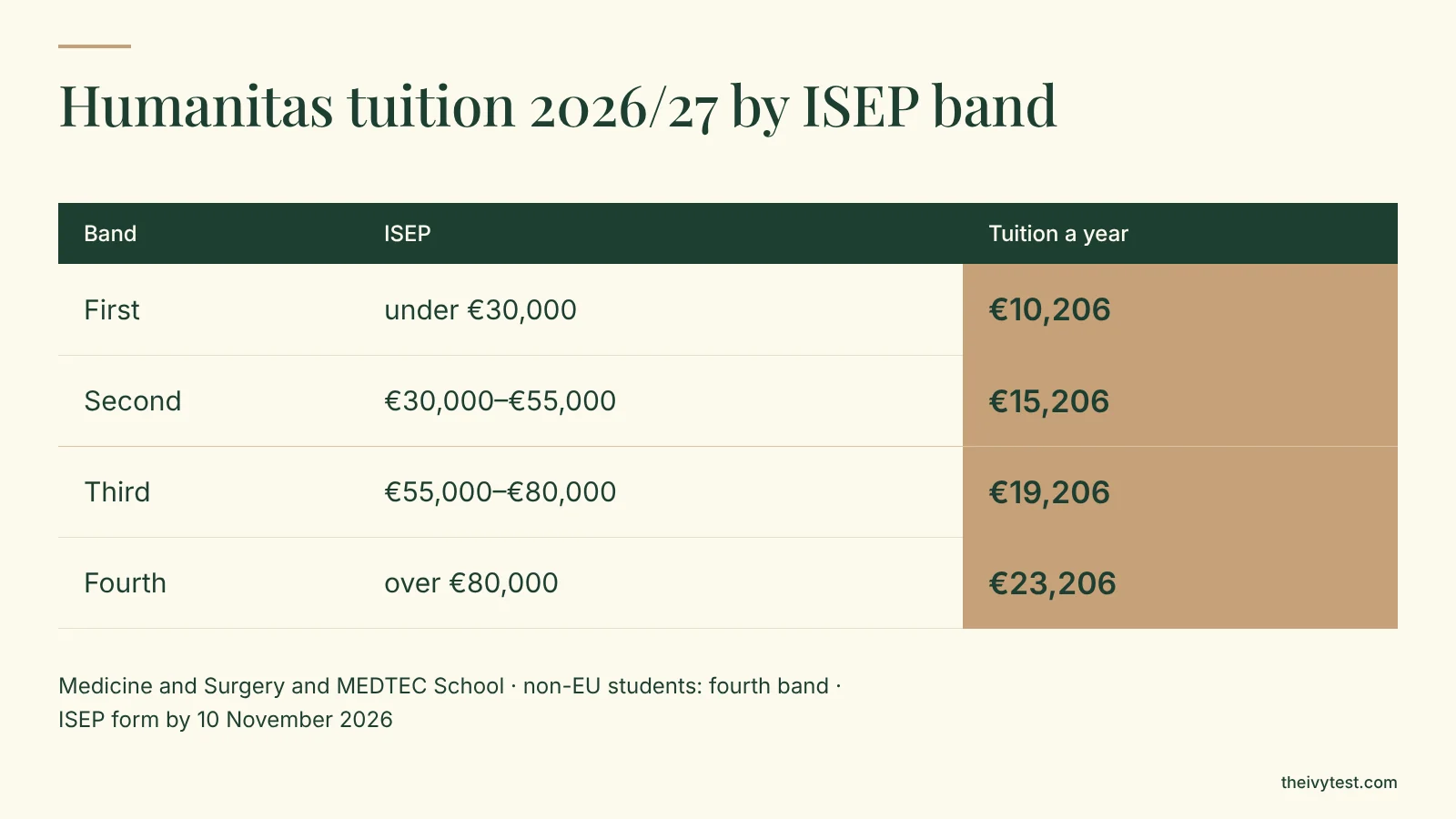
Tuition by ISEP band, 2026/27 (Medicine and Surgery, MEDTEC School)
| Band | ISEP | Tuition a year |
|---|---|---|
| First | under €30,000 | €10,206 |
| Second | €30,000–€55,000 | €15,206 |
| Third | €55,000–€80,000 | €19,206 |
| Fourth | over €80,000 | €23,206 |
When each band pays, 2026/27
| Instalment | Due | First | Second | Third | Fourth |
|---|---|---|---|---|---|
| 1st instalment | At enrolment | €5,206 | €5,206 | €5,206 | €5,206 |
| 2nd instalment | 11 Dec 2026 | €2,000 | €4,000 | €5,000 | €6,000 |
| 3rd instalment | 26 Feb 2027 | €2,000 | €3,000 | €5,000 | €6,000 |
| 4th instalment | 16 Apr 2027 | €1,000 | €3,000 | €4,000 | €6,000 |
| Total | €10,206 | €15,206 | €19,206 | €23,206 |
How the ISEP is calculated
- Income: the 2025 taxable income of everyone in the family unit, earned in Italy or abroad, counted in full (an exemption or special regime such as the impatriate workers' regime does not reduce it), plus financial income left out of the tax return, such as interest, dividends and fund returns. Child support counts in full; loans do not count.
- Property: 20% of the value of buildings and building land the family owns, 10% for the main home. In Italy the value is the cadastral income plus 5%, multiplied by 100 for categories A, B and C (34 for C/1, 50 for A/10), by 50 for D and by 34 for E. Abroad it is the purchase price or a sworn valuation, or €500 per square metre.
- Savings and investments: 10% of their value on 31 December 2025: securities, bonds, funds, shares and company stakes, life and pension policies (what has been paid in), and bank balances above €10,000.
What reduces it
- 10% off for each member of the family unit from the third, the student included.
- 10% off for each disabled member other than the student.
- 25% of the 2025 rent, on a lease in the family member's own name, or of the 2025 mortgage payments on the main home.
- 20% of the 2025 mortgage payments on a second home.
- A sibling also enrolling in Medicine in 2026/27 is placed one band below the first sibling.
How to apply, and the deadline
Fill in the ISEP form by 10 November 2026 on the Income Category Evaluation Portal, reached from the course's Fees & Scholarships page and opened with your Campus ID, and upload the documents behind each figure: tax returns, property records, bank statements. The portal shows a provisional band; Humanitas confirms the final one by email once it has checked the documents.
Skip the form, miss the deadline or leave it incomplete and you are placed in the fourth band. A family with very low income or assets has to show it can afford the fees. The band is worked out again every year.
From Humanitas's University Fee Regulation 2026/27 (sections 3.1 and 4), read on 13 October 2026. The Italian regulation is the binding text. University Fee Regulation 2026/27, summary for international students · Fees & Scholarships: Medicine and Surgery · ISEP handbook
Rankings
Humanitas University in the rankings
Times Higher Education (THE) ranks Humanitas University joint 267th in the world in its World University Rankings 2027, published in October 2026. In THE's Clinical and Health table, the subject ranking that covers medicine, it has been in the 151–175 band in each of the 2024, 2025 and 2026 editions; the 2027 subject tables are not out yet. Humanitas first appeared in the 2023 edition.
A ranking describes the university, not your chances of getting in: admission to Medicine depends only on your HUMAT score and the minimum in each section.
Humanitas University in THE's World University Rankings
| Edition | World | Clinical and Health |
|---|---|---|
| THE 2027 | =267 | not out yet |
| THE 2026 | 251–300 | 151–175 |
| THE 2025 | 251–300 | 151–175 |
| THE 2024 | 251–300 | 151–175 |
| THE 2023 | 201–250 | 176–200 |
Curriculum
The six-year Medicine curriculum
Medicine and Surgery at Humanitas is a six-year single-cycle degree of 360 CFU over 12 semesters, taught entirely in English. From the first year, interdisciplinary theory modules are combined with practical exercises and simulation.
- From the third year, a professional training pathway, planned by Humanitas's OME on the RIME framework, takes what you have learnt into three settings: simulation, clinical case discussions in class, and the hospital ward. It builds professional behaviour, clinical skills (history taking and physical examination) and clinical reasoning.
- Simulation runs in Humanitas's Simulation Center, more than 3,000 m² and the only facility in Italy with Full SESAM accreditation.
- The Virgilio Program is a research track you can apply to join: interdisciplinary seminars and a month of laboratory work every year.
- Time abroad is possible with scholarships, Travel Grants and Erasmus.
Transfer
Transferring to Humanitas Medicine
If you are already enrolled in Medicine and Surgery elsewhere, you can apply to join a later year without sitting the admission test (Council of State, Plenary Meeting 1/2015), through Humanitas's transfer call. The first year is open only through the HUMAT. For 2026/27 there were 6 places in year 2, 7 in year 3 and 8 in year 4, with more if students withdraw.
- Your degree must be in Medicine and Surgery, at a university fully recognised in its own country.
- You need a set number of credits in each discipline for the year you apply to, and a close match between your programme's content and Humanitas's.
- Your English is assessed in an interview, and working Italian is required from the third year.
- Year 4 is open only with a closely matching programme, good Italian and the essential professional skills for that year.
- You apply with the transfer form and an application fee, uploading official transcripts and detailed syllabi in Italian or English (with an official translation otherwise).
Sources, read on 14 October 2026: Times Higher Education: Humanitas University · Degree Course in Medicine and Surgery · Transfer to Humanitas University · Simulation Center
The campus
The Humanitas University campus
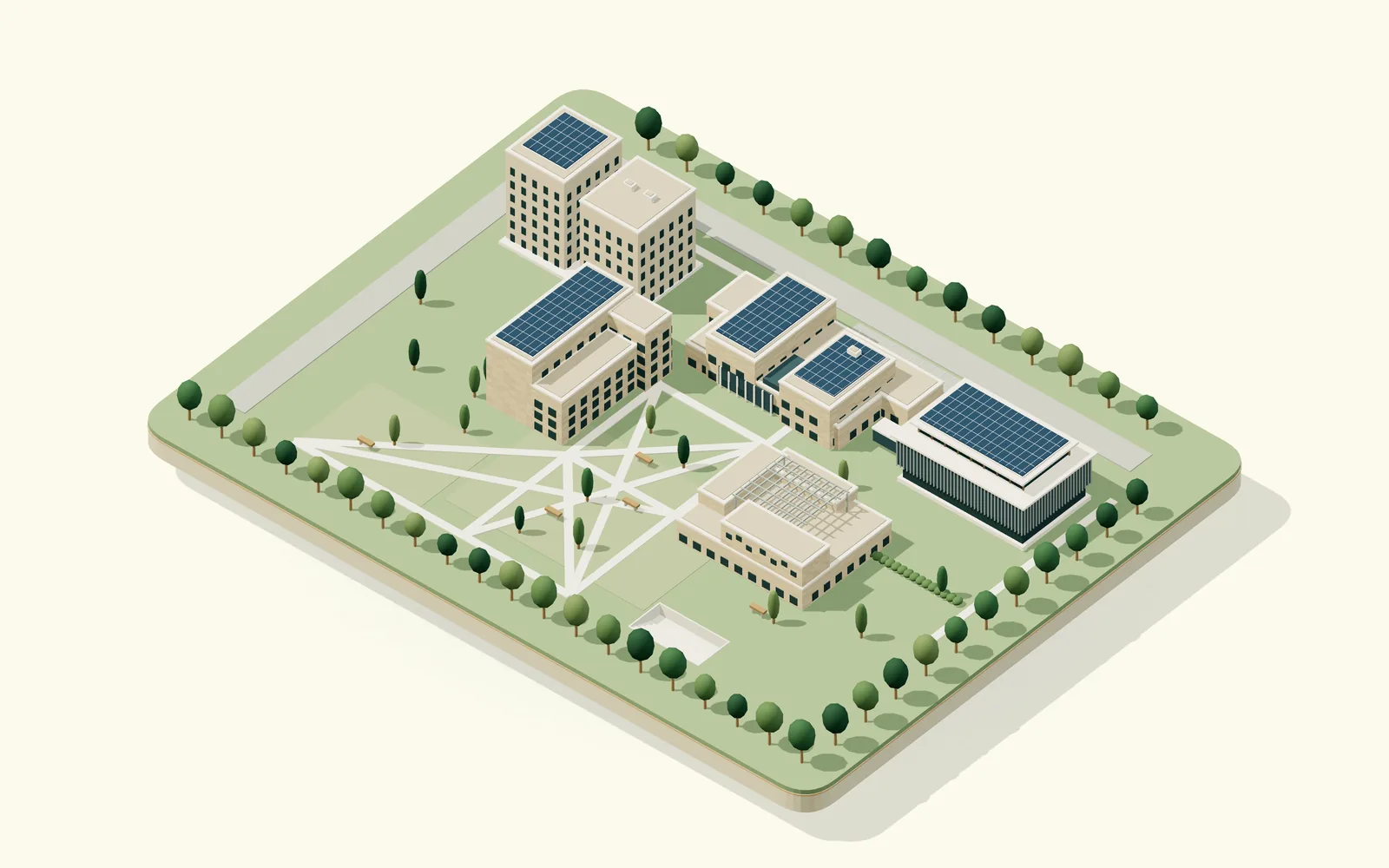
Humanitas University's campus is in Pieve Emanuele, on the edge of Milan, a short walk from Humanitas Research Hospital. Its 20,000 square metres hold classrooms and laboratories, student residences, sports areas and a Simulation Center of more than 3,000 m², the only one in Italy with full SESAM accreditation.
Teaching building
Building A · Classrooms and laboratories.
Campus hub
Building B · The campus's multifunctional hub.
Research building
Building C · Research laboratories and offices.
Mario Luzzatto Student House
The on-campus residence, opened in 2018, with 240 beds.
Roberto Rocca Innovation Building
Classrooms, labs for 3D printing, electron microscopy and AI, and the Humanitas AI Center.
Student life
Living in Milan as a medical student
The Humanitas campus sits in Pieve Emanuele, in the Milan metropolitan area rather than the city centre — budget for a commute if you want to live centrally. What's on site is substantial: a 20,000 sqm campus with a Simulation Center of more than 3,000 m² holding full SESAM accreditation (the only facility in Italy with it, Humanitas says), an Anatomy Lab and the CUBE skills lab.
Housing is on campus at the Mario Luzzatto Student House, run as Camplus Humanitas University (240 beds, from €9,515 a year for a double room in a shared flat to €17,600 for a suite), alongside Milan's private rental market. Milan's public transport runs five metro lines plus trams and buses.
Student life at a glance
- Campus
- Pieve Emanuele, Milan metro area
- Facilities
- 20,000 sqm campus · SESAM-accredited Simulation Center · Anatomy Lab
- Housing
- Mario Luzzatto Student House (Camplus), on campus
- Transport
- 5 metro lines, trams & buses
FAQ
Humanitas admissions FAQ
Yes. Both tracks sit the same HUMAT, with the same three sections (Scientific Thinking & Academic Literacy, Biology & Chemistry, Mathematics & Physics), scored differently, so one guide covers everything.
60 five-option questions in 120 minutes, in three timed sections of 20: Scientific Thinking & Academic Literacy (45 minutes), Biology & Chemistry (35) and Mathematics & Physics (40). A correct answer earns points and a wrong one costs a quarter of that section's value, while a blank scores zero. Points per section differ between the Medicine and Surgery and MEDTEC rankings, each out of 960. There's no interview.
It's built on the most recent official call, for the 2026/27 cycle. Humanitas hadn't published its 2027/2028 call as of this guide's last update, so check the new call for any changes once it's out.
Absolutely. The simulator includes Humanitas HUMAT-specific questions that complement the guide content perfectly.
Humanitas doesn't publish an official acceptance rate, but it does publish its full ranking lists: in 2026/27 the last EU candidate admitted to Medicine and Surgery had 450 of 960 (read on 17 October 2026). It offers 200 seats for Medicine and Surgery: 150 for EU/EU-equated applicants and 50 reserved for non-EU applicants, who are ranked separately. The separate MEDTEC dual degree has 130 seats: 90 for EU/EU-equated applicants and 40 for non-EU applicants, again ranked separately. Any acceptance-rate percentage you see elsewhere is a third-party estimate, not a Humanitas figure.
Within the EU, yes. It's a standard Italian medical degree (LM-41), automatically recognised for practice across the EU/EEA once you register with the relevant national medical authority. Outside the EU, recognition isn't automatic as a rule. For the UK, the Medical Act 1983 (sections 21B and 21C, as in force on 12 October 2026) spares holders of an Italian medical degree the knowledge test other international graduates take through PLAB/UKMLA, but the UK's list pairs the laurea with the Diploma di abilitazione all'esercizio della medicina e chirurgia, which Italy stopped issuing in March 2020, when the practical training moved inside the degree. The GMC's Italy page therefore offers graduates since then provisional registration on the laurea, for a UK Foundation Year 1 post, and asks for evidence of supervised practice, such as a 12-month internship, for full registration. US-bound graduates need ECFMG certification (USMLE Step 1 and Step 2 CK), the same process every international medical graduate follows, not something specific to Humanitas.
Humanitas hadn't published its 2027/2028 call as of this guide's last update; its FAQ page says the Medicine and Surgery call usually comes out in October. For reference, the 2026/2027 cycle's registration closed 26 February 2026 (12 March 2026 for the second round only), with the online test held on 5-6 March and on 18 and 20 March 2026; you could sit both rounds for one €200 fee and only the higher score counted. Expect something similar, but confirm the exact dates on hunimed.eu once the new call is out.
Ready to prepare for the HUMAT?
The Humanitas Complete Admissions System — study guide, exam simulator, video courses and application help, built from Humanitas University's own syllabus.