
Which ONE of the following statements about the genetic code and protein synthesis is correct? (On the real LF2 paper this would be presented as four independent statements to mark true or false, with the item scored only if all four calls are right.)
Exam guide · Updated for 2027 admissions
Charles University Second Faculty of Medicine Entrance Exam 2027: Complete Preparation Guide
Everything you need to know about the Charles University Second Faculty of Medicine entrance exam (LF2, the 2nd Faculty of Medicine in Prague): the multiple-response science format, the official topics and 300 sample questions, scoring, the interview stage, dates and the application deadline, fees, preparation strategy and practice.
Applying to more than one Charles faculty? Compare all five →
Updated for 2027 admissions · Last updated: 16 October 2026
Charles University LF2 Entrance Exam at a glance
Overview
What is the Charles University Second Faculty of Medicine entrance exam?
The Second Faculty of Medicine (LF2) sets its own entrance examination for its English-taught General Medicine programme in Prague. There is no shared national Czech admission test: each faculty writes its own paper, and even within Charles University the five medical faculties differ in subject list, question count and answer format. LF2's is the broadest of the three Prague faculties (four sections rather than two or three), and it is the only one in this catalogue whose science questions are not single best answer.
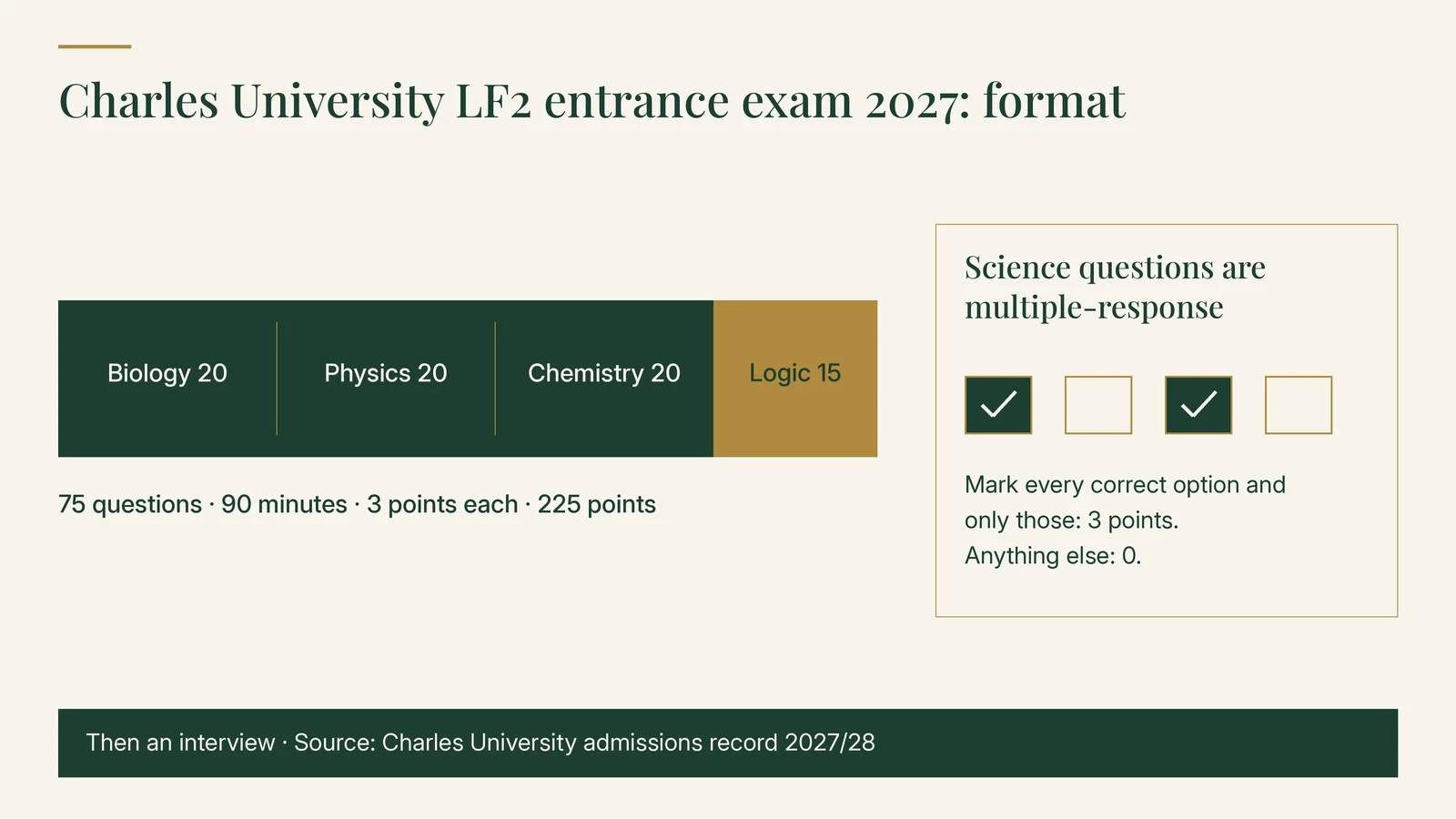
The written test is 75 questions in 90 minutes: Biology 20, Physics and Biophysics 20, Chemistry 20, and a separate Logic block of 15. Each question offers four options, a) to d), and is worth up to three points, 225 in all. In the three science sections those four options are not four candidate answers with one winner: they are four independent statements, any number of which may be true, and the faculty awards full points only if every correct option is selected and every incorrect option is left unmarked. Its own words on the point are unambiguous: no points are awarded if there is any discrepancy between the selected answers and the correct solution. Only the Logic block works the familiar way, with exactly one correct option.
That single rule changes the arithmetic of the whole paper, and the scoring section below works through what it actually costs. Beyond the written test, admission runs in two stages: applicants with the best first-stage results are invited to an interview, in which a three-member committee hears two drawn discussion topics and awards up to 90 points. No fixed first-stage pass mark is published, because the cut is set by results and capacity rather than in advance. It is also worth knowing before you start revising that LF2 operates several exemption routes: A-levels, the IB, the European Baccalaureate, AP or MCAT results, a medical-related bachelor degree, or country-specific matriculation grades, any of which can waive the whole entrance exam, written test and interview, for conditional acceptance pending final grades.
Programmes that use the Charles University LF2 Entrance Exam
- General Medicine (English-taught, Prague)
Timeline
Charles University LF2 Entrance Exam 2027: dates and deadlines
When to expect your exam · 2027 start
- June 20273 JunPublished
- July 202722 JulPublished
Applications open 1 Nov 2026.
Dates the university has published for this cycle. See every university on the calendar →
- Applications open1 November 2026
- Application deadline30 April 2027
- Written test: sitting 13 June 2027
- Written test: sitting 222 July 2027
- Interview stageInterview dates not yet announced; invitations follow the first stage and LF2 publishes no fixed interval
- Enrolment deadlineNot yet announced as a date; LF2's application timeline puts enrolment in Prague in early September, while its After Your Admission page says the end of September or the beginning of October
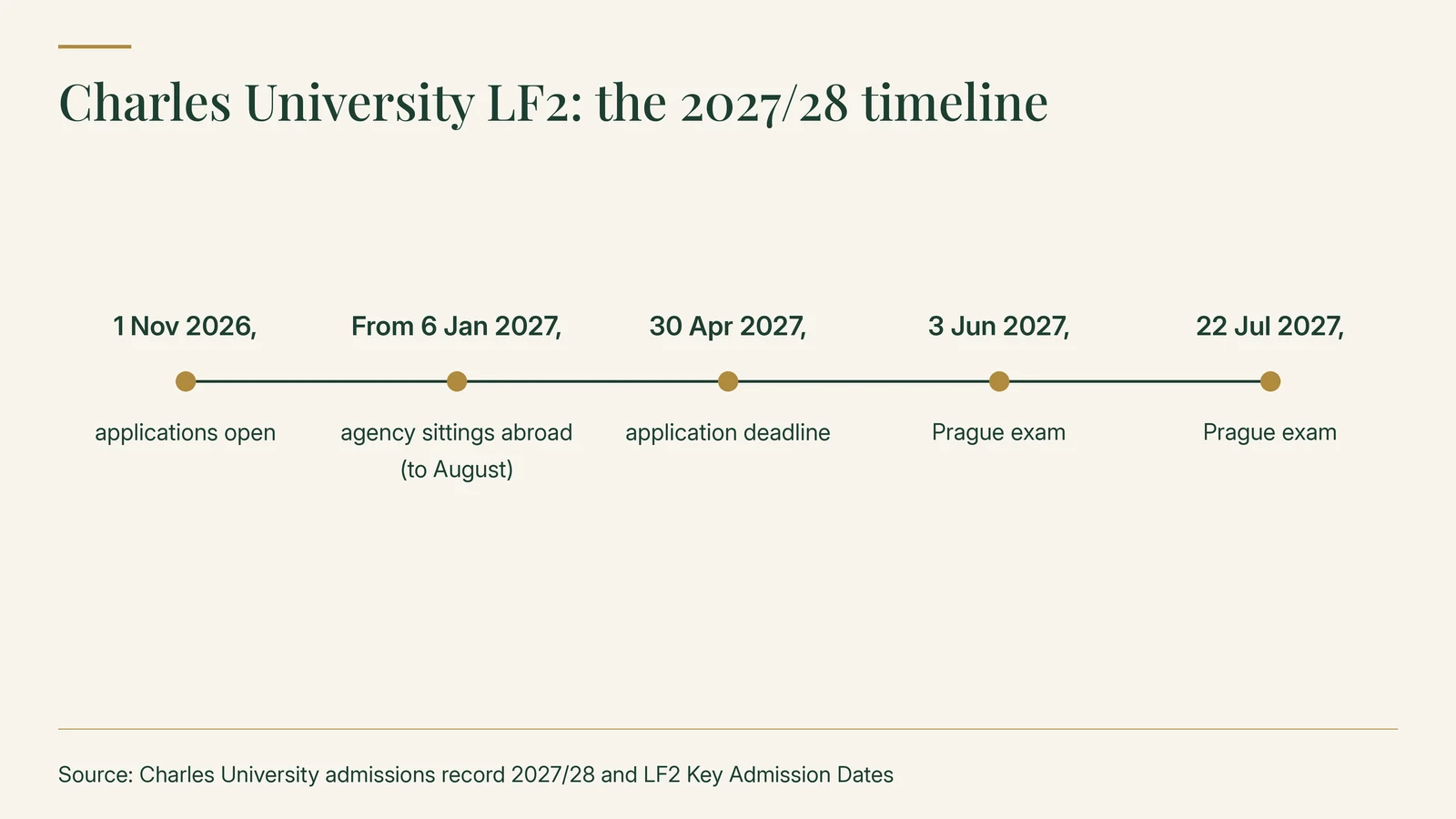
LF2's official entrance-exam page and key admission dates page were re-read on 7 October 2026: they confirm the structure, scoring and answer format described here and publish the 2027/2028 application window and Prague sittings above. Partner agencies have published dates abroad from 6 January 2027 (Tel Aviv) to 13 July 2027 (Berlin), and the faculty notes that more are still being added. Neither the topic list nor the 300-question model paper is tied to a named academic year: both are 2024 files. IvyTest re-checks lf2.cuni.cz and updates this guide if the dates change.
Structure
Charles University LF2 Entrance Exam format
75 questions in 90 minutes (72 seconds a question on average), across four blocks, with no section breaks. The block sizes are confirmed on the faculty's own page, which also states that each question is worth up to three points and that the written test totals 225, so every block's share of the score follows directly from its question count.
| Section | Questions | Weighting | Suggested time |
|---|---|---|---|
| Biology | 20 | 27% (60 of 225 points) | *see the note below the table |
| Physics and Biophysics | 20 | 27% (60 of 225 points) | *see the note below the table |
| Chemistry | 20 | 27% (60 of 225 points) | *see the note below the table |
| Logic | 15 | 20% (45 of 225 points) | *see the note below the table |
- One continuous 90-minute sitting; LF2 sets no per-section time limit
Content
Question and subject breakdown
Three sciences of equal size and a shorter Logic block. The three sciences are the sections LF2 publishes an official topic list for, and the three that are scored all-or-nothing. Every question is worth up to three points, so the shares below are each block's part of the 225-point written score.
Biology
27%Eleven official headings, from an introduction to biology through cell and molecular biology, genetics, bacteria and viruses, plants and fungi, animals and protists, human biology, evolution, ecology and the history of biology. In the faculty's own 300-question model paper this was the most multiple-response-heavy section of all (44 of its 100 biology items had more than one correct option), and its heaviest areas were molecular biology, human biology and genetics.
Physics and Biophysics
27%The faculty names this section inconsistently across its own documents (the topic list heads it PHYSICS, the model paper heads it Biophysics), and the content sits between the two, leaning medical wherever the physics allows it: ultrasound, the eye, X-rays, moving fluids. Nine areas, from units and mechanics through waves and acoustics, thermodynamics, molecular physics, electricity and magnetism, electromagnetic radiation, optics and atomic and nuclear physics. Electricity and magnetism was the single heaviest area of the model paper.
Chemistry
27%Five official headings (general, inorganic, chemical calculations, organic and biochemistry), which the model paper sampled evenly at 20 questions each. It was also the most single-answer-heavy section of the model paper, with 80 of 100 items carrying exactly one correct option, so multiple-response items appear here but are the minority.
Logic
20%The only block with exactly one correct answer per question, and the only block with no published content at all: the faculty's topic list covers the three sciences only, and its 300-question model paper contains no logic items. In practice it covers numerical reasoning, verbal and abstract logic, and spatial and pattern reasoning.
Marks
Charles University LF2 Entrance Exam scoring
There is no negative marking on this paper (a wrong answer and a blank are both worth zero), but that is the less important half of the rule. The half that decides scores is that a science question is marked as one indivisible unit: you are credited only if every correct option is selected and every incorrect option is left unmarked, and any discrepancy at all scores nothing. Partial knowledge of a science item is worth exactly the same as no knowledge of it.
- Correct answer
- +3 points (each question is worth up to three points)
- Incorrect answer
- 0 points (no negative marking)
- Unanswered question
- 0 points
- Science items (Biology, Physics, Chemistry)
- Multiple-response: one, two, three or four of the four options may be correct, and the item is scored all-or-nothing on the full set
- Logic items
- Single answer: exactly one of the four options is correct
- Partial credit
- None: three of four statements right scores the same as none of them
- Per-block point value
- Biology, Physics and Chemistry 60 points each, Logic 45: 225 in total
- Minimum eligible score
- None published; applicants with the best first-stage results proceed to the interview, so the threshold is set by results and capacity rather than in advance
- Per-subject floors
- None: LF2 publishes no per-section minimum
- Interview stage
- Up to 90 points on the faculty's page, awarded by a three-member committee on two drawn discussion topics; Charles University's 2027/28 admissions record gives 1 to 20 points per topic from each of the three members, 120 in all. Applicants are then ranked on their total score
Worked example
Treat a science item as what it is: four independent true-or-false judgements that all have to land. Suppose you are 90% reliable on any single statement, strong by most standards. The chance of getting a whole item right is 0.9 × 0.9 × 0.9 × 0.9 = 0.656, so across the 60 science questions you would expect roughly 39 correct items, not 54. At three points each that is about 117 points. Add a Logic block where you answer all 15 and get 11 (33 points), and the written total is about 150 out of 225. On a conventional single-best-answer paper, that same 90% reliability would have produced about 54 of the 60 science items. The 15-item difference, some 45 points, is created entirely by the all-or-nothing rule, not by knowing less. The same arithmetic run at other accuracies: 95% per statement gives 0.95⁴ = 81% of science items; 80% gives 0.80⁴ = 41%; 70% gives 0.70⁴ = just 24%. Blind guessing collapses even harder: there are 2⁴ = 16 possible ways to mark four options, so a random pattern matches the key about 6% of the time, against the 25% a four-option single-best-answer question would give you. Two practical consequences follow. First, because a blank and a wrong pattern both score zero and there is no penalty, there is never a reason to leave a science item unmarked. Second, and less obvious: you cannot abstain on an individual statement either. Leaving one option unmarked is not a blank: it is an assertion that the statement is false, and it will be marked as one.
The IvyTest simulator scores every practice paper against these exact rules.
See the Charles University LF2 Entrance Exam simulatorSyllabus
Charles University Second Faculty entrance exam topics (LF2)
The subject headings below are official (they are the faculty's own entrance-exam topic list, in the order it gives them), but that list supplies headings only, with no detail beneath them, and it carries no date or academic year. The content under each heading is expanded from LF2's own 300-question model paper rather than from a published syllabus, so treat it as indicative of what has been examined rather than as a guarantee of what will be. The Logic block is derived from neither: the topic list covers the three sciences only and the model paper contains no logic questions at all.
Eleven official headings. Molecular biology, human biology and genetics carried the heaviest question counts in the model paper, and this was the section with the most multiple-response items.
- Introduction to biology: characteristics of life, levels of organisation, cell theory, metabolism, homeostasis, reproduction and gametes, asexual reproduction, enzymes, the four classes of macromolecule, and the branches of biology including genetics, ecology, physiology, microbiology and ethology
- Cell biology: prokaryotic and eukaryotic cells, the plasma membrane and phospholipid bilayer, membrane proteins, diffusion, osmosis, active transport, endocytosis and exocytosis, organelles, the cytoskeleton, the cell cycle, mitosis and meiosis, chromosomes, chromatids, centromeres and telomeres, haploid and diploid cells, gametogenesis, fertilisation and the zygote, chromosomal abnormalities
- Molecular biology: DNA and RNA structure, replication, transcription and translation, the central dogma, the genetic code, codons and anticodons, start and stop codons, exons and introns, mRNA, tRNA and rRNA, protein synthesis, point and frameshift mutations, DNA denaturation, PCR, DNA fingerprinting, recombinant DNA, transformation, transduction and conjugation, reverse transcription and retroviruses
- Genetics: genes and alleles, genotype and phenotype, homozygotes and heterozygotes, dominant, recessive, autosomal, X-linked and mitochondrial inheritance, Mendel's laws, Punnett squares and pedigrees, monogenic and multifactorial traits, penetrance and expressivity, karyotype, monosomy and trisomy, ABO and Rh blood groups, Hardy-Weinberg equilibrium, gene pool and population genetics, haemophilia, colour blindness and phenylketonuria
- Biology of bacteria and viruses: prokaryotic cell structure, the bacterial chromosome and plasmids, cell wall and peptidoglycan, Gram-positive and Gram-negative bacteria, bacterial reproduction and conjugation, bacteriophages, capsid and envelope, DNA and RNA viruses, viral replication and the virion, prions, viral versus bacterial disease, antibiotics and resistance
- Biology of plants and fungi: plant cell structure, chloroplasts and chlorophyll, photosynthesis including the light reactions and the Calvin cycle, plant tissues, roots, stems and leaves, monocots and dicots, plant reproduction, seeds and fruits, fungi, yeasts and moulds, fungal reproduction, lichens and mycorrhizae
- Biology of animals and protists: animal classification, protists and protozoa, parasites including Toxoplasma, Plasmodium and Trichomonas, invertebrates, arthropods, crustaceans, arachnids and insects, chordates and vertebrates, fish, amphibians, reptiles, birds and mammals, human parasites and their vectors
- Human biology: human tissues, the nervous system with neurons, axons and synapses, brain, spinal cord and peripheral nerves, the sense organs including eye and ear, the endocrine system with pituitary, thyroid, pancreas, adrenals and gonads, the heart, vessels, circulation and blood components, the respiratory system and control of breathing, the digestive system with liver, gallbladder, pancreas and bile, the kidney and nephron, the reproductive system and the basics of fertilisation and pregnancy, the immune system with B and T lymphocytes and autoimmune disease, the basics of cancer
- Evolutionary biology: Darwinian evolution, natural selection, fitness and adaptation, mutation and variation, speciation, phylogeny, human evolution, mitochondrial DNA and the origin of Homo sapiens, geological eras
- Ecology and environment protection: individual, population, community, ecosystem, biome and biosphere, food chains and food webs, energy flow, producers, consumers and decomposers, the carbon, nitrogen and water cycles, eutrophication, pollution, acid rain, the greenhouse effect, biodiversity and conservation, human impact on ecosystems
- History of biology: cell theory, Pasteur, Mendel and Darwin, the discovery of DNA structure, the Human Genome Project, vaccination milestones, the development of microbiology and genetics
Nine official areas, in the topic list's own order. Items lean medical wherever the physics allows it, and electricity and magnetism was the heaviest area in the model paper by a wide margin.
- Basic terms: SI base and derived units, prefixes, dimensional analysis and unit equivalence, scalars and vectors, scientific notation, and the recurring quantities pressure, energy, work, power, frequency, wavelength, charge, current, voltage and resistance
- Mechanics: kinematics, Newton's laws, force and weight, work, kinetic and potential energy and power, efficiency, momentum, gravitation, hydrostatic pressure, Pascal's principle, Archimedes' principle, fluid flow, Bernoulli's equation, elasticity and Hooke's law
- Vibration, waves and acoustics: oscillations, period, frequency and amplitude, mechanical waves, transverse and longitudinal waves, sound, infrasound, audible sound and ultrasound, the decibel scale, the Doppler effect, resonance, the basics of medical ultrasound
- Thermodynamics: temperature scales, heat and internal energy, heat capacity and specific heat, latent heat, work done by a gas, the ideal gas, the first and second laws, entropy, heat transfer by conduction, convection and radiation
- Molecular physics: kinetic theory, molecular motion, diffusion and osmosis, Brownian motion, surface tension, viscosity, states of matter, phase transitions, thermal expansion, amorphous and crystalline materials
- Electricity and magnetism: charge, electric field and potential, current, voltage and resistance, Ohm's law, direct and alternating current, capacitors and inductors, RLC circuits, conductors, insulators and semiconductors, diodes, electrolytes and the basics of electrolysis, magnetic field and magnetic induction, the Lorentz force, electromagnetic induction
- Electromagnetic radiation: the electromagnetic spectrum, radio, infrared, visible, ultraviolet, X-ray and gamma radiation, wavelength, frequency and photon energy, absorption and emission, polarisation, lasers, biological effects of radiation
- Optics: reflection, refraction and refractive index, total internal reflection, lenses and image formation, the optical microscope, magnification and resolving power, the human eye, myopia and hyperopia and their correction
- Atomic and nuclear physics: atomic structure, protons, neutrons and electrons, atomic and mass number, isotopes, electron shells and excited states, ionisation, radioactivity, alpha, beta and gamma radiation, half-life and activity, nuclear decay, radiation protection
Five official headings, sampled evenly at 20 questions each in the model paper, the closest thing to a published weighting this subject has.
- General chemistry: atomic structure, atomic and mass number, isotopes and nuclides, electron configuration and quantum numbers, groups, periods and periodic trends, chemical bonding and molecular polarity, intermolecular forces, reaction energetics, exothermic and endothermic reactions, activation energy and catalysts, equilibrium, the solubility product, acids and bases, pH and pOH, strong and weak acids and bases, buffers, dispersions and colloids
- Inorganic chemistry: acidic, basic and amphoteric oxides, hydroxides, acids and salts, hydrides and carbides, nomenclature, oxidation numbers, redox reactions, oxidising and reducing agents, electrolysis with anode and cathode products, alkali and alkaline earth metals, the boron, carbon, nitrogen and oxygen groups, halogens and noble gases, important compounds of H, O, C, N, S, P, Cl, Na, K, Ca, Mg, Fe and I, biogenic elements, toxic inorganic substances such as carbon monoxide, chlorine and phosgene
- Chemical calculations: relative atomic and molecular mass, molar mass, amount of substance and the Avogadro constant, percentage composition, empirical and molecular formulas, balancing equations, stoichiometry and limiting reactant, mass and volume calculations, gas volume at normal conditions, molar and mass concentration, mass and volume fraction, dilution and mixing of solutions, water of crystallisation and hydrates, pH and acid-base calculations, balancing redox equations
- Organic chemistry: carbon bonding and hybridisation, alkanes, alkenes, alkynes and aromatic compounds, benzene, alcohols, phenols, ethers, aldehydes, ketones, carboxylic acids, esters, amines and amides, structural, stereo- and optical isomerism, substitution, addition, elimination, oxidation, reduction, esterification, hydrolysis and polymerisation, nomenclature, biologically relevant organic molecules
- Biochemistry: water in biological systems, carbohydrates from monosaccharides to polysaccharides including glucose, starch, glycogen and cellulose, lipids with fatty acids, triglycerides, phospholipids and cholesterol, amino acids, the peptide bond and the four levels of protein structure, enzymes and coenzymes, nucleic acids, nucleotides and ATP, vitamins, minerals and hormones, glycolysis, the Krebs cycle and oxidative phosphorylation, the biochemistry of photosynthesis, acid-base balance in the body
Derived, not official, and the only block on the paper with no published content of any kind. The faculty's topic list covers Physics, Biology and Chemistry only, and its 300-question model paper contains no logic items to reverse-engineer. Replace this mapping the moment LF2 publishes logic topics or a sample.
- Numerical reasoning: number sequences, arithmetic and geometric patterns, fractions, percentages, ratios and proportions, basic probability, short word problems
- Verbal and abstract logic: syllogisms and valid conclusions, true and false statements, analogies, odd one out, classification, conditional statements
- Spatial and pattern reasoning: shape sequences, rotations and reflections, paper folding, matrix reasoning, visual analogies
Test your Charles University LF2 Entrance Exam knowledge
Take free diagnosticDifficulty
How difficult is the Charles University LF2 Entrance Exam?
LF2's content is ordinary school science. Its difficulty is almost entirely structural, and it comes from one decision the faculty made about how an answer is marked.
Four right answers, or none: the compounding problem
Each science question is four independent true-or-false judgements and scores only if all four land. Reliability therefore compounds: 90% accuracy on individual statements converts to 0.9⁴ = 66% of science items, and 80% accuracy converts to 0.8⁴ = 41%. The flip side is the most useful fact in this guide: closing a ten-point gap in per-statement accuracy, from 80% to 90%, lifts your science-block accuracy rate by 25 percentage points, worth close to 15 additional items, about 45 points, across the 60-question science total. Nowhere else in this catalogue does consolidation pay that well.
You cannot abstain on a statement
Full points require every correct option selected and every incorrect one left unmarked, so an unmarked option is not a skipped question: it is a positive claim that the statement is false, and it is graded as one. Across 60 science items that is 240 forced binary decisions, with 15 single-answer logic items on top: 255 judgements in 90 minutes, about 21 seconds each.
Guessing barely works here
With four options that may each be true or false, there are 16 possible ways to mark a science item, so a blind pattern matches roughly 6% of the time, against 25% on a conventional four-option question. There is still no reason ever to leave one blank, since a blank and a wrong pattern both score zero and there is no penalty, but you should not plan around guesses the way you might on a single-best-answer paper.
A fifth of the paper has no published content at all
The Logic block is 15 of the 75 questions, and it is the only section the faculty's topic list does not cover. Its 300-question model paper (otherwise the single best guide to what LF2 examines) contains no logic items either. Candidates have three official sciences to revise from and nothing official for the fourth block.
Physics carries the same weight as biology, under a medical framing
Physics and Biophysics is 20 questions, the same as Biology and Chemistry, and it is the section applicants from biology-heavy school backgrounds most often underweight. The faculty cannot decide what to call it (the topic list heads it PHYSICS, the model paper heads it Biophysics), and the content lands between the two: circuits and radioactivity alongside ultrasound, the eye and pressure in moving fluids. Electricity and magnetism alone was the largest area in the model paper.
Benchmarks
What is a good Charles University LF2 Entrance Exam score?
LF2 publishes no pass mark, and on a re-check of its entrance-exam page on 28 September 2026 the rule it does publish explains why: applicants with the best written results, according to the Dean's decision, are invited to the interview. The threshold is produced by that year's cohort and that year's capacity, not set in advance.
That makes a specific target score meaningless in principle, not just unpublished. A written result that earned an interview one year need not earn one the next, because what changes between cycles is who else sat the paper. It also means the number is generated after you sit the exam rather than before, so there is nothing to aim at except being high in the order.
There is a second reason not to fixate on a number: the interview is worth up to 90 points and is where a three-member committee hears two drawn discussion topics. The written test's job is to get you into that room. Alongside it sit the exemption routes (A-levels, the IB, the European Baccalaureate, AP or MCAT results, a medical-related bachelor degree, or country-specific matriculation grades), which can waive the whole entrance exam, interview included; if you already hold one of those qualifications, checking your eligibility is worth more than any amount of mock-exam analysis.
Pending verification
- · How many first-stage candidates are invited to the interview, and at what score
- · Historical first-stage thresholds by year and by sitting
- · The minimum total score for admission, set each year according to capacity
These specific numbers aren't public yet — an IvyTest simulator score is the closest benchmark you can get today.
Check your Charles University LF2 Entrance Exam scoreStrategy
How to prepare for the Charles University LF2 Entrance Exam
12+ weeks
Three sciences of equal size, revised to certainty rather than coverage
Biology, Physics and Chemistry in parallel at 20 questions each, plus the unsyllabused Logic block.
- Sit a full 75-question diagnostic in week one under the real rules (every science item marked all-or-nothing), and record your per-statement accuracy separately from your per-item score. The gap between the two is what this exam actually charges you for.
- Rotate the three sciences weekly rather than blocking them. They are the same size, and Physics and Biophysics is the one applicants from a biology background most often leave until last.
- Practise science items as four true-or-false calls from the very start, not as 'pick the best one'. The habit of evaluating every option on its own is the whole skill here, and it does not develop from single-best-answer practice.
- Work the 15-question Logic block into the schedule early despite there being no official topic list (numerical reasoning, verbal and abstract logic, and spatial and pattern reasoning), and add full 90-minute timed sittings from week six.
8 weeks
Convert 'mostly right' into 'certain'
Depth on topics already half-known, since partial knowledge scores nothing.
- Diagnostic first, then list the topics where you get three statements out of four right. Those are the highest-return targets on this paper: moving from 80% to 90% per-statement accuracy lifts your science-block accuracy rate by 25 percentage points, worth close to 15 additional items, about 45 points, across the block.
- For each of the three sciences, work from the faculty's own topic-list headings (eleven in Biology, nine in Physics and Biophysics, five in Chemistry), so no official heading goes untouched.
- One full timed 90-minute mock a week from week two, scored strictly all-or-nothing, reviewed the same day. Log each science miss by which single statement broke it.
- Give Logic a fixed weekly slot. It is a fifth of the paper, it is single-answer, and it is the one block where a four-option guess is still worth 25%.
4 weeks
Full 90-minute sittings at 21 seconds a decision
Volume of timed papers under the real marking rule.
- Two full 75-question mocks a week at the 90-minute limit, with every science item marked all-or-nothing and no partial credit awarded in review.
- Time yourself against the real throughput: 240 statement judgements plus 15 logic items in 90 minutes is roughly 21 seconds per decision, and that pace has to be practised rather than discovered.
- Drill the weakest single statement type in each science rather than re-reading whole chapters: one recurring blind spot can cost every item it appears in.
- Answer every science item completely. A blank and a wrong pattern both score zero, so an unmarked option is never a safe abstention.
Under 4 weeks
Protect certainty, and check whether you need the paper at all
Triage toward depth, plus the exemption routes.
- Before anything else, check the exemption pathways: A-levels, the IB, the European Baccalaureate, AP or MCAT results, a medical-related bachelor degree, or country-specific matriculation grades can waive the whole entrance exam, written test and interview, for conditional acceptance pending final grades.
- Stop adding topics. Adding a topic you will only half-know returns 0.7⁴ = 24% of its items; consolidating one you three-quarters know returns far more.
- Sit at least two full, scored 90-minute mocks in the final ten days, marked strictly, then taper.
- Spend one session on the interview stage: it is worth up to 90 points, is heard by a three-member committee, and turns on two discussion topics drawn on the day.
Get your personalised Charles University LF2 Entrance Exam study plan
Take free diagnosticExplore the full Charles University LF2 Entrance Exam planPractice
Free Charles University LF2 Entrance Exam practice questions
Three questions in the format the exam uses. Choose an answer to see the explanation — nothing is recorded.
A 6 Ω resistor and a 3 Ω resistor are connected in parallel across a 12 V supply. What total current is drawn from the supply?
In a group of 40 medical students, 24 speak German and 18 speak Spanish. Every student speaks at least one of the two languages. How many speak both?
Illustrative examples written by IvyTest to show the question style — not past Charles University LF2 Entrance Exam papers.
Past papers
Charles University LF2 Entrance Exam past papers
LF2 publishes no past papers. Its Topics and Sample Questions page links two free PDFs: the official topic list (headings only, for Physics, Biology and Chemistry) and 300 model questions, 100 each in Biophysics, Biology and Chemistry, with one to four correct options and the correct answers in bold in the document's last section. Both are 2024 files, and neither covers the Logic block. IvyTest's free practice paper, with every answer explained, follows the live format.
University
Charles University: Second Faculty of Medicine medicine admissions
The written test is the first of two stages, and for some applicants it is avoidable altogether. The figures below describe the English-taught General Medicine programme at the Second Faculty of Medicine; Charles University's other four Czech medical faculties set their own fees, calendars and exams independently.
- Degree
- General Medicine (English-taught)
- Language of instruction
- English
- Campus
- Second Faculty of Medicine, Prague
- Tuition
- CZK 420,000 / year for students enrolling in 2026/2027 (around €17,000–€18,000); for 2027/2028 entry, Charles University's admissions record gives CZK 440,000 a year
- Application fee
- CZK 2,500 (about €102), paid when you submit, per LF2's Apply Online page; Charles University's admissions records set the last day as the 3rd day after the application deadline, after which the application counts as withdrawn
- Interview
- Yes, a second stage worth up to 90 points, heard by a three-member committee on two drawn discussion topics
- Entrance-exam waiver
- A-levels, the IB, the European Baccalaureate, AP/MCAT results, a medical-related bachelor degree, or country-specific matriculation grades can waive the whole entrance exam, written test and interview, for conditional acceptance pending final grades
- English certificate
- No specific certificate or level is named: LF2 states that English proficiency is assessed as part of the examination or through documentation
- Motivation letter
- Not required
- Recommendation letters
- Not required
- Document requirements
- Legalisation and certified translation required; apostille depends on the issuing country
- Cost of living
- €450–1,050 a month, by LF2's own estimate for Prague; a room in Charles University's halls of residence costs about €210 a month
- Seats available
- 100 for 2027/28, as for 2026/27; in the past academic year 305 of 699 applicants were admitted
- Application process
- Apply through the LF2 admissions portal; sit the written test, then the interview if invited on first-stage results, unless an exemption route waives the whole exam
IvyTest Charles University LF2 Entrance Exam preparation
Ready to prepare properly for the Charles LF2 entrance exam?
Everything above is free and always will be. When you want structure (a syllabus-mapped book across all four blocks, a simulator that marks science items the way LF2 actually marks them, lessons for the gaps your results flag, and help with the application itself), that is what the IvyTest Charles LF2 package is.
Study guide
All four blocks, organised against the faculty's own topic-list headings, including the Logic content LF2 publishes nothing for.
Exam simulator
Timed 90-minute mocks with multiple-response science items scored all-or-nothing, as on the real paper, plus per-statement analytics.
Video courses
Focused lessons in biology, physics and biophysics, chemistry and reasoning for the topics your results flag.
Application support
MedApply: deadlines, documents, exemption eligibility, legalisation and enrolment steps carried through to a confirmed place.
FAQ
Charles University LF2 Entrance Exam frequently asked questions
It's the two-stage admission process the Second Faculty of Medicine uses for its English-taught General Medicine programme in Prague. Stage one is a 75-question written test in 90 minutes: Biology 20, Physics and Biophysics 20, Chemistry 20 and Logic 15, three points a question and 225 in total. Applicants with the best results are invited to stage two, an interview worth up to 90 points.
Neither. There is no shared national medical entrance test in the Czech Republic, and Charles University's five medical faculties run structurally different papers. LF2 is the only one of the three Prague faculties with four sections and a separate Logic block, and the only one whose science questions are multiple-response: the First Faculty runs Biology, Chemistry and General Science as single best answer, and the Third Faculty runs only Biology and Chemistry.
In the Biology, Physics and Chemistry sections each question offers four options and any number of them may be correct. The faculty awards full points only if every correct option is selected and every incorrect option is left unmarked, and states that no points are awarded if there is any discrepancy between the selected answers and the correct solution. There is no partial credit: three statements right out of four scores the same as none. Logic questions are ordinary single-answer items.
No negative marking (a wrong answer and a blank both score zero), so there is never a reason to leave a question unmarked. But guessing is weak here: with four options that may each be true or false there are 16 possible marking patterns, so a blind attempt at a science item lands about 6% of the time against 25% on a conventional four-option question. The Logic block is the only place where a four-option guess is worth the usual 25%.
Not in any meaningful sense. Because full points require every incorrect option to remain unmarked, leaving an option blank is itself an answer: it asserts that the statement is false, and it is graded as one. There is no way to abstain on a single statement within a science item.
No published figure. LF2's entrance-exam page states that applicants with the best written results, according to the Dean's decision, are invited to the interview, so the threshold is produced by that year's cohort and capacity rather than fixed in advance. There are also no per-subject minimums: LF2 publishes no per-section floor.
Several exemption routes exist, and they can waive the whole entrance exam, written test and interview, for conditional acceptance pending final grades: A-levels, the International Baccalaureate, the European Baccalaureate, AP or MCAT results, a medical-related bachelor degree, and country-specific matriculation grades. If you hold any of these, checking your eligibility with the faculty is worth doing before you start revising.
In person: it's a written multiple-choice test sat at the Second Faculty of Medicine in Prague or at selected locations abroad, and the science paper is marked anonymously. The faculty's current pages do not state whether the paper is computer-based or paper-based (a 2018 page says only that tests are processed by computer), nor whether a calculator is permitted; the arithmetic in its own model paper is light enough to be done by hand, but confirm both with the faculty before the day.
LF2 publishes no past papers, but its Topics and Sample Questions page links two free PDFs: the official topic list and a 300-question model paper covering Biophysics, Biology and Chemistry at 100 questions each, with one to four correct options and the correct answers in bold in its last section. It is the single most useful guide to what LF2 examines. Two caveats: it carries a January 2024 file date and is not tied to a stated academic year, and it contains no Logic questions at all.
Charles University's 2027/28 admissions record lists 100 expected places, as for 2026/27, and reports that 305 of 699 applicants were admitted in the past academic year, about 44%; the year before it reported 257 of 679. The faculty publishes no acceptance rate as such, and the record does not say which year it counts. Admission to the second stage goes to the best written results, and the final ranking to the highest total scores, which makes the competition explicitly relative.
Within the EU, yes: automatically, as a standard Czech medical degree. There is no separate national licensing exam afterwards: the Czech state exam is built into the MUDr degree itself, and registration with the Czech Medical Chamber (ČLK) is compulsory to practise in the country. Outside the EU recognition isn't automatic as a rule, but the UK is an exception. Under the Medical Act 1983 (section 21B, as in force on 12 October 2026), a Czech medical degree (MUDr.) is a 'relevant European qualification', so a graduate who applies to the GMC with one, whatever their nationality, is not asked to show the knowledge and skills other international graduates prove through PLAB/UKMLA; evidence of English is still required, and the rule is UK policy that can change. US-bound graduates need ECFMG certification via USMLE Step 1 and Step 2 CK, the same requirement every international medical graduate faces.
Yes. The IvyTest simulator runs LF2-format practice (75 questions across the four blocks, with science items presented as four statements and marked all-or-nothing exactly as the faculty marks them) in timed, tutor and review modes, with a free diagnostic available without payment.
Applications for 2027/2028 run from 1 November 2026 to 30 April 2027, which is also the registration deadline for both Prague sittings and for requesting a waiver. The written test is held in Prague on 3 June 2027, with an alternative date on 22 July 2027. Partner agencies abroad have so far published dates from 6 January 2027 (Tel Aviv) to 13 July 2027 (Berlin), with more to come. Interview dates are not announced yet.
Secondary education completed with a school-leaving examination (maturita or equivalent), an online application with the CZK 2,500 fee paid on submission (at the latest by the 3rd day after the 30 April 2027 deadline, under Charles University's admissions record), and the entrance exam or a waiver. No English certificate, motivation letter or references are asked for: English is assessed in the exam or through documents. The faculty assesses a foreign school certificate for CZK 990 (free for IB and EB), with authentication where your country needs it; for 2026/27 the documents were due by 31 August.
Tuition is CZK 420,000 a year (approximately €17,000–18,000) for students enrolling in 2026/2027, the same figure LF2 lists for every year of study and for the 2024/25 and 2025/26 intakes; for 2027/2028 entry, Charles University's admissions record gives CZK 440,000 a year. The application fee is CZK 2,500 and the foreign-education assessment CZK 990. Living costs are extra: LF2 estimates €450–1,050 a month in Prague, with university halls at about €210.
Six years, taught in English since 1992 and leading to the MUDr./MD degree. Years 1 to 3 are taught at the Plzeňská Campus, whose Department of Anatomy opened in 2019 with 16 dissection tables and a virtual dissection table; the first-year plan includes Anatomy, Histology and Embryology, Biophysics, Cell, Biology, Nursing, First Aid, Latin Terminology and Czech. Years 4 to 6 are clinical rotations at Motol and Homolka University Hospital, with paediatrics a particular strength, ending in state examinations in five subjects.
LF2's own pages cite Charles University's places in subject tables: 146th worldwide for Medicine in the QS World University Rankings 2026, 301-400 in Times Higher Education's 2026 Medicine and Health table and 151-200 in ShanghaiRanking's 2025 Clinical Medicine. These rank the university, not LF2 alone, and IvyTest has not checked the tables itself. LF2 grew out of the faculty founded with the university in 1348, became the Faculty of Paediatric Medicine in 1953 and took its present name in 1990, and it states its degree is recognised across the EU and by the Medical Board of California.
IvyTest publishes no student reviews of its own. LF2 publishes quotes from students on its English programme and runs events where applicants can question them directly: an Open Day at Motol on 16 January 2027, a Virtual Open Day on 6 February 2027 and an admissions Q&A with students on 3 April 2027, the last two from 10:00 to 12:00 CET on Zoom with no sign-up needed.
Yes: r/CharlesSecondFaculty, where Charles University: Second Faculty of Medicine applicants ask each other about the Charles University LF2 Entrance Exam and share how their preparation is going. It is run by the IvyTest team. Dates, rules and results come only from the university's own pages, listed under Official sources on this page.
Verification
Official sources
- Entrance exam: How to apply, Second Faculty of MedicineChecked: 7 October 2026
Charles University, Second Faculty of Medicine
- Admission procedure: Second Faculty of Medicine (general page, last updated 2018)Checked: 7 October 2026
Charles University, Second Faculty of Medicine
- Key admission dates 2027/2028: Second Faculty of MedicineChecked: 7 October 2026
Charles University, Second Faculty of Medicine
- Official entrance-exam topic list: Physics, Biology, ChemistryChecked: 7 October 2026
Charles University, Second Faculty of Medicine
- Official 300-question model entrance test (Biophysics, Biology, Chemistry)Checked: 7 October 2026
Charles University, Second Faculty of Medicine
- Entrance exam exemptionsChecked: 7 October 2026
Charles University, Second Faculty of Medicine
- Apply online (application fee)Checked: 7 October 2026
Charles University, Second Faculty of Medicine
- Tuition fees and fundingChecked: 7 October 2026
Charles University, Second Faculty of Medicine
- How we evaluate applicantsChecked: 7 October 2026
Charles University, Second Faculty of Medicine
- General Medicine (English), admission criteria 2026/2027Checked: 7 October 2026
Charles University admissions system
- Entrance Exam Topics and Sample Questions (the two PDFs above)Checked: 7 October 2026
Charles University, Second Faculty of Medicine
- Application Timeline (enrolment in early September)Checked: 7 October 2026
Charles University, Second Faculty of Medicine
- After Your Admission (enrolment at the end of September or beginning of October)Checked: 7 October 2026
Charles University, Second Faculty of Medicine
- Recognition of Your Education (assessment fee CZK 990)Checked: 7 October 2026
Charles University, Second Faculty of Medicine
- Fees and Scholarships (tuition by year of first enrolment)Checked: 7 October 2026
Charles University, Second Faculty of Medicine
- Living and Accommodation in Prague (estimated living costs)Checked: 7 October 2026
Charles University, Second Faculty of Medicine
- MD ProgrammeChecked: 7 October 2026
Charles University, Second Faculty of Medicine
- Study plan, 1st study year, General Medicine (International Students)Checked: 7 October 2026
Charles University, Second Faculty of Medicine
- Plzeňská Campus (Department of Anatomy)Checked: 7 October 2026
Charles University, Second Faculty of Medicine
- Recognition and RankingsChecked: 7 October 2026
Charles University, Second Faculty of Medicine
- About Faculty (history, rankings, teaching bases)Checked: 7 October 2026
Charles University, Second Faculty of Medicine
- Open Day 2027Checked: 7 October 2026
Charles University, Second Faculty of Medicine
- Talk to Our Students (virtual events for applicants)Checked: 7 October 2026
Charles University, Second Faculty of Medicine
- General Medicine (English), admission criteria 2027/2028 (application fee due date)Checked: 12 October 2026
Charles University
- Medical Act 1983, section 21B: registration with a relevant European qualification, without the knowledge test, for applications made since IP completion day (Brexit)Checked: 12 October 2026
legislation.gov.uk (The National Archives)
- Directive 2005/36/EC on the recognition of professional qualifications, consolidated text of 29 October 2025, Annex V point 5.1.1 (Czechia: the MUDr. diploma in general medicine, no accompanying certificate)Checked: 12 October 2026
Publications Office of the European Union (EUR-Lex)
- Evidence of qualifications from the Czech RepublicChecked: 12 October 2026
General Medical Council (GMC)
Last reviewed by IvyTest editorial team: 16 October 2026. Admission rules change every cycle — always confirm against the official Charles University: Second Faculty of Medicine call for applications before acting on a deadline.
Find out how ready you are for the Charles LF2 entrance exam.
The diagnostic takes one sitting, marks science items the way LF2 does, and shows you the gap between your per-statement accuracy and your actual score: no payment, no commitment.