

Red-green colour blindness is an X-linked recessive condition. A woman who is a carrier and a man with normal colour vision have children. What proportion of their SONS is expected to be colour blind?
Exam guide · Updated for 2027 admissions
Charles University First Faculty of Medicine (LF1) Entrance Exam 2027: Complete Preparation Guide
Everything you need to know about the Charles University entrance exam for the First Faculty of Medicine (LF1) in Prague: the two-round structure, format, syllabus, the official mock test, scoring, dates and deadlines, fees, preparation strategy and practice.
Applying to more than one Charles faculty? Compare all five →
Updated for 2027 admissions · Last updated: 15 October 2026
Charles University LF1 Entrance Exam at a glance
Overview
What is the Charles University entrance exam at the First Faculty of Medicine?
The First Faculty of Medicine (LF1) is Charles University's oldest and largest medical faculty, and it sets its own entrance examination for its English-taught General Medicine and Dentistry programmes in Prague. There is no shared national admission test behind it: even within Charles University, the five medical faculties run structurally different papers, so an LF1 candidate is preparing for a specific exam rather than for a Czech equivalent of the IMAT or the UCAT.
Admission runs in two rounds, and this is the single most important thing to understand about it. Round 1 is a 75-question written paper in three equally weighted blocks of 25 (Biology, Chemistry and General Science), sat in 90 minutes with four answer options per question and no negative marking. In LF1's own words, only applicants who pass this first round are invited to continue to the second round. Round 2 is an online Multiple Mini Interview: five consecutive ten-minute stations worth 20 points each, 100 points in total.
Round 2 is scored independently of Round 1 and is what actually determines admission. That makes the written paper a gate, not a scoreboard: a near-perfect result buys you an invitation and nothing more, while a result just over the line buys exactly the same invitation. The third block is also where LF1 differs most from its sister faculties: LF1 has no Physics paper at all. Physics-style reasoning is examined inside General Science instead, alongside data interpretation, graph reading and quantitative problem solving. The Pilsen and Hradec Králové faculties of the same university do run a separate Physics section, and this guide does not describe their exams.
Programmes that use the Charles University LF1 Entrance Exam
- General Medicine (English-taught, Prague)
- Dentistry (English-taught, Prague), admitted through the same entrance examination
Timeline
Charles University LF1 Entrance Exam 2027: dates and deadlines
When to expect your exam · 2027 start
- May 202724-28 MayPublished
- June 20277-11 JunPublished
Dates the university has published for this cycle. See every university on the calendar →
- Applications open2027/28 opening date not yet published; the 2026/27 application window opened 1 December 2025. Exam dates abroad are due on LF1's website by the day applications open
- Application deadline30 April 2027
- Round 1: written examination24-28 May 2027 (alternative 7-11 June 2027)
- Round 1 results / Round 2 invitationsDate not yet announced; the admission records say candidates learn through SIS at least two days before the MMI whether they qualify. LF1 says the online MMI usually takes place within a week after the written test, and its admission criteria allow up to 30 days
- Round 2: online MMI2027/28 MMI dates not yet announced; the admission records hold it online within 30 days of the written test
- Enrolment deadlineEnrolment deadline not yet announced; legalised documents for the recognition of foreign education are due by 31 August 2027 (2027/28 admission records)
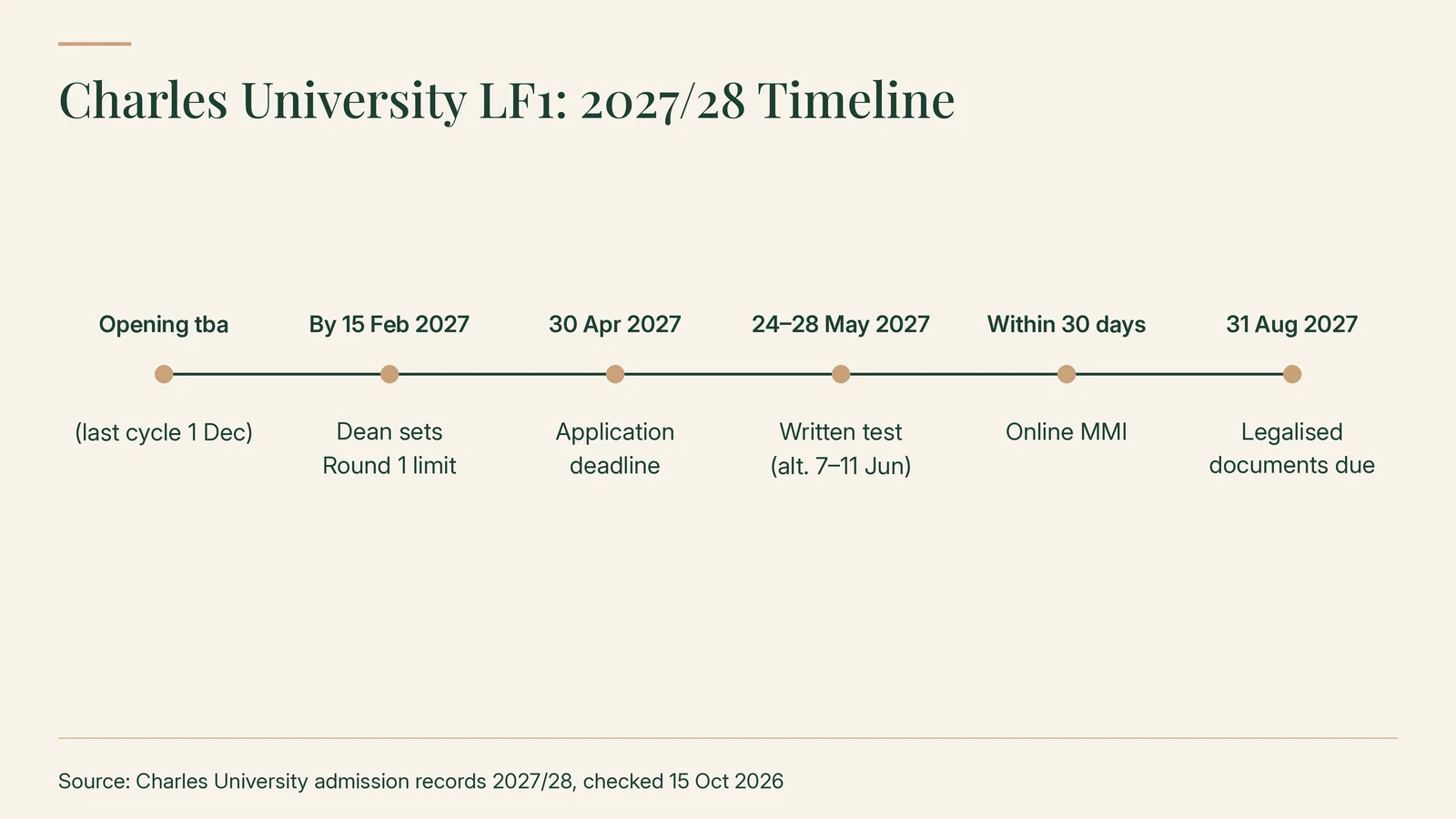
LF1 publishes no single official Call PDF. The binding sources are its own admissions pages at en.lf1.cuni.cz and the programmes' admission criteria in Charles University's admissions system. On 12 October 2026 LF1's pages still described the 2026/2027 cycle (there is no 2027/2028 admissions page yet), while the admissions system already carried the 2027/2028 criteria for General Medicine and Dentistry: the deadline and exam dates above come from those. Where the two differ, this guide gives both. IvyTest re-checks LF1's admissions pages and updates this guide when LF1 posts its 2027/2028 calendar.
Structure
Charles University LF1 Entrance Exam format
Round 1 is 75 scored multiple-choice questions in 90 minutes (about 72 seconds per question), split into three equally weighted blocks of 25 marks each. It is not divided into separately timed sections, so you manage the full 90 minutes across all three yourself. Every question is Single Best Answer: exactly one of the four options is the best answer, and a blank or multi-marked answer scores zero.
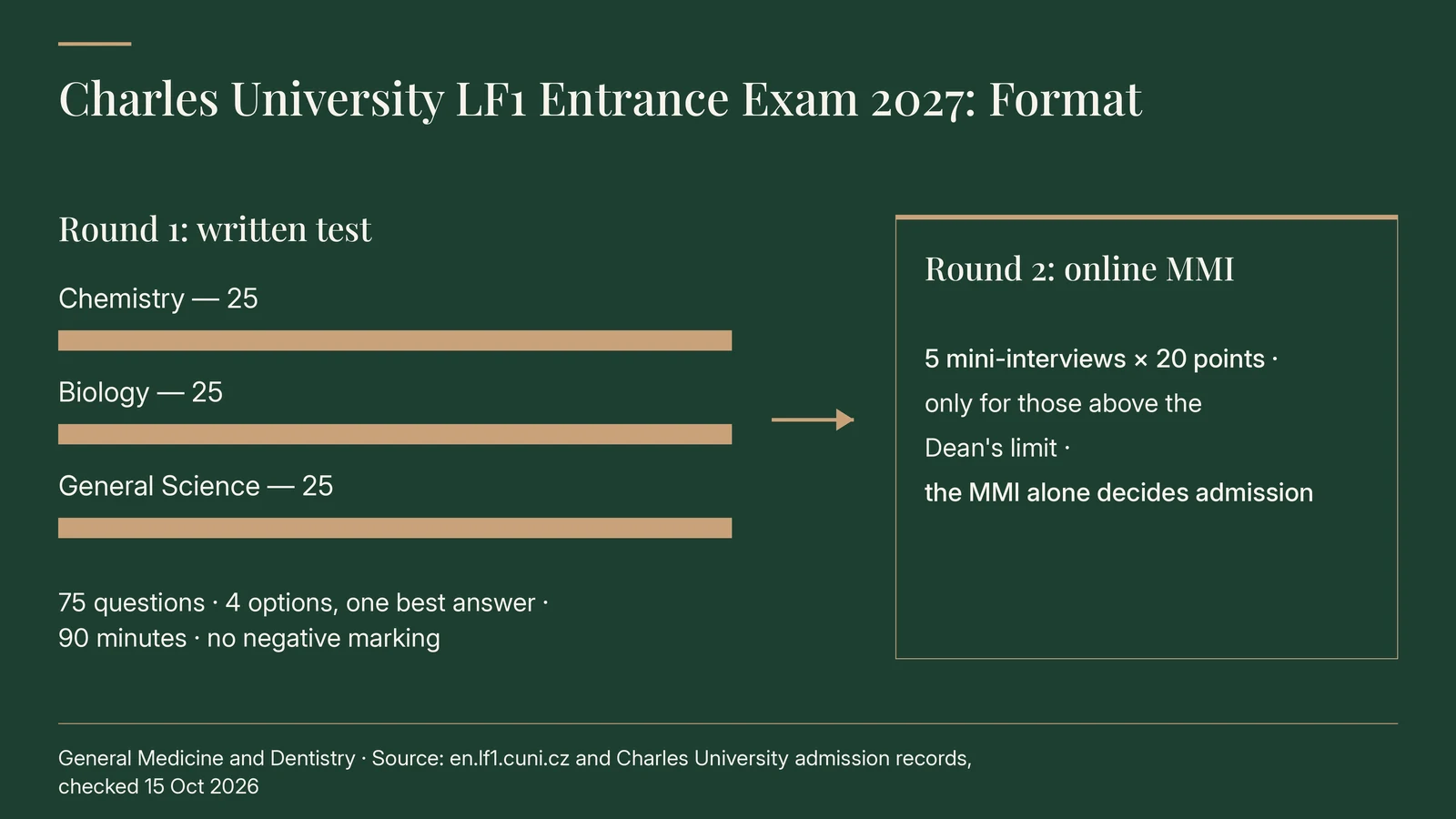
| Section | Questions | Weighting | Suggested time |
|---|---|---|---|
| Biology | 25 | 33% (25 of 75) | *see the note below the table |
| Chemistry | 25 | 33% (25 of 75) | *see the note below the table |
| General Science | 25 | 33% (25 of 75) | *see the note below the table |
- One continuous 90-minute sitting; LF1 sets no per-section time limit
Content
Question and subject breakdown
Three blocks, 25 questions each, weighted identically. LF1 states that the closest curriculum to its expected level is the British A-level system, so the pitch is a strong final-year school student rather than a first-year medical student. Two of the three blocks have an official topic list; the third does not.
Biology
33%Officially divided by LF1 into Systematic Biology, General Biology and Genetics, and Biology of the Man. In practice that spans classification and microorganisms, animal diversity, cell biology, metabolism and photosynthesis, molecular genetics, evolution and ecology, and a substantial run of human anatomy and physiology across the circulatory, respiratory, digestive, excretory, endocrine, nervous and reproductive systems.
Chemistry
33%Follows LF1's published Chemistry topic list: atomic structure and periodicity, bonding and inorganic nomenclature, the mole and stoichiometry, states of matter and solutions, acids and bases, redox and electrochemistry, kinetics and equilibrium, organic chemistry and biochemistry. Calculations appear throughout, and LF1 states no calculator rule, so practise them by hand.
General Science
33%The block with no official syllabus. LF1 describes it as interpreting data, reading graphs and writing problems down using mathematical equations, and there is no separate Physics paper at LF1, so mechanics, fluids, electricity and waves are examined here, alongside units, proportional reasoning, exponential growth and decay, statistics and applied quantitative items drawn from biology and chemistry contexts. Charles University's admission criteria describe this third part as physics that also tests logical, critical and creative thinking.
Marks
Charles University LF1 Entrance Exam scoring
LF1's scoring rule is stated on its own admissions page and it is the single fact that should change how you sit this paper: there is no negative marking. A wrong answer and a blank are worth exactly the same: nothing, so leaving a question unanswered can only cost you and can never protect you.
- Correct answer
- +1 point
- Incorrect answer
- 0 points (no negative marking)
- Unanswered question
- 0 points
- Multi-marked answer
- 0 points; marking two options is scored as a miss, not as a hedge
- Maximum possible score
- 75 points (three blocks of 25)
- How the result is reported
- Each of the three parts is converted to a 0-100% scale by a standardised method set in a Dean's directive, and progression to Round 2 rests on the sum of the three percentages; LF1's own page shows the result as a percentage total. The 10% bonus that qualifying IB, A-level or Abitur results earned in 2026/27 is not in the 2027/28 admission records, which instead let such results exempt you from Round 1
- Minimum eligible score
- No numeric pass mark published; the Dean sets the Round 1 limit (for 2027/28 by 15 February 2027) and states no rule for how it is decided
- Per-subject floors
- None. LF1 has no per-section minimum; the three blocks are simply equally weighted at 25 marks each
- What decides admission
- Round 2 only: the MMI is scored independently of Round 1 and alone determines a place; the Dean sets the admission limit from the MMI results and the programme's capacity (150 General Medicine, 30 Dentistry for 2027/28)
Worked example
Suppose you know 52 of the 75 questions confidently, can narrow 15 more to two plausible options, and have no idea on the remaining 8. Answer everything. The 52 score 52. On the 15 you have narrowed to two options, a coin flip returns about 15 × 0.5 = 7.5 marks. On the 8 you are guessing blind across four options, the expected return is 8 × (1/4 × 1) + 8 × (3/4 × 0) = 2 marks. Expected total: about 61.5 out of 75, or 82%. Now run the same paper leaving the 23 uncertain questions blank: you score 52, or 69%. That 9.5-mark difference (thirteen percentage points) is created purely by the decision to answer, not by knowing anything more. Because the expected value of a completely blind four-option guess here is +0.25 marks and the expected value of a blank is exactly 0, there is no question on this paper that is worth leaving empty; the only thing you must not do is mark two options, which scores zero however good one of them was.
The IvyTest simulator scores every practice paper against these exact rules.
See the Charles University LF1 Entrance Exam simulatorSyllabus
LF1 entrance exam syllabus and topics
LF1 publishes official topic lists for Biology and Chemistry, and the groups below preserve every area those lists name, regrouped into pools of comparable size. General Science has no official topic list at all: that group is derived from LF1's official mock test and from the faculty's own one-line description of the section, and should be read as IvyTest's mapping rather than as a published syllabus.
LF1's own division is Systematic Biology, General Biology and Genetics, and Biology of the Man. Depth benchmark: British A-level, not medical school.
- Classification and microorganisms: purpose of biological classification, taxonomic ranks and binomial nomenclature, protozoa (Flagellata, Rhizopoda, Sporozoa, Ciliata), viruses as acellular particles and their replication cycles, bacterial cell structure, binary fission, beneficial and pathogenic bacteria, antibiotic resistance
- Animal diversity and vertebrates: Porifera, Cnidaria and Acnidaria, Platyhelminthes, Nemathelminthes, molluscs, annelids and arthropods with their medical relevance, protostome and deuterostome development, chordate and vertebrate features, Cyclostomata and Chondrichthyes, fish, amphibians, reptiles, mammals, primates and the human position among them
- Cell biology: cell theory, prokaryotic and eukaryotic cells, animal and plant cells, organelles, plasma membrane structure and selective permeability, diffusion, osmosis, facilitated diffusion, active transport, endocytosis and exocytosis, tonicity, the cell cycle and its checkpoints, mitosis, meiosis, crossing over and independent assortment
- Metabolism and photosynthesis: catabolism and anabolism, ATP as energy currency, enzymes and activation energy, effects of temperature, pH and substrate concentration, aerobic respiration at overview level (glycolysis, the Krebs cycle, oxidative phosphorylation), fermentation, heterotrophy, autotrophy and mixotrophy, chloroplast structure, light-dependent reactions and the Calvin cycle, limiting factors
- Molecular biology and genetics: chromosome structure and number, intranuclear and extranuclear DNA, semi-conservative replication, RNA types, the genetic code and protein synthesis, Mendel's rules of inheritance, monohybrid and dihybrid crosses, test crosses and Punnett squares, heritability of sex and sex-linked inheritance, gene linkage, polygenic inheritance, human hereditary diseases and pedigrees, spontaneous and induced mutations, population genetics
- Evolution, ecology and reproduction: origin of life on Earth, endosymbiotic theory, Darwin and natural selection, adaptation and fitness, speciation, evidence for evolution, human origins and biological variation, biotic and abiotic components, food chains and webs, trophic levels and energy flow, circulation of substances in nature, ecosystem stability and succession, human impact, sexual and asexual reproduction, ontogenesis
- Skeleton, blood and circulation: bone structure and bone connections, the human skeleton, voluntary and smooth muscle, body fluids and the internal environment, blood composition and function, red cells, leucocyte subtypes, non-specific and specific immunity, immunisation and vaccination, blood groups, the Rhesus factor, transfusion and coagulation, heart structure and function, pulmonary and systemic circulation, capillaries and tissue fluid, control of circulation, lymph
- Respiration, digestion and excretion: the respiratory system, ventilation, gas exchange in lungs and tissues, breathing control, the digestive system and its parts, digestive enzymes and the conversion of saccharides, lipids and proteins, the liver and its functions, optimal composition of food, fat-soluble vitamins, the B group and vitamin C with their avitaminoses, body temperature regulation, the kidneys, the nephron and urine formation, the skin
- Control, senses and reproduction: endocrine glands and negative feedback, insulin, adrenals, thyroid and parathyroid, anterior and posterior pituitary, the neuron and nervous conduction, synapses, conditioned and unconditioned reflexes, the involuntary nervous system, the human brain and its parts, olfaction, taste, skin perception, the eye, hearing and the vestibular apparatus, ovaries and female sex hormones, the menstrual cycle, pregnancy, intrauterine development, the placenta and labour, the testes and male sex hormone, the periods of human life
Every area of LF1's published Chemistry topic list appears below; the only regrouping is that acid-base chemistry and redox are split apart, and inorganic nomenclature is filed with bonding because the official list ties naming to valence and oxidation number.
- Atomic structure and periodicity: subatomic particles and their arrangement, atomic number, mass number, atomic mass and isotopes, the principal chemical laws, electrons in principal energy levels and sublevels, orbitals, valence electrons and electron-dot formulas, the periodic law, periods and groups, periodic trends, using the periodic table to predict oxidation numbers, properties, formulas and bonding type
- Bonding and nomenclature: valence and oxidation number, ions, cations and anions, the ionic bond, the covalent and co-ordinate covalent bond, polyatomic ions and their formulas, structural formulas, systematic names of inorganic compounds, binary compounds of two non-metals, binary compounds of a metal and a non-metal, ternary and higher compounds, acids, bases and salts as inorganic classes
- The mole and stoichiometry: the mole, Avogadro's number, molar volume of a gas, molecular mass, percentage composition, empirical and molecular formulas, balancing chemical equations, mole ratios, mass-mass and mass-volume calculations, limiting reagent, theoretical and percentage yield
- States of matter and solutions: gases, liquids and solids and changes of state, the polarity of water and hydrogen bonding, the chemical and physical properties of water and its reactions, hydrates, hydrogen peroxide, ozone, types of solution, solubility, concentration and dilution, colligative properties, colloids and the Tyndall effect
- Acids, bases and pH: definitions and properties of acids and bases, Brønsted-Lowry theory and conjugate pairs, strong and weak acids and bases, the ionisation of water and Kw, pH and pOH, neutralisation and salt formation, electrolytes and nonelectrolytes, full and net ionic equations, spectator ions
- Redox and electrochemistry: definitions of oxidation and reduction, oxidising and reducing agents, assigning oxidation numbers to identify a redox reaction, half-equations and balancing simple redox equations, the galvanic cell, anode and cathode, electrolyte and salt bridge, electrolysis
- Reaction rates and equilibrium: rate as change in concentration over time, collision theory and activation energy, the effects of concentration, pressure, temperature, surface area and catalysts, reversible and irreversible reactions, dynamic equilibrium, equilibrium position, Le Chatelier's principle
- Organic chemistry: carbon bonding and tetravalency, homologous series and functional groups, IUPAC nomenclature and properties, structural isomerism, stereoisomerism and cis-trans isomerism, alkanes, alkenes, alkynes and aromatic hydrocarbons, addition polymers, organic halides, alcohols, phenols and ethers, aldehydes and ketones, carboxylic acids and esters, amides, amines, amino acids and nitro-derivatives, heterocyclic compounds
- Biochemistry: proteins, the peptide bond and the four levels of protein structure, denaturation, monosaccharides, disaccharides and polysaccharides, glycosidic bonds, lipids, triglycerides, saturated and unsaturated fatty acids, phospholipids and steroids, nucleosides, nucleotides and nucleic acids, enzymes and their inhibition, hormones, vitamins and their solubility classes
Derived, not official. LF1 publishes no General Science topic list; the areas below come from its official mock test and from its own description of the section as interpreting data, reading graphs and writing problems down using mathematical equations. Physics is examined here rather than as a separate paper.
- Measurement and units: scientific notation and standard form, significant figures and rounding, decimal places versus significant figures, SI base and derived units, length, area and volume conversions including the effect of powers, mass, time and speed conversions, concentration units, dimensional analysis and checking a formula by its units
- Proportional reasoning: percentages, percentage change and the difference between a percentage change and percentage points, ratio and proportion, scaling a quantity by area, mass, volume or time, dose and rate calculations, estimation and order-of-magnitude checks
- Charts and graphs: reading pie and bar charts, estimating values from visual data, expressing a category as a percentage of a total, identifying the largest and smallest contribution, axis and label traps, straight-line graphs, gradient and y-intercept, choosing the equation of a plotted line, interpreting a slope in a scientific context
- Exponential growth and decay: doubling time and repeated doubling in a culture, half-life, rearranging an exponential decay expression and solving for the decay constant, recognising when repeated multiplication rather than a linear step is required
- Statistics and study interpretation: mean, variability and spread, standard deviation, values falling within a tolerance range, the normal distribution and the 68-95-99.7 rule, positive and negative correlation, the strength of a correlation and the coefficient r, p-values as evidence against chance, why association does not prove causation
- Mechanics and energy: speed, distance and time, acceleration and average speed from rest, motion at constant speed, free fall and impact speed, force and net force, why constant speed means zero resultant force, weight, normal force and friction, inclined-plane reasoning, work as force times distance, the joule, kinetic energy and its dependence on the square of speed, potential energy, conservation of energy, power
- Fluids and oscillations: density, pressure in fluids, buoyant force and Archimedes' principle, displaced volume and why buoyancy depends on fluid density rather than on the object's mass, period and frequency, the simple pendulum and why its period depends on length and gravitational acceleration but not on the mass of the bob
- Electricity and waves: resistance, series and parallel circuits, why equivalent resistance in parallel is lower than the smallest individual resistor, current, voltage and Ohm's law, wave speed as frequency times wavelength, what happens to wavelength when a wave enters a faster medium at constant frequency, sound and ultrasound as mechanical waves, the electromagnetic spectrum, the speed of electromagnetic radiation in vacuum, shorter wavelength as higher frequency and higher photon energy
- Applied science data: biology and chemistry crossover items in a quantitative frame, complementary base pairing and deducing base percentages in double-stranded DNA, colony-forming units and microbial growth, energy and environmental data such as hospital consumption in megawatt hours, translating a worded scientific scenario into an equation and selecting the most reasonable answer
Test your Charles University LF1 Entrance Exam knowledge
Take free diagnosticDifficulty
How difficult is the Charles University LF1 Entrance Exam?
LF1's written paper is not conceptually advanced; the faculty benchmarks it against British A-level. What makes it hard is the shape of the thing: two rounds with very different jobs, one section nobody can revise from an official list, and a clock that gives you barely over a minute per question.
No negative marking, so a blank is a pure loss
LF1 states it plainly: no negative marking. A blind four-option guess has an expected value of +0.25 marks and a blank has an expected value of exactly 0, which makes every unanswered question a decision to accept a worse outcome. The one real trap is multi-marking: marking two options to hedge scores zero, the same as leaving it empty, because only a single best answer is accepted.
A third of the paper has no official syllabus
LF1 publishes topic lists for Biology and Chemistry but not for General Science, which is nevertheless worth the same 25 marks. The only official material for it is a mock test and a one-line description of the section. That makes General Science the block where candidates most often discover the content on the day rather than before it.
Physics is in the paper, but not as a Physics paper
LF1 has no Physics section. Mechanics, fluids, electricity and waves all appear inside General Science, mixed in with statistics, graph reading and unit work. Candidates who prepare from a sister faculty's material (Pilsen and Hradec Králové do run a separate Physics section) end up revising the right physics in the wrong proportion and skipping the data-handling half entirely.
The written paper is a gate, not a score
Only applicants who pass Round 1 are invited to Round 2, and Round 2, an online MMI of five ten-minute stations worth 20 points each, is scored independently and alone determines admission. A written result far above the line and a written result just above it produce the same next step. Time spent turning an already-passing score into a spectacular one is time not spent preparing for the stations that actually decide the outcome.
72 seconds a question, arithmetic by hand
75 questions in 90 minutes is 1.2 minutes each, and that average has to absorb the General Science items that need genuine multi-step arithmetic (exponential growth, dilution, gradients, unit conversions), with no calculator rule stated by LF1. The paper is written to stay tractable by hand, but only if you have practised it by hand.
Benchmarks
What is a good Charles University LF1 Entrance Exam score?
There is no published number to aim at. IvyTest checked LF1's admissions page, its admission-process page, its preparation page and its page on changes to admission testing on 21 September 2026: all four describe a Dean-set pass/fail gate for Round 1, and none of them states a figure or a rule for how the figure is chosen.
Because the threshold is set by the Dean and the result is reported as a percentage out of 75, the honest answer to 'what score do I need' is that the faculty does not say, and any specific percentage circulating elsewhere is somebody's estimate rather than an LF1 statement. What is published is the structure around it: pass Round 1 and you are invited to the MMI; fail it and the application ends there.
That structure suggests a different target than a ranking exam would. On a purely ranked paper, every extra mark is worth having. Here, the written score's only job is to clear a line you cannot see in advance, so the useful preparation goal is a comfortable margin across all three blocks on full, timed 90-minute mocks, rather than a peak score in your strongest subject. Since Round 2 is scored independently and decides admission on its own, a candidate who passes Round 1 with room to spare and has rehearsed the MMI is in a materially better position than one who maximised the written paper alone.
Pending verification
- · The numeric Round 1 pass mark, and the rule the Dean uses to set it
- · Historical pass thresholds by year
- · Applicant numbers for 2027/28
- · How many Round 1 passes are invited to the Round 2 MMI
These specific numbers aren't public yet — an IvyTest simulator score is the closest benchmark you can get today.
Check your Charles University LF1 Entrance Exam scoreStrategy
How to prepare for the Charles University LF1 Entrance Exam

12+ weeks
Three equal blocks, and the MMI treated as a real fourth
Even coverage of Biology, Chemistry and General Science, with MMI rehearsal started early.
- Sit a full 75-question diagnostic in week one under the real +1/0/0 rule, and split it by block: the three are worth 25 marks each, so an imbalance anywhere is worth the same as an imbalance anywhere else.
- Give General Science equal calendar time from the start, not leftover time. It is the only block with no official topic list, so it needs the most deliberate coverage: units, proportion, graphs, exponentials, statistics, mechanics, fluids, electricity and waves.
- Work Chemistry calculations by hand from day one; LF1 states no calculator rule, and stoichiometry, dilution and pH items are where hand-arithmetic speed is actually won.
- Start MMI practice by week six. Five ten-minute stations worth 100 points decide admission, and they cannot be crammed in the week after the written result arrives.
8 weeks
Close the General Science gap while the sciences stay warm
Targeted repair, with the unsyllabused block getting the largest share.
- Diagnostic first, then audit General Science specifically against the nine areas LF1's mock test covers: most candidates arrive strong on Biology and Chemistry and thin on data handling.
- Keep Biology and Chemistry on a weekly rotation rather than blocking them; the paper mixes all three and there are no section breaks to reset between them.
- One full timed 90-minute mock a week from week two, reviewed the same day, with wrong answers logged by cause: content gap, misread question, or ran out of time.
- Book two MMI rehearsals in this window, ideally with someone who will hold you to the ten-minute station limit.
4 weeks
Full 90-minute sittings, and never a blank
Volume of timed papers at the real pace, plus answer-everything discipline.
- Two full 75-question mocks a week at the 90-minute limit, scored with +1 for correct and 0 for everything else.
- Practise finishing. With 72 seconds a question, the recoverable marks at the end of the paper are usually lost to pacing rather than to knowledge.
- Build the habit of answering every single item: with no negative marking, a blind guess is worth +0.25 and a blank is worth 0, and never marking two options on the same question.
- Rehearse the practical setup (in English, on paper or on screen, arithmetic by hand) so nothing about the format is new on the day.
Under 4 weeks
Pass the gate, then turn to the stations
Triage for a pass/fail paper rather than a peak score.
- Stop adding new content. Consolidate the highest-frequency areas in all three blocks, weighting whichever block your mocks show weakest; they carry identical marks.
- Drill General Science arithmetic specifically: unit conversions, percentage change, doubling and half-life, reading a gradient. These are learnable in days and appear throughout the block.
- Sit at least two full, scored 90-minute mocks in the final ten days, then taper.
- Reserve real time for the MMI. Round 1 only has to be passed; Round 2 is scored independently and is what decides whether you are admitted.
Get your personalised Charles University LF1 Entrance Exam study plan
Take free diagnosticExplore the full Charles University LF1 Entrance Exam planPractice
Free Charles University LF1 Entrance Exam practice questions
Three questions in the format the exam uses. Choose an answer to see the explanation — nothing is recorded.
How many grams of sodium hydroxide are needed to prepare 500 mL of a 0.200 mol/L NaOH solution? (M(NaOH) = 40.0 g/mol)
A bacterial culture doubles in number every 20 minutes. Starting from 5,000 cells, how many cells are present after 2 hours, assuming growth remains unrestricted?
Illustrative examples written by IvyTest to show the question style — not past Charles University LF1 Entrance Exam papers.
Past papers
Charles University LF1 Entrance Exam past papers
LF1 publishes no past papers, but its How to prepare page links an official mock test as a free PDF: 75 questions, 25 each in Chemistry, Biology and General Science, with the answer key on its last page, and a separate General Science mock with the correct options marked. It is the official picture of the paper: the four-option format on this page was confirmed on it. The practice paper on this page is IvyTest's own: all 75 questions in LF1's format, each with its answer explained, which the official key does not do.
University
Charles University, First Faculty of Medicine medicine admissions
The written paper sits inside a two-round application, and passing it is only the first half. The figures below describe the English-taught programmes at the First Faculty of Medicine in Prague; Charles University's other four Czech medical faculties set their own fees, calendars and exams independently.
- Degrees
- General Medicine and Dentistry (English-taught), both admitted through this examination
- Language of instruction
- English
- Campus
- First Faculty of Medicine, Prague
- Tuition
- €24,250 / year: for 2026/27 entrants on LF1's admissions and fee pages, and the same figure in the 2027/28 admission records. It is the highest of Charles University's five Czech medical faculties, each of which sets its own fee schedule independently
- Application fee
- €285
- Interview
- Yes. Round 2 is an online MMI: five consecutive 10-minute stations, 20 points each, 100 in total
- English certificate
- Not required. LF1 states that for 2026/27 no English proficiency certificate and no personal statement is needed; the 2027/28 admission records say English is demonstrated by passing the MMI
- Motivation letter
- Not required
- Recommendation letters
- Not required
- Document requirements
- Legalisation and certified translation required; apostille depends on the issuing country
- Cost of living
- No verified Prague cost-of-living figure yet; IvyTest's Czech city research has not reached Prague
- Seats available
- 150 in General Medicine and 30 in Dentistry for 2027/28, as for 2026/27. For the past academic year the 2027/28 records report 119 of 614 General Medicine applicants and 31 of 108 Dentistry applicants admitted; the 2026/27 records had reported 102 of 785 and 21 of 109
- Application process
- Apply through the LF1 admissions portal; pass the Round 1 written test to be invited to the Round 2 online MMI, which alone decides admission
The campus
The First Faculty's Purkyně Institute
The First Faculty of Medicine teaches in buildings across Prague; the model shows one of them, the Purkyně Institute at Albertov 4, in the university's Albertov quarter. Designed by Alois Špalek, built in 1923–1925 and opened in 1926, it houses the Institutes of Biology and Medical Genetics, Pharmacology, Histology and Embryology, and Cell Biology and Pathology, around the 331-seat Purkyně Amphitheatre, with the semicircular rotunda at its west end.

Explore the Purkyně Institute.
Open it in 3D to turn it and see what each building holds.
Stylized campus illustration, not a map or to scale.
Purkyně Institute
The main front on Albertov, with the inscription Purkyňův ústav over the entrance. It houses First Faculty institutes: Biology and Medical Genetics, Pharmacology, Histology and Embryology, and Cell Biology and Pathology.
Rotunda
The semicircular west end and the building's signature: a museum in its basement, the Vejdovský hall on the ground floor and the Jánošík hall on the second floor, where students do microscopy practicals.
Purkyně Amphitheatre
The great lecture hall in the central wing, with tiered seating for 331 students.
East wing
Built for the institute of pharmacology and pharmacognosy; the Institute of Pharmacology is still in the building.
Address: Albertov 4, 128 00 Praha 2
IvyTest Charles University LF1 Entrance Exam preparation
Ready to prepare properly for the Charles LF1 entrance exam?
Everything above is free and always will be. When you want structure (a syllabus-mapped book that covers General Science as seriously as it covers Biology and Chemistry, a simulator that runs the real 75-question, four-option, no-penalty format, lessons for the gaps your results flag, and help with the application itself), that is what the IvyTest Charles LF1 package is.
Study guide
All three blocks at equal depth, including the General Science content LF1 publishes no topic list for.
Exam simulator
Timed 90-minute mocks in the real 4-option, +1/0/0 format, with per-question explanations and per-block analytics.
Video courses
Focused lessons in biology, chemistry and the quantitative reasoning General Science leans on.
Application support
MedApply: deadlines, documents, legalisation and enrolment steps carried through to a confirmed place.
FAQ
Charles University LF1 Entrance Exam frequently asked questions
It's the two-round admission process the First Faculty of Medicine uses to select candidates for its English-taught General Medicine and Dentistry programmes in Prague. Round 1 is a 75-question written paper in 90 minutes: Biology, Chemistry and General Science, 25 questions each. Round 2 is an online MMI of five ten-minute stations worth 100 points in total.
Neither. There is no shared national medical entrance test behind it, and the five medical faculties of Charles University run structurally different papers. LF1's third block is General Science; the Pilsen and Hradec Králové faculties run a Physics section in its place; the Second Faculty runs four sections including a separate Logic block; the Third Faculty runs only Biology and Chemistry. Preparation built for one faculty does not transfer cleanly to another.
Round 1 is sat in person, in Prague or abroad through an official LF1 partner agency, and delivered entirely in English. LF1's 2026/27 page calls it paper-based; Charles University's 2027/28 admission criteria allow paper or electronic form. For 2026/27 an online Emergency Distance format applied only to candidates in conflict-affected regions. Round 2, the MMI, is conducted online.
+1 for a correct answer, 0 for an incorrect one and 0 for a blank; LF1 states there is no negative marking. A blind guess across four options is therefore worth +0.25 marks on average and a blank is worth 0, so there is never a reason to leave a question unanswered. The one thing to avoid is marking two options: every item is Single Best Answer, and a multi-marked answer scores zero.
LF1 operates Round 1 as a pass/fail gate (only applicants who pass are invited to the second round), but no numeric pass mark is published. IvyTest checked the admissions page, the admission-process page, the preparation page and the page on changes to admission testing on 21 September 2026, and all four describe a Dean-set threshold without stating a figure. Charles University's 2027/28 admission criteria convert each part to 0-100% and base progression on the sum of the three percentages, with the Dean setting the limit by 15 February 2027.
No. LF1 publishes no per-section minimum: the three blocks are simply equally weighted at 25 marks each, and there is no Czech counterpart to the per-subject 'additional learning requirement' floors used by some Italian medical schools.
It's a Multiple Mini Interview held online: five consecutive ten-minute stations, each worth 20 points, 100 points in total. It is scored independently of the written paper and it alone determines admission: passing Round 1 gets you into the room, but it does not carry a score forward with you.
Yes. LF1's entrance examination is the Medicine and Dentistry Entrance Examination, and both English-taught programmes are admitted through it. It is not used for doctoral (PhD) study: LF1 admits PhD students separately, through an interview with an examination committee, usually in June.
For 2027/28 Charles University's admissions system lists 150 expected places in General Medicine and 30 in Dentistry, as for 2026/27, and reports that 119 of 614 General Medicine applicants and 31 of 108 Dentistry applicants were admitted in the past academic year: an acceptance rate of about 19% and 29%. The 2026/27 records had reported 102 of 785 and 21 of 109 (about 13% and 19%). What decides who gets a place is the structure: a pass/fail written gate followed by a 100-point MMI.
Within the EU, yes: automatically, as a standard Czech medical degree. There's no separate national licensing exam afterwards: the Czech state exam (státní rigorózní zkouška) is built into the MUDr degree itself, and registration with the Czech Medical Chamber (ČLK) is compulsory to practise in the country. Graduates of English-taught programmes typically also go through an additional Ministry of Health 'recognition of fitness to practise' step that Czech-taught graduates don't need. Outside the EU recognition isn't automatic as a rule, but the UK is an exception. Under the Medical Act 1983 (section 21B, as in force on 12 October 2026), the Czech medical degree (MUDr) is a 'relevant European qualification', so a graduate who applies to the GMC with one, whatever their nationality, is not asked to show the knowledge and skills other international graduates prove through PLAB/UKMLA; evidence of English is still required, and the rule is UK policy that can change. LF1's own study-programmes page says the MUDr is 'recognised throughout the EU, UK, U.S.', but in the US that still means the ECFMG route. US-bound graduates need ECFMG certification via USMLE Step 1 and Step 2 CK, the same requirement every international medical graduate faces.
Yes. The IvyTest simulator runs LF1-format practice (75 questions, four options, the real +1/0/0 scoring across Biology, Chemistry and General Science) in timed, tutor and review modes, with a free diagnostic available without payment.
LF1 publishes no past papers, but its How to prepare page links an official mock test as a free PDF: 75 questions (25 Chemistry, 25 Biology and 25 General Science) with the answer key on its last page, and a separate General Science mock with the correct options marked. The same page links the official Biology and Chemistry topic lists; every area they name is in the syllabus on this page.
Charles University's 2027/2028 admission criteria close applications on 30 April 2027 and date the written test 24-28 May 2027, with an alternative on 7-11 June 2027; LF1's own pages have not yet posted the 2027/2028 calendar or the opening date. For 2026/2027, applications ran from 1 December 2025 to 5 September 2026; Prague held the written test on 8 June 2026 and again on 16 and 23 September 2026, and representatives ran sittings abroad from 30 May to 4 September 2026. The online MMI usually follows within a week.
You need secondary education completed with a school-leaving examination (you may apply before finishing it) and the €285 application fee; no English certificate or personal statement is required, and the 2027/2028 criteria say English is shown by passing the MMI. Admission rests on the entrance exam: pass Round 1, then the MMI decides. Under the 2027/2028 criteria you may ask to skip Round 1 with a medicine or dentistry degree, a related degree completed in 2022 or later, six semesters of medicine or dentistry since 2022 (Czech Republic, EU or OECD), or a top result from 2022 or later in the IB (36 points, with 13 from two HL subjects including Biology or Chemistry), A-levels (A*AA), AP, the European Baccalaureate or the Abitur; in 2026/2027 such school results earned a 10% bonus instead. Someone who passed both rounds in 2026/2027 but could not start for serious reasons, such as a visa delay, may ask to skip the whole exam. You may apply once per academic year, and a foreign school certificate must be recognised, with legalised documents due by 31 August 2027.
At the First Faculty of Medicine, tuition for General Medicine and Dentistry in English is €24,250 a year for students starting in 2026/2027, paid in euros to the faculty, and Charles University's 2027/2028 admission criteria give the same €24,250. The application fee is €285, and you cannot sit the entrance exam until it is paid. Living costs are not included, and LF1's optional Induction Course for new students costs €150. Each Charles University medical faculty sets its own fees; LF1's are the highest of the five.
Yes. LF1 has taught General Medicine in English for more than 30 years: a 6-year programme leading to the MUDr degree, alongside a 5-year Dentistry programme (MDDr). About 800 students from 50 countries study in English there, with clinical teaching in 5 Prague hospitals. The first-year study plan for 2026/2027 includes Anatomy with dissections, Biology and Genetics, Biophysics, Histology and Embryology, Medical Terminology and Czech, and LF1 publishes each year's plan.
LF1 runs none itself, but its admission criteria recommend the foundation programmes of Charles University's Institute for Language and Preparatory Studies (ILPS). Its Medicine and Pharmacy in English programmes teach Biology, Chemistry and Physics, with mock tests and MMI practice: COMPLEX in Poděbrady at €7,990 and FAST in Prague from €4,936. LF1's own Induction Course is for admitted students, not applicants.
Founded in 1348, Charles University is one of Europe's oldest, and LF1 calls itself the oldest medical faculty in Central Europe and the largest in the Czech Republic. Charles University's own preparatory institute cites the QS World University Rankings 2025 (top 250), QS's Medicine table (151-200) and ShanghaiRanking's Clinical Medicine (151-200, 2024 data): these rank the university, not LF1 alone. QS's own 2025 table has Charles University at =246, and ShanghaiRanking's Clinical Medicine table has it at 151-200 in 2024, as again in 2025 and 2026; the QS Medicine figure carries no year, and that table could not be read. For students' own views, LF1 points applicants to MEDSOC, its students' organisation.
Yes: r/charlesfirstfaculty, where Charles University, First Faculty of Medicine applicants ask each other about the Charles University LF1 Entrance Exam and share how their preparation is going. It is run by the IvyTest team. Dates, rules and results come only from the university's own pages, listed under Official sources on this page.
Verification
Official sources
- Admissions 2026/2027, First Faculty of MedicineChecked: 12 October 2026
Charles University, First Faculty of Medicine
- Admission process, First Faculty of MedicineChecked: 7 October 2026
Charles University, First Faculty of Medicine
- How to prepare for entrance exams (official Biology and Chemistry topic lists)Checked: 7 October 2026
Charles University, First Faculty of Medicine
- Official entrance examination mock test (Chemistry, Biology, General Science, 75 questions with the answer key)Checked: 7 October 2026
Charles University, First Faculty of Medicine
- Tuition fee for first-year students in the academic year 2026/2027Checked: 12 October 2026
Charles University, First Faculty of Medicine
- Changes to admission testing at the 1st Faculty of MedicineChecked: 7 October 2026
Charles University, First Faculty of Medicine
- Written entrance test dates and locationsChecked: 12 October 2026
Charles University, First Faculty of Medicine
- General Medicine (English), admission criteria 2026/2027Checked: 7 October 2026
Charles University admissions system
- Dentistry (English), admission criteria 2026/2027Checked: 7 October 2026
Charles University admissions system
- Mock test GenSci (the General Science questions, correct options marked)Checked: 7 October 2026
Charles University, First Faculty of Medicine
- Applicants (study programmes, fees, MEDSOC student organisation)Checked: 12 October 2026
Charles University, First Faculty of Medicine
- Study plans, General Medicine 2026/2027Checked: 7 October 2026
Charles University, First Faculty of Medicine
- Induction Course 2026 (for admitted students, EUR 150)Checked: 7 October 2026
Charles University, First Faculty of Medicine
- Faculty in facts and numbersChecked: 7 October 2026
Charles University, First Faculty of Medicine
- First Faculty of Charles University is the oldest in Central EuropeChecked: 7 October 2026
Charles University, First Faculty of Medicine
- Doctoral studies: Admission ProcedureChecked: 7 October 2026
Charles University, First Faculty of Medicine
- Increase your chances for admission to the First Faculty of Medicine (foundation programmes and the rankings cited)Checked: 7 October 2026
Charles University, Institute for Language and Preparatory Studies
- General Medicine (English), admission criteria 2027/2028Checked: 12 October 2026
Charles University admissions system
- Dentistry (English), admission criteria 2027/2028Checked: 12 October 2026
Charles University admissions system
Last reviewed by IvyTest editorial team: 15 October 2026. Admission rules change every cycle — always confirm against the official Charles University, First Faculty of Medicine call for applications before acting on a deadline.
Find out how ready you are for the Charles LF1 entrance exam.
The diagnostic takes one sitting and returns a block-by-block picture of where you stand. No payment, no commitment.