

In human skeletal muscle working anaerobically, pyruvate is reduced to lactate. What is the principal purpose of this reaction?
Exam guide · Updated for 2027 admissions
Semmelweis Entrance Exam 2027: Complete Preparation Guide
Everything you need to know about the Semmelweis entrance exam for the English-taught Medicine, Dentistry and Pharmaceutical Sciences programmes in Budapest: the official topic list and free sample test, exam dates, the four-test format, scoring, the oral interview that follows, how to prepare and practice questions.
Updated for 2027 admissions · Last updated: 14 October 2026
Semmelweis Entrance Exam at a glance
Overview
What is the Semmelweis University entrance examination?
Semmelweis University is Hungary's oldest and best-known medical school, and it runs its own entrance examination for the English-taught Medicine, Dentistry and Pharmaceutical Sciences programmes in Budapest. There is no shared Hungarian national medical entrance test: Semmelweis, Debrecen, Pécs and Szeged each write, time and deliver their own paper, and the four differ enough in shape that preparation built for one does not transfer cleanly to another.
The written stage is four separately timed tests of 20 questions in 20 minutes each (Medical Biology, Medical Chemistry, General English and Biomedical English), which adds up to 80 questions in 80 minutes. That arithmetic hides the thing that actually matters: the four clocks run independently, so time you save in Medical Biology does not become time you can spend on Medical Chemistry. Questions appear one at a time in a fixed order, cannot be revisited once you move on, and the answers you have given submit themselves automatically when each 20-minute block expires.
The second thing to understand is the subject balance. Half of this paper (40 of the 80 questions) is English: a General English test of grammar, vocabulary and reading, and a Biomedical English test of scientific and clinical terminology. Candidates who arrive treating English as a formality they already speak routinely lose more marks there than in either science. And the written stage is not the end: an oral interview in Biology, Chemistry and English follows, which also assesses motivation and communication. Candidates may sit up to two exam occasions per calendar year.
Programmes that use the Semmelweis Entrance Exam
- Medicine (English-taught, Budapest)
- Dentistry (English-taught, Budapest)
- Pharmaceutical Sciences (English-taught, Budapest)
Timeline
Semmelweis Entrance Exam 2027: dates and deadlines
When to expect your exam · 2027 start
- February 2027any dateExpected
- March 2027any dateExpected
- April 2027any dateExpected
- May 2027any dateExpected
- June 2027any dateExpected
Predicted from this university's past sittings until it publishes its own dates. See every university on the calendar →
- Applications openNot yet announced: the programme pages say the application start is 'to be announced soon'
- Application deadline31 May 2027
- Entrance examination window2027/28 not yet published. Semmelweis's admission rules set the window from early February to the end of June, with exams once or twice a week booked through the SEMAPHOR portal
- Oral interviewHeld on announced dates after the written tests, in person by default, though online interviews are also offered; no fixed interval between the two is published
- Results publishedNo calendar date: the programme pages give notification within 2 weeks after the exam, and the Admission Rules say the decision letter follows within a week of the oral interview
- Enrolment deadline2027/28 not yet published. Semmelweis's FAQ puts the first semester's tuition (less the deposit) and the enrolment fee before 21 August, the date the school-leaving certificate is due; its 2026/27 Admission Rules set 31 July 2026
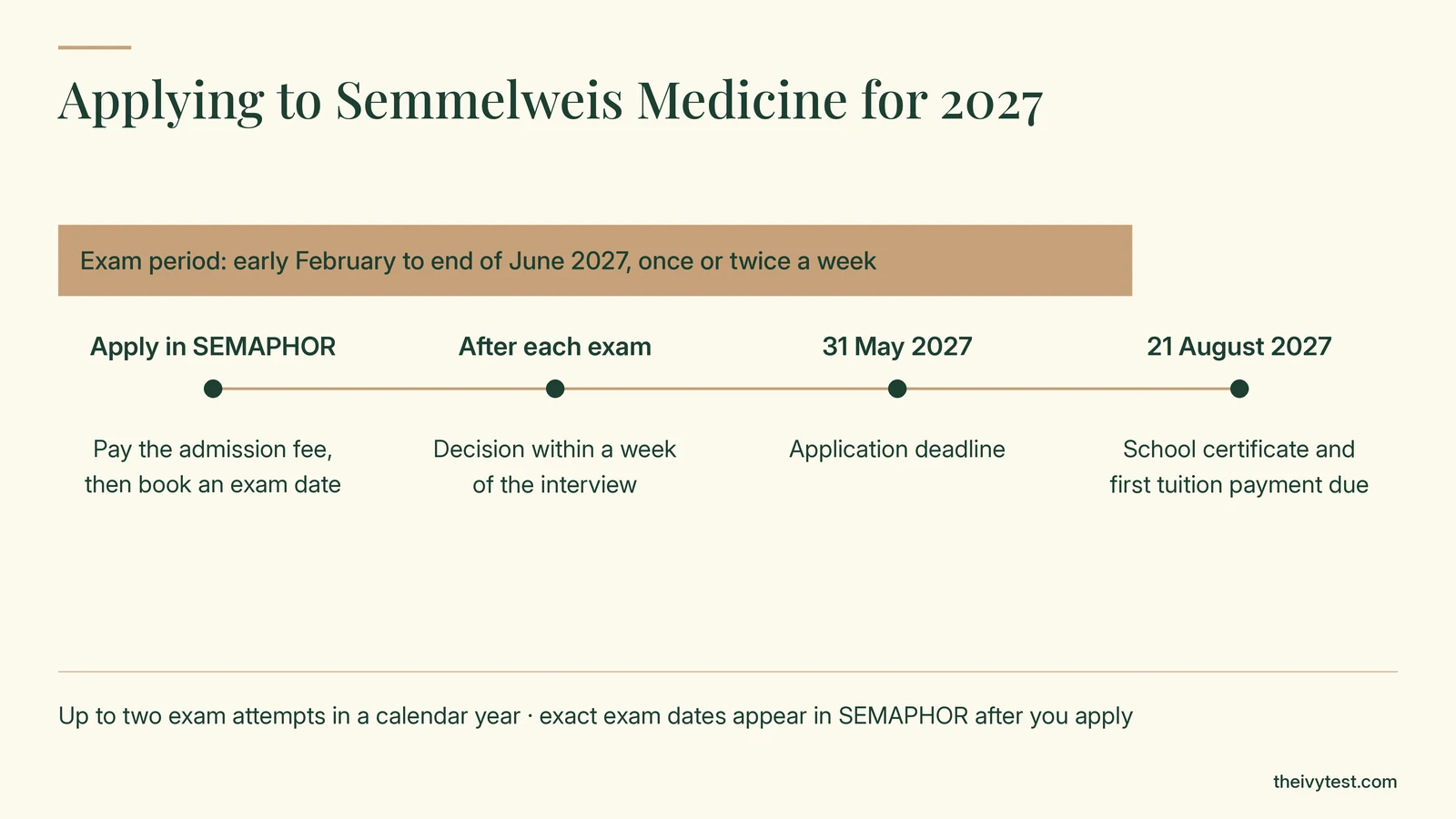
Semmelweis publishes no single Call document equivalent to an Italian bando; the binding sources are its own admission pages at semmelweis.hu and its annual Admission Rules. On 28 September 2026 the programme pages already gave 31 May 2027 as the application deadline for 2027/2028, with the application start still 'to be announced soon'; the exam dates themselves are announced through SEMAPHOR once you have applied. IvyTest re-checks the official admission pages and updates this guide when the next cycle's dates appear.
Structure
Semmelweis Entrance Exam format
Four tests of 20 questions each, every one of them on its own 20-minute clock. This is not an 80-minute paper you pace yourself across; it is four 60-second-per-question sprints in sequence, and unused time in one is simply lost rather than carried into the next. Within each test, questions arrive one at a time in a fixed order, may be left blank, and cannot be returned to once you proceed. A calculator is permitted in the Medical Chemistry test only.
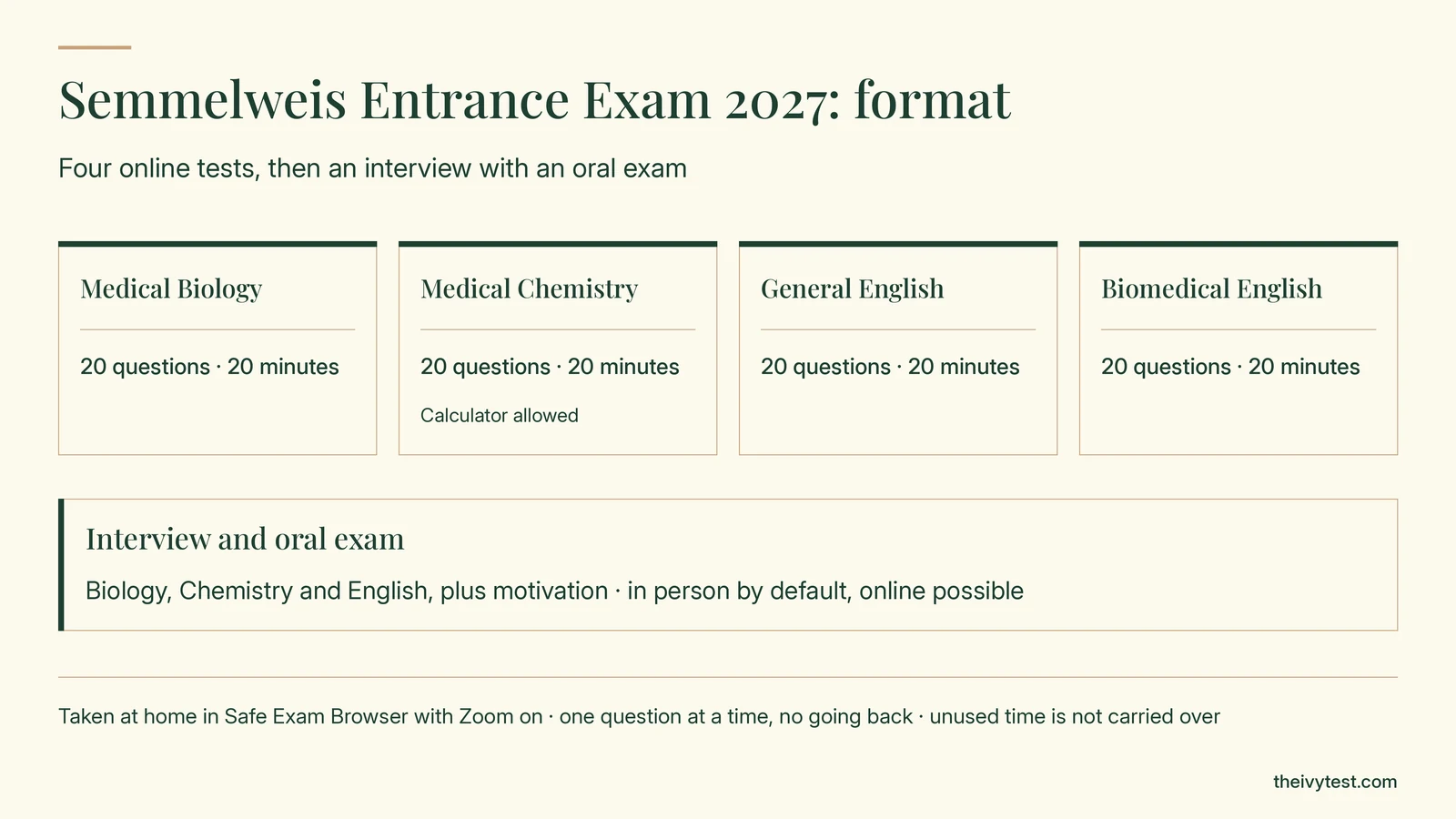
| Section | Questions | Weighting | Suggested time |
|---|---|---|---|
| Medical Biology | 20 | 25% (20 of 80) | 20 minutes (its own clock) |
| Medical Chemistry | 20 | 25% (20 of 80) | 20 minutes (its own clock) |
| General English | 20 | 25% (20 of 80) | 20 minutes (its own clock) |
| Biomedical English | 20 | 25% (20 of 80) | 20 minutes (its own clock) |
Content
Question and subject breakdown
Four equally weighted tests of 20 questions each. Two are sciences with an official topic list behind them (the Admission topics of Semmelweis University PDF names 27 Medical biology topics and 23 Medical chemistry topics), and two are English tests for which the university publishes no syllabus at all.
Medical Biology
25%Pitched at the molecular and physiological level rather than at whole-organism biology: biomolecules and protein structure, enzymes and their regulation, replication, transcription and translation, glycolysis and the citrate cycle, the electron transport chain, cell compartmentation and organelle function, Mendelian and mitochondrial inheritance, signalling and the cell cycle, human physiology across the heart, lungs, gut, kidney, muscle and nervous tissue, and reproduction, immunity and viruses. The university's own Admission Rules state the published topic list guides preparation and is not the source of the actual questions, so learn the topic, not the wording.
Medical Chemistry
25%The only test in which a calculator is permitted, and the only one where numerical work is squarely in scope: concentration and dilution, pH, the solubility product, cell potential and enthalpy all appear. Beyond the calculations it runs from atomic structure and bonding through solutions, equilibrium and buffers, redox and electrochemistry, thermodynamics and kinetics, organic foundations, bioorganic chemistry and the biochemical building blocks. Everything still has to be answerable in about a minute.
General English
25%A full quarter of the paper, and one Semmelweis publishes no syllabus for. Reported style is semi-academic and scientific: short reading passages tested for main idea, purpose, tone and factual detail; grammar and sentence structure including the scientific passive, conditionals, relative clauses and sentence correction; academic vocabulary and word formation; and scientific sentence patterns where the task is to pick the option that correctly restates a statement.
Biomedical English
25%The second English test, and the one candidates most often underestimate. It examines English terminology across the same scientific ground the two science tests cover (core biology, molecular genetics, physiology, immunology and infection, chemistry and biochemistry), plus seven language functions: definition, process description, comparison, cause and effect, location, function and regulation. Its characteristic trap is the sound-alike pair: mitosis and meiosis, transcription and translation, purine and pyrimidine, competitive and non-competitive.
Marks
Semmelweis Entrance Exam scoring
Semmelweis publishes the shape of its marking but not the number at the centre of it. A correct answer is worth one point and a blank is worth nothing (both stated). For a wrong answer the official entrance-exam page says exactly this and no more: 'Fragment points are subtracted for incorrect answers proportionally.' The size of that fraction is published nowhere, official or unofficial, and IvyTest has not found it on any page checked to date.
- Correct answer
- +1 point
- Incorrect answer
- A proportional fragment of a point is subtracted: the mechanism is official, the fraction is not published
- Unanswered question
- 0 points
- Maximum possible score
- 80 points (four tests of 20)
- Minimum eligible score
- No pass mark or qualifying threshold appears on the official entrance-exam page, the official FAQ or the programme pages
- Answer options per question
- Not published: the official page states only that one option is correct at each question
- Revisiting a question
- Not possible: questions are presented one at a time in a fixed order and cannot be returned to once you proceed
- Automatic submission
- Yes: each 20-minute test submits whatever you have answered when its clock expires
- Per-subject floors
- None. Semmelweis publishes no per-test minimum, and Hungary has no counterpart to the Italian OFA subject floors
- What follows the written tests
- An oral interview in Biology, Chemistry and English, which also assesses motivation and communication
Worked example
Work the two things that matter separately, because they use different units. First, the penalty. Suppose you answer all 80 questions and get 56 right and 24 wrong. The correct answers give you 56 marks. The 24 wrong ones cost 24 × p, where p is the unpublished fraction: if p were 0.25 you finish on 50, if p were one third on 48, if p were 0.5 on 44. That six-mark spread across plausible values of p is 7.5 percentage points of an 80-mark paper, which is precisely why the missing number is worth flagging rather than guessing at. Second, guessing. With four options (itself an estimate, not a published figure), a blind guess is worth (1/4 × 1) + (3/4 × −p) = 0.25 − 0.75p. That expression is positive for any p below one third and negative above it, and exactly zero at p = 1/3. So unless Semmelweis is deducting more than a third of a mark per error, a genuine blind guess is still slightly better than a blank, and eliminating even one option before answering raises the return further. Third, and separately, be careful which unit you claim an improvement in. Lifting your per-question accuracy from 60% to 75% across the 80 questions is +15 percentage points of accuracy: that is 12 more correct answers and 12 fewer wrong ones. In raw marks it is worth 12 + 12p, which is +15 marks at p = 0.25 and +18 at p = 0.5: between 19 and 23 percentage points of the 80-mark maximum. Fifteen points of accuracy and fifteen marks are not the same quantity, and on a paper with a penalty they are never equal.
The IvyTest simulator scores every practice paper against these exact rules.
See the Semmelweis Entrance Exam simulatorSyllabus
Semmelweis entrance exam topic list
The two science groups below carry every topic of the official Admission topics of Semmelweis University PDF (27 Medical biology topics and 23 Medical chemistry topics), regrouped into pools of comparable size. The two English groups are derived rather than official: Semmelweis publishes no English syllabus, and the areas below follow the preparation areas named in the university's own entrance-exam material. Read them as IvyTest's mapping, not as a published list.
Official. Seven groups covering all 27 Medical biology topics of the Admission topics PDF. The Admission Rules state the list guides preparation and is not the source of the questions themselves.
- Biomolecules: structure and functions of proteins, primary, secondary, tertiary and quaternary structure, allostery, polysaccharides and chemically modified carbohydrates, glycoproteins and proteoglycans, glycerolipids including triglycerides and phosphoglycerolipids, nucleic acids and the types of RNA, chromosomes, genes, alleles and the genetic code, vitamins with their classification and biologically active derivatives
- Enzymes and molecular genetics: reversible inhibition of enzyme activity, physiological regulation by allosteric regulation and covalent modification, semiconservative DNA replication and the DNA polymerases, DNA repair mechanisms, transcription, the promoter and the initiation of transcription, RNA polymerases and the regulation of transcription, processing of eukaryotic mRNA, the place and mechanism of translation
- Energy metabolism: glucose oxidation, glycolysis and its regulation, aerobic and anaerobic energy metabolism, the fates of pyruvate, lactate and NAD+ regeneration, the citrate cycle, the electron transport chain, chemiosmosis and oxidative phosphorylation, comparison of aerobic and anaerobic ATP yield
- Cell origins and compartmentation: the origin of life, chemical evolution and the RNA world, characteristics of prokaryotic cells, bacterial diseases, compartmentation of the eukaryotic cell, functions of the nucleus, nucleolus and mitochondria, functions of the endoplasmic reticulum, Golgi apparatus and lysosomes
- Genetics, signalling and the cell cycle: the Mendelian laws of inheritance, sex-linked inheritance, inheritance of mitochondrial genes, control of mitotic cell division and cell-cycle checkpoints, the role of growth factors, cellular responses to signals, cell-surface and cytoplasmic or nuclear receptors, G proteins, second messengers and protein kinase cascades, endocrine, paracrine and autocrine effects, hormones and neurohormones with examples from the hypothalamus, pituitary and adrenal gland
- Human physiology: structure and function of the mammalian heart, the cardiac cycle and the generation and conduction of action potentials, the respiratory system and gas exchange in the alveoli, transport of oxygen and carbon dioxide in the blood, the digestive system and the major enzymes of carbohydrate, protein and lipid digestion, absorption of nutrients, the kidney and the nephron, filtration and reabsorption, the mechanism of muscle contraction and the role of the calcium ion, skeletal, cardiac and smooth muscle tissue, nervous tissue, nerve cells and glial cells, resting and action potential
- Reproduction, immunity and viruses: the human reproductive system, male and female sexual organs and sexual hormones, the biological role of meiosis, cellular and humoral immune responses, T cells, B cells and plasma cells, the major histocompatibility complex, immunoglobulins, active and passive immunisation, the general design of viruses, multiplication of bacteriophages and animal viruses, RNA replication and reverse transcription
Official. Seven groups covering all 23 Medical chemistry topics of the Admission topics PDF. This is the one test in which a calculator is permitted, so numerical items are squarely in scope.
- Atoms, bonds and water: general structure of atoms, the chemical elements of living organisms with their atomic orbitals and electron configurations, primary chemical bonds and secondary interactions, covalent bonds in organic compounds, the physical and chemical properties of water including intermolecular forces and self-ionisation
- Solutions, acids and equilibrium: solutions, their components and the types of concentration, solubility of solid, liquid and gaseous solutes, precipitation and the solubility product, acid-base reactions, the definition of pH and the pH scale, examples of strong and weak acids and bases, chemical equilibria, Le Chatelier's principle, acid-base buffer solutions
- Redox and electrochemistry: redox reactions, changes in oxidation number and the transfer of electrons, voltaic cells, standard reduction potentials and the effect of temperature, pressure and concentration on the reduction potential, redox and Lewis acid-base reactions of iron and its different ions, the biological roles of heme
- Thermodynamics and kinetics: heat of chemical reactions, exothermic and endothermic reactions, conservation of energy, changes in entropy and in free enthalpy, the driving force of natural processes, entropy and the state of matter, the rate of a chemical reaction and its dependence on temperature, activation energy and catalysis
- Organic chemistry foundations: carbon-carbon covalent bonds, saturated and unsaturated hydrocarbons, aromatic compounds, alcohols and phenols with their reactions and physical properties, oxidised derivatives of alcohols, biologically important aldehydes, ketones and carboxylic acids, amines and imines with their types and most important reactions
- Bioorganic chemistry: condensed bonds in organic compounds including ether, ester, amide, anhydride and Schiff base, the special roles of phosphate esters in biology, sulfur atoms in bioorganic molecules including thiols, thioesters and disulfides, structure and biological functions of steroids such as cholesterol and its derivatives
- Biochemical building blocks: monosaccharides and disaccharides with their definition, classification and most important representatives, the proteinogenic amino acids with their classification and examples, the peptide bond, nucleotides and nucleic acids, building blocks, purines and pyrimidines, polymer structure and base pairing
Derived, not official. Semmelweis publishes no English syllabus; these four areas follow the preparation areas named in the university's own entrance-exam material. Passages are short enough to read and answer inside a minute, and the register is semi-academic and scientific.
- Reading comprehension: main idea, purpose and tone of a short text, locating a factual detail at speed, safe inference from context without over-interpreting, cause and effect, contrast, comparison, sequence and definition structures, reference words such as this, which, it and the former, working out an unknown word from context
- Grammar and sentence structure: verb tenses including perfect and continuous forms, the passive voice as used in scientific writing, modal verbs, zero, first, second and third conditionals, relative clauses, articles, prepositions, subject-verb agreement, countable and uncountable nouns, comparatives and superlatives, reported speech and indirect questions, sentence correction covering word order, parallelism, pronoun reference and modifier placement
- Vocabulary and word formation: academic verbs such as analyse, derive, indicate, regulate and inhibit, connectors such as however, therefore, although and whereas, prefixes such as hypo-, hyper-, endo-, exo- and inter-, suffixes such as -ase, -ose, -lysis, -genic and -emia, synonyms, antonyms and near-synonyms in scientific context, collocations such as bind to a receptor and secrete a hormone, formal versus conversational wording, false friends
- Scientific sentence patterns: high-frequency academic sentence frames, statements of composition, function, location, conversion and regulation, sentences describing an increase or decrease as a variable changes, unlike-X-Y contrast patterns, choosing the option that correctly restates a scientific statement
Derived, not official. The only official statement is that English terminology is required across the scientific areas, so the six areas below map the terminology domains and language functions Semmelweis's own material points at. Every term stays inside the official Medical biology and Medical chemistry topic scope.
- Core biology terminology: cell, tissue, organ and organelle, membrane, nucleus, mitochondrion and ribosome, enzyme, substrate, receptor and signal, gene, chromosome, allele and mutation, metabolism, catabolism, anabolism and homeostasis, each recognised in a one-sentence definition and inside a cause-and-effect statement
- Molecular biology and genetics terminology: DNA and RNA, replication, transcription and translation, codon and anticodon, polymerase, promoter and splicing, mRNA, tRNA and rRNA, genotype and phenotype, inheritance, dominant and recessive, sex-linked inheritance and mitochondrial inheritance
- Physiology terminology: heart, atrium, ventricle and valve, circulation and blood pressure, respiration, alveolus, oxygen, carbon dioxide and haemoglobin, kidney, nephron, filtration and reabsorption, digestion and absorption, muscle contraction, neuron, action potential and synapse
- Immunology and infection terminology: pathogen, bacterium and virus, capsid, antigen and antibody, immunoglobulin, T cell, B cell and plasma cell, MHC, vaccine, active and passive immunisation, inflammation and immune response
- Chemistry and biochemistry terminology: atom, orbital and electron configuration, covalent, ionic and hydrogen bond, solution, concentration and solubility, acid, base, pH and buffer, redox, oxidation and reduction, enthalpy, entropy, free energy, activation energy and catalyst, hydrocarbon, alcohol, aldehyde, ketone, carboxylic acid, amine, ester, amide, thiol, steroid, monosaccharide, amino acid and nucleotide
- Scientific language functions: the seven functions this test rewards (definition, process description, comparison, cause and effect, location, function and regulation), judging whether a sentence uses a biomedical term correctly, and learning sound-alike term pairs as deliberate contrasts rather than one at a time
Test your Semmelweis Entrance Exam knowledge
Take free diagnosticDifficulty
How difficult is the Semmelweis Entrance Exam?
Nothing on this paper is conceptually beyond a strong final-year school student. The difficulty is structural: four independent clocks, no way back to a question you have left, half the marks riding on English, and a marking rule whose central number the university does not publish.
Four clocks, not one
80 questions in 80 minutes sounds like a paper you can pace across. It is not. Each of the four tests runs 20 minutes of its own, and finishing Medical Biology in fourteen minutes buys you nothing in Medical Chemistry: the surplus is simply gone. Practising against a single 80-minute timer builds exactly the wrong habit, because it teaches you to borrow time you will not be allowed to borrow.
No going back
Questions are presented one at a time in a fixed order and cannot be revisited once you proceed. There is no 'flag it and come back', no final sweep, no rereading the stem after a later question jogged your memory. Every item is a one-shot decision taken in about sixty seconds, and the exam submits whatever you have when the clock runs out.
Half the paper is English
General English and Biomedical English are worth 40 of the 80 marks between them, the same as both sciences combined. Candidates who speak English fluently routinely assume this half is free and prepare for it last or not at all. The Biomedical English test in particular is built around sound-alike contrasts such as mitosis and meiosis or transcription and translation, which fluency alone does not protect you from.
A penalty whose size is not published
The official page confirms that fragment points are subtracted for incorrect answers proportionally, but the fraction appears nowhere. Neither does the number of answer options. That means you cannot calculate, in advance, exactly what a guess is worth; the honest position is the algebra: with four options a blind guess returns 0.25 − 0.75p marks, which stays positive until the deduction exceeds a third of a mark.
At home, but not relaxed
The tests are sat on your own computer in Safe Exam Browser, on a single display, with Zoom camera and microphone on throughout, and a calculator is permitted in the Medical Chemistry test only. That is four separate technical requirements to have working before the clock starts, and a second display or a failed Safe Exam Browser launch is a preventable way to lose an exam slot.
Benchmarks
What is a good Semmelweis Entrance Exam score?
There is no published number to aim at. IvyTest read the official entrance-exam page, the official FAQ for Medicine, Dentistry and Pharmaceutical Sciences and the General Medicine programme page on 21 September 2026: none of them states a pass mark, a minimum score or a ranking rule.
One figure on the official FAQ is regularly mistaken for a threshold and is not one. Asked whether there is a GPA minimum for application or admission, Semmelweis answers that there is none, and that an entrance examination has to be taken instead. That is a statement about school-leaving grades not being a barrier to applying; it says nothing about what score the entrance examination itself requires, and it should never be quoted as a pass mark.
Because both the pass mark and the wrong-answer deduction are unpublished, the useful preparation target is not a number but a margin. Aim for a comfortable, even result across all four tests rather than a peak in one: they carry 20 marks each, so twenty marks lost in Biomedical English cost exactly as much as twenty lost in Medical Chemistry. And build the margin on top of a scoring model you have chosen conservatively: if you practise assuming a penalty at the harsher end of the plausible range, an exam with a milder one can only flatter you.
Pending verification
- · The exact fraction of a point deducted for a wrong answer
- · The number of answer options per question, and whether it is uniform across the four tests
- · Any pass mark, minimum eligible score or ranking rule
- · Seats available and applicants per cycle for each of the three programmes
- · How the written tests and the oral interview are weighted against each other
These specific numbers aren't public yet — an IvyTest simulator score is the closest benchmark you can get today.
Check your Semmelweis Entrance Exam scoreStrategy
How to prepare for the Semmelweis Entrance Exam
12+ weeks
Four tests, four equal shares of the calendar
Even coverage of both sciences and both English tests, practised on separate clocks from the start.
- Sit a full diagnostic in week one as four separate 20-minute tests rather than one 80-minute block, and read the result per test: each is worth 20 marks, so an imbalance anywhere costs the same.
- Give General English and Biomedical English half your calendar, because they are half the paper. Build a running terminology list organised by sound-alike pairs (mitosis and meiosis, transcription and translation, purine and pyrimidine, competitive and non-competitive inhibition), and review it weekly rather than in one block.
- Work Medical Biology at the molecular and physiological level the official topic list actually names: replication and translation, glycolysis and the citrate cycle, signalling cascades, nephron function, action potentials, not whole-organism biology.
- Practise Medical Chemistry numerical items with a calculator, since it is the only test that permits one, and cap yourself at a minute per item so the arithmetic stays inside the real time budget.
8 weeks
Repair the weakest test, protect the English half
Targeted work with the four-way weighting kept honest.
- Diagnostic first, then rank all four tests by marks lost. Resist the instinct to put the two sciences at the top of the list purely because they feel more like a medical entrance exam.
- Rotate all four weekly rather than blocking them: the real exam runs them back to back with no break to reset, so switching between science and language under time pressure is itself a skill worth rehearsing.
- One full four-test mock a week from week two, reviewed the same day, logging each wrong answer by cause: content gap, misread stem, or ran out of the 20 minutes.
- Start preparing the oral interview now. It covers Biology, Chemistry and English and also assesses motivation and communication, and it cannot be crammed the week after your written result arrives.
4 weeks
Four independent 20-minute clocks, every single sitting
Volume of timed practice under exactly the real constraints.
- Two full mocks a week, always as four separate 20-minute tests with no borrowing of time between them and no returning to an earlier question.
- Drill the one-shot decision: about sixty seconds per item, commit, move on. Practise recognising within fifteen seconds that an item is not going to come to you.
- Decide your guessing policy in advance and rehearse it. With four options a blind guess returns 0.25 − 0.75p marks, positive for any deduction under a third of a point, and eliminating even one option before answering raises that return, whatever p turns out to be.
- Rehearse the technical setup end to end: Safe Exam Browser launching cleanly, a single display connected, Zoom camera and microphone on, and a calculator to hand for the Medical Chemistry test only.
Under 4 weeks
Consolidate the four, then turn to the interview
Triage across four equal blocks, with the oral stage given real time.
- Stop adding new content in the sciences. Consolidate the highest-frequency areas of the official topic lists instead (replication and translation, glycolysis, nephron function, pH and dilution, redox), and let the long tail go.
- Spend the recovered hours on Biomedical English terminology, which is the fastest-moving score on this paper in a short window: a list of sound-alike pairs learned as contrasts converts directly into marks.
- Sit at least two complete four-test mocks in the final ten days, scored, then taper.
- Reserve real time for the oral interview in Biology, Chemistry and English, and confirm your SEMAPHOR exam slot and the technical setup before the last week rather than during it.
Get your personalised Semmelweis Entrance Exam study plan
Take free diagnosticExplore the full Semmelweis Entrance Exam planPractice
Free Semmelweis Entrance Exam practice questions
Three questions in the format the exam uses. Choose an answer to see the explanation — nothing is recorded.
10 mL of 0.10 mol/L hydrochloric acid is diluted with water to a final volume of 100 mL at 25 °C. What is the pH of the diluted solution?
Complete the sentence with the correct term: 'In a eukaryotic cell, the process in which the base sequence of a gene is copied into a messenger RNA molecule is called ___.'
Illustrative examples written by IvyTest to show the question style — not past Semmelweis Entrance Exam papers.
Past papers
Semmelweis Entrance Exam past papers
Semmelweis publishes no past papers. What it offers instead is a free sample version of the online test on its Moodle, 10 questions in 10 minutes, with the logins given on its entrance-exam page; like the real tests, it runs only in Safe Exam Browser. The same page links the official topic list and four recommended textbooks. The practice questions on this page are IvyTest's own, written in the same format.
University
Semmelweis University medicine admissions
The written tests sit inside a longer process: application, a booked exam slot, four written tests and then an oral interview. The figures below describe the English-taught programmes in Budapest.
- Degrees
- Medicine, Dentistry and Pharmaceutical Sciences (English-taught), all admitted through this entrance examination
- Language of instruction
- English
- Campus
- Budapest: the campus clusters across the 8th and 9th districts along Üllői út, connected by Metro Line 3
- Tuition
- €18,680 / year
- Application fee
- USD 350
- Interview
- Yes: an oral examination in Biology, Chemistry and English that also assesses motivation and communication
- Exam attempts
- Up to two exam occasions per calendar year
- English certificate
- Not required
- Motivation letter
- Required
- Recommendation letters
- Optional
- Document requirements
- Originals or certified copies, in English or with a certified English translation
- Cost of living
- €500–800 / month in Budapest
- Seats available
- Semmelweis publishes no seat count for the English-taught programmes
- Application process
- Apply directly to the university, book an entrance-exam slot through the SEMAPHOR portal, then sit the four written tests before a separate oral interview
The campus
Semmelweis's Basic Medical Science Center (EOK)
Semmelweis University's buildings are spread across Budapest; the model shows one of them, the Basic Medical Science Center (Elméleti Orvostudományi Központ, EOK) at Tűzoltó utca 37–47. Its four parallel wings, with gardens between them, hold the theoretical institutes, from Physiology and Biochemistry to Molecular Biology and Biophysics, behind a central lobby, three lecture halls, seminar rooms, the library and the Directorate of International Studies. A second building, EOK II, is being built.

Explore the Basic Medical Science Center.
Open it in 3D to turn it and see what each building holds.
Stylized campus illustration, not a map or to scale.
Central lobby
The building's main entrance and its heart, also used for exhibitions, with a passage towards Klinikák metro station.
Institute wings (corridors A–D)
Four parallel wings with gardens between them, home to the theoretical institutes: Biophysics and Radiation Biology, Physiology, Clinical Pathophysiology, Biochemistry and Molecular Biology.
Lecture halls
The Szent-Györgyi (320 seats), Hevesy (160 seats) and Békésy (320 seats) lecture halls.
Library
The EOK library, on the ground floor beside corridor C.
Address: Tűzoltó utca 37–47, 1094 Budapest
IvyTest Semmelweis Entrance Exam preparation
Ready to prepare properly for the Semmelweis entrance exam?
Everything above is free and always will be. When you want structure (a syllabus-mapped book that treats the two English tests as seriously as the two sciences, a simulator that runs four independent 20-minute clocks instead of one long one, lessons for the gaps your results flag, and help with the application itself), that is what the IvyTest Semmelweis package is.
Study guide
All four tests at equal depth: the official Medical biology and Medical chemistry topic lists in full, plus the General and Biomedical English content Semmelweis publishes no syllabus for.
Exam simulator
Timed mocks that run as four separate 20-minute tests with no backward navigation, mirroring the real delivery, with per-question explanations and per-test analytics.
Video courses
Focused lessons in medical biology, medical chemistry and biomedical terminology for the topics your results flag.
Application support
MedApply: deadlines, the SEMAPHOR exam booking, documents, legalisation and enrolment steps carried through to a confirmed place.
FAQ
Semmelweis Entrance Exam frequently asked questions
It's Semmelweis University's own admission examination for its English-taught Medicine, Dentistry and Pharmaceutical Sciences programmes in Budapest. The written stage is four separately timed tests of 20 questions in 20 minutes each (Medical Biology, Medical Chemistry, General English and Biomedical English, 80 questions in total), and an oral interview in Biology, Chemistry and English follows it.
There is no single national date. Exams are held once or twice a week from early February until the end of June, and Semmelweis sends the exact dates to applicants who have applied through its SEMAPHOR system, where you book a slot. For a 2027 start the application deadline is 31 May 2027; the 2027 exam dates are not published yet.
Its content is within reach of a strong final-year school student; the format is what makes it hard. Each of the four tests has its own 20-minute clock for 20 questions, you cannot go back to a question, half the marks are English, and a wrong answer costs a fraction of a point whose size is not published. An oral interview follows.
Semmelweis publishes no pass mark: its Admission Committee decides on your exam performance and your school record. So the aim is the highest score you can reach in all four tests. Learn the official topic list for Medical Biology and Medical Chemistry, give the two English tests as much time as the sciences, and practise in four separate 20-minute blocks with no going back.
Semmelweis publishes no past papers. Its entrance-exam page offers a free sample version of the online test on its Moodle, 10 questions in 10 minutes, with the logins given on that page; like the real tests, it opens only in Safe Exam Browser. The same page links the official topic list and four recommended textbooks. For study notes, the topic list and those textbooks are Semmelweis's own material; IvyTest's study guide covers every topic on that list, and IvyTest's free sample test, linked on this page, sets 80 new questions in the same four-test format with every answer explained.
Tuition is €9,340 per semester, €18,680 a year, as Semmelweis's General Medicine page gives it, plus one-time fees. On top come a USD 350 admission-procedure fee, a non-refundable USD 2,000 deposit deducted from the first semester's tuition, and a USD 220 enrolment fee. Semmelweis's own pages disagree on those two fees: the admissions FAQ gives USD 350 and USD 220, while the General Medicine page and the 2026/27 Admission Rules give USD 400 and USD 230, so check the amount when you pay. Living costs in Budapest run at about €500 to €800 a month.
Neither. There is no shared Hungarian medical entrance test. Each of the four schools writes and delivers its own, and the shapes differ substantially: Semmelweis runs four separately timed 20-minute tests with English worth half the marks, Debrecen pairs a compulsory Biology paper with a choice of Chemistry or Physics, Pécs runs a single 100-minute paper in which 60 of the 100 questions are English, and Szeged runs 60 questions in 60 minutes across Biology, Chemistry and a combined General and Medical English section.
Online. The written tests are computer-based, delivered through the university's Moodle, and sat on your own computer in Safe Exam Browser on a single display, with Zoom camera and microphone on throughout. The oral interview follows separately, in person by default, though online interviews are also offered. A calculator is permitted in the Medical Chemistry test only.
A correct answer is worth +1 and a blank is worth 0 (both official). For a wrong answer the official page says only that 'Fragment points are subtracted for incorrect answers proportionally', and the exact fraction is published nowhere. That matters for guessing: with four options a blind guess is worth 0.25 − 0.75p marks, where p is that fraction. The expression is positive for any p below one third, exactly zero at p = 1/3, and negative above it. So unless the deduction is larger than a third of a mark, guessing beats leaving a blank, and eliminating even one option first improves the return whatever p is.
None is published. IvyTest checked the official entrance-exam page, the official FAQ and the programme pages on 21 September 2026 and found no pass mark, minimum score or ranking rule. One answer is often misread as a threshold: the FAQ states there is no GPA minimum for application or admission, and that an entrance examination must be taken instead. That is about school-leaving grades, not about the exam result, and it is not a pass mark.
No. Semmelweis publishes no per-test minimum, and Hungary has no counterpart to the Italian Obblighi Formativi Aggiuntivi mechanism. The four tests are simply equally weighted at 20 marks each.
Because the programmes are taught and examined in English, and Semmelweis tests it as two separate subjects rather than as a fluency check. General English covers grammar, vocabulary and semi-academic reading; Biomedical English covers scientific and clinical terminology across the same ground the two science tests examine. Together they are worth 40 of the 80 marks, the same as Medical Biology and Medical Chemistry combined.
No. Questions are presented one at a time in a fixed order and cannot be revisited once you proceed. You may leave an item blank, but you cannot return to it. Each 20-minute test submits automatically when its clock expires, and time saved in one test does not carry into the next.
Semmelweis publishes no seat count or applicant volume for its English-taught programmes, so any acceptance rate quoted elsewhere is an estimate rather than a university figure. What is documented is the institution's standing: Semmelweis is consistently ranked Hungary's leading medical university and among the strongest in Central and Eastern Europe, but that reflects prestige rather than a published admissions-difficulty number. Candidates may sit up to two exam occasions per calendar year.
Within the EU, yes: automatically, as a standard Hungarian medical degree. There is no separate Hungarian licensing exam afterwards: the closing exam (záróvizsga) is built into year six of the degree itself, and registration with Hungary's national register of healthcare professionals is automatic rather than competitive. A specialist exam (szakvizsga) applies later, only to those pursuing specialty practice after residency. Outside the EU recognition isn't automatic as a rule, but the UK is an exception. Under the Medical Act 1983 (section 21B, as in force on 12 October 2026), a Hungarian medical degree is a 'relevant European qualification', so a graduate who applies to the GMC with one, whatever their nationality, is not asked to show the knowledge and skills other international graduates prove through PLAB/UKMLA; evidence of English is still required, and the rule is UK policy that can change. US-bound graduates need ECFMG certification via USMLE Step 1 and Step 2 CK, the same requirement every international medical graduate faces.
Yes. The IvyTest simulator runs Semmelweis-format practice (four separate 20-minute tests of 20 questions each across Medical Biology, Medical Chemistry, General English and Biomedical English, with no backward navigation) in timed, tutor and review modes, with a free diagnostic available without payment.
The entrance exam is the requirement: written tests in Biology, Chemistry, General English and Biomedical English, then an oral interview. No language certificate is asked for, though upper-intermediate English is expected. You apply in SEMAPHOR by 31 May 2027 with a motivation letter and your documents in English. The admission office, Semmelweis's Admission Team, answers at admissions@semmelweis.hu.
General Medicine takes six years (12 semesters, 360 credits) in English. Years 1 and 2 are the theoretical module (medical chemistry, cell science, biophysics, anatomy, histology, physiology), year 3 is pre-clinical (pathology, microbiology, immunology), years 4 and 5 are clinical block rotations in small groups, and year 6 is the internship year, with the thesis submitted in its January.
Not on the transfer route, which is open only to students of another Hungarian medical university: the Faculty of Medicine's Examination and Studies Committee decides on their academic results (at least 30 credits, and an average of at least 3.51 in the last two semesters; applications in SEMAPHOR by 15 July), and its published criteria include no entrance exam. From a medical school abroad, Semmelweis recommends the regular admission, entrance exam included, with credits for equivalent subjects transferred after admission. Separately, the 2026/27 Admission Rules let applicants with a relevant B.Sc. taught in English ask the Admission Committee for an exemption from the exam; it is discretionary, not automatic.
Yes. After the four written tests comes a personal interview that includes an oral examination: Semmelweis says it covers your knowledge of Biology, Chemistry and English as well as your professional attitude, motivation towards medicine and communication in English. It is held in person by default, with online interviews also offered, on announced dates after the written tests. The professor who conducts it records an evaluation and a recommendation, and the Admission Committee, which includes that professor, decides on the written tests, the interview and your documents together. The decision letter follows within a week of the interview, usually in a couple of days.
Only in one case, and never automatically. Under the Admission Rules (2026/27, the latest published), an applicant with a B.Sc. or higher degree in a field closely related to medicine, biology or chemistry, from a programme taught in English, may ask for an exemption: submit the application in SEMAPHOR with the diploma, transcripts, recommendation letters and proof of English, then email the request to admission@semmelweis.hu. The Admission Committee decides case by case, and if it says no you can still sign up for the exam. No standardised test replaces the exam, and there is no GPA minimum either: the decision rests mainly on the entrance examination.
Yes: r/semmelweisuni, where Semmelweis University applicants ask each other about the Semmelweis Entrance Exam and share how their preparation is going. It is run by the IvyTest team. Dates, rules and results come only from the university's own pages, listed under Official sources on this page.
Verification
Official sources
- Entrance exam: Medicine, Dentistry and Pharmaceutical SciencesChecked: 14 October 2026
Semmelweis University
- FAQ for Medicine, Dentistry and Pharmaceutical SciencesChecked: 14 October 2026
Semmelweis University
- General Medicine programme page (application deadline 31 May 2027; no language certificate required)Checked: 14 October 2026
Semmelweis University
- Admission topics of Semmelweis University (official Medical biology and Medical chemistry topic lists)Checked: 14 October 2026
Semmelweis University
- Admission Rules 2026/2027 (fees, two exam occasions per calendar year, documents, topic lists as a guide only)Checked: 14 October 2026
Semmelweis University
- Official entrance-examination sample test (Semmelweis Moodle)Checked: 5 October 2026
Semmelweis University
- Transfer (Registrar's knowledge base, with the Faculty of Medicine's transfer criteria)Checked: 12 October 2026
Semmelweis University
Last reviewed by IvyTest editorial team: 14 October 2026. Admission rules change every cycle — always confirm against the official Semmelweis University call for applications before acting on a deadline.
Find out how ready you are for the Semmelweis entrance exam.
The diagnostic takes one sitting and returns a test-by-test picture of where you stand, including the two English halves most candidates never measure. No payment, no commitment.