
In garden peas, tall stem (T) is completely dominant over dwarf stem (t). A heterozygous tall plant is crossed with a dwarf plant. What proportion of the offspring is expected to be dwarf?
Exam guide · Updated for 2027 admissions
Debrecen Entrance Exam 2027: Complete Preparation Guide
Everything you need to know about the Debrecen entrance exam, the University of Debrecen's own entrance examination and interview for international students applying to its English-taught Medicine, Dentistry, Pharmacy and Basic Medicine Course programmes: the compulsory-plus-elective structure, format, topics, sample tests, scoring, dates and deadlines, fees, preparation strategy and practice.
Updated for 2027 admissions · Last updated: 12 October 2026
Debrecen Entrance Exam at a glance
Overview
What is the University of Debrecen entrance exam?
The University of Debrecen runs its own entrance examination and interview for its English-taught Medicine, Dentistry, Pharmacy and Basic Medicine Course programmes. There is no Hungarian national medical entrance test behind it: Debrecen, Semmelweis, Pécs and Szeged each write, time and deliver their own, and Debrecen's differs from all three of the others in one structural way that shapes the whole of your preparation.
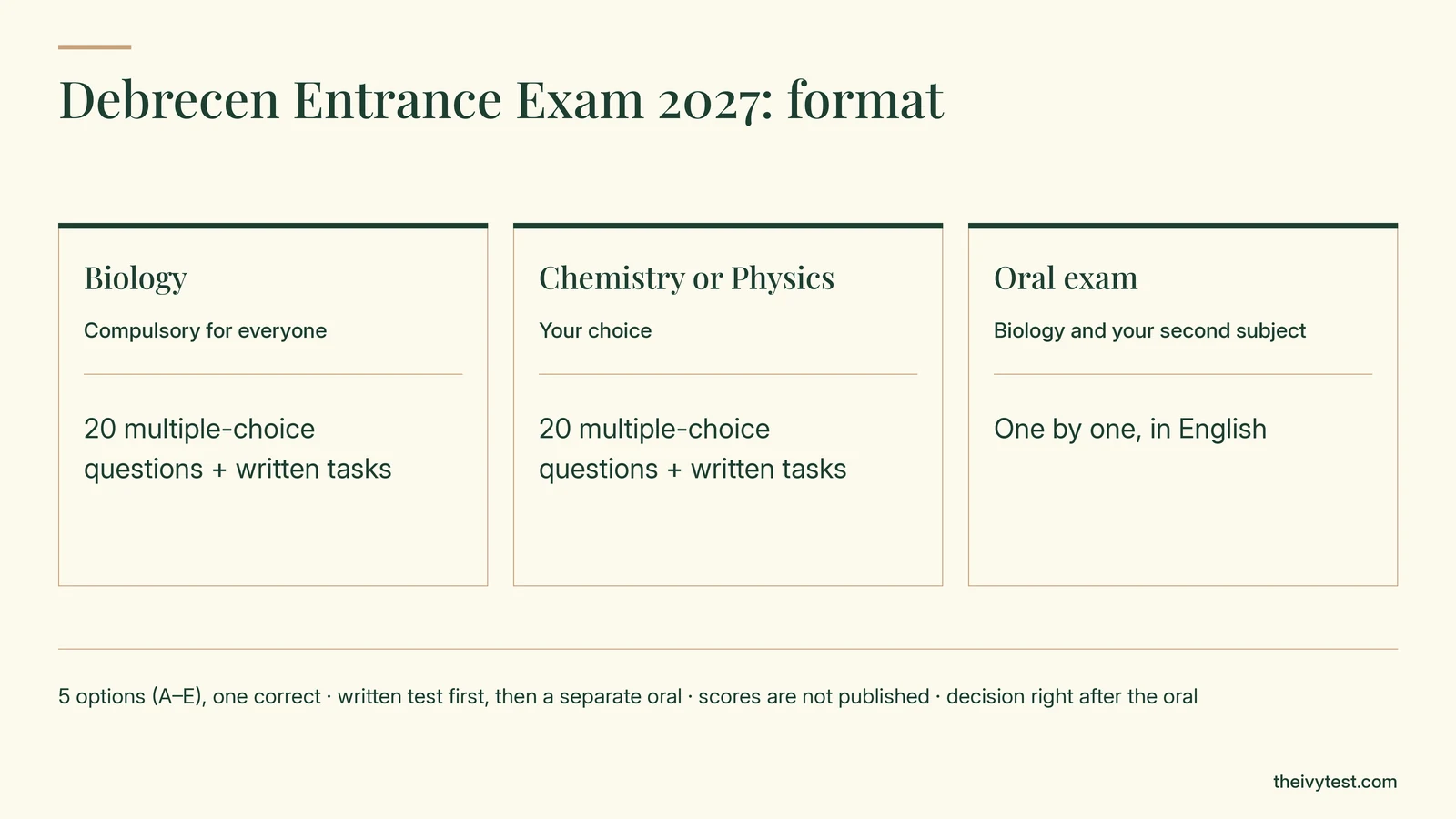
That difference is the subject choice. Biology is compulsory for every candidate, and you then select either Chemistry or Physics as your second written subject. You sit two papers of 20 multiple-choice questions, so 40 MCQs in total, not the 60 you get if you add all three official subject papers together. Every question offers five options labelled A to E with a single correct answer, verified item by item across Debrecen's own published sample tests. Alongside the multiple-choice items, each official sample paper carries structured written sections labelled at 30 points (naming, definitions, calculations, and tasks reading a graph or a table), so the written stage is not purely multiple-choice.
The written test is followed by a separate oral exam, taken one candidate at a time, covering Biology and the same second subject you chose. Two facts about the marking are worth holding onto from the start: Debrecen does not publish a marking scheme, and it does not publish a pass mark. Its own entrance-examination page says the scores of the different parts of the exam are for internal use and are not communicated to applicants, which is an unusually explicit statement that the number you would like to aim at does not exist publicly.
Programmes that use the Debrecen Entrance Exam
- General Medicine (English-taught, Debrecen)
- Dentistry (English-taught, Debrecen)
- Pharmacy (English-taught, Debrecen)
- Basic Medicine Course: the preparatory route into the degree programmes
Timeline
Debrecen Entrance Exam 2027: dates and deadlines
When to expect your exam · 2027 start
- January 2027late JanExpected
- April 2027late AprExpected
- May 2027early MayExpected
- June 2027early JunExpected
Predicted from this university's past sittings until it publishes its own dates. See every university on the calendar →
- Applications openNo opening date is published: the Application and admission page gives only the deadlines (1 November 2026 for a January/February 2027 start, 15 May 2027 for September 2027), and Debrecen admits on a rolling basis
- Application deadline15 May 2027
- Entrance examination sittings2027/28 not yet published. Debrecen's official exam-date calendar listed sittings hosted by representatives abroad on 24 and 25 January, 24 April, 5 May and 5 June 2026; for everyone else the FAQ says the exam date is set by email with you or your representative
- Oral exam / interviewNo published date: the oral follows the written test and its date is arranged by email, like the written exam's
- Results publishedNo calendar date: the FAQ says the decision is announced right after the oral exam
- Enrolment deadlineEnrolment deadline not yet announced
Debrecen publishes official topic lists and sample tests rather than a dated Call document, and none of its published exam materials names an academic year. The binding sources are its own pages at edu.unideb.hu; on 7 October 2026 the Application and admission page gave 15 May 2027 as the application deadline for the September 2027 intake. Because the programme has closed early to applications in past cycles, check live availability before relying on any deadline, including one published by the university itself. IvyTest re-checks the entrance-examination page and the FAQ and updates this guide when the next cycle's dates appear.
Structure
Debrecen Entrance Exam format
You sit two written papers of 20 multiple-choice questions each: Biology, which everyone takes, and either Chemistry or Physics, which you choose. Every item offers five options (A-E) with exactly one correct answer. The table below shows all three subject papers Debrecen publishes; only two of the three rows will ever be yours. Each official sample paper also carries structured written sections labelled at 30 points (naming, definitions, calculations, and graph and table tasks), which are not multiple-choice and are not covered by the question counts here.
| Section | Questions | Weighting | Suggested time |
|---|---|---|---|
| Biology: compulsory | 20 | Half of the 40-question paper you actually sit | *see the note below the table |
| Chemistry: elective | 20 | Half of your paper, if you choose Chemistry over Physics | *see the note below the table |
| Physics: elective | 20 | Half of your paper, if you choose Physics over Chemistry | *see the note below the table |
- Contradicted between two live official pages: 45 minutes per written test on the entrance-exam page, 50 minutes per subject on the FAQ
Content
Question and subject breakdown
Three published subject papers, two of which you sit. Debrecen names a recommended textbook for each one in its own official topic PDFs, which is a more precise signal of expected depth than most schools give, and worth taking literally when you choose which second subject to offer.
Biology
50% of your paper (20 of 40)Compulsory for every candidate, and organised around sixteen official numbered topics: the eukaryotic cell and its organelles, metabolism and enzymes, DNA structure, replication and protein synthesis, mitosis and meiosis, genetics and inheritance including testcross probability, respiration and circulation, digestion and excretion, nervous and endocrine regulation, muscle and locomotion, and immunity. Debrecen's own topic PDF names Sadava, Heller, Orians, Purves and Hillis, Life: The Science of Biology (8th edition) as the reference text. The sample paper rewards recognising structures, describing a process in words, simple genetic and proportional calculation and reading biological graphs, so it is not a pure-recall paper.
Chemistry
50% of your paper if chosen (20 of 40)One of the two second-subject options, following the official topic PDF's General, Inorganic and Organic Chemistry lists: measurement and classification of matter, atomic structure and the periodic table, bonding and intermolecular forces, stoichiometry, states of matter and the gas laws, solutions and equilibrium, acids and bases, thermochemistry, redox, descriptive inorganic chemistry, hydrocarbons and aromatics, functional groups and their derivatives, and isomerism. The reference text Debrecen names is McMurry and Fay, Chemistry (6th edition, 2012). The sample paper repeatedly asks you to move between a name, a formula, a structure and a reaction equation.
Physics
50% of your paper if chosen (20 of 40)The alternative second subject, and a real option rather than a formality: one of only two Hungarian schools in our catalogue that let you substitute Physics for Chemistry, and the one that offers it most openly: Szeged's Physics route runs only in sittings hosted by its Admissions Office and is closed to Stipendium Hungaricum applicants, while at Debrecen the choice is simply part of the standard exam. It spans kinematics and vectors, Newton's laws, work, energy and momentum, rotational motion and gravitation, solids and fluids, thermodynamics, vibrations and waves, electricity and circuits, magnetism and induction, optics, and modern physics. The reference text named is Serway, Faughn and Vuille, College Physics (9th edition). The sample leans conceptual (direction, limiting cases, units and graph slopes) more than arithmetic.
Marks
Debrecen Entrance Exam scoring
Debrecen is unusually direct about not telling you how the exam is marked. Its entrance-examination page states, in its own words, that 'the overall exam performance is taken into consideration and the scores of different parts of the exam are for internal use only and not to be communicated to the applicants.' There is no published mark per question, no published negative-marking rule and no published pass threshold, so the rules below record what is known and mark the rest as unpublished rather than filling the gaps.
- Answer options
- 5 (A-E), exactly one correct, verified across all three official sample tests
- Correct answer
- Not published. IvyTest practises against +1 as the neutral default; Debrecen states part-scores are internal
- Incorrect answer
- No negative-marking rule is published anywhere on unideb.hu. IvyTest practises against 0 rather than inventing a penalty
- Unanswered question
- Not published; treated as 0 under the same neutral model
- Multiple-choice questions you sit
- 40 (Biology 20 plus your chosen second subject 20)
- Structured written sections
- Present on every official sample paper, labelled at 30 points per subject: naming, definitions, calculations, graph and table tasks
- Minimum eligible score
- No pass mark appears on any official page. A widely repeated '260 points for Medicine, 150 for the Basic Medicine Course' figure is unsourced against unideb.hu and is not adopted here
- Per-subject floors
- None published; Hungary has no counterpart to the Italian OFA subject floors
- What follows the written test
- A separate one-to-one oral exam on Biology and your chosen second subject
Worked example
Because no penalty is published, the only defensible model is +1 for a correct answer and nothing for a wrong one, and under that model there is never a reason to leave a question blank. Work it through on the 40 MCQs you actually sit. Suppose you know 24 confidently, can narrow 10 more to two plausible options, and are genuinely blind on the last 6. Answer everything: the 24 score 24, the 10 coin-flips return 10 × 0.5 = 5, and the 6 blind guesses across five options return 6 × (1/5 × 1) = 1.2. Expected total, about 30.2 of 40. Leave all 16 uncertain items blank instead and you score 24. The 6.2-mark gap is created entirely by the decision to answer. For comparison, the penalty that would make a blind five-option guess exactly break-even is −0.25 per wrong answer (the standard Italian convention), and Debrecen publishes nothing of the kind, so the guess is worth +0.2 and the blank 0. Now the unit warning, which matters more here than at most schools. That 6.2-mark gain is 15.5 percentage points of the 40-mark multiple-choice set, but it is not 15.5 percentage points of your exam. Each official sample paper carries a further 30 labelled points of structured written work per subject, and the university does not publish how the parts combine. So state improvements in the unit you actually measured: marks on the MCQ set, or percentage of MCQ items answered correctly. Converting either one into 'percent of the exam' would be a guess dressed up as arithmetic.
The IvyTest simulator scores every practice paper against these exact rules.
See the Debrecen Entrance Exam simulatorSyllabus
Debrecen entrance exam topics
All three groups below are official: they follow Debrecen's own published topic PDFs (sixteen numbered Biology topics, the General, Inorganic and Organic Chemistry lists, and the five Physics headings with the large Mechanics block split out). Remember that you sit Biology plus exactly one of the other two.
Official. Reference text named by Debrecen: Sadava, Heller, Orians, Purves and Hillis, Life: The Science of Biology, 8th edition.
- Cell structure and function: basic structure and characteristics of the eukaryotic cell, the cellular organelles, and how the structure of each relates to its function
- Metabolism and enzymes: the basic metabolic pathways (glycolysis, biological oxidation and photosynthesis), the biological role and basic characteristics of enzymes, substrate specificity, and oxidising and reducing coenzymes
- DNA, replication and protein synthesis: the structure of DNA and its role in heredity, the genetic code, replication of the genetic material and the enzymes involved, translation, mRNA, rRNA, tRNA and ribosomes
- Cell division: chromatin and chromosomes, the behaviour of chromosomes during mitosis, meiosis and its role in sexually reproducing organisms, and the differences between mitotic and meiotic division
- Genetics and inheritance: genotype, phenotype, genes and alleles, the monohybrid cross, dominant-recessive inheritance, co-dominance and the first Mendelian law, X-linked inheritance, the dihybrid cross and the second Mendelian law, genetic linkage and crossing-over, and testcross probability calculation
- Respiration and circulation: basic anatomy and physiology of the human respiratory and circulatory systems, gas transport and partial pressures, regulation of breathing, and the cardiac cycle
- Digestion and excretion: basic anatomy and physiology of the human digestive and excretory systems, the digestive secretions and their substrates, the order of structures from mouth to anus, and nephron function
- Nervous and endocrine regulation: homeostasis, the basic structure and function of the human nervous system, hormones and the human endocrine system, pituitary and hypothalamic control, feedback regulation, and the female ovarian cycle with its hormone profile
- Muscle and locomotion: basic structure and function of skeletal muscle cells, and locomotion in humans
- Immunity and defence: the basic defence systems against infection, the humoral and cellular immune response in humans, and conditions associated with immune failure
Official. Reference text named by Debrecen: McMurry and Fay, Chemistry, 6th edition (2012).
- Measurement and classification of matter: the SI system, unit conversion between multiples and submultiples, classification of matter, mixtures and compounds, elements and their symbols
- Atomic structure and the periodic table: the structure of atoms, atomic and mass number, isotopes and ions, electronic structure including quantum numbers, orbitals and electron configuration, the periodic table and main groups, and periodic properties such as atomic radius, electronegativity and ionisation energy
- Chemical bonding and intermolecular forces: types of chemical bond, the covalent bond, Lewis structures, molecular shapes, valence bond theory, bond polarity and bond length, intermolecular forces and hydrogen bonding
- Stoichiometry and mass relationships: atomic, molecular and molar mass relationships, chemical equations and stoichiometry, balancing equations, limiting reactant and yield, and particle diagrams representing a reaction
- States of matter and gas laws: the gaseous state, the gas laws, stoichiometric relationships involving gases, the kinetic-molecular theory, the liquid and solid states, and phase changes
- Solutions and chemical equilibrium: solutions and their properties, concentration, solubility and the factors affecting it, ions in aqueous solution, electrolytes and nonelectrolytes, chemical equilibrium and the equilibrium constant
- Acids and bases: pH in solutions of strong acids and strong bases, equilibria in solutions of weak acids and weak bases, degree of dissociation, Brønsted-Lowry acid-base reactions and conjugate acid-base pairs
- Thermochemistry: energy changes and energy conservation, expansion work, energy and enthalpy, Hess's law, and heat of formation
- Oxidation and reduction: oxidation state, the activity series of the elements, oxidising and reducing agents, and balancing redox reactions
- Inorganic chemistry: hydrogen and oxygen and their compounds, the halogens and their compounds, the noble gases, nitrogen, phosphorus and sulfur and their compounds, carbon and its allotropic forms, inorganic carbon compounds, and the s-block, p-block and transition metals
- Hydrocarbons and aromatics: the covalent bonds of carbon, multiple covalent bonds in carbon compounds, alkanes, cycloalkanes, alkenes and alkynes, their characteristic reaction types, and aromatic and heteroaromatic compounds
- Functional groups and derivatives: alcohols, phenols and ethers, aldehydes and ketones, carboxylic acids and substituted carboxylic acids, carboxylic acid derivatives including esters, amides and anhydrides, nitrogen-containing organic compounds and amine classification, naming of common substituent groups, and boiling-point trends across functional groups
- Isomerism: structural, geometrical and optical isomers, cis-trans pairs, enantiomers, and keto-enol tautomers
Official. Reference text named by Debrecen: Serway, Faughn and Vuille, College Physics, 9th edition. The sample paper leans conceptual (direction, limiting cases, units and graph slopes) more than arithmetic.
- Kinematics and vectors: motion in one dimension, displacement, velocity and acceleration, motion diagrams, freely falling objects, vectors and two-dimensional motion, and projectile motion
- Newton's laws and forces: the laws of motion, forces, Newton's first, second and third laws, forces of friction, and free-body diagrams
- Work, energy and momentum: work, power, kinetic energy and the work-energy theorem, systems and energy conservation, gravitational and spring potential energy, momentum, collisions and conservation of momentum, and elastic and inelastic collisions
- Rotational motion and gravitation: rotational motion and the law of gravity, rotational equilibrium and rotational dynamics, torque and the conditions for equilibrium, centripetal and tangential acceleration, moment of inertia and angular momentum
- Solids and fluids: states of matter, density and pressure, Archimedes' principle, buoyant force, and the condition for floating expressed in terms of object and fluid densities
- Thermodynamics: temperature and the zeroth law, the kinetic theory of gases, thermal expansion of solids and liquids, heat and internal energy, specific heat and latent heat, the laws of thermodynamics, entropy, and ideal-gas proportional reasoning at constant pressure
- Vibrations and waves: Hooke's law, elastic potential energy, simple harmonic motion, motion of a pendulum, waves and their interference, frequency, amplitude and wavelength, sound and the characteristics of sound waves, and the Doppler effect
- Electricity and circuits: electric forces and the electric field, electric charges, insulators and conductors, Coulomb's law, electrical energy and capacitance, the parallel-plate capacitor, current and resistance, Ohm's law, the temperature variation of resistance, direct-current circuits, resistors in series and parallel, Kirchhoff's laws and RC circuits
- Magnetism and induction: magnetism and magnetic fields, motion of charged particles in a magnetic field, torque on a current-carrying loop, induced voltage and inductance, Faraday's law of induction, alternating current, and resistors and capacitors in AC circuits
- Light and optics: the nature of light, reflection, refraction, total internal reflection, polarisation, mirrors and lenses, converging and diverging lenses, image formation by a flat mirror and by thin lenses, and the wavelength range of visible light
- Modern physics: the speed of light, Einstein's principle of relativity, atomic spectra, the exclusion principle and the periodic table, binding energy, radioactivity and alpha, beta and gamma decay, nuclear fusion and fission, elementary particles and the fundamental forces
Test your Debrecen Entrance Exam knowledge
Take free diagnosticDifficulty
How difficult is the Debrecen Entrance Exam?
Debrecen's paper is not conceptually harder than its Hungarian peers; the difficulty is in how much of the machinery around it is left unstated, and in one decision you have to make well before test day.
You choose your second subject, and the choice is permanent for this exam
Biology is compulsory; Chemistry or Physics is yours to pick, as part of the standard exam rather than by special arrangement. This is a genuine advantage: a strong physicist can avoid organic chemistry entirely, which at Szeged is possible only in Admissions Office sittings and not at all for Stipendium Hungaricum applicants. But it is also a decision worth making on evidence rather than instinct. Sit a diagnostic in both before committing, because the same subject that feels easier in class does not always score better under a 45-to-50-minute clock.
The duration is contradicted on the university's own site
Two live official pages disagree: the entrance-examination page says each written test takes 45 minutes, the FAQ says 50 minutes per subject and adds that the online exam schedule may be different. Neither cross-references the other. The safe response is to prepare against the shorter figure, because a candidate trained for 45 minutes loses nothing if given 50, while the reverse costs real marks.
The marking scheme is deliberately not published
Debrecen's entrance-examination page says outright that part-scores are internal and not communicated to applicants. There is no published mark per question, no published penalty and no published pass mark. That is a statement about transparency, not about difficulty, but it means you cannot optimise against a threshold, and any prep site that quotes one is quoting something the university has not said.
The paper is not only multiple-choice
Every official sample carries structured written sections labelled at 30 points alongside its 20 MCQs: naming, definitions, calculations, and tasks reading a graph or a table. Preparation that consists entirely of multiple-choice drilling leaves that half untouched, and writing a correct definition or laying out a calculation under time pressure is a different skill from recognising the right option among five.
The oral exam re-tests the same two subjects
A separate one-to-one oral exam follows the written test, covering Biology and whichever second subject you chose. It is not a soft-skills interview with a science question attached; it re-examines the same material orally, in English. Candidates who prepared to recognise answers rather than to explain them find that out in the room.
Benchmarks
What is a good Debrecen Entrance Exam score?
There is no published number to aim at, and unusually, Debrecen says so explicitly rather than simply omitting it. IvyTest read the entrance-examination page and the FAQ directly on 28 September 2026: neither states a minimum score, and a site-restricted search across unideb.hu returns no threshold figure anywhere on the university's own domain.
One figure circulates widely enough to need naming. Several third-party preparation sites state that Medicine requires 260 points and the Basic Medicine Course 150. That figure is not sourced to any University of Debrecen page, and it sits awkwardly beside the university's own confirmed statement that the scores of the different parts of the exam are for internal use only and not communicated to applicants. Treat it as somebody's estimate, not as a target, and do not build a preparation plan around clearing it.
What is worth planning around instead is the shape of the process. You are assessed on two written papers, structured written sections that are not multiple-choice, and a one-to-one oral exam on the same two subjects, with the university stating that overall performance is what it considers. That points at even, explainable competence across Biology and your chosen second subject rather than a peak score in one of them, and at practising the written and spoken forms of the same knowledge together rather than in sequence.
Pending verification
- · Any marking scheme: marks per correct answer, and whether wrong answers are penalised
- · Any pass mark or minimum eligible score, for Medicine, Dentistry, Pharmacy or the Basic Medicine Course
- · The resolved per-subject duration: 45 minutes or 50 minutes per written test
- · How the multiple-choice items, the structured written sections and the oral exam are weighted against each other
- · Seats available and applicants per cycle
These specific numbers aren't public yet — an IvyTest simulator score is the closest benchmark you can get today.
Check your Debrecen Entrance Exam scoreStrategy
How to prepare for the Debrecen Entrance Exam
12+ weeks
Settle the Chemistry-or-Physics question first, then go deep on two subjects
Biology throughout, one second subject chosen early and prepared properly.
- In week one, sit a diagnostic in Biology and in both Chemistry and Physics under a 45-minute clock. Choose your second subject on those results, and then stop preparing the other one: the advantage of the choice is that it halves what you have to cover, and splitting it away gives that advantage back.
- Work Biology from Debrecen's own sixteen official topics, using the reference text it names (Sadava et al., Life: The Science of Biology, 8th edition) to set depth rather than guessing at it.
- Build the structured-response half deliberately from the start: write out definitions, name compounds and structures, lay out calculations in full, and practise reading values off a graph or table. The official samples label those sections at 30 points per subject and no amount of multiple-choice drilling covers them.
- Start explaining things aloud by week six. The oral exam covers exactly the same two subjects, so rehearsing spoken explanations is revision for both stages at once.
8 weeks
Two papers, one clock, and the oral running alongside
Targeted repair across Biology and your chosen second subject.
- If you have not already committed to Chemistry or Physics, decide this week on diagnostic evidence and do not revisit it.
- Alternate Biology and your second subject weekly rather than blocking them: you sit both on the same day, and switching between them under time pressure is its own skill.
- One full timed mock a week from week two, sat at 45 minutes per paper, reviewed the same day with wrong answers logged by cause: content gap, misread stem, or ran out of time.
- Book two spoken rehearsals in this window with someone who will make you explain a mechanism out loud in English rather than accept a keyword.
4 weeks
Five options, every question answered, both papers timed
Volume of timed practice under the real constraints.
- Two full mocks a week (Biology plus your second subject) at 45 minutes per paper, which is the shorter of the two durations the university's own pages give.
- Answer every single item. No penalty is published, so under the only defensible model a blind five-option guess is worth +0.2 and a blank is worth exactly 0; eliminating even one option before answering raises that further.
- Keep at least a third of each session on structured written responses rather than MCQs: definitions, naming, full calculations, graph and table reading.
- Rehearse the practical setup you will actually use, on site or online, remembering that the FAQ warns the online exam schedule may differ from the on-site one.
Under 4 weeks
Consolidate two subjects, and get your mouth working
Triage, plus real time for the oral exam.
- Stop adding new content. Consolidate the highest-frequency areas of the official topic lists: in Biology, replication and protein synthesis, genetics calculations, circulation and the nephron; in your second subject, whichever three areas your mocks show weakest.
- Sit at least two complete, timed two-paper mocks in the final ten days, then taper.
- Spend the recovered hours explaining your weakest topics aloud, in English, to a timer. The oral exam re-tests the same two subjects and is the part candidates most often arrive at unrehearsed.
- Confirm your sitting, your chosen second subject and the format you will sit in, and check live application status, because Debrecen has closed Medicine and Dentistry applications ahead of the standard deadline in past cycles.
Get your personalised Debrecen Entrance Exam study plan
Take free diagnosticExplore the full Debrecen Entrance Exam planPractice
Free Debrecen Entrance Exam practice questions
Three questions in the format the exam uses. Choose an answer to see the explanation — nothing is recorded.
Five compounds of similar molar mass are listed below. Which has the highest boiling point at atmospheric pressure?
A solid block floats in water with exactly three quarters of its volume below the surface. Taking the density of water as 1000 kg/m³, what is the density of the block?
Illustrative examples written by IvyTest to show the question style — not past Debrecen Entrance Exam papers.
Past papers
Debrecen Entrance Exam past papers
The University of Debrecen publishes no past papers and no answer keys. Its Exam topics and sample tests page offers one sample test each for Biology, Chemistry and Physics as a free PDF download, with multiple-choice questions and structured tasks (naming, calculations, problem solving), beside a one-page topic list per subject. The five-option format on this page was confirmed on them. The practice questions on this page are IvyTest's own.
University
University of Debrecen medicine admissions
The written test and the oral exam sit inside a rolling application process, and one practical fact dominates the timing: Debrecen has closed its most popular programmes early in past cycles.
- Degrees
- General Medicine, Dentistry and Pharmacy (English-taught), plus the Basic Medicine Course as a preparatory route
- Language of instruction
- English
- Campus
- Debrecen, Hungary's second-largest city
- Tuition
- Around €15,500 / year
- Application fee
- Around €460
- Interview
- Yes: a separate one-to-one oral exam on Biology and your chosen second subject
- Admissions type
- Rolling
- English certificate
- Required
- Motivation letter
- Not required
- Recommendation letters
- Not required
- Document requirements
- School-leaving certificate and transcripts in English or translated into English
- Cost of living
- Roughly 24% below Budapest
- International student body
- Around 7,800 international students from over 140 countries, university-wide
- Seats available
- Debrecen publishes no seat count for the English-taught programmes
- Application process
- Apply directly to the university on a rolling basis, sit the written test in Biology plus your chosen second subject, then a separate one-to-one oral exam on the same two subjects
IvyTest Debrecen Entrance Exam preparation
Ready to prepare properly for the Debrecen entrance exam?
Everything above is free and always will be. When you want structure (a syllabus-mapped book covering Biology plus whichever second subject you choose, a simulator that runs the real five-option format at the real clock, lessons for the gaps your results flag, and help with the application itself), that is what the IvyTest Debrecen package is.
Study guide
Debrecen's own official topic lists in full, across Biology, Chemistry and Physics, so you can compare the two second-subject options before committing to one.
Exam simulator
Timed mocks in the real five-option (A-E) format at 45 minutes per paper, the shorter of Debrecen's two official timings, with per-question explanations and per-subject analytics.
Video courses
Focused lessons in biology, chemistry and physics for the topics your results flag, and for the structured-response tasks MCQ drilling never touches.
Application support
MedApply: deadlines, live application-status checks, documents, legalisation and enrolment steps carried through to a confirmed place.
FAQ
Debrecen Entrance Exam frequently asked questions
It's Debrecen's own two-stage admission assessment for its English-taught Medicine, Dentistry, Pharmacy and Basic Medicine Course programmes. First a written test in two subjects: compulsory Biology plus either Chemistry or Physics, 20 multiple-choice questions each with five options, alongside structured written sections. Then a separate one-to-one oral exam covering the same two subjects.
Neither. There is no shared Hungarian medical entrance test, and Debrecen's is structurally the odd one out: it is the only one of the four that does not test English as a separately scored written subject, and one of only two that let you substitute Physics for Chemistry, the other being Szeged, where the Physics route is restricted to Admissions Office sittings and closed to Stipendium Hungaricum applicants. Semmelweis runs four separately timed 20-minute tests with English worth half the marks, Pécs puts 60 of its 100 questions into General and Medical English, and Szeged runs 60 questions in 60 minutes with a combined English section.
Yes. Biology is compulsory and you choose either Chemistry or Physics as your second subject, so you sit 40 multiple-choice questions in total. Debrecen publishes topic lists and sample tests for all three subjects (which is where the figure of 60 questions comes from), but no candidate sits all three papers.
Both formats exist. The written test is delivered in English and can be sat on site or online, and Debrecen's FAQ notes that the online exam schedule may differ from the on-site one. The oral exam is taken one candidate at a time.
Debrecen doesn't publish a marking scheme. Its entrance-examination page states that the scores of the different parts of the exam are for internal use only and are not communicated to applicants, and no negative-marking rule appears anywhere on its site. Under the only defensible model (one mark for a correct answer, nothing for a wrong one), a blind guess across five options is worth +0.2 marks and a blank is worth exactly 0, so there is no question worth leaving empty. For reference, the penalty that would make a five-option guess break-even is −0.25 per error, and Debrecen publishes nothing of the kind.
No pass mark is published on any official University of Debrecen page, and there are no per-subject minimums either: Hungary has no counterpart to the Italian Obblighi Formativi Aggiuntivi floors, and Debrecen states that overall exam performance is what it considers. The '260 points for Medicine, 150 for the Basic Medicine Course' figure circulates on third-party preparation sites but is not sourced to unideb.hu, and it sits awkwardly next to the university's own statement that part-scores are internal and not communicated to applicants. Don't plan against it.
The university's own pages disagree, and both are live. The entrance-examination page states that each written test takes 45 minutes; the FAQ states 50 minutes per subject and adds that the online schedule may be different. Neither page resolves the other. Prepare against 45 minutes per paper: a candidate trained for the shorter limit loses nothing if given the longer one.
No, and this is where Debrecen differs most from its Hungarian peers. Its written papers are Biology plus Chemistry or Physics, with no separately scored English component. You still need English throughout, because the entire exam and the oral are conducted in it, and an English certificate is required to apply.
Debrecen publishes no seat count or applicant figure, so any acceptance rate quoted elsewhere is an estimate. What is documented is a real demand signal: in September 2026 its own programme pages recorded Medicine closing to September 2026 applications because of an exceptionally high number of applications, and Dentistry's 2026/27 intake as fully booked, and the university hosts around 7,800 international students from over 140 countries across all faculties. Treat early application as a practical advantage rather than an optional one.
Within the EU, yes: automatically, as a standard Hungarian medical degree. There's no separate Hungarian licensing exam afterwards: the closing exam (záróvizsga) is built into the sixth year of the degree itself, and registration with the national healthcare register is automatic. A specialist exam (szakvizsga) applies later, only to those pursuing specialty practice. Outside the EU recognition isn't automatic as a rule, but the UK is an exception. Under the Medical Act 1983 (section 21B, as in force on 12 October 2026), a Hungarian medical degree is a 'relevant European qualification', so a graduate who applies to the GMC with one, whatever their nationality, is not asked to show the knowledge and skills other international graduates prove through PLAB/UKMLA; evidence of English is still required, and the rule is UK policy that can change. Debrecen's own Medicine page says the same: its graduates are 'NOT required to take the PLAB exam for practicing in the UK'. US-bound graduates need ECFMG certification via USMLE Step 1 and Step 2 CK, the same requirement every international medical graduate faces.
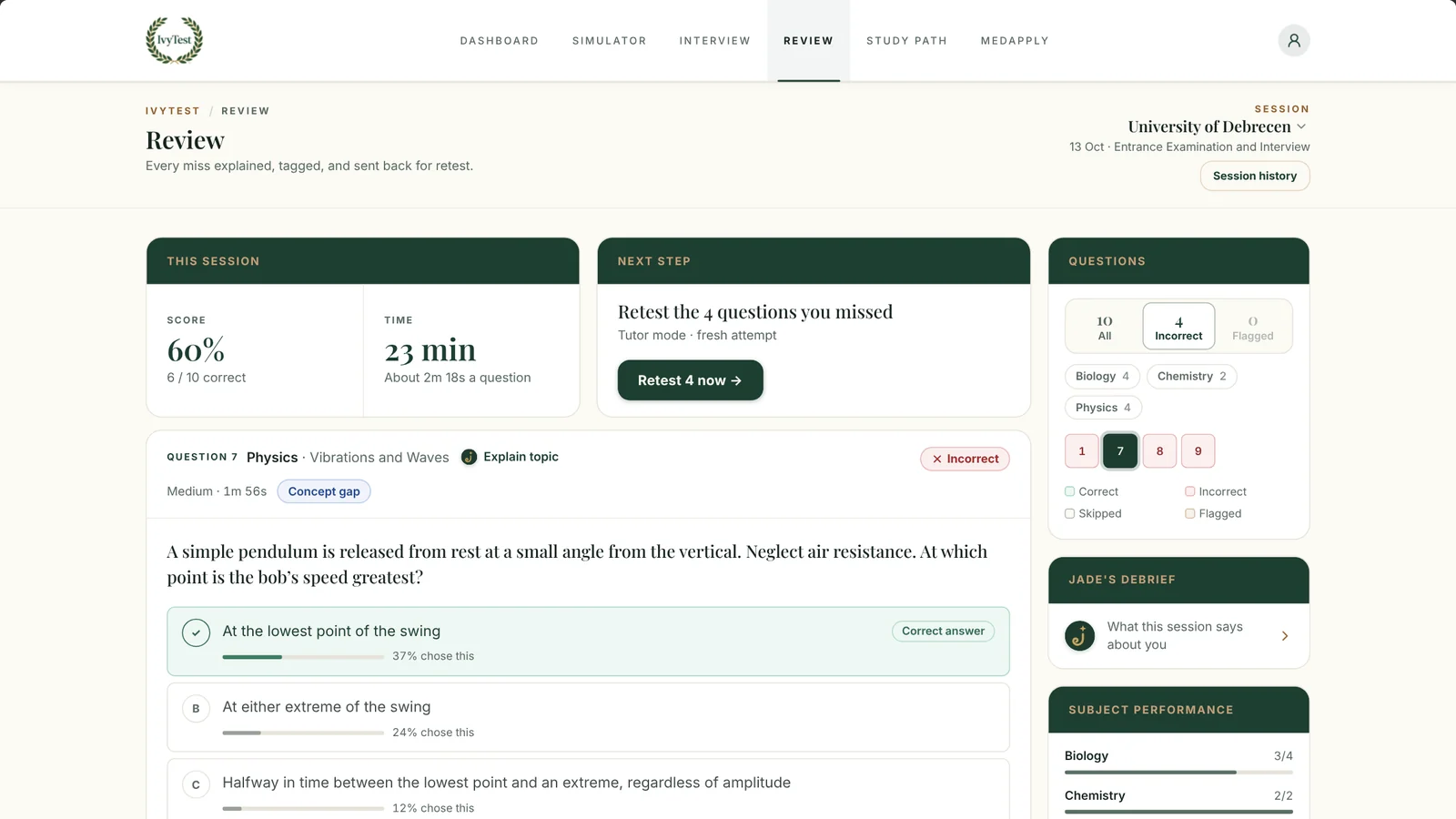
Yes. The IvyTest simulator runs Debrecen-format practice (20 questions per subject in the real five-option (A-E) format, across Biology plus your choice of Chemistry or Physics) in timed, tutor and review modes, with a free diagnostic available without payment.
Debrecen publishes no past papers and no answer keys. Its Exam topics and sample tests page offers one sample test each for Biology, Chemistry and Physics as a free PDF download, beside a one-page topic list per subject. Each sample has multiple-choice questions plus structured tasks such as naming, calculations and problem solving. The Mathematics topics on that page are for non-medical BSc programmes: Medicine tests Biology and Chemistry or Physics.
The application deadline for the September 2027 intake is 15 May 2027 (1 November 2026 for a January/February 2027 start). The 2027 exam dates are not published yet: Debrecen's exam calendar lists sittings hosted by its representatives abroad, the last so far on 5 June 2026, and otherwise the date is set by email with you or your representative. The decision comes right after the oral exam, with your Letter of Acceptance.
A high school certificate (final-year students may apply with transcripts and predicted grades), a B2-level English certificate unless you are a native speaker or were schooled in English, and the entrance exam: written and oral, in Biology and Chemistry or Physics. Completing Debrecen's Basic Medicine Course is the other route in. You apply online with a CV, a medical certificate, your passport and the USD 150 application fee, and for medical programmes the gap since your last studies can be at most 6 years.
For students admitted for 2026/27, the latest year published, Medicine costs USD 16,900 a year, with health insurance, the medical check-up and the student card included. Applying costs USD 150 and the entrance exam USD 350, both paid by bank transfer. To hold your place you pay the seat reservation fee set in your Letter of Acceptance, or the full year's tuition if you need a visa. From year 2, a 4.0 average can earn a tuition reduction.
The Bulletin is the Faculty of Medicine's yearly handbook, a free PDF on its Bulletins page: the 2026/2027 edition runs to 460 pages, with the curriculum year by year, the credit rules, the university calendar, the required electives and the textbook list. Medicine takes 12 semesters and 360 credits, about 30 a semester. The sixth year is an internship in internal medicine, surgery, gynaecology, neurology, psychiatry and paediatrics, and Hungarian is taught so you can talk with patients from year 3.
No. For Medicine, Dentistry, Pharmacy and the Basic Medicine Course the exam is Biology plus Chemistry or Physics, a written test and then an oral, on Debrecen's entrance-exam page. The Mathematics topics and sample test on its Exam topics and sample tests page are listed for the Non-Medical BSc programmes only, so they are not part of the medical exam. Numbers still come up: the Chemistry and Physics papers include calculations, and Biology can set one in genetics.
Yes: r/DebrecenMedicine, where University of Debrecen applicants ask each other about the Debrecen Entrance Exam and share how their preparation is going. It is run by the IvyTest team. Dates, rules and results come only from the university's own pages, listed under Official sources on this page.
Verification
Official sources
- Entrance examination / interview (45 minutes per written test, part-scores internal only, exam-date calendar)Checked: 7 October 2026
University of Debrecen
- Frequently asked questions (50 minutes per subject, exam date set by email, decision right after the oral)Checked: 7 October 2026
University of Debrecen
- Topics on Biology for Admission Test (official topic list)Checked: 5 October 2026
University of Debrecen
- Topics on Chemistry for Admission Test (official topic list)Checked: 5 October 2026
University of Debrecen
- Topics on Physics for Admission Test (official topic list)Checked: 5 October 2026
University of Debrecen
- Official Biology, Chemistry and Physics sample tests (source of the five-option A-E format)Checked: 7 October 2026
University of Debrecen
- Medicine, Full-time Graduate Program (12 semesters, 360 ECTS, USD 16,900 a year, main subjects by year)Checked: 7 October 2026
University of Debrecen
- Tuition Fee, Application + Entrance fee (USD 150 application fee, USD 350 entrance fee)Checked: 7 October 2026
University of Debrecen
- Dentistry, Full-time Graduate Program (the 2026/27 intake was listed as fully booked in September 2026)Checked: 5 October 2026
University of Debrecen
- Application and admission (deadlines 1 November 2026 and 15 May 2027, required documents, B2 English certificate or exemption)Checked: 7 October 2026
University of Debrecen
- Bulletins (English Program Bulletin, Faculty of Medicine, 2026/2027)Checked: 7 October 2026
University of Debrecen
Last reviewed by IvyTest editorial team: 12 October 2026. Admission rules change every cycle — always confirm against the official University of Debrecen call for applications before acting on a deadline.
Find out how ready you are for the Debrecen entrance exam.
The diagnostic takes one sitting and returns a subject-by-subject picture of where you stand, including whether Chemistry or Physics is genuinely your stronger second paper. No payment, no commitment.