
Semmelweis University Admissions Guide
Everything you need to apply to Semmelweis University: entrance requirements, application deadlines, tuition and cost of living, and the Semmelweis Entrance Exam.

At a glance
Semmelweis University in brief
- Entrance exam
- Semmelweis Entrance Exam
- Language of instruction
- English
- Interview required
- Yes
- Tuition
- €18,680 / year
- Cost of living
- €500–800 / month (Budapest); central 1-bedroom apartments run higher, around €600–650
- Application deadline
- 2027/28: application deadline 31 May 2027 (start date to be announced). Entrance exams run once or twice a week from early February to the end of June, booked through the SEMAPHOR portal.
- Subjects tested
- Medical Biology, Medical Chemistry, General English, Biomedical English
Source: Semmelweis University Admissions · Verified 28 Sep 2026
Admission test
Semmelweis Entrance Exam
Semmelweis University requires the Semmelweis Entrance Exam for admission. Here are the essential figures.
- Total Questions
- 80
- Test Duration
- 80 min
- Main Sections
- 4
- Maximum Score
- 80
Not sure you'd clear the cutoff?
Take the free Semmelweis University diagnostic: real questions from its own question bank, scored against its cutoff. No account needed.
What the exam tests
- Medical Biology
- Medical Chemistry
- General English
- Biomedical English
4 tested areas · Semmelweis Entrance Exam
Application
Application requirements
- Entrance exam
- Required
- Medical Biology, Medical Chemistry, General English, Biomedical English
- Computer-based, remote · home-based via Moodle/Safe Exam Browser, Zoom-invigilated
- Interview
- Required
- Scholarship
- Separate application required
- Application fee
- US$350
Fees
Fees for international students
Semmelweis quotes General Medicine's tuition in euros, per semester, and its application and enrolment fees in US dollars. These are the figures on its admission pages for the 2027 intake (application deadline 31 May 2027).
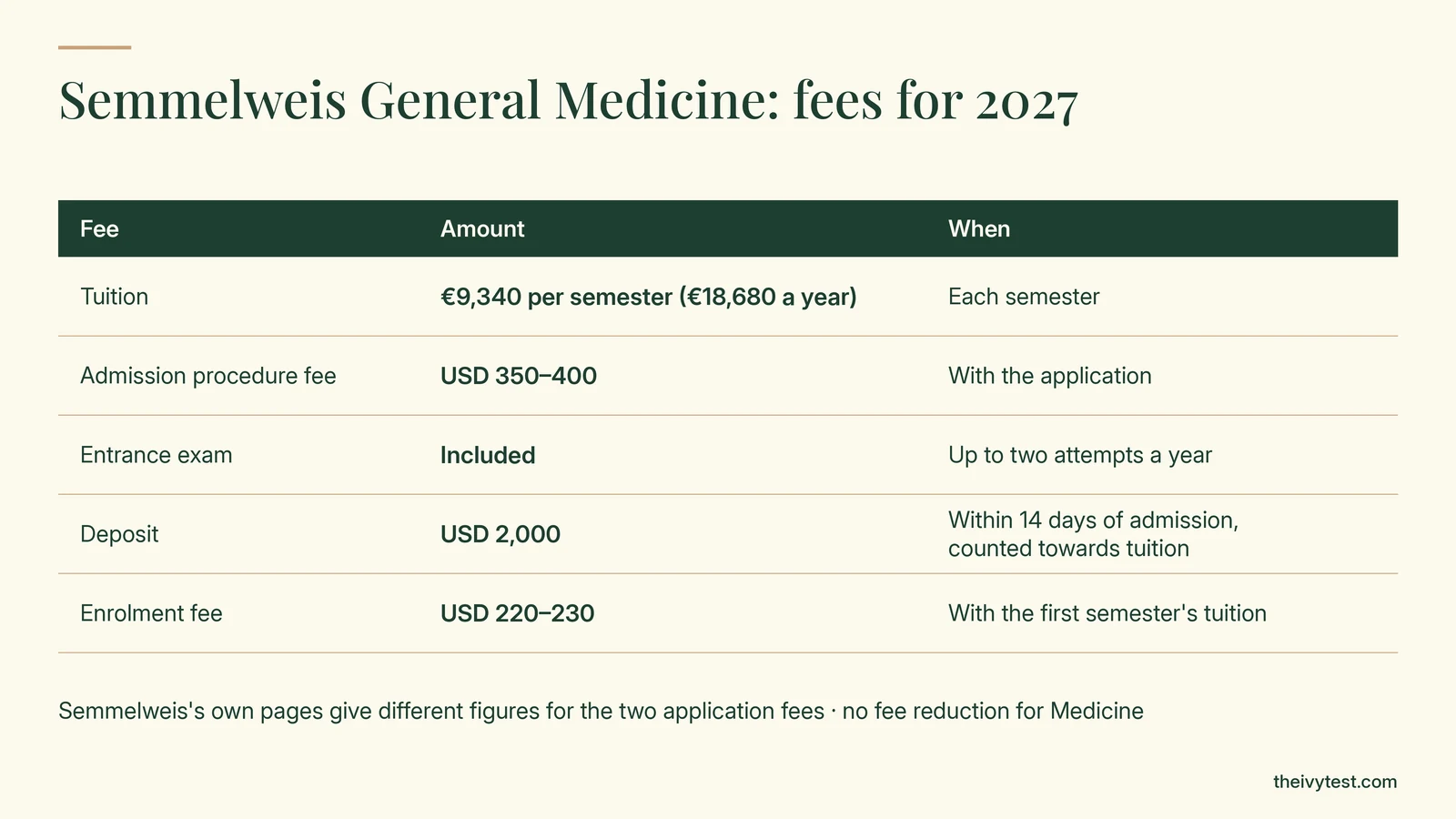
General Medicine in English: fees for the 2027 intake
| Fee | Amount | When |
|---|---|---|
| Tuition | €9,340 per semester (€18,680 a year) | Each semester; the first one, less the deposit, before 21 August |
| Admission procedure fee | USD 350 on the FAQ; USD 400 on the General Medicine page and in the 2026/27 Admission Rules | With the application, by card in SEMAPHOR or by transfer |
| Entrance exam | No extra fee | The admission procedure fee covers up to two exam occasions in a calendar year |
| Deposit | USD 2,000, non-refundable | Within 14 days of admission; deducted from the first semester's tuition |
| Enrolment fee | USD 220 on the FAQ; USD 230 on the General Medicine page and in the 2026/27 Admission Rules | With the first semester's tuition |
Semmelweis's own pages disagree on the two application fees, so check the amount when you pay. Its FAQ also says payments by transfer are made in US dollars while the programme page gives tuition in euros: the finance office (application.finance@semmelweis.hu) can say which currency your invoice is in. Applicants who need a student visa may have to pay one or two semesters before the visa is processed. Semmelweis offers no fee reduction for Medicine on these pages; for scholarships, see below.
Entry requirements
Who can apply, and what to upload
Admission rests on Semmelweis's own entrance exam: four written tests and an interview with an oral exam. There is no minimum grade average, and no standardised test can replace the exam. You can apply in your last year of school; the school-leaving certificate must then be uploaded to SEMAPHOR by 21 August. Applicants should preferably be under 30, and must be at least 18 by the end of May 2027, the end of the first year's spring semester.
No English certificate is required, but Semmelweis expects upper-intermediate English, which the written tests and the interview measure. The English-taught programmes are for applicants without a Hungarian school-leaving exam; Hungarian citizens who completed school abroad, and dual citizens, may apply.
- School-leaving (matriculation) certificate, original or certified copy, in English or with a certified translation
- CV in English
- Personal statement (motivation letter)
- Copy of passport (or ID card for Schengen citizens)
- Portrait photo
- For applicants under 18: a declaration by a parent or guardian, issued within 30 days before upload
- On accepting an offer: a medical certificate, issued within 90 days before upload
Scholarships
Scholarships for international students
Semmelweis's scholarships page lists four programmes. Stipendium Hungaricum, the Hungarian government's scholarship, covers tuition and pays a monthly stipend, medical insurance and a housing allowance; you apply through your own country's sending partner, under a bilateral agreement with Hungary, and the page does not say which Semmelweis programmes a given country's places cover. The Hungarian Diaspora Scholarship is for people from Hungarian communities outside Europe (every country except EU members, Serbia and Ukraine's Zakarpattia region).
Semmelweis's own Pannonia In Excellence Scholarship is merit-based and for students already enrolled who come from a set group of countries: it is awarded for a year, can be applied for again and is paid in 12 monthly instalments. Pannónia Out funds study, research or traineeships abroad during the degree.
Rankings
Rankings and how competitive it is
In Times Higher Education's World University Rankings 2027, Semmelweis is joint 247th in the world; in THE's Medical and Health subject table (the 2026 edition, the latest), it is in the 176–200 band.
Semmelweis publishes no acceptance rate and no number of places for its English-taught programmes, so any rate quoted elsewhere is an estimate. What it does publish: the Admission Committee decides on the written tests, the oral interview and your school record together, also weighing geographical and cultural diversity and gender balance; you may sit the exam twice in a calendar year; and applicants who just miss a place can be put on a waiting list for places left at the end of the admission period.
Semmelweis University in THE's World University Rankings
| Edition | World | Medical and Health |
|---|---|---|
| THE 2027 | =247 | 176–200 (2026 table) |
Curriculum
The six-year General Medicine programme
General Medicine is six years, 12 semesters and 360 credits, taught in English at the Faculty of Medicine, and leads to the Doctor of General Medicine (MD) degree. Hungarian is taught as a subject, because students meet Hungarian patients at the university's polyclinics from the pre-clinical years.
General Medicine at Semmelweis, by year
| Years | Module | What it covers |
|---|---|---|
| 1–2 | Theoretical | Medical chemistry, cell science, biophysics, molecular and cell biology, anatomy, histology, embryology, physiology |
| 3 | Pre-clinical | Pathology, pathophysiology, microbiology, immunology |
| 4–5 | Clinical | The whole range of clinical disciplines, in small-group block rotations |
| 6 | Internship | Internal medicine, surgery, paediatrics, obstetrics and gynaecology, neurology, psychiatry, with short blocks in transfusion medicine, infectology, emergency care and family medicine |
Behavioural subjects such as introduction to medical practice, ethics and medical psychology run through all six years. The thesis is submitted in January of the final year, and the degree ends with written state exams, set by the National State Examination Committee, and oral state exams. The Hungarian Accreditation Committee holds WFME recognition until 31 March 2032, which matters for graduates who want to train or practise in the United States.
Contact
Contacting the admissions office
Applications for the English-taught programmes are handled by the Division of English Language Programs. Everything, from the application to booking an exam and accepting an offer, goes through the online portal SEMAPHOR, and the admissions website is semmelweis.hu/admission.
- Admissions email: admission@semmelweis.hu (the Admission Rules and FAQ); the General Medicine page gives admissions@semmelweis.hu
- Payments: application.finance@semmelweis.hu
- Application portal: semaphor.semmelweis.hu
- Office: H-1094 Budapest, Tűzoltó utca 37–47; phone +36 1 266 0452 (2026/27 Admission Rules)
Sources, read on 14 October 2026: General Medicine · Entrance Exam: Medicine, Dentistry and Pharmaceutical Sciences · FAQ for Medicine, Dentistry and Pharmaceutical Sciences · Rules and Principles for Application and Admission 2026/2027 · Scholarships · Times Higher Education: Semmelweis University
The campus
Semmelweis's Basic Medical Science Center (EOK)
Semmelweis University's buildings are spread across Budapest; the model shows one of them, the Basic Medical Science Center (Elméleti Orvostudományi Központ, EOK) at Tűzoltó utca 37–47. Its four parallel wings, with gardens between them, hold the theoretical institutes, from Physiology and Biochemistry to Molecular Biology and Biophysics, behind a central lobby, three lecture halls, seminar rooms, the library and the Directorate of International Studies. A second building, EOK II, is being built.

Central lobby
The building's main entrance and its heart, also used for exhibitions, with a passage towards Klinikák metro station.
Institute wings (corridors A–D)
Four parallel wings with gardens between them, home to the theoretical institutes: Biophysics and Radiation Biology, Physiology, Clinical Pathophysiology, Biochemistry and Molecular Biology.
Lecture halls
The Szent-Györgyi (320 seats), Hevesy (160 seats) and Békésy (320 seats) lecture halls.
Library
The EOK library, on the ground floor beside corridor C.
Student life
Living in Budapest as a medical student
Semmelweis runs its own university clinics as teaching hospitals — described as Hungary's largest healthcare provider — with students seeing live patients from year 3 onward. The campus clusters across Budapest's 8th and 9th districts along Üllői út, connected by Metro Line 3.
Semmelweis consistently ranks as Hungary's top medical university and among the top in Central and Eastern Europe (QS and THE both place it in their top tiers), though this reflects institutional prestige rather than a published admissions-difficulty figure. On-campus housing includes the Katai Gábor Dormitory; most international students live in private shared flats.
FAQ
Semmelweis University admissions FAQ
Yes. Semmelweis University delivers Medicine in English and runs its admission process in the same language.
Yes, at all four Hungarian schools in our catalogue. At Semmelweis, Debrecen and Szeged it re-tests science orally in English (at Debrecen, biology and the second subject you chose). At Pécs it is a 20 to 30 minute personal interview with a professor on motivation and medicine-related questions, which per Pécs's own FAQ includes two biology and two chemistry questions.
At three of the four Hungarian schools in our catalogue, yes. Semmelweis, Pécs and Szeged score English as a separate written subject, split into general and medical English. Debrecen doesn't: its written papers are biology plus chemistry or physics, although the whole exam and the oral are held in English.
Not a separate one. Hungary's final ('closing') exam, the záróvizsga, is built into year six of the degree itself, combining a clinical internship with finals across internal medicine, surgery, gynaecology, neurology, psychiatry and paediatrics. Registration afterwards with Hungary's national register of healthcare professionals is automatic rather than competitive. A separate specialist exam (szakvizsga) applies later, but only for those pursuing specialty practice after residency, not as a general precondition to work as a doctor.
Yes, it's the 2027 edition, built from the latest admission rules Semmelweis University has published. Where a 2027 date or detail isn't published yet, confirm it with the university before you rely on it.
Yes. Semmelweis University-format practice sessions are available inside the simulator and align with the guide section by section.
Ready to prepare for the Semmelweis Entrance Exam?
The Semmelweis University Complete Admissions System — study guide, exam simulator, video courses and application help, built from Semmelweis University's own syllabus.