
In the complete aerobic respiration of one glucose molecule, which stage yields by far the most ATP?
Exam guide · Updated for 2027 admissions
Medical University of Lodz Entrance Exam 2027: Complete Preparation Guide
Everything you need to know about the Medical University of Lodz entrance exam, the oral exam MUL uses to select candidates for its English-taught six-year MD: the Microsoft Teams format, the two-science choice, the 32-point scale, the 18-point pass mark, sample questions, dates and the application deadline, fees, entry requirements, preparation strategy and practice.
Updated for 2027 admissions · Last updated: 17 October 2026
Medical University of Lodz Entrance Exam at a glance
Overview
What is the Medical University of Lodz entrance exam?
The Medical University of Lodz (MUL, or UMED) admits to its English-taught six-year MD through an examination that looks nothing like the written multiple-choice papers most European medical schools set. It is a single oral examination of about thirty minutes, conducted online over Microsoft Teams, in English, with a committee on the other end. Poland runs no shared national medical entrance test, so every university writes its own, and MUL's is the one that asks you to talk.
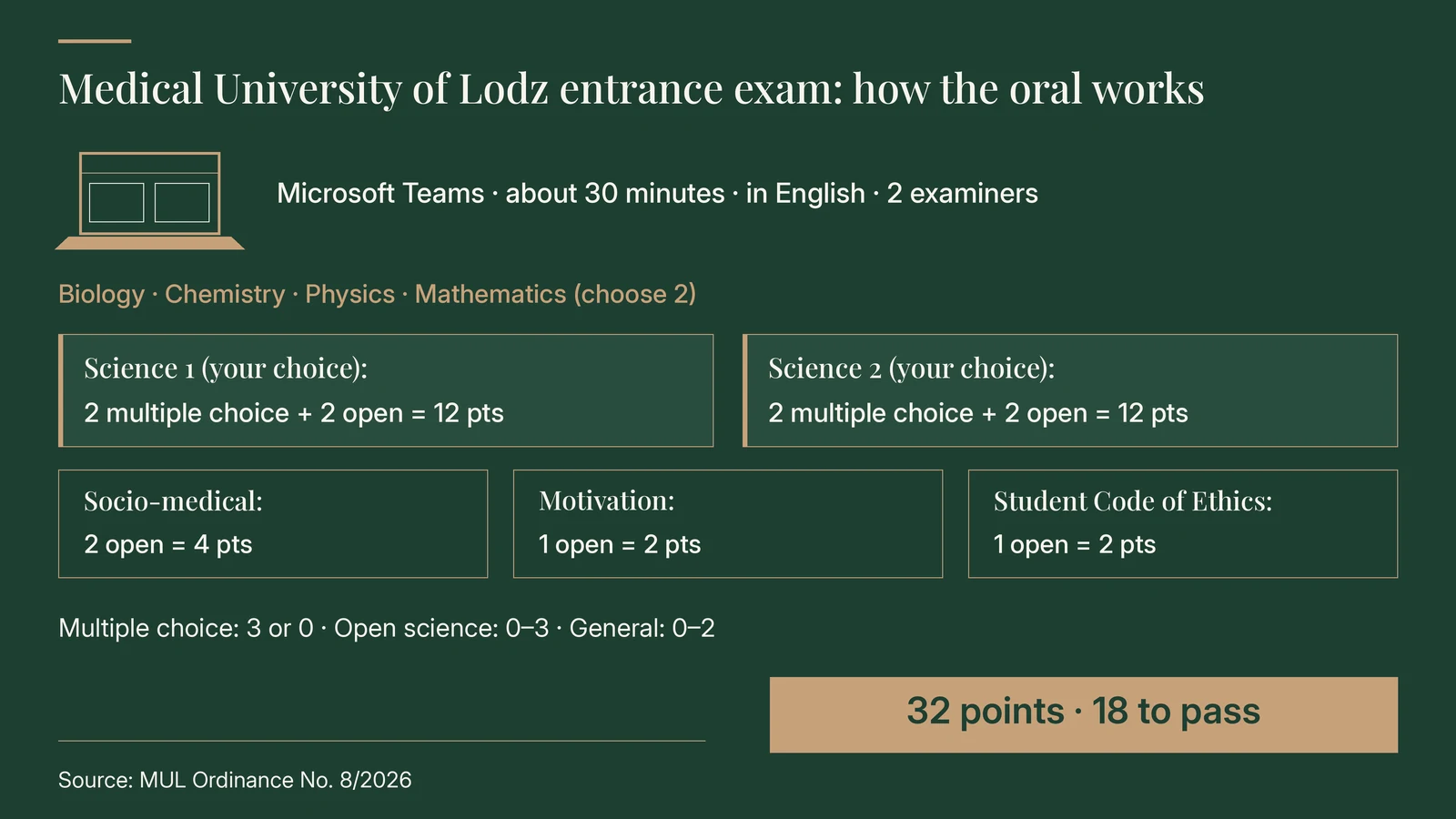
The paper is 12 questions worth 32 points in total, and it is built in two halves. The science half is elective: you choose two of Biology, Chemistry, Physics and Mathematics on your application form and sit only those two. Each chosen subject carries four questions: two closed multiple-choice items at 3 points each and two open questions scored 0 to 3 each, for 12 points per subject and 24 across the two. The other half is compulsory and identical for everyone: two open socio-medical questions and two open questions on motivation, interests and ethics, each scored 0 to 2, for 8 points.
Three consequences follow, and they shape everything about how to prepare. First, only 4 of the 12 questions have options to choose between; 20 of the 32 points come from answers you have to construct and say out loud, with the Regulations noting that the committee is not expected to prompt a candidate whose answer is incomplete. Second, unlike most schools in this catalogue, MUL publishes a real pass mark: 18 of 32 points, set out in §6.3 of the governing Ordinance, and it decides admission: candidates who pass are listed in order of exam result within the Minister of Health's admission limit, which was 104 places in 2026/27. Third, there is a documented way out of the science block entirely: §7 exempts IB, European Baccalaureate and Matura holders, and graduates of MUL's own Pre-Medical Preparatory Course with a GPA of 4.0 or above, awarding them maximum science points outright. Before any of this, your school grades have to clear a points threshold the admissions committee sets for the year.
Programmes that use the Medical University of Lodz Entrance Exam
- Medicine, 6-Year MD (English-taught), Lodz Campus
Timeline
Medical University of Lodz Entrance Exam 2027: dates and deadlines
When to expect your exam · 2027 start
- March 2027any dateBased on 2026
- April 2027any dateBased on 2026
- May 2027any dateBased on 2026
- June 2027any dateBased on 2026
- July 2027any dateBased on 2026
- August 2027any dateBased on 2026
- September 2027any dateApproximate
Applications open 15 Jan 2027.
Predicted from this university's past sittings until it publishes its own dates. See every university on the calendar →
- Admission opensRecruitment for 2027/28 opens on 15 January 2027 under Senate Resolution No. 60/2026, the date MUL's Application Calendar now gives; the 2026/27 window opened 15 January 2026
- Application deadline2027/28 deadline not yet published: the Application Calendar lists it as to be advised, and the recruitment procedure itself runs to 31 October 2027. The 2026/27 window closed 7 September 2026 at 9:00 Polish time, one of the longest application windows of any medical school in this catalogue
- Entrance exam sittingScheduled individually rather than on a fixed national date: the exam is a booked Microsoft Teams appointment within the admission window, and the 2026/27 sessions started on 5 March 2026 with multiple dates to choose from
- ResultsCandidate-specific: MUL emails your result within two working days of your exam (Ordinance 8/2026, §8)
- Enrolment deadlineNo single date is published. After passing, you email your final diploma (and NAWA statement where required) to receive the Letter of Acceptance, then pay the first instalment within two weeks of it. In 2026 orientation ran in the last week of September and classes began on 1 October
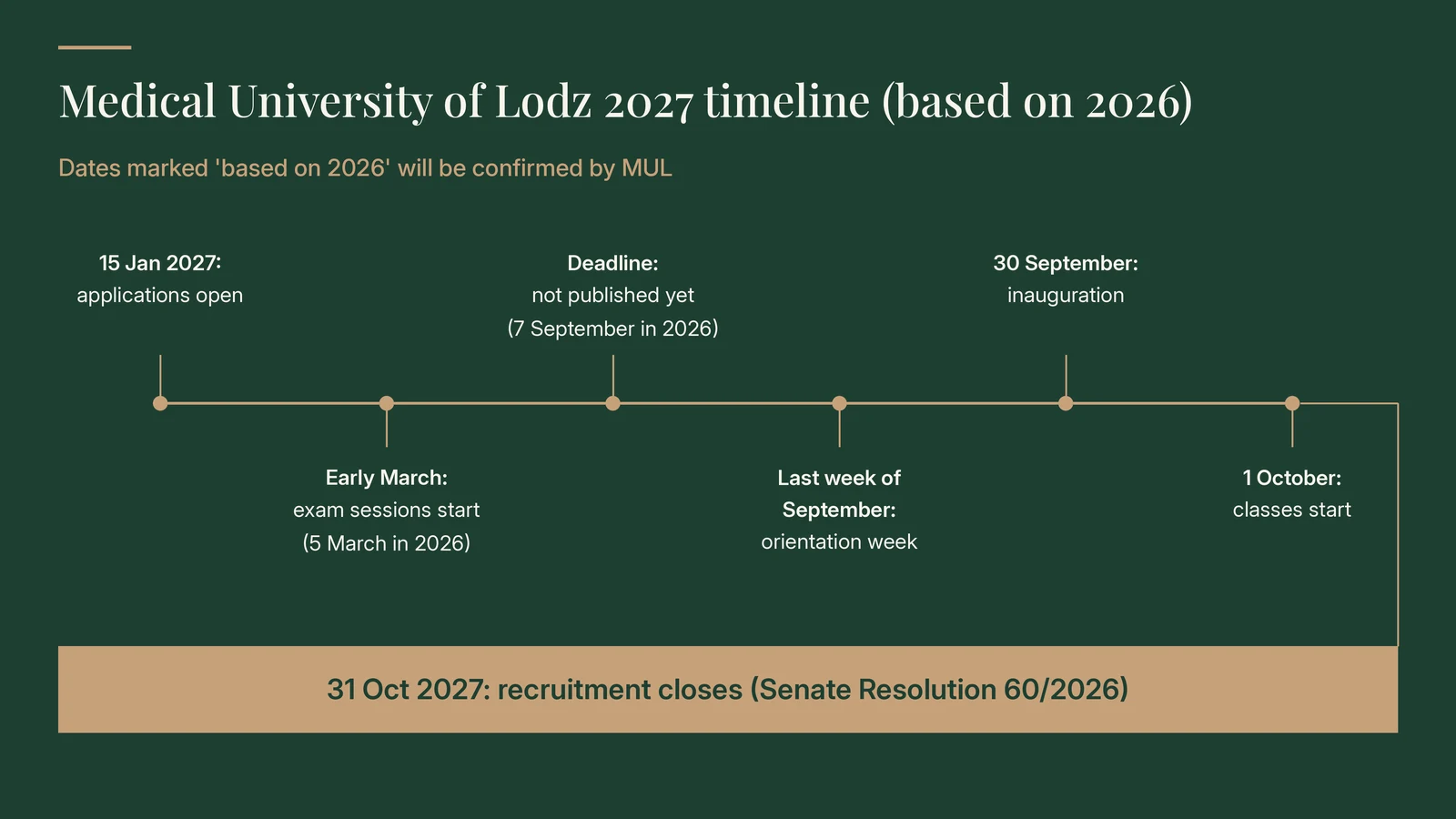
The exam described here is governed by Ordinance No. 8/2026 of January 12, 2026 of the Rector of the Medical University of Łódź and its Annex, the Regulations for the Entrance Examination, signed by Rector Prof. Janusz Piekarski, MD, PhD, and published on the university's own admissions portal. Its §2 states that the Regulations apply to recruitment procedures conducted from academic year 2026/2027 onward, and every format value in this guide was read directly from that document, and re-checked on 17 October 2026, with one exception: the 30-minute duration is not stated in the Ordinance text, which specifies only a 10-minute no-show grace period and a 5-minute reconnection grace period, and is confirmed instead on UMED's own admissions page. One forward-looking note: the Senate's recruitment rules for 2027/2028, Uchwała nr 60/2026 of 25 June 2026, run recruitment from 15 January to 31 October 2027, require a minimum school-grade score to reach the exam and a minimum exam result to be admitted, both set before recruitment starts, and leave the exam's detailed rules to the Rector. IvyTest last read it on 17 October 2026; it does not describe the exam's format, so check for a new Rector's ordinance before relying on this guide for a 2027/2028 application.
Structure
Medical University of Lodz Entrance Exam format
Twelve questions in about thirty minutes (two and a half minutes each) as one continuous spoken conversation. The table below lists all six subjects, but no candidate sits all six: the four sciences are an elective group from which you choose two, and only the last two rows appear on every paper.
| Section | Questions | Weighting | Suggested time |
|---|---|---|---|
| Biology (elective) | 4 (two closed multiple-choice, two open) | 12 of 32 points, on the papers of candidates who choose it | *see the note below the table |
| Chemistry (elective) | 4 (two closed multiple-choice, two open) | 12 of 32 points, on the papers of candidates who choose it | *see the note below the table |
| Physics (elective) | 4 (two closed multiple-choice, two open) | 12 of 32 points, on the papers of candidates who choose it | *see the note below the table |
| Mathematics (elective) | 4 (two closed multiple-choice, two open) | 12 of 32 points, on the papers of candidates who choose it | *see the note below the table |
| Socio-Medical Topics (compulsory) | 2 (both open, no multiple choice at all) | 4 of 32 points, on every paper | About 30 minutes for the whole exam, with no per-subject time limit published |
| Motivation and Ethics (compulsory) | 2 (both open, no multiple choice at all) | 4 of 32 points, on every paper | About 30 minutes for the whole exam, with no per-subject time limit published; one question on motivation, predisposition and interests, one on the Student Code of Ethics |
- About 30 minutes for the whole exam, with no per-subject time limit published; 12 questions in 30 minutes is roughly two and a half minutes each
Content
Question and subject breakdown
Six subjects exist; any one candidate sits four of them. The two you choose from the science group are three-quarters of your score, so the choice made on the application form is one of the highest-leverage decisions in this whole admission process.
Biology
12 of 32 points (37.5%) when selectedEight areas grouping the 43 numbered headings of MUL's official Range of Knowledge: macromolecules and enzymes; cell structure and organelles; cell communication and the cell cycle; metabolism and cellular respiration; genetics and molecular biology; human anatomy and physiology; microbiology; and ecology and evolution. The headings are official, the grouping into eight is editorial. Human anatomy and physiology is by far the largest of the eight, running from the skeletal system through to the reproductive systems.
Chemistry
12 of 32 points (37.5%) when selectedNine areas grouping the seventeen numbered units of the official Range of Knowledge, from measurement and matter through atoms and nuclear chemistry, bonding, chemical quantities and reactions, gases and solutions, acids and bases, organic chemistry and functional groups, biomolecules and metabolic pathways. One detail worth carrying into revision: MUL's own Sample Questions paper tests the Lewis definition of an acid, so Lewis acid and base recognition is examinable even where the published unit list reads as a standard Arrhenius and Brønsted-Lowry treatment.
Physics
12 of 32 points (37.5%) when selectedNine areas grouping the 25 numbered topics of the official Range of Knowledge, which follow the chapter order of Giancoli, Physics: Principles with Applications, the textbook named on MUL's own admissions page. Coverage runs from measurement and kinematics through dynamics and gravitation, work, energy and momentum, rotation and equilibrium, fluids and thermodynamics, oscillation, waves and sound, electricity and DC circuits, magnetism and electromagnetic waves, and optics.
Mathematics
12 of 32 points (37.5%) when selectedThe elective with the widest gap between its published syllabus and its published sample paper. The official Range of Knowledge tracks Greenwell, Ritchey and Lial, Calculus for the Life Sciences (the textbook named on the admissions page) and runs from algebra and functions through limits, derivatives, integration, multivariable calculus and probability. But every one of the five Mathematics items in MUL's own official Sample Questions paper is aptitude-style arithmetic, number theory, percentage or counting work rather than calculus. A candidate who chooses Mathematics has to be ready for both.
Socio-Medical Topics
4 of 32 points (12.5%), compulsory, on every paperFive official areas, one for each numbered item of the Range of Knowledge: treatment and prevention; lifestyle and environmental risk factors; challenges in the medical field; donation, vaccination and alternative medicine; and global and local health problems. Both questions are open and answered aloud: there are no closed items in this subject at all, and the official prompts are phrased as opinion questions, so what is actually being assessed is whether you can reason from public-health facts rather than whether you hold a particular view.
Motivation and Ethics
4 of 32 points (12.5%), compulsory, on every paperTwo open questions: one on motivation, predisposition and interests, one on the Student Code of Ethics. The Code is the only part of this subject backed by a published text, and therefore the only part with a genuinely checkable answer: it names specific unethical conduct, specific reprehensible conduct and a specific ladder of disciplinary measures. The rest of the subject covers the duties and responsibilities of doctors, your own expectations of the programme, lifestyle factors affecting health, studying and living abroad, and your hobbies, interests and future plans.
Marks
Medical University of Lodz Entrance Exam scoring
MUL is one of the few schools in this catalogue that publishes an actual pass mark: 18 of 32 points, set out in §6.3 of the governing Ordinance. What makes the exam hard to plan for is not the threshold but the shape of the 32 points underneath it: only 12 of them come from questions with options to choose between.
- Closed science question (2 per chosen subject)
- +3 points for a correct answer, 0 for an incorrect one, no negative marking (§6.1(1))
- Open science question (2 per chosen subject)
- Scored 0–3 each by the committee
- Each chosen science subject
- 12 points maximum (two closed at 3, two open at 0–3)
- Socio-medical questions (2, compulsory)
- Open, scored 0–2 each, 4 points maximum (§6.1(2))
- Motivation and ethics questions (2, compulsory)
- Open, scored 0–2 each, 4 points maximum (§6.1(2))
- Maximum possible score
- 32 points: 12 + 12 + 4 + 4 (§6.2)
- Minimum eligible score
- 18 of 32 points (§6.3), a genuinely published threshold, not an inference
- Per-subject floors
- None: the Ordinance sets a single overall floor and no per-section minimum, and Poland has no equivalent of the Italian OFA mechanism
- Reserve or replacement questions
- Not published. The Ordinance and its Annex describe no reserve, spare or replacement items, and say nothing about what happens if an item is found faulty, so there is no figure to record, not a confirmed absence of one.
- Science-block exemption (§7)
- IB, European Baccalaureate and Matura holders, and MUL Pre-Medical Preparatory Course graduates with a GPA of 4.0 or above, skip the science block and are awarded maximum science points; they need 5 of the 8 points on the socio-medical and motivation/ethics part
Worked example
Thirty-two points, and only twelve of them are multiple choice. Work out what that means before you plan any revision. Each chosen science subject gives you two closed questions at 3 points and two open questions scored 0 to 3, so 12 points per subject and 24 across the two you choose, three-quarters of the exam. The remaining 8 come from four open questions answered aloud, two socio-medical and two on motivation and ethics, each marked 0 to 2. Now put the 18-point line against that shape. Get all four closed questions right and you have banked 12; you then need only 6 of the remaining 20 open points (30 per cent of them) to pass. Get none of the four right and you need 18 of those 20, which means something close to full marks on every spoken answer you give: four science answers at 3 out of 3, plus 6 of 8 on the general part. Those two candidates differ by 12 points on 37.5 per cent of the exam, and that difference decides whether the rest of the half hour is comfortable or nearly impossible. Guessing is free, because §6.1(1) awards 3 points for a correct closed answer and 0 for an incorrect one with no penalty attached: with four options a blind guess is worth (1/4 × 3) + (3/4 × 0) = +0.75 points, so guessing all four closed questions returns an expected 3 points: a sixth of the way to 18 from no knowledge at all. Be careful which unit you use when you talk about improving here, because three different numbers describe the same change. Going from 2 of 4 closed questions to 4 of 4 is a 50-percentage-point gain in closed-question accuracy; it is 6 raw points on the 32-point scale; and it is 18.75 percentage points of your total score. Only the raw points decide admission. Finally, the exemption route rewrites the arithmetic entirely. An IB, European Baccalaureate or Matura holder, or a MUL Pre-Medical Preparatory Course graduate with a GPA of 4.0 or above, skips the science block and is awarded its maximum outright, and 24 points on its own already clears the 18-point overall floor. So the Ordinance's requirement that such candidates take 5 of the 8 points on the socio-medical and motivation/ethics part is a separate, standalone condition rather than a consequence of the 18-point rule: for an exempt candidate the entire examination is four spoken questions worth 8 points, of which 5 have to be earned.
The IvyTest simulator scores every practice paper against these exact rules.
See the Medical University of Lodz Entrance Exam simulatorSyllabus
Full Medical University of Lodz Entrance Exam syllabus
Every heading below comes from MUL's official Range of Knowledge Required (Medicine 6MD and Dentistry 5DMD, 2025), grouped into teachable blocks: the headings are official, the grouping is editorial. Two departures are flagged in the group intros: the Mathematics arithmetic block is derived from MUL's own Sample Questions paper rather than from the Range of Knowledge, and the Student Code of Ethics content comes from the published Code itself. The official lists carry a handful of typographical errors; the labels here are the corrected forms.
Eight areas covering the 43 numbered headings of the official Range of Knowledge. Human anatomy and physiology is much the largest.
- Macromolecules and enzymes: carbohydrates, lipids, proteins and nucleic acids: structure, synthesis, metabolism, functions and examples of their use in living organisms; enzymes, activation energy, substrates and the active site
- Cell structure and organelles: the prokaryotic and the eukaryotic cell, cell membrane structure and functions including transport, mitochondria and chloroplast, nucleus, nucleolus and rough endoplasmic reticulum, ribosomes, Golgi apparatus and cytoskeleton
- Cell communication and the cell cycle: cell junctions, receptors and chemical messengers, pathways of intracellular signal transduction, the cell cycle, mitosis and meiosis
- Metabolism and cellular respiration: energy of life, metabolism and energy flow through organisms, free energy and equilibrium, ATP synthesis, hydrolysis, function and regeneration, catabolic and anabolic processes, glycolysis, the Krebs cycle, electron transport, proton motive force, oxidative phosphorylation, protein and fat metabolism and their connections to other pathways
- Genetics and molecular biology: Mendelian genetics and its connection to modern genetics, linkage and chromosomes, organization of genetic material, sex-linked and linked genes, genetic disorders and inheritance patterns, DNA and RNA as genetic material, transcription and translation, regulation of gene expression in prokaryotes and eukaryotes, gene and chromosome mutations and their role in pathogenesis and evolution, DNA technology and genome evolution including sequencing, cloning, GMO and DNA-based biotechnology
- Human anatomy and physiology: the skeletal system and structural classes of joints, muscle structure, physiology and contraction, skin and its accessory structures and glands, the nervous system with neurons, glial cells, the blood-brain barrier and electrical and chemical synapses, sense organs and types of sensory receptor, the respiratory system and the function of haemoglobin, pulmonary and systemic circulation with the heart and vessels, the functions and composition of blood including leucocyte types and clotting, the immune system and vaccination, the endocrine system with water-soluble and fat-soluble hormones and feedback regulation, the digestive tract with liver, gallbladder and pancreas, the urinary system and the nephron, and the reproductive systems with gametogenesis and the menstrual cycle
- Microbiology: viruses including structure, replication, bacteriophages, viroids and prions, human virus infections, transmission, tissue tropism and emerging viruses; bacteria including the five basic shapes, cell surface structures, the Gram stain, motility, growth, plasmids, nutritional and metabolic adaptation, and harmless, beneficial and harmful roles; fungal types, structure, reproduction and pathogenicity; protists and their role in the environment
- Ecology and evolution: biosphere, ecosystem, community, population, habitat, niches, biotic potential, limiting factors, tolerance, carrying capacity, adaptation, succession, consumers and producers, food chains, symbiosis, mutualism, commensalism and parasitism; evolution in populations, human evolution, Hardy-Weinberg equilibrium, natural selection, genetic drift, gene flow, phylogeny and the tree of life
Nine areas covering the seventeen numbered units of the official Range of Knowledge, in its own order.
- Measurement, matter and energy: what chemistry studies, units of measurement, density, classification of matter, states and properties of matter, temperature, energy, specific heat and changes of state
- Atoms, elements and nuclear chemistry: elements and their symbols, the periodic table, the atom, atomic number and mass number, isotopes and atomic mass, electron energy levels, nuclear radioactivity, nuclear reactions, radiation measurement, the half-life of a radioisotope, nuclear fission and fusion
- Ionic and molecular compounds: ions, naming ionic compounds and writing their formulas, polyatomic ions, molecular compounds, electronegativity and bond polarity, shapes and polarity of molecules, attractive forces between compounds
- Chemical quantities and reactions: the mole, molar mass and calculations, equations for chemical reactions, types of reaction, oxidation-reduction reactions, mole relationships in chemical equations, mass calculations for reactions, energy in chemical reactions
- Gases and solutions: properties of gases and the laws of Boyle, Charles, Gay-Lussac, Avogadro and Dalton; solutions, electrolytes and nonelectrolytes, solubility, concentrations of solutions, dilution and the properties of solutions
- Acids, bases and equilibrium: acids and bases and their strengths, the ionization of water, the pH scale, reactions of acids and bases, buffers, and the Lewis definition of an acid, which MUL's own Sample Questions paper tests directly
- Organic chemistry and functional groups: organic compounds, alkanes and substituents and their properties, alkenes and alkynes, cis-trans isomers, aromatic compounds, alcohols, phenols, thiols and ethers, aldehydes and ketones and their reactions, carboxylic acids and their properties, esters and their hydrolysis, amines and amides
- Biomolecules: carbohydrates, chiral molecules, Fischer projections and Haworth structures of monosaccharides, the chemical properties of monosaccharides, disaccharides and polysaccharides; lipids, fatty acids, waxes and triacylglycerols, phospholipids, steroids including cholesterol and bile salts, cell membranes; proteins and amino acids, amino acids as acids and bases, primary, secondary, tertiary and quaternary protein structure, enzymes and the factors affecting enzyme activity; the components and primary structure of nucleic acids, the DNA double helix, RNA and the genetic code, protein synthesis, genetic mutations and viruses
- Metabolic pathways and energy production: metabolism and ATP energy, the digestion of food, coenzymes in metabolic pathways, glycolysis as the oxidation of glucose, the citric acid cycle, electron transport and oxidative phosphorylation, the oxidation of fatty acids, the degradation of amino acids
Nine areas covering the 25 numbered topics of the official Range of Knowledge, which follow the chapter order of Giancoli, Physics: Principles with Applications, the textbook MUL names on its admissions page.
- Measurement and kinematics: units, conversions and estimation, motion in one dimension with position, displacement, velocity, acceleration and the constant-acceleration equations, kinematics in two dimensions, vectors and their components, projectile motion, and interpreting position-time, velocity-time and acceleration-time graphs
- Dynamics, gravitation and circular motion: Newton's laws of motion, inertia, force and mass, weight, normal force, friction, free-body reasoning, uniform circular motion, centripetal acceleration and force, Newtonian gravitation and orbits
- Work, energy and momentum: work, kinetic and potential energy, conservation of mechanical energy, power, linear momentum, impulse, conservation of momentum, collisions and recoil
- Rotational motion and equilibrium: angular displacement, velocity and acceleration, torque, moment of inertia, rotational kinetic energy, static equilibrium of forces and torques, centre of gravity, elasticity, stress and strain, elastic limit and fracture
- Fluids, heat and thermodynamics: density, pressure, hydrostatic pressure, Pascal's principle, buoyancy, continuity and Bernoulli's principle, temperature scales and kinetic theory, the ideal gas relation between temperature and volume, heat, specific heat, calorimetry, latent heat, conduction, convection and radiation, the first and second laws of thermodynamics, internal energy and entropy
- Oscillation, waves and sound: simple harmonic motion, amplitude, period and frequency, wavelength and wave speed, superposition and resonance, sound as a longitudinal wave, the speed of sound, intensity and decibels, the Doppler effect
- Electric charge, potential and DC circuits: electric charge, Coulomb's law, conductors and insulators, electric field and field lines, electric potential energy, voltage and potential difference, capacitors, electric current, resistance, Ohm's law and electrical power, DC circuits with resistors in series and parallel, batteries and meters
- Magnetism and electromagnetic waves: magnetic fields, forces on moving charges and current-carrying wires, simple motors, electromagnetic induction and Faraday's law, magnetic flux, Lenz's law, generators and transformers, electromagnetic waves, the spectrum from radio waves to gamma rays, and the relation between frequency, wavelength and the speed of light
- Optics and the nature of light: geometric optics with reflection, refraction, mirrors, lenses, ray diagrams and image formation, the wave nature of light with interference, diffraction, polarization and the double-slit experiment, optical instruments, focal length, the eye and corrective lenses
Seven areas from the official Range of Knowledge, which tracks Greenwell, Ritchey and Lial, Calculus for the Life Sciences, plus an eighth that is derived rather than official. Arithmetic and number reasoning appears nowhere in the Range of Knowledge, but every one of the five Mathematics items in MUL's official Sample Questions paper is work of exactly that kind, so the list would misrepresent the paper without it.
- Algebra and expressions: polynomials, factoring, rational expressions, equations, inequalities, exponents and radicals, simplifying expressions, solving linear and quadratic equations
- Functions and graphs: composition of functions, lines and linear functions, the least squares line, properties of functions, quadratic functions, translation and reflection, polynomial and rational functions, domain and range
- Exponentials, logarithms and trigonometry: exponential functions and growth and decay, logarithmic functions and log laws, solving exponential and logarithmic equations, trigonometric functions, radians and degrees, basic identities and graphs
- Limits and the derivative: limits, continuity, rates of change, the definition of the derivative, graphical differentiation, derivatives of products and quotients, the chain rule, graphs and the derivative, increasing and decreasing functions, relative and absolute extrema
- Integration: antiderivatives, substitution, integration by parts, definite and indefinite integrals, area under a curve
- Multivariable calculus: functions of several variables, partial derivatives, maxima and minima, total differentials and approximations
- Probability and random variables: sets, conditional probability, independent events, discrete random variables, expected value and the variance of continuous random variables
- Arithmetic and number reasoning (derived, not official): divisibility, prime factors and smallest-value factor problems, digit sums and digit-constrained integer counting, ratios and proportional reasoning, percentage profit and loss, the area of a triangle from two sides and the included angle, and systematic counting problems. Taken from MUL's official Sample Questions paper rather than from the Range of Knowledge.
Five official areas, one for each numbered item of the Range of Knowledge. Both questions are open and spoken; the official prompts are phrased as opinion questions, so the facts are what you reason from rather than what you are scored on reciting.
- Treatment and prevention: primary, secondary and tertiary prevention, screening, health promotion, and the relationship between preventive and curative care and how each is resourced
- Lifestyle and environmental risk factors: environmental and lifestyle-related factors affecting health, a healthy lifestyle, the health needs of society and risk factors including smoking, alcohol, diet, physical activity, sleep, pollution and socioeconomic determinants
- Challenges in the medical field: an ageing population, chronic and noncommunicable disease, mental health, antimicrobial resistance, epidemics, health misinformation, workforce shortage and access to care
- Donation, vaccination and alternative medicine: blood and organ donation and the consent models around it, vaccination and herd immunity, volunteer work in a health setting, and how evidence-based medicine relates to alternative and complementary therapies
- Global and local health problems: major health problems and challenges compared from a global versus a local perspective, including infectious disease, maternal and child health, health inequality and resource constraint
Six areas from the Range of Knowledge, with the Student Code of Ethics separated out because it is the only part backed by a published text, and therefore the only part with a checkable right answer. The official heading for this subject reads GENERAL QUESTIONS REGARDING MOTIVATIONS, INTERESTS AND ETHICS.
- Duties and responsibilities of doctors: how you understand the requirements, duties and responsibilities of doctors, dentists and other medical staff, including competence, confidentiality, honesty with patients, teamwork and patient safety
- The Student Code of Ethics: the Code's purpose as a guide in situations of moral dilemma; respect for law and for other viewpoints, beliefs and cultural traditions, and the duty to prevent discrimination and to oppose unethical behaviour lawfully; the obligations to work diligently, prepare conscientiously for tests and examinations and respect staff and fellow students
- The Student Code of Ethics: conduct expressly considered unethical: consultation with outsiders, unauthorised aids, devices capable of downloading, communicating or recording, breach of intellectual property, forgery of grades, falsification of documents, impersonating another student and exploiting family relationships
- The Student Code of Ethics: conduct considered reprehensible, including lateness, disruption of classes and examinations, insults, poor hygiene, inappropriate expression and the use of stimulants or intoxicants; the Student as a representative of the University and the treatment of University property; and the disciplinary ladder from admonition through reprimand, reprimand with warning and suspension of student rights to expulsion
- Motivation and expectations of study: your motivation for medicine and for the English-language programme, your expectations of studying at the Medical University of Lodz, and the attitudes and features expected of a student
- Personal context: your own practice of the lifestyle factors that affect health and how a future clinician's habits relate to the advice they will give; studying and living abroad, cultural differences, independence and adaptation to an international academic environment; and your hobbies, interests and future plans and what they show about balance, discipline, teamwork and commitment
Test your Medical University of Lodz Entrance Exam knowledge
Take free diagnosticDifficulty
How difficult is the Medical University of Lodz Entrance Exam?
Nothing here is conceptually harder than school science. What makes MUL difficult is that most of it has to be said out loud, unprompted, in half an hour, and that the two subjects carrying three-quarters of the score are chosen by you, months in advance, on a form.
Eight of the twelve questions have no options at all
Only the four closed science items (12 of the 32 points) offer anything to choose between. The other 20 points come from answers you construct and speak. There is no elimination, no four-way guess and no credit for recognising the right answer when you see it. The Regulations make the consequence explicit: the committee is not expected to prompt a candidate whose answer is incomplete. Silence after you stop talking is not an invitation to continue; it is the end of the answer.
Your subject choice is 75 per cent of the score, and you make it on a form
You pick two of Biology, Chemistry, Physics and Mathematics when you apply, and those two are worth 24 of the 32 points. Six pairings are possible and they are not equally easy for any given candidate. A choice made casually (because a subject sounds more medical, or because a friend chose it) commits three-quarters of your score before you have revised a single page.
The Mathematics option's syllabus and its sample paper disagree
MUL's official Range of Knowledge for Mathematics tracks a life-sciences calculus textbook all the way to partial derivatives and total differentials. Every one of the five Mathematics items in MUL's own official Sample Questions paper is arithmetic, number theory, percentages or counting. Both are official documents from the same university. Choosing Mathematics means preparing for the union of the two, which is a wider brief than choosing Biology or Chemistry.
Eight of the points are scored on subjects nobody revises
The socio-medical and motivation-and-ethics questions are compulsory, worth 8 of 32, and sit outside every science syllabus. One of them is specifically about MUL's own Student Code of Ethics: a published document naming particular unethical acts, particular reprehensible acts and a particular disciplinary ladder. It is the most readable, most learnable four pages in this entire guide, and it is routinely the part candidates arrive not having opened.
Half an hour, live, with very little slack
Twelve questions in about thirty minutes is two and a half minutes each, in a single Microsoft Teams conversation with your face visible throughout. The Ordinance allows a 10-minute grace period for a late start and a 5-minute grace period for a reconnection, and that is the whole of the contingency. A calculator, a periodic table, blank paper and a pen are permitted, but only under camera visibility; everything else, including notes and any second device, is prohibited.
Benchmarks
What is a good Medical University of Lodz Entrance Exam score?
MUL is unusual twice over: it publishes a real threshold (18 of 32 points), and it runs exam sessions across an unusually long window, from March to early September in 2026. Those two facts together change what a target score even means here.
At most schools in this catalogue the published minimum is a floor and the real contest happens well above it, because places go to the highest-ranked candidates in a single round. At MUL, candidates who pass the exam and submit their documents receive a Letter of Acceptance, and the 2027/28 rules list qualified candidates in order of exam result within the Minister of Health's limit of 104 places (2026/27). MUL does not say whether places run out before the window closes, so do not treat 18 of 32 as a guarantee, and do not leave the application to the last weeks either.
The other thing worth knowing before you set a target is which points are actually reachable. The four closed questions give you 12 points that are partly winnable by elimination and free to guess at; the eight open questions give you 20 that are not. A candidate aiming at 18 who has banked all 12 closed points needs 6 of 20 open points and can afford to be genuinely weak on two of the four spoken science answers. A candidate who misses all four closed questions needs 18 of 20 and effectively cannot afford a single poor answer. Plan the closed items first (they are the cheapest points on the paper), then build the spoken practice that the remaining 20 require.
Pending verification
- · The exam format for the 2027/2028 cycle: Uchwała nr 60/2026 leaves the detailed rules to a Rector's ordinance not yet issued
- · Applicants per cycle on the English-taught 6-year MD, and the school-grade threshold for reaching the exam
- · Typical or competitive scores above the published 18-point minimum
- · Whether the two open science questions are drawn from the same areas as the two closed ones
- · Confirmed 2027/2028 application window dates
These specific numbers aren't public yet — an IvyTest simulator score is the closest benchmark you can get today.
Check your Medical University of Lodz Entrance Exam scoreStrategy
How to prepare for the Medical University of Lodz Entrance Exam
12+ weeks
Choose your two sciences deliberately, then learn to say the answers
Two elective sciences worth 24 points, plus the 8 compulsory points almost nobody revises.
- Decide your two science subjects in week one, not on the application deadline. They are 24 of 32 points, there are six possible pairings, and the decision is fixed once the form is submitted, so test yourself against all four Ranges of Knowledge before committing.
- Build spoken practice in from the start. Twenty of the thirty-two points come from open questions answered aloud with no prompting, and reading a topic until it feels familiar is not the same skill as explaining it in ninety seconds to a committee that will not help you.
- Read MUL's Student Code of Ethics early and properly: it is a published document, it is the only part of the motivation and ethics subject with a checkable answer, and it names specific unethical conduct, specific reprehensible conduct and a specific disciplinary ladder.
- If Mathematics is one of your two, prepare both versions of it: the Range of Knowledge's calculus through partial derivatives, and the arithmetic, number-theory and counting work that fills MUL's own official Sample Questions paper.
8 weeks
Bank the twelve closed points, then build the twenty spoken ones
Securing the guessable half before working on the half that cannot be guessed.
- Drill the two closed items per science subject first. They are worth 3 points each, 12 in total, and they are the only points on this exam that respond to elimination and multiple-choice technique.
- Then move the bulk of your time to open-answer practice across both chosen sciences, because the other 20 points have no options and no partial credit from recognition.
- Give the socio-medical areas a weekly slot: prevention, lifestyle and environmental risk factors, challenges in the medical field, donation and vaccination, and global versus local health problems. They are 4 points, they are compulsory, and the official prompts are opinion-shaped, so practise reasoning from public-health facts rather than rehearsing a position.
- Rehearse a two-minute answer to the motivation question and a two-minute answer on the Student Code of Ethics. Together they are 4 of the 32 points and they are entirely within your control.
4 weeks
Run the real thing: thirty minutes, twelve questions, out loud
Full-length spoken rehearsal under Microsoft Teams conditions.
- Run two full mock examinations a week: twelve questions in thirty minutes, four closed and eight open, with someone playing the committee and deliberately not prompting you when an answer trails off.
- Score them honestly on the real scale: 3 points per correct closed item, 0 to 3 on each open science answer, 0 to 2 on each general answer, out of 32 against the 18-point line.
- Rehearse the logistics on Teams itself, with your face visible, alone in the room, and your permitted aids (blank paper, a pen, a calculator and a periodic table) laid out where the camera can see them.
- Practise finishing an answer cleanly. Because the committee is not expected to prompt an incomplete answer, the habit to build is stating your conclusion explicitly rather than tailing off and waiting to be asked for more.
Under 4 weeks
Check whether you need the science block at all, then defend the cheap points
Exemption eligibility, closed-question technique and the compulsory eight.
- Check §7 of the Ordinance before you do anything else. If you hold the IB, the European Baccalaureate or a Matura, or graduated from MUL's Pre-Medical Preparatory Course with a GPA of 4.0 or above, you skip the science block entirely and are awarded maximum science points, and your whole exam becomes four spoken questions worth 8 points, of which you need 5.
- If you are sitting the sciences, answer both closed questions in each subject whatever happens. A blind guess is worth an expected 0.75 points and costs nothing, so four guesses are worth an expected 3 points of the 18 you need.
- Spend a full session on the compulsory 8 points: the five socio-medical areas and the Student Code of Ethics. They are the smallest, most learnable body of content on this exam and they are on every single paper.
- Do at least three timed spoken run-throughs in the final week. Two and a half minutes per question is not long, and it is the pacing, not the content, that most candidates discover too late.
Get your personalised Medical University of Lodz Entrance Exam study plan
Take free diagnosticExplore the full Medical University of Lodz Entrance Exam planPractice
Free Medical University of Lodz Entrance Exam practice questions
Three questions in the format the exam uses. Choose an answer to see the explanation — nothing is recorded.
Under the Lewis definition, an acid is a species that:
How many two-digit positive integers are divisible by both 4 and 6?
Illustrative examples written by IvyTest to show the question style — not past Medical University of Lodz Entrance Exam papers.
Past papers
Medical University of Lodz Entrance Exam past papers
The Medical University of Lodz publishes no past papers. Its MS Teams entrance exam page links one free Sample Questions PDF (2023): 20 questions, five each in Biology, Chemistry, Physics and Mathematics, a mix of open questions to answer aloud and four-option multiple-choice items, with no answer key. The same page links the Range of Knowledge, the official topic list for every subject, and the Student Code of Ethics that one of the oral questions is about. The practice questions on this page are IvyTest's own.
University
Medical University of Lodz medicine admissions
The oral examination is the whole of MUL's exam stage: there is no separate written paper before it and no second interview after it, although your school grades must first clear a points threshold to reach it. The figures below describe the English-taught six-year MD at the Lodz campus.
- Degree
- Medicine, 6-Year MD (English-taught)
- Language of instruction
- English
- Campus
- Medical University of Lodz, Poland
- Entrance exam mode
- Online oral examination over Microsoft Teams, about 30 minutes
- Admission model
- Two stages: a school-grade threshold, then the exam. Candidates who pass and submit their documents receive a Letter of Acceptance, and the 2027/28 rules list qualified candidates in order of exam result within the admission limit
- Application process
- Application submitted online; the oral exam is then booked as an individual Microsoft Teams appointment within the admission window
- Application window
- For 2027/28, recruitment runs from 15 January to 31 October 2027, with the application deadline not yet published; the 2026/27 window ran 15 January to 7 September 2026, among the longest of any school in this catalogue
- Tuition
- €15,100 for the first year and €14,900 a year for years 2 to 6, for students starting in 2026; the first-year fee can be paid in two instalments of €7,550
- Application fee
- €24, non-refundable, paid before the exam
- English certificate
- B2, required from candidates who are not EU, EFTA, Swiss or UK citizens, and from those citizens if they were educated outside the IB, EB, OECD, EFTA, Chinese or Ukrainian systems; a medium-of-instruction letter or a Duolingo certificate is not accepted
- Motivation letter
- Not required as a document; motivation is assessed in the exam itself instead, through one of the two compulsory motivation and ethics questions
- Recommendation letters
- Not required
- Document requirements
- Legalised or apostilled diploma and transcript with sworn Polish translations, a criminal-record certificate, and a NAWA recognition statement where required
- Cost of living
- MUL's Student Guide 2026/27 gives average rents of PLN 1,300-2,000 a month for a studio and PLN 700-1,000 for a room in a shared flat. In the IvyTest catalogue, Lodz is one of the more affordable of Poland's five medical-school cities, alongside Lublin
- Seats available
- 104 in 2026/27: the Minister of Health's admission limit for MUL's medicine taught in a language other than Polish. MUL publishes no applicant volume
IvyTest Medical University of Lodz Entrance Exam preparation
Ready to prepare properly for the Lodz entrance exam?
Everything above is free and always will be. When you want structure (a syllabus-mapped book across all four elective sciences and the two compulsory subjects, a simulator that drills the closed-question half, lessons for the gaps your results flag, and help with the application itself), that is what the IvyTest Lodz package is.
Study guide
All four elective sciences against MUL's official Range of Knowledge, plus the socio-medical areas and the Student Code of Ethics that every candidate is examined on.
Exam simulator
Drills the closed half of the paper in the real four-option, 3-points-per-correct format, so the 12 guessable points are the ones you arrive certain about.
Video courses
Focused lessons in biology, chemistry, physics and mathematics for the topics your results flag, including the arithmetic and number reasoning MUL's own sample paper actually uses.
Application support
MedApply: the long admission window, documents, legalisation, exemption eligibility and enrolment steps carried through to a confirmed place.
FAQ
Medical University of Lodz Entrance Exam frequently asked questions
It is a single oral examination of about thirty minutes, conducted online over Microsoft Teams and delivered in English. It contains 12 questions worth 32 points: four questions in each of two science subjects you choose, plus two compulsory socio-medical questions and two compulsory questions on motivation, interests and ethics. You need 18 of the 32 points.
Neither. Poland has no shared national medical entrance test: every university sets its own, and MUL's spoken format is unlike Warsaw's 80-question written competency test or Gdańsk's 60-question written paper. It is not the Matura either, although holding a Matura does matter here: under §7 of the governing Ordinance it is one of the qualifications that exempts you from the science block entirely.
Online, over Microsoft Teams, with your face visible on camera throughout and no one else in the room. You may have blank white paper, a pen or pencil, a calculator and a periodic table, but all of them only under camera visibility. External notes, additional devices, communication tools and unauthorised software are prohibited. The Ordinance allows a 10-minute grace period if you are late to start and 5 minutes to reconnect if you drop out.
You pick two of Biology, Chemistry, Physics and Mathematics on the application form and sit only those, alongside the two compulsory subjects everyone takes. Your two choices carry 24 of the 32 points (three-quarters of the exam), so the decision is worth making on the basis of a real self-test against all four official Ranges of Knowledge rather than on which subject sounds most medical.
Only partly, and this is the most important thing to understand about the exam. Four of the twelve questions are closed multiple-choice items: two per chosen science subject, four options each, one correct, worth 3 points apiece. The other eight are open questions answered aloud, with no options at all, and the Regulations note that the committee is not expected to prompt a candidate whose answer is incomplete. So 20 of the 32 points come from answers you have to construct and finish yourself.
A correct closed question scores 3 points and an incorrect one scores 0: there is no negative marking, so you should answer all four. The two open questions in each chosen science are scored 0 to 3 each, giving 12 points per science subject, and the four compulsory open questions are scored 0 to 2 each, giving 8. That makes 32 in total. Because guessing is free, a blind guess on a closed item is worth an expected 0.75 points, and guessing all four is worth an expected 3.
Yes, and unusually it is published rather than inferred: §6.3 of the governing Ordinance sets it at 18 of 32 points. There are no per-subject floors. Candidates who pass and submit their documents receive a Letter of Acceptance, and the 2027/28 rules list qualified candidates in order of exam result within the admission limit, so 18 is the line you must clear rather than a guarantee of a place.
Yes, through a documented route. Section 7 of the Ordinance exempts holders of the International Baccalaureate, the European Baccalaureate and the Matura, along with graduates of MUL's own Pre-Medical Preparatory Course with a GPA of 4.0 or above, from the science block entirely, and awards them maximum science points. Since those points alone already exceed the 18-point overall floor, the Ordinance sets exempt candidates a separate requirement of 5 of the 8 points on the socio-medical and motivation/ethics part. In practice their whole examination is four spoken questions.
The Minister of Health's 2026/27 admission limit gives MUL 104 places in medicine taught in a language other than Polish. MUL publishes no applicant volume, so any acceptance rate quoted elsewhere is an estimate. What is known is the model: a school-grade threshold decides who reaches the exam, and candidates who pass it are listed in order of exam result within that limit, across a window that ran from mid-January to early September in the last published cycle.
Within the EU, yes, under the EU's automatic recognition of medical degrees, but Poland's entry asks for more than the diploma. Annex V of the EU Directive on professional qualifications lists the Polish lekarz diploma together with the certificate of the LEK (Lekarski Egzamin Końcowy), Poland's national final exam, and the certificate of completing the postgraduate internship (staż), so the LEK matters beyond practising in Poland itself. The UK applies the same list: under the Medical Act 1983 (section 21B), a doctor of any nationality who holds it can register with the GMC without the knowledge test other international graduates sit, while a graduate without the LEK and the internship goes through the UKMLA. MUL's own Accreditation page says the same: graduates who pass the LEK and complete the practical training can practise in the UK. US-bound graduates need ECFMG certification via USMLE Step 1 and Step 2 CK, the same requirement every international medical graduate faces.
Yes, and it is free. The oral practice page sets the exam in its own format: for each of Biology, Chemistry, Physics and Mathematics, two mock sets of two closed and two open questions, every open question with a model spoken answer and a guide to what earns 1, 2 and 3 points, then 17 socio-medical, motivation and Code of Ethics questions with outlines for your own answer. Its mock mode builds a 12-question exam from the two sciences you pick, with a 30-minute timer, reads each question aloud and adds up your score out of 32. The annotated topic checklist covers all 103 topics of the Range of Knowledge, and the IvyTest simulator drills the closed questions in their real format (four options, 3 points or 0).
MUL publishes no past papers. Its MS Teams entrance exam page links one free Sample Questions PDF: 20 questions, five each in Biology, Chemistry, Physics and Mathematics, a mix of open questions and four-option multiple-choice items (all five in Mathematics are multiple choice), with no answer key and none for the socio-medical or motivation part. The same page links the Range of Knowledge, the Student Code of Ethics and the textbooks the questions draw on, such as Campbell Biology and Timberlake's Chemistry. The practice questions on this page are IvyTest's own.
MUL had not set either on 17 October 2026: its Application Calendar opens admission on 15 January 2027 and lists the exam sessions and the application deadline as to be advised. Senate Resolution No. 60/2026 runs the 2027/28 recruitment from 15 January to 31 October 2027. In the last cycle, sessions started on 5 March, you picked your own date, and applications closed on 7 September 2026 at 9:00 Polish time. There is one intake a year, in October.
Not published yet. Recruitment for 2027/28 runs from 15 January to 31 October 2027 (Senate Resolution No. 60/2026), and MUL's Application Calendar lists the deadline as to be advised; in 2026 it was 7 September at 9:00 Polish time. Don't wait for it: you book your exam date only after MUL has verified your documents, and in 2026 the exam sessions started on 5 March.
Online, on MUL's registration portal (registration.umed.lodz.pl): create an account, choose the 6MD programme, submit the form (it cannot be edited afterwards), upload your school certificates and transcripts, passport, photo and, if required, English certificate and NAWA information, and pay the €24 application fee. Within two working days of a positive document check you are told to sign up for the exam, with 14 days to book a date. The Virtual University (wu.umed.lodz.pl) is not for applicants: it is MUL's system for enrolled students.
A secondary-school certificate that qualifies you for university at home (MUL names A-levels, where it asks for three including two sciences, the IB and the EB), with two of Biology, Chemistry, Physics or Mathematics on it. Those grades are converted into points, and only candidates above the year's threshold sit the entrance exam, where 18 of 32 passes. Candidates who are not EU, EFTA, Swiss or UK citizens, and some who are, add a B2 English certificate, and some certificates need NAWA recognition. Predicted grades are accepted, and there is no age limit.
For students starting in October 2026, the 6-year MD costs €15,100 for the first year and €14,900 a year for years 2 to 6, the same for EU and non-EU students; MUL had not published fees for 2027 starters on 17 October 2026. The first year can be paid in two instalments of €7,550, the first within two weeks of the Letter of Acceptance. The application fee is €24, non-refundable. MUL offers no scholarships, but sibling and high-GPA discounts apply from the second year, and it refunds payments in full after a visa refusal.
The 6MD is a unified master's programme of 12 semesters, run by MUL's Faculty of Medicine, leading to the Polish lekarz degree (Doctor of Medicine). Preclinical subjects such as anatomy, histology, biochemistry, physiology, pathomorphology and pharmacology fill mainly the first three years, clinical subjects the last three, and the sixth year is 60 ECTS of practical clinical training. The 2026/27 first year carries 60 ECTS, including Gross Anatomy (16 ECTS) and compulsory Polish, which continues in year 2. MUL posts each intake's study programme on its Curriculum page.
The English Division is MUL's Studies in English, run within the Faculty of Medicine by a Vice-Dean for Studies in English. It began in 2003 with 8 students from the USA and Canada and now teaches the 6-year MD and the 5-year DMD in Dentistry entirely in English, with over 100 new students a year and 700+ international students from nearly 70 countries. MUL's admissions in English cover only Medicine, Dentistry, the PREMED course and PhD study: the Faculty of Health Sciences (Public Health, Dietetics, Emergency Medicine, Nursing, Midwifery) is listed under its studies in Polish.
In THE's own World University Rankings 2027 table, MUL is in the 801–1000 band, second among Polish medical universities after Wroclaw Medical University (451–500). MUL's Accreditation and rankings page adds: 301-400 in the world and fourth among Polish medical universities in the Shanghai Global Ranking of Academic Subjects 2026, third among 48 Polish universities in THE 2027 by its own count, third among Polish medical universities in Perspektywy 2026, and 562nd in the world for Clinical Medicine in U.S. News. It calls itself the largest public medical university in Poland. For reviews, its Student interviews page carries 13 interviews with students.
In Łódź, Poland, which MUL describes as the heart of the country. Its campus is spread across the city: the Admission Office and the Administrative Centre for Studies in English are in Building U1, 253 Pomorska Street, on the campus of the Clinical and Didactic Centre, and the university's administration is at 4 Kościuszki Avenue. Most international students arrive at Warsaw Chopin airport; by MUL's Student Guide, trains between Warsaw and Łódź run about every hour and take about 1.5 hours. Teaching takes place in the university's three hospitals, with over 1,600 beds, and in wards of the city's hospitals. MUL is a separate university from the University of Lodz and the Lodz University of Technology, which run their own admissions.
Yes: r/MedicalUniLodz, where Medical University of Lodz applicants ask each other about the Medical University of Lodz Entrance Exam and share how their preparation is going. It is run by the IvyTest team. Dates, rules and results come only from the university's own pages, listed under Official sources on this page.
Verification
Official sources
- Checked: 17 October 2026
- Application Calendar: admission opening and deadlineChecked: 17 October 2026
Medical University of Lodz
- Tuition & other fees: 6-Year MD MedicineChecked: 17 October 2026
Medical University of Lodz
- MS Teams Entrance Exam: 6-Year MD Medicine admissionsChecked: 17 October 2026
Medical University of Lodz
- Range of Knowledge Required: Medicine 6MD and Dentistry 5DMD (2025 edition)Checked: 17 October 2026
Medical University of Lodz
- Entrance Exam Sample QuestionsChecked: 17 October 2026
Medical University of Lodz
- Code of Ethics of the Student of the Medical University of LodzChecked: 17 October 2026
Medical University of Lodz
- 6MD FAQ: one attempt per cycle, exam sessions from 5 March, tuition instalments and the English-certificate rulesChecked: 17 October 2026
Medical University of Lodz
- Admission criteria: the school-grade threshold before the exam, English certificates and exemptionsChecked: 17 October 2026
Medical University of Lodz
- Application documents: legalisation, sworn translation, criminal record and NAWA recognitionChecked: 17 October 2026
Medical University of Lodz
- Uchwała nr 60/2026 Senatu Uniwersytetu Medycznego w Łodzi z dnia 25 czerwca 2026 r.: recruitment rules for English-taught studies starting in 2027/2028Checked: 17 October 2026
Medical University of Łódź
- Minister of Health regulation of 28 August 2026 on admission limits for medicine and dentistry in 2026/2027 (Journal of Laws 2026, item 1167)Checked: 5 October 2026
Minister of Health, Poland
- Application process: registration portal, documents, fee and exam bookingChecked: 17 October 2026
Medical University of Lodz
- Steps after acceptance: Letter of Acceptance, first payment and orientationChecked: 7 October 2026
Medical University of Lodz
- 6MD program at Medical University of Lodz: degree, 12 semesters, preclinical and clinical yearsChecked: 17 October 2026
Medical University of Lodz
- Study programme 6MD, recruitment 2026-27 (spreadsheet, all six years)Checked: 17 October 2026
Medical University of Lodz
- About English DivisionChecked: 17 October 2026
Medical University of Lodz
- Accreditation and rankingsChecked: 17 October 2026
Medical University of Lodz
- Student interviewsChecked: 7 October 2026
Medical University of Lodz
- MUL email account and the Virtual UniversityChecked: 7 October 2026
Medical University of Lodz
- Studies in Polish: the faculties, including the Faculty of Health SciencesChecked: 7 October 2026
Medical University of Lodz
- Contact us: Admission Office, Building U1, 253 Pomorska StreetChecked: 17 October 2026
Medical University of Lodz
- Student Guide 2026/27: cost of living and the academic yearChecked: 17 October 2026
Medical University of Lodz
- Directive 2005/36/EC on the recognition of professional qualifications, consolidated text of 29 October 2025, Annex V point 5.1.1 (Poland: the lekarz diploma with the LEK and postgraduate internship certificates)Checked: 12 October 2026
Publications Office of the European Union (EUR-Lex)
- Medical Act 1983, section 21B: registration with a relevant European qualification, without the knowledge test, for applications made since IP completion day (Brexit)Checked: 12 October 2026
legislation.gov.uk (The National Archives)
Last reviewed by IvyTest editorial team: 17 October 2026. Admission rules change every cycle — always confirm against the official Medical University of Lodz call for applications before acting on a deadline.
Find out how ready you are for the Lodz entrance exam.
The diagnostic takes one sitting, drills the closed half of the paper in its real 3-points-per-correct format, and shows you which of the four elective sciences you should actually be choosing, no payment, no commitment.