
Universidad de Navarra Admissions Guide
Everything you need to apply to Universidad de Navarra: entrance requirements, application deadlines, tuition and cost of living, and the University of Navarra Medicine Admission Test.
At a glance
Universidad de Navarra in brief
- Entrance exam
- University of Navarra Medicine Admission Test
- Language of instruction
- English & Spanish
- Interview required
- No
- Tuition
- €20,400 / year
- Cost of living
- €750–1,150 / month (Pamplona)
- Application deadline
- 9 March 2027 for the on-site test on 13 March 2027 (2027/28 window opens 1 October 2026; international applicants also have a 9 December 2026 window)
- Subjects tested
- Biology, Chemistry, Physics, Reading Comprehension
Source: Universidad de Navarra Admissions · Verified 28 Sep 2026
Admission test
University of Navarra Medicine Admission Test
Universidad de Navarra requires the University of Navarra Medicine Admission Test for admission. Here are the essential figures.
- Total Questions
- 180
- Test Duration
- 180 min
- Main Sections
- 4
- Maximum Score
- 180
Not sure you'd clear the cutoff?
Take the free Universidad de Navarra diagnostic: real questions from its own question bank, scored against its cutoff. No account needed.
What the exam tests
- Biology
- Chemistry
- Physics
- Reading Comprehension
4 tested areas · University of Navarra Medicine Admission Test
Application
Application requirements
- Entrance exam
- Required
- Biology, Chemistry, Physics, Reading Comprehension
- In-person · Pamplona
- Interview
- Not required
- Scholarship
- Need to apply early
- Application fee
- €100
Entry requirements
Entry requirements and the two routes into Medicine
To apply for Medicine at the Universidad de Navarra (UNAV) for 2027/28 you must be in the final year of school (2º de Bachillerato or its equivalent) with a final grade of 7 out of 10 or more in the year before (1º de Bachillerato). The same minimum of 7 applies to international applicants. You apply on UNAV's miUNAV portal and pay a €100 processing fee, which is not refunded. UNAV asks for the Bachillerato, preferably in health sciences, or an equivalent school-leaving diploma, and the PAU (Spain's university entrance exam) where Spanish law requires it; if you sit the PAU you must pass it at the first sitting to enrol in Medicine. International students do not need the PAU.
Spanish and international applicants do not reach Medicine the same way. The national route is the on-site test in Pamplona, in the March round. Applicants at a school outside Spain, whatever their nationality, are international applicants and choose one of three routes: the ISAT with the School of Medicine's own online test, the International Baccalaureate route, or the same on-site test in March. Only international applicants can use the December round.
- On-site test (national route, open to international applicants too): in Pamplona, at the Área de Ciencias by about 14:30, in Spanish or in English. 150 science questions (50 Biology, 50 Chemistry, 50 Physics, plus 6 reserve questions) and a reading paper, one scientific article with 30 questions; about three hours in all, no calculator, no penalty for a wrong answer. The final grade is 70% the test and 30% your 1º de Bachillerato grade.
- ISAT route (school outside Spain): the ISAT, plus the School's online test in English of 150 Biology, Chemistry and Physics questions (plus 6 reserve), proctored by webcam from about 14:30 Spanish time, about three hours, no calculator, no reading paper. A Spanish test for non-native speakers, and possibly an interview. The final grade is ISAT 30%, the School's test 40% and your school record 30%.
- International Baccalaureate route: a predicted 37 points or more with 6 in Biology HL and Chemistry HL, and an online interview instead of a test; final IB grades are due by 10 July 2027.
Medicine at UNAV: the 2027/28 rounds, as UNAV's calendar gave them on 14 October 2026
| Round | Who can use it | Apply by | Test | Result | Enrolment |
|---|---|---|---|---|---|
| December | International Medicine applicants only | 9 Dec 2026 | 12 Dec 2026 | 21 Jan 2027 | Until 23 Feb 2027 |
| March | Everyone, Spanish applicants included | 9 Mar 2027 | 13 Mar 2027, in the afternoon | 15 Apr 2027 | Until 31 May 2027 |
Applications for 2027/28 opened on 1 October 2026. The guide to the test sets out each route's format, the syllabi and how to prepare.
Fees
What Medicine at the University of Navarra costs
UNAV is a private university and charges by the credit. For 2026/27 the first year of Medicine costs €340 per ECTS credit, €20,400 for its 60 credits, and the price is the same whether you take Medicine alone or Medicine with the International Program. UNAV has not yet published its 2027/28 prices; the table shows the 2026/27 ones, the latest on its site.
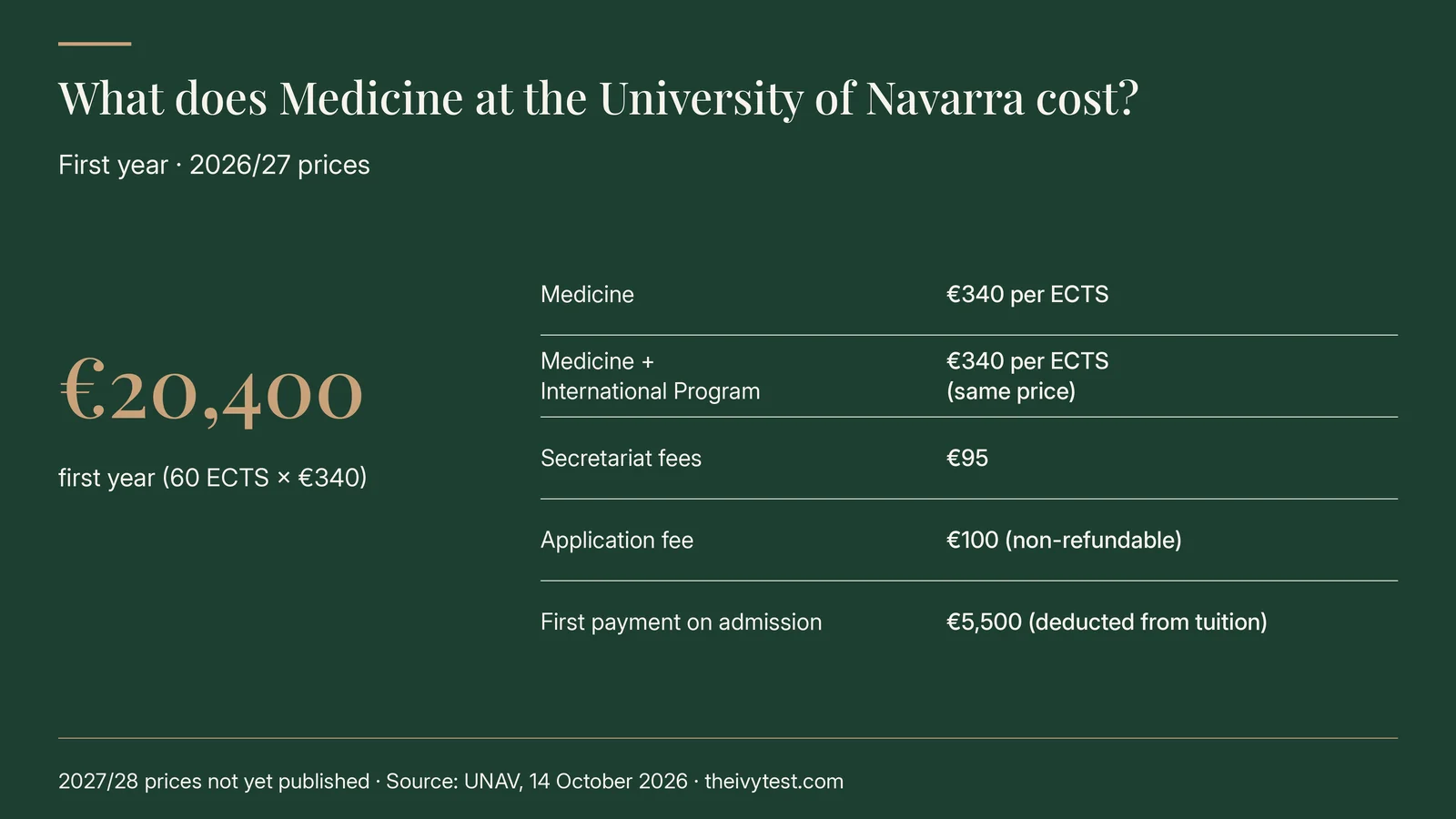
Medicine at UNAV: first-year costs, 2026/27 prices
| Item | Amount | Note |
|---|---|---|
| Tuition, Medicine | €340 per ECTS; €20,400 for the first year | 60 ECTS |
| Tuition, Medicine + International Program | €340 per ECTS; €20,400 for the first year | The same price |
| Secretariat fees | €95 | Added to the year's tuition |
| Application processing fee | €100 | Not refunded |
| First enrolment payment | €5,500 | Paid on admission and deducted from the year's tuition; refunded only if you fail the PAU |
Living costs in Pamplona come on top. The degree lasts six years, so check each year's price on UNAV's page before you plan the whole course.
Nota de corte
Is there a nota de corte at Navarra?
Not in the public sense. At a Spanish public university the nota de corte is the lowest PAU admission grade that won a place, published every year. UNAV is private and sets its own test, so it ranks candidates by its own final grade (on the on-site route, 70% test and 30% 1º de Bachillerato) against the places it has, and publishes no cutoff and no scores. The figures you may see quoted online for a 'nota de corte' at Navarra are not UNAV's.
Two numbers are fixed: you need 7 or more in 1º de Bachillerato to apply at all, and on the on-site route the waiting list moves on the PAU, using the two best of Biology, Chemistry and Physics, each weighted 0.2, as places come free.
Do not confuse UNAV with the Universidad Pública de Navarra (UPNA), a separate public university also in Pamplona. UPNA's Medicine degree has 75 places, is taught in Spanish and takes students from the Bachillerato or related higher vocational qualifications through its own pre-enrolment, like any public university, so its notas de corte are UPNA's to publish. IvyTest has not checked them.
Places
Places and acceptance rate
UNAV's Medicine page offers 200 places. In September 2026, 220 new students from 23 nationalities began the degree, according to the university's own news. UNAV publishes no applicant numbers, so there is no official acceptance rate, and any rate you see quoted is an estimate.
Curriculum
The study plan, year by year, and the International Program
Medicine at UNAV is an official six-year degree of 360 ECTS, taught on site in Pamplona, in Spanish and English. UNAV says its Integrated Curriculum was developed with Harvard Medical School and set up in 2020. The third year is a full year of clinical rotations at the Clínica Universidad de Navarra, in Pamplona or Madrid.
Main subjects by year, from UNAV's subject list for Medicine
| Year | Main subjects |
|---|---|
| 1 | From the molecule to the cell I and II; foundations of structure and function; integrated organ systems I and II; anthropology; practice of medicine I |
| 2 | Research methodology; mechanisms of disease; pathology of organs and systems I and II; mind, brain and behaviour; practice of medicine II; ethics; electives |
| 3 | Nine rotations at the Pamplona or Madrid site: primary care, surgery I and II, medicine I and II, obstetrics and gynaecology, paediatrics, psychiatry, emergency medicine and radiology |
| 4 | Medical-surgical subjects I to IV; history of medicine; cultural keys I and II; applied research methodology I; clinical practice I and II |
| 5 | Medical-surgical subjects V to VII; paediatrics; applied research methodology II; medical ethics; clinical practice III and IV |
| 6 | Clinical practice V; emergency medicine and intensive care; preventive medicine and public health; integrated case-based medicine; health management and economics; forensic medicine; final degree project |
The International Program, run since 2013, is an option inside the same degree. You choose 'Medicine + International Program' when you apply and upload an English certificate: CAE 180, TOEFL iBT 95, IELTS 7, IB English A 6 or B 7, or an A level in English at grade B. Without one, you are considered for Medicine alone. UNAV's subject list marks six of the seven first-year subjects (all but practice of medicine I) and, in the second year, research methodology and the electives as taught in English; core electives are taught by doctors from partner universities, and a limited number of the best students do clinical rotations abroad. Completing it is recorded in the European Diploma Supplement.
Everyone needs Spanish at B2.2 before starting. UNAV offers an intensive summer programme for students between B2.1 and B2.2, and a gap year in its IFP for those below B2.1, keeping the place meanwhile.
Scholarships
Scholarships for Medicine
UNAV's School of Medicine gives five Prof. Jiménez Vargas scholarships a year to first-year students, each covering up to 70% of tuition and kept for all six years if renewed. You need a Bachillerato average of 9 or more, in health sciences, and a family income of up to €20,000 per person, and you apply by the same deadline as for admission. To keep it you need 8 or more after the first and second years and 8.5 from the third. The scholarships page still asks for an older tax return, so check the current call before applying.
Rankings
The University of Navarra in the rankings
Times Higher Education ranks the University of Navarra joint 275th in the world in its World University Rankings 2027. In THE's Medical and Health table, the subject ranking that covers medicine, it is in the 176–200 band in the 2026 edition; the 2027 subject tables are not out yet. Only rankings read on their publisher's own site are shown here.
A ranking describes the university, not your chances: admission depends on your final grade on the route you choose.
The University of Navarra in THE's World University Rankings
| Edition | World | Medical and Health |
|---|---|---|
| THE 2027 | =275 | not out yet |
Sources, read on 14 October 2026: Plazos de admisión (curso 27/28) · Perfil de ingreso, Grado en Medicina · Proceso de admisión internacional, Grado en Medicina · Precios de primer curso 2026-27 · Grado en Medicina · Asignaturas, Grado en Medicina · International Program in Medicine · Becas (Prof. Jiménez Vargas) · Times Higher Education: University of Navarra
The campus
The University of Navarra's sciences buildings
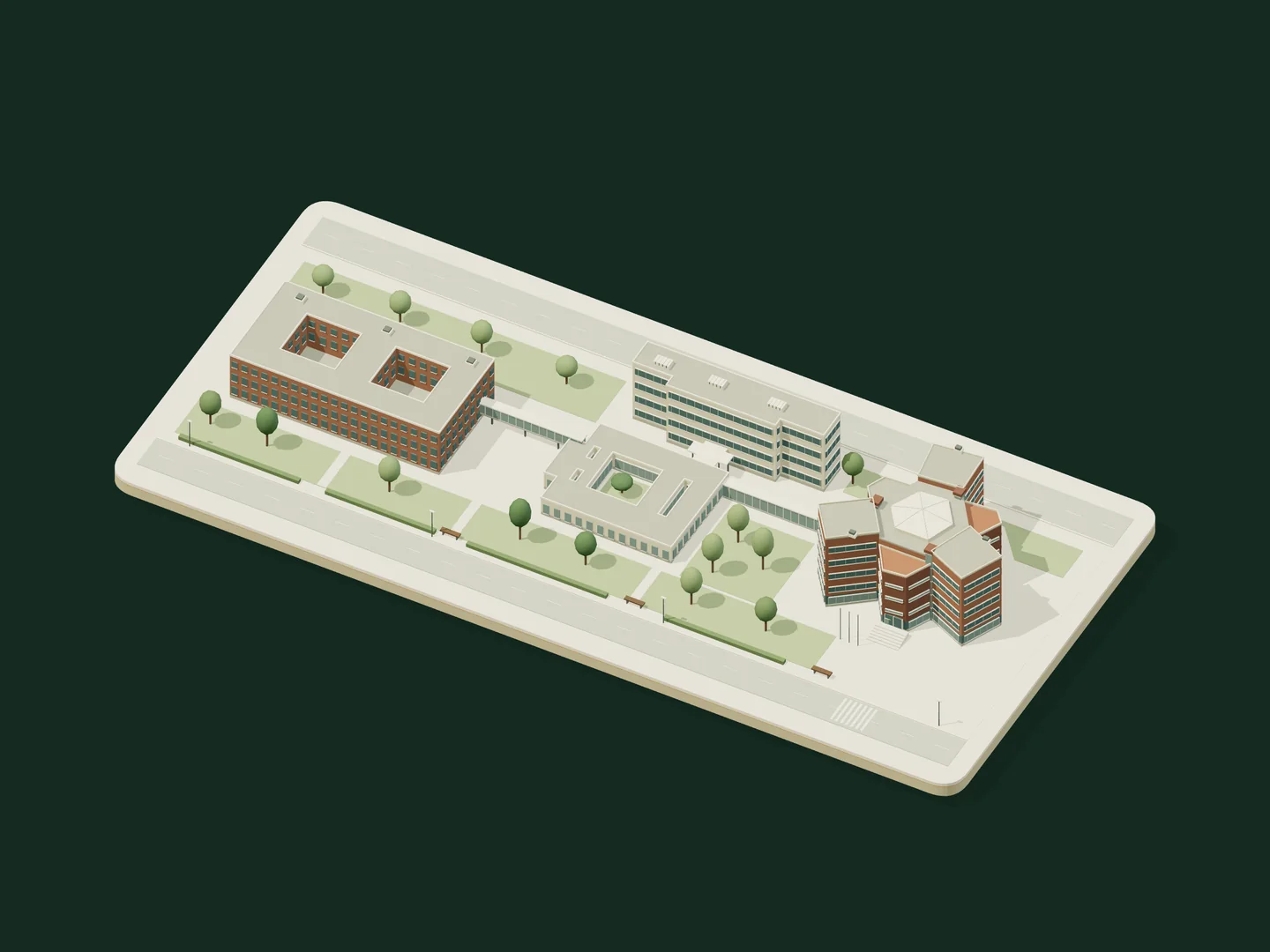
The model shows one part of the University of Navarra's campus in Pamplona: its sciences buildings, shared from the start by the faculties of Medicine, Nursing, Pharmacy and Nutrition, and Sciences. The Research Building (1958) was the University's first; Los Castaños followed in 1963 and the Hexágono, designed by Carlos Sobrini, in 1970. The Science Library (1990, extended in 1997) added classrooms and laboratories, and a new building, the Centro Bioma, has been under construction since January 2026.
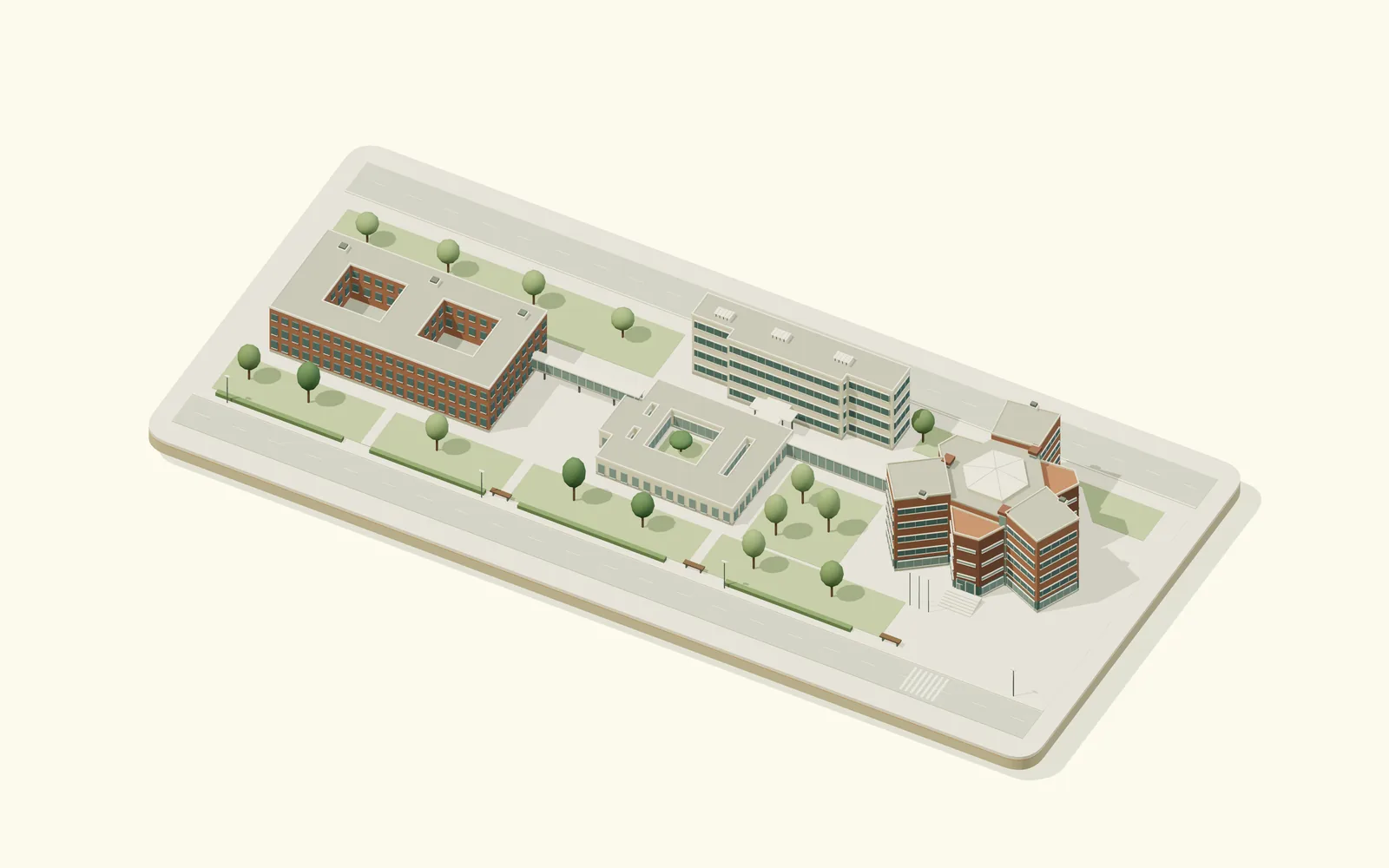
Hexágono (Edificio de Ciencias)
Designed by Carlos Sobrini and finished in 1970, in dark rough brick, with its rooms organised around a central heart. The University's Museum of Sciences has shown part of its collections here since 1998.
Edificio de Investigación
The University's first building, built in 1958.
Los Castaños
Built in 1963. The first Biology students shared classrooms and laboratories on its two floors with Medicine, Nursing and Pharmacy.
Biblioteca de Ciencias
The Science Library, built in 1990 and extended in 1997, which added classrooms and laboratories.
Student life
Living in Pamplona as a medical student
Universidad de Navarra requires a minimum secondary-school average of 7/10 to apply: one of the more explicit academic thresholds among Spain's private medical schools.
The 2027/28 window opens on 1 October 2026; for Medicine you apply by 9 March 2027 and sit the test on 13 March, and international applicants also have an earlier December window.
Pamplona is a smaller, quieter university city than Madrid or Barcelona, with a correspondingly lower cost of living.
FAQ
Universidad de Navarra admissions FAQ
Yes, the programme runs in English and Spanish. The admission test can be sat in Spanish or in English, but the science model paper Navarra publishes is in Spanish, so confirm your test language with Admissions when you apply.
Yes. Every Spanish private medical school in our catalogue runs its own written knowledge test, typically biology and chemistry, often with physics, mathematics or English added. Format, length and delivery (online or on campus) differ by school; this guide covers the one your target university runs.
Not at any school that publishes a rule. CEU Cardenal Herrera, Universidad de Navarra, CEU San Pablo, CEU Fernando III and UIC Barcelona all state that a wrong answer costs nothing. Alfonso X el Sabio and Católica de Valencia publish no marking rule at all, so confirm theirs directly.
Yes, it's the 2027 edition, built from the latest admission rules Universidad de Navarra has published. Where a 2027 date or detail isn't published yet, confirm it with the university before you rely on it.
Yes. Universidad de Navarra-format practice sessions are available inside the simulator and align with the guide section by section.
Ready to prepare for the University of Navarra Medicine Admission Test?
The Universidad de Navarra Complete Admissions System — study guide, exam simulator, video courses and application help, built from Universidad de Navarra's own syllabus.