
A karyotype is reported as 47,XY,+21. What does this notation describe?
Exam guide · Updated for 2027 admissions
Paracelsus (PMU) Admissions Test 2027: Complete Guide
Everything you need to know about the admissions test for Paracelsus Medical University's Human Medicine programme in Salzburg: the 3.5-hour written test, what each of its blocks is worth, the quota chain that decides who is admitted, and how to prepare.
Updated for 2027 admissions · Last updated: 16 October 2026
Paracelsus Admissions Test at a glance
Overview
What is the Paracelsus (PMU) Admissions Test?
Paracelsus Medical University is a private medical university in Salzburg, Austria, with a second campus in Nuremberg. It does not use the MedAT (Austria's standardised test for public medical universities) and runs its own digital admissions test instead, sat on PMU-provided laptops over roughly three and a half hours, followed by an interview for the highest-ranked candidates.
The written test is not a science paper with extras attached. Its own regulations describe it as several scientifically developed and evaluated sub-areas (natural sciences, stress and resilience, cognitive abilities, English, and more), and the published weighting makes the balance explicit: natural sciences and English together are worth 40%, cognitive abilities another 40%, and work style the remaining 20%. Biology, chemistry and physics are therefore sharing a block with English that is worth no more than the aptitude block on its own. PMU's own pages also state that any of the science subjects may contain factual questions, fill-in-the-blanks and diagrams, so this is not uniformly a four- or five-option multiple-choice paper.
What happens to your result is published in unusual detail, and it is the most important thing on this page. There is no pass mark, and not because PMU declines to print one: its Durchführungsverordnung states that both the calculation of test results and the ranking of candidates are done relatively, within that year's applicant cohort. Admission is then fixed by quota rather than by a score. The top 405 candidates nationally (240 for Salzburg, 165 for Nuremberg) are invited to interview; the best 135 of those are put to the selection committees; and the committees admit 80 in Salzburg and 55 in Nuremberg. You are not trying to clear a bar. You are trying to finish above enough other people.
Programmes that use the Paracelsus Admissions Test
- Human Medicine (Bachelor programme, Salzburg campus)
Timeline
Paracelsus Admissions Test 2027: dates and deadlines
When to expect your exam · 2027 start
- April 202714-15 Apr, 20-22 AprPublished
Applications open 1 Nov 2026.
Dates the university has published for this cycle. See every university on the calendar →
- Applications open1 November 2026 (registration for the 2027 procedure, on PMU's application portal)
- Application deadline31 March 2027
- Written admissions test14 and 15 April 2027 in Nuremberg; 20 to 22 April 2027 in Salzburg. You choose the place and date; it does not decide where you study
- Admission interviews7 to 18 June 2027, at both campuses
- Decisions issuedEnd of June 2027: the admissions committee decides on admission and the waiting list
- Enrolment deadlineEnrolment deadline not yet announced
| Campus | Salzburg | Nuremberg |
|---|---|---|
| Written test 2027 | 20 to 22 April 2027 | 14 and 15 April 2027 |
| Same test? | Yes: one test, one ranking for both campuses | Yes: one test, one ranking for both campuses |
| Where you sit it | On PMU laptops at the Salzburg campus; you choose place and date, which do not decide where you study | On PMU laptops at the Nuremberg campus (Klinikum Nürnberg); same choice |
| Invited to interview | 240 | 165 |
| Interviews | 7 to 18 June 2027 | 7 to 18 June 2027 |
| Places | 80 | 55 |
| Tuition | EUR 22,300 a year | EUR 22,300 a year |
PMU issues no public Call comparable to an Italian Rector's Decree; its binding rules are the Studien- und Prüfungsordnung Bachelor-/Masterstudium Humanmedizin (Rev. 05, in force since 1 October 2025) and the Durchführungsverordnung 2025/26 (Rev. 04, in force since 1 August 2025), both of which govern structure rather than publishing a calendar. PMU's application page was re-read directly on 16 October 2026 and gives the 2027 dates above, with applications open from 1 November 2026 to 31 March 2027. It now gives the Salzburg test as 20 to 22 April 2027 (on 6 October 2026 it still printed the year as 2026). In 2026 the test ran on 16 and 17 April in Nuremberg and 21 to 23 April in Salzburg, and the interviews from 8 to 18 June. A place offered after the procedure must be accepted within 14 days or it lapses. Note also that PMU states it provides no preparation materials of its own; the detailed test description and sample questions arrive when you book a test date, not before.
Structure
Paracelsus Admissions Test format
PMU publishes percentage weights, not question counts, for the written test as a whole and for every block inside it. That is confirmed rather than assumed: the current Studien- und Prüfungsordnung and Durchführungsverordnung were both checked and neither states an item count or an options-per-question figure. What the weights do tell you is where the marks are, and they are not where most candidates assume.
| Section | Questions | Weighting | Suggested time |
|---|---|---|---|
| Natural sciences and English | 1see the note below the table | 40% of the written test | 1see the note below the table |
| Cognitive abilities | 2see the note below the table | 40% of the written test | 2see the note below the table |
| Work style | 3see the note below the table | 20% of the written test | 3see the note below the table |
- PMU publishes no item count and no split between Biology, Chemistry, Physics and English inside this block; no per-block timing is published either
- PMU publishes no item count or per-block timing. It gives examples of the tasks rather than a closed list
- PMU publishes no item count or per-block timing. This block is a personality assessment, not a knowledge paper; items have no objectively correct answer
Content
Question and subject breakdown
Six areas, in three blocks of very different kinds. Three of the six are sciences and together with English they account for 40% of the written test; the aptitude block matches them on its own; and a fifth of the test is not a test of knowledge at all.
Biology
PMU publishes no split inside the 40% natural-sciences-and-English block. If the four areas inside it were equal (which PMU does not say), Biology would be about 10% of the written testThe broadest of the three sciences, and the only one PMU's published topic headings break down in detail: microbiology, virology and parasitology, then cell biology, molecular biology, genetics, human genetics and cytogenetics, closing on evolution. Depth is Matura/Abitur level, not university medicine, but the breadth across microbiology and cytogenetics is wider than most admission syllabuses reach.
Chemistry
PMU publishes no split inside the 40% natural-sciences-and-English blockThe structure of matter, chemical reactions including kinetics, equilibrium, acid-base and thermodynamics, organic chemistry, and the biomolecules relevant to metabolism. School chemistry with simple calculation rather than medical biochemistry: reaction recognition, not advanced mechanism.
Physics
PMU publishes no split inside the 40% natural-sciences-and-English blockMechanics, electricity and magnetism, light, nuclear physics, direct-current circuits and resistance, and lenses and optical instruments. Conceptual physics with basic formula use and (PMU's own wording) diagram interpretation, so ray diagrams and circuit diagrams are worth genuine fluency.
English
PMU publishes no question count for this area and no options-per-question figure; it names fill-in-the-blanks alongside multiple choice, and a fill-in-the-blank item has no options to countB2+ comprehension tested through English texts: scientific reading comprehension, vocabulary in context, grammar in context, and the language of data: trends, comparisons, quantities and experimental results. Sits inside the same 40% block as the three sciences.
Cognitive abilities
40% of the written testWorth exactly as much as the three sciences and English combined. Numerical reasoning, concentration, memory, shapes and patterns, planning, multitasking and attention to detail. Several of these are timed performance tasks rather than questions with a syllabus behind them; you train the underlying skill, you do not revise content.
Work style
20% of the written testA personality assessment covering conscientiousness, stress tolerance, self-organisation and professional attitude. It has no objectively correct answers. Instruments of this kind reward honest, consistent self-description and detect inconsistency, so the right preparation is to understand what is being measured and answer straightforwardly, not to try to produce the profile you imagine PMU wants.
Marks
Paracelsus Admissions Test scoring
PMU does not publish a per-item marking rule, and after its own regulations were checked the reason looks structural rather than secretive: the documents describe a selection formula and a quota chain, not a points scheme. Understanding those two mechanisms tells you far more about what to do than a marking rule would.
- Correct answer
- No per-item marking rule is published. IvyTest's working estimate is one mark per correct answer, the neutral assumption
- Incorrect answer
- Not published. PMU neither states nor rules out a penalty
- Minimum eligible score
- None; there is no absolute score to publish
- How results are calculated
- Relatively, within that year's applicant cohort; both the test result and the ranking (Durchführungsverordnung §1.1)
- Ranking formula
- 20% school grades · 80% test result
- Invited to interview
- The top 405 ranked candidates nationally (240 for Salzburg, 165 for Nuremberg)
- Proposed to the committees
- The best 135 of those 405
- Admitted
- 80 in Salzburg and 55 in Nuremberg
- Attempts permitted
- Three; the SPO caps participation in the Bachelor admission procedure at three times
Worked example
Work the published funnel through and it produces a genuinely useful number. Of the 405 candidates invited to interview, 135 are proposed to the selection committees, and the committees admit 80 in Salzburg and 55 in Nuremberg, 135 in total. So every candidate who reaches the committee stage is admitted, and the cut happens at interview: 135 of 405 is exactly one in three. The same ratio holds on each campus separately: 80 of 240 in Salzburg and 55 of 165 in Nuremberg are both exactly one third. Reaching the interview therefore means a one-in-three chance on published figures, and the interview is not a formality. Now the ranking formula, and here the units matter. A candidate whose school grades convert to 70 on PMU's scale and whose test result is 85 ranks at (0.20 × 70) + (0.80 × 85) = 14 + 68 = 82 ranking points. Gaining 10 points on the test scale moves that ranking figure by 0.80 × 10 = 8 ranking points; gaining 10 points on school grades would move it by 2. School grades are also fixed by the time you apply, so four-fifths of your ranking position is the only part still in your control. Finally, guessing: PMU publishes no penalty and no option count. If the sciences carry five options and there is no penalty, a blind guess is worth (1/5 × 1) + (4/5 × 0) = +0.20 marks; under a five-option neutralising penalty of −0.25 it is worth exactly 0. The English fill-in-the-blank items have no options at all, so there is nothing to guess between; a blank there is simply a zero.
The IvyTest simulator scores every practice paper against these exact rules.
See the Paracelsus Admissions Test simulatorSyllabus
Full Paracelsus Admissions Test syllabus
PMU publishes topic headings for the three sciences (unusually detailed ones) and describes the English and cognitive areas by example rather than by syllabus. The work-style block has no syllabus at all, by nature. Note that PMU states it provides no preparation materials of its own; a detailed test description and sample questions are supplied only when you book a test date.
Nine published headings, running from microorganisms through the cell to inheritance and evolution. Depth is Matura/Abitur level.
- Microbiology: prokaryotes and fungi, prokaryotic cell structure including membrane, wall, cytoplasm, ribosomes and plasmids, bacterial growth, reproduction and basic metabolism, classification logic, fungal cell structure and reproduction, and broad medical relevance
- Virology: bacterial and animal viruses, virus structure including genome, capsid, envelope and surface proteins, DNA against RNA viruses at conceptual level, bacteriophages, replication cycles, lytic and lysogenic logic, and host-cell dependence
- Parasitology: general parasitology, host-parasite relationships, reservoirs and vectors, transmission routes, ectoparasites against endoparasites, protozoa against helminths at overview level, life-cycle interpretation, and prevention
- Cell biology: methods including microscopy, staining, centrifugation and electrophoresis, eukaryotic cells, organelles and their functions, membranes and transport by diffusion, osmosis, active and vesicular routes, the nucleus, the cell cycle, mitosis and meiosis with chromosome behaviour, and the cytoskeleton: microtubules, microfilaments and intermediate filaments
- Molecular biology: genetic material and DNA structure, base pairing, semi-conservative replication, mutation and recombination including substitution, insertion, deletion and frameshift, transcription and reverse transcription, and protein synthesis and translation with codons, tRNA and the ribosome
- Genetics: the founders of genetics, the basic genetic laws, homozygosity and heterozygosity, dominant and recessive inheritance, genotype and phenotype, mono- and dihybrid crosses, segregation and independent assortment, Punnett squares and probability, and recombination and linkage at introductory level
- Human genetics: the particular challenges of human genetics, pedigree symbols and three-generation pedigree analysis, autosomal dominant, autosomal recessive and X-linked patterns, phenotype expression, penetrance and expressivity, environmental effects, and recurrence probability
- Cytogenetics: chromosomes, the human karyotype, autosomes and sex chromosomes, numerical aberrations such as trisomy, monosomy and polyploidy, structural aberrations such as deletion, duplication, inversion and translocation, meiotic errors, and prenatal diagnosis
- Evolution: natural selection and adaptation, mutation, genetic drift and gene flow, speciation and common ancestry, evidence from fossils, comparative anatomy and molecular similarity, and medical relevance such as antibiotic resistance and pathogen variation
Four published headings. School chemistry plus simple calculation, reaction recognition rather than advanced mechanism.
- Structure of matter: atoms, molecules and ions, the electronic structure of atoms, isotopes and electron configuration, periodic properties and trends in electronegativity, atomic radius and ionisation energy, molecular structure and bonding theories, ionic, covalent, polar covalent and metallic bonding, Lewis structures, molecular geometry and polarity, intermolecular forces, and liquids and solids
- Chemical reactions: chemical kinetics with reaction rate, activation energy and catalysis, chemical equilibrium and shifts in equilibrium, acid-base equilibria, pH and pOH, strong and weak acids and bases, buffers at overview level, chemical thermodynamics with enthalpy, entropy, Gibbs free energy and exothermic and endothermic change, and balancing equations
- Organic chemistry: electron structure and bonding in carbon compounds, organic acids and bases, organic compounds and functional groups with elements of nomenclature, alkanes, alkenes, alkynes, alcohols, aldehydes, ketones, carboxylic acids, amines and esters, delocalised electron systems and resonance, aromaticity, benzene reactions and reactions of substituted benzenes
- Biomolecules relevant to metabolism: carbohydrates as mono-, di- and polysaccharides with glycosidic bonds and energy storage, proteins with amino acids, peptide bonds, structural levels and enzymes, lipids including fatty acids, triglycerides, phospholipids and membranes, and nucleic acids with nucleotides and DNA and RNA structure
Six published headings. PMU's own pages confirm diagram questions appear in the science subjects, so ray diagrams and circuit diagrams are worth real fluency rather than recognition.
- Mechanics: dynamics and Newton's laws, forces, mass and acceleration, free-body diagrams, friction, weight against mass, work, kinetic and potential energy, power, and conservation of energy
- Electricity and magnetism: electric charge and electric fields, the Coulomb force as a concept, potential difference, magnetism, the generation of magnetic fields by currents and moving charges, and electromagnetic induction through changing magnetic flux
- Light: light as an electromagnetic wave, wavelength, frequency and the speed of light, the electromagnetic spectrum, interference, diffraction and polarisation, and basic reflection and refraction
- Nuclear physics: the atomic nucleus and isotopes, radioactivity, alpha, beta and gamma radiation, half-life and decay curves, fission and fusion, nuclear energy, and radiation-safety concepts
- Electric currents and resistance: direct-current circuits, current, voltage and resistance, Ohm's law, series and parallel circuits, equivalent resistance, electrical power, and circuit diagrams and measurement logic
- Lenses and optical instruments: convex and concave lenses, focal length and image formation, magnification, ray diagrams, real and virtual images, the basics of the microscope and telescope, and the optics of the human eye at general conceptual level
B2+ comprehension through English texts, with multiple-choice and fill-in-the-blank items. Sits inside the same 40% block as the three sciences.
- Scientific reading comprehension: main idea, supporting detail, author's purpose, logical flow, interpretation of short academic and biomedical passages, and locating the textual evidence for an answer
- Vocabulary in context: biology, chemistry and general scientific terms, prefixes and suffixes, cause-and-effect language, and inferring meaning from sentence context without translating
- Grammar in context: tense consistency, subject-verb agreement, connectors such as however, therefore, although, because, whereas and in contrast, relative clauses, prepositions, articles, and fill-in-the-blank completion driven by both grammar and meaning
- Data-linked language: the language of trends and comparisons, quantities, experimental results, and explaining a figure or a table in clear English
Worth 40% of the written test on its own. PMU gives examples rather than a closed list, so treat these as open-ended. Several are timed performance tasks that a static question bank can only approximate; practice trains the underlying skill rather than reproducing the format.
- Numerical reasoning: percentages, ratios, proportional reasoning, tables and graphs, unit conversions, and timed mental arithmetic
- Concentration: repetitive comparison tasks, symbol and number scanning, and sustained accuracy under monotony
- Memory: visual memory, sequence recall, paired items, and short-term retention after an intervening distractor task
- Shapes and patterns: fitting shapes and completing patterns, mental rotation, figure series, missing-piece and matrix patterns, figural analogies, and transformations of rotation, reflection, count, shading and position
- Planning: sequencing, route logic, order constraints, and efficient multi-step execution
- Multitasking: switching rules, tracking two variables at once, and calculating while monitoring symbols
- Attention to detail: spotting inconsistencies in text, numbers, diagrams and tables
A fifth of the written test, and not a knowledge paper. There are no correct answers to learn. Understand what each dimension measures, then answer honestly and consistently: self-report instruments of this kind are built to detect inconsistency, and a manufactured profile is more likely to be caught than rewarded.
- Conscientiousness: carefulness, organisation, persistence and reliability
- Stress tolerance: maintaining function as time pressure rises, stable routines, and recovery after mistakes
- Self-organisation: planning, prioritisation, disciplined execution, and a realistic, balanced working style rather than extreme perfectionism
- Professional attitude: responsibility, integrity, motivation for demanding training, teamwork and patient-centred values
Test your Paracelsus Admissions Test knowledge
Take free diagnosticDifficulty
How difficult is the Paracelsus Admissions Test?
Paracelsus is the most selective test in this batch by design rather than by reputation, and its difficulty is structural. Sixty per cent of the written test is not science, the competition is relative rather than absolute, the university supplies no preparation material, and you get three attempts in a lifetime.
Sixty per cent of the written test is not science
Cognitive abilities are 40% on their own (exactly as much as Biology, Chemistry, Physics and English combined), and work style is another 20%. A candidate who arrives with excellent Matura-level science and no aptitude-test practice has prepared, at most, the 40% block they share with English. That is the single most consequential fact about this exam.
There is no score to clear, only people to outrank
PMU's Durchführungsverordnung states that both the test result and the ranking are calculated relative to that year's applicant cohort, with admission fixed by quota rather than by a threshold. 'Good enough' is not a concept this procedure has. The figure that matters is where you sit relative to everyone who booked a test date the same year you did.
Three attempts, ever
The Studien- und Prüfungsordnung caps participation in the Bachelor admission procedure at three times. Most exams in this catalogue can be re-sat indefinitely or twice within a cycle. Here a sitting spent finding out what the test is like is a third of your total allowance, which is a strong argument for arriving prepared the first time.
PMU supplies no preparation material until you book
The university states explicitly that it provides no preparation materials of its own. A detailed test description and sample questions are sent when you book a test date, not before, and not in time to shape a twelve-week plan. Everything you build before that point is built from the published topic headings and the block weights.
Not all of it is multiple choice
PMU's own pages state, for Biology, Chemistry and Physics alike, that you may meet factual questions, fill-in-the-blanks and diagrams. That rules out a single options-per-question figure even in principle, and it rules out a guessing strategy for the fill-in-the-blank items entirely: there is nothing to eliminate between. Diagram interpretation (ray diagrams, circuit diagrams, karyotypes, pedigrees) needs to be fluent rather than merely familiar.
Benchmarks
What is a good Paracelsus Admissions Test score?
There is no score to guide you towards, and that is a finding rather than a gap: PMU's own regulations confirm that results and ranking are calculated relative to each year's applicant cohort, with admission fixed by quota. Any 'cutoff' quoted elsewhere is describing something PMU's procedure does not produce.
What PMU does publish is the shape of the competition, in more detail than most universities offer: 405 candidates invited to interview across both campuses, 135 proposed to the selection committees, and 80 admitted in Salzburg and 55 in Nuremberg. Those figures are quotas, not predictions, and they do not tell you how many people applied, so they bound the outcome without describing the odds at the point of entry.
During preparation, the only meaningful measure is your own trajectory on full-length timed practice across all three blocks, with the aptitude and work-style components included rather than skipped. Scoring well on the sciences and never practising a timed pattern-completion or multitasking task leaves you strong in 40% of a test and untested in the other 60%.
Pending verification
- · Applicant volume per cycle: the quotas are published, the denominator is not
- · Question counts and any per-item marking rule
- · The split between Biology, Chemistry, Physics and English inside the 40% block
- · How the interview stage is scored and what the selection committees weigh
- · Master-stage tuition: PMU's Bachelor fee page gives the Bachelor years only
These specific numbers aren't public yet — an IvyTest simulator score is the closest benchmark you can get today.
Check your Paracelsus Admissions Test scoreStrategy
How to prepare for the Paracelsus Admissions Test
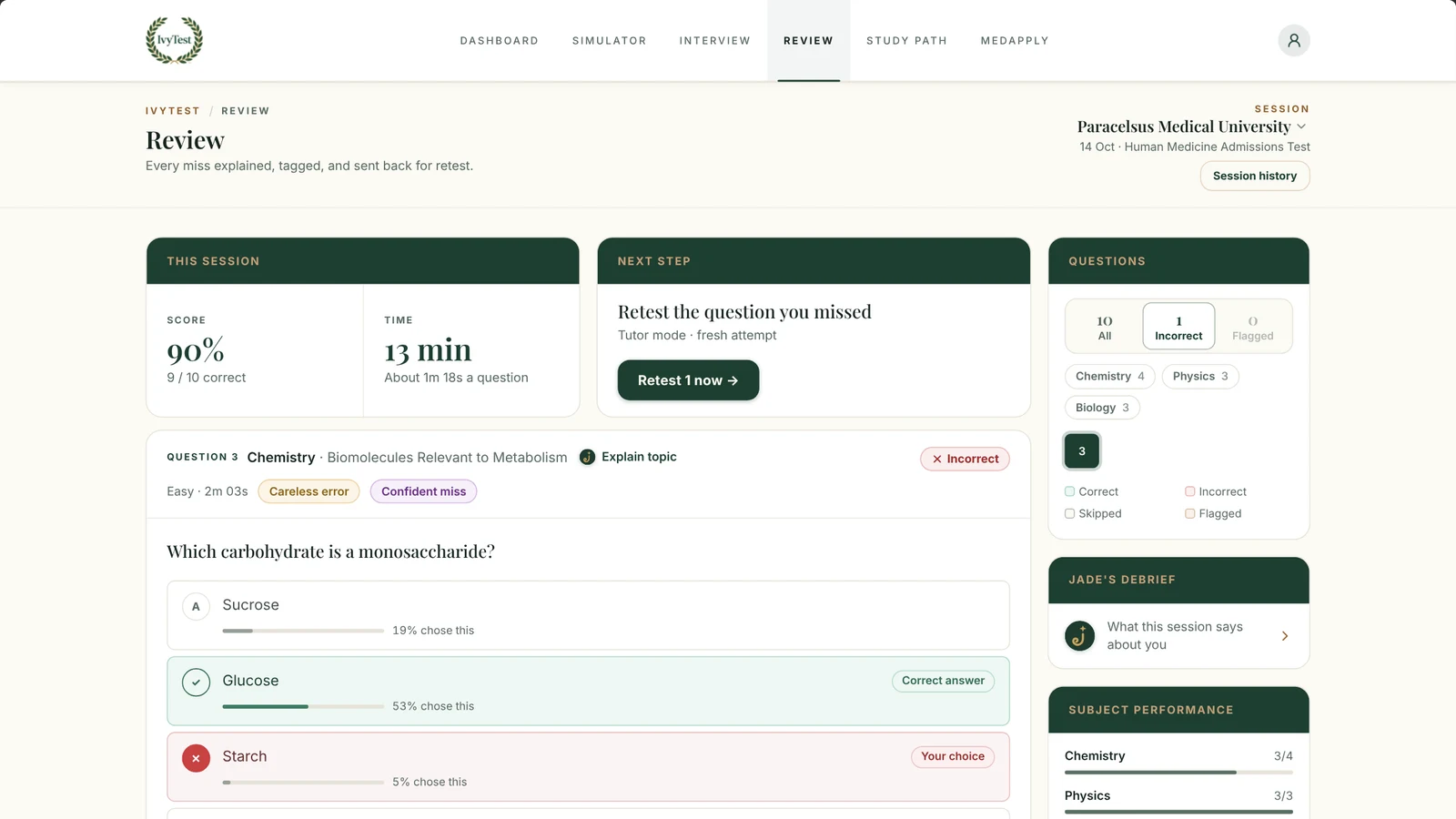
Free practice tasks for every part of the test, with answers
12+ weeks
Treat the aptitude block as a subject, not a warm-up
The 40/40/20 weighting driving the calendar, with cognitive abilities given equal billing to the sciences.
- Sit a full diagnostic in week one covering all three blocks (sciences and English, cognitive abilities, and a work-style inventory), so the plan reflects the real 40/40/20 weighting rather than your comfort zone.
- Give cognitive abilities the same weekly hours as the sciences. It is 40% of the written test on its own, several of its tasks are timed performance tasks rather than knowledge questions, and it is the area that improves most with deliberate practice.
- Work through PMU's published science headings in order: microbiology, virology and parasitology are named explicitly and are absent from most pre-med syllabuses, as are cytogenetics and pedigree analysis.
- Build diagram fluency deliberately: ray diagrams, circuit diagrams, karyotypes and three-generation pedigrees. PMU's own pages confirm diagram items appear across all three sciences.
8 weeks
Close the aptitude gap, then the science gaps
Timed cognitive practice alongside targeted science repair.
- Diagnostic first, then check the three blocks against their published weights rather than against each other: being strong in the 40% you enjoy does not move the ranking much.
- Run timed cognitive drills several times a week in short sessions: number series, matrices and mental rotation, sustained-attention scanning, and a rule-switching task for multitasking. Short and frequent beats long and occasional for these.
- One full timed science-and-English block a week, reviewed the same day, with every miss logged by heading so it maps back to PMU's own topic list.
- Read what the work-style dimensions actually measure (conscientiousness, stress tolerance, self-organisation, professional attitude) once, properly, and then plan to answer honestly rather than strategically.
4 weeks
Full-length sittings at 3.5 hours
Stamina across a long paper and volume of timed aptitude work.
- Build up to full-length 3.5-hour sittings. The endurance problem is real: most candidates have never done three and a half hours of continuous assessment, and the aptitude tasks are precisely the ones that degrade when concentration slips.
- Two full timed science-and-English blocks a week plus daily short cognitive drills, with mental arithmetic done without a calculator.
- Practise fill-in-the-blank and diagram items specifically, not just multiple choice: PMU confirms all three formats appear in the science subjects, and only one of them can be guessed at.
- Remember the three-attempt cap when deciding whether to book. A sitting taken to 'see what it's like' costs a third of your lifetime allowance.
Under 4 weeks
Protect the aptitude block and pace the long sitting
Consolidation on the sciences, daily short work on cognitive tasks.
- Stop opening new science content; consolidate the published headings you already half-know, with cytogenetics and human genetics first since they carry the most unfamiliar notation.
- Keep the cognitive drills going daily right up to the taper: these are skills that hold with short frequent practice and fade without it.
- Sit at least one full-length 3.5-hour mock in the final ten days so the day itself is not the first time you have concentrated for that long.
- When your test description and sample questions arrive at booking, read them immediately and adjust: they are the only official picture of the paper you will get, and they arrive late by design.
Get your personalised Paracelsus Admissions Test study plan
Take free diagnosticExplore the full Paracelsus Admissions Test planPractice
Free Paracelsus Admissions Test practice questions
Three questions in the format the exam uses. Choose an answer to see the explanation — nothing is recorded.
For the exothermic equilibrium N₂(g) + 3H₂(g) ⇌ 2NH₃(g), which change shifts the position of equilibrium towards ammonia?
An object is placed 30 cm from a converging lens of focal length 10 cm. How far from the lens is the image formed?
Illustrative examples written by IvyTest to show the question style — not past Paracelsus Admissions Test papers.
University
Paracelsus Medical University medicine admissions
The written test is the first stage of a three-step procedure (test, interview, selection committee), and it feeds a single national ranking across the Salzburg and Nuremberg campuses. Tuition and the application fee below are from PMU's own Bachelor fee page, checked on 28 September 2026.
- Degree
- Human Medicine (Bachelor programme, with a subsequent Master stage)
- Campus
- Salzburg, Austria; PMU also runs a Nuremberg campus under the same ranking
- Language
- PMU does not name the written test's language outright. Its application page asks for school-leaving-level English and C1 German for the test, its Durchführungsverordnung sets German at C1 and English at B2 for admission (its admission-requirements page puts both 'between B2 and C1'), and the test includes an English comprehension area of its own; confirm directly before planning around either
- Where the test is sat
- On PMU-provided laptops, over approximately 3.5 hours
- Interview
- Required for the top 405 ranked candidates nationally; the best 135 then go to the selection committees
- Seats
- 80 in Salzburg · 55 in Nuremberg
- Attempts permitted
- Three, by the Studien- und Prüfungsordnung
- Preparation material from the university
- None: PMU states it provides no preparation materials of its own; a test description and sample questions follow when you book a test date
- Tuition
- €22,300 per year in the Bachelor stage (PMU's published rate); the first year comes to €22,615 with the application fee and a €25 lab coat, and the three Bachelor years to €68,479 including the USMLE Step 1 fee; the Master stage is priced separately
- Application fee
- €290, invoiced once you submit the application form and not refunded
- Application process
- Register on PMU's application portal between 1 November 2026 and 31 March 2027 and upload your documents, including a CV and a motivation letter; after a formal check you are invited to the digital test at the campus and date you choose (the test location does not bind your study campus); the top 405 ranked candidates are then interviewed
IvyTest Paracelsus Admissions Test preparation
Ready to prepare properly for the Paracelsus test?
Everything above is free and always will be. When you want structure (a syllabus-mapped book covering PMU's own published science headings, timed cognitive-ability practice for the 40% almost nobody prepares, lessons for the gaps your results flag, and help with the application itself), that is what the IvyTest Paracelsus package is.
Study guide
Biology, Chemistry, Physics and scientific English mapped to PMU's own published topic headings, including the microbiology, virology, parasitology and cytogenetics most pre-med syllabuses omit.
Exam simulator
Timed practice across the sciences plus dedicated cognitive-ability drills (numerical reasoning, patterns, concentration, memory and multitasking), built for the 40/40/20 weighting.
Application support
MedApply: deadlines, documents, legalisation and enrolment steps carried through to a confirmed place.
FAQ
Paracelsus Admissions Test frequently asked questions
It is Paracelsus Medical University's own digital admissions test for its Human Medicine Bachelor programme in Salzburg: roughly three and a half hours on PMU-provided laptops, covering natural sciences and English (40% of the written test), cognitive abilities (40%) and work style (20%). The highest-ranked candidates are then invited to interview.
Registration for the 2027 procedure runs on PMU's application portal from 1 November 2026 to 31 March 2027. The written test is on 14 and 15 April 2027 in Nuremberg. In Salzburg it runs from 20 to 22 April 2027, and you choose the place and date, which do not decide where you study. Interviews run from 7 to 18 June 2027 and decisions follow at the end of June.
Three blocks over about 3.5 hours. Natural sciences and English (Biology, Chemistry, Physics and English comprehension) are worth 40%; cognitive abilities another 40% (numerical reasoning, concentration, memory, shapes and patterns, planning, multitasking and attention to detail); and work style 20%, a personality assessment with no right answers. The sciences can include factual questions, fill-in-the-blanks and diagrams.
Hard by design rather than by content. The science is at Matura or Abitur level, but results are ranked against that year's cohort instead of a pass mark, and only 135 of the 405 candidates invited to interview are admitted. Sixty per cent of the test is not science, PMU provides no preparation material before you book a date, and you get three attempts in total.
Start with a diagnostic across all three blocks, then give timed cognitive-ability practice as many hours as the sciences: it is worth as much as Biology, Chemistry, Physics and English together. Work through PMU's own published science headings, practise diagrams (ray and circuit diagrams, karyotypes, pedigrees) and sit full 3.5-hour mocks in the final weeks.
PMU's Bachelor fee page gives €22,300 a year for the Bachelor stage, plus a €290 application fee that is not refunded. With the application fee and a €25 lab coat, the first year comes to €22,615, and the three Bachelor years to €68,479 including the USMLE Step 1 fee. The Master stage is priced separately.
No. The MedAT is the standardised test used by Austria's public medical universities. Paracelsus is a private university and runs its own test, with its own structure, its own weighting and its own quota-based selection. The Austrian MedAT convention of five options with one correct answer is not a PMU statement and should not be assumed here.
In person. The written test is sat on laptops PMU provides, over approximately three and a half hours. Third-party sites quoting four or five hours conflict with PMU's own figure and should be treated as stale.
PMU publishes no per-item marking rule and no option count, and this was confirmed against its current Studien- und Prüfungsordnung and Durchführungsverordnung rather than just its website. What it does publish is the selection formula (20% school grades, 80% test result) and the block weighting inside the written test: 40% natural sciences and English, 40% cognitive abilities, 20% work style.
No, and importantly, not because PMU declines to publish one. Its Durchführungsverordnung states that both the calculation of test results and the ranking of candidates are done relatively, within that year's applicant cohort, with admission then fixed by quota. There is no absolute score in the procedure to disclose. The top 405 ranked candidates nationally go to interview, the best 135 to the selection committees, and 80 are admitted in Salzburg and 55 in Nuremberg.
PMU does not state this, and it is worth confirming directly. What is known is that the application page expects high-school English and C1 German, and that the written test contains an English comprehension area of its own. Do not assume the science blocks are in English just because part of the test assesses English.
It is a personality assessment worth 20% of the written test, covering conscientiousness, stress tolerance, self-organisation and professional attitude. It has no objectively correct answers. Instruments of this kind reward honest, consistent self-description and are designed to detect inconsistency, so the useful preparation is to understand what is being measured and then answer straightforwardly, not to construct the profile you imagine the university wants.
Three. Paracelsus's Studien- und Prüfungsordnung caps participation in the Bachelor admission procedure at three attempts in total. That is stricter than most schools in this catalogue, and it is a strong argument against booking a sitting simply to find out what the test is like.
The quota chain is published: 405 candidates are invited to interview nationally (240 for Salzburg, 165 for Nuremberg), the best 135 are proposed to the selection committees, and the committees admit 80 in Salzburg and 55 in Nuremberg. That makes the interview stage exactly a one-in-three cut, on each campus separately as well as overall. PMU does not publish how many candidates apply in the first place, so the odds at the point of entry are not derivable from these figures.
Within the EU, yes: automatically, as a standard Austrian medical degree. Austria has no national licensing exam: the route to practice runs through registration and supervised training, a general Basisausbildung period followed by either a roughly three-year general-practice track or a five-to-six-year specialist track, administered by the Austrian Medical Chamber and ending in the right to practise. Outside the EU recognition isn't automatic as a rule, but the UK is an exception. Under the Medical Act 1983 (section 21B, as in force on 12 October 2026), the Austrian Dr. med. univ., the degree PMU awards and the title Annex V of the EU Directive lists for Austria, is a 'relevant European qualification', so a graduate who applies to the GMC with one, whatever their nationality, is not asked to show the knowledge and skills other international graduates prove through PLAB/UKMLA; evidence of English is still required, and the rule is UK policy that can change. US-bound graduates need ECFMG certification via USMLE Step 1 and Step 2 CK, the same requirement every international medical graduate faces.
Yes. The IvyTest simulator runs Paracelsus-format practice across Biology, Chemistry, Physics and scientific English, alongside timed cognitive-ability drills for the 40% block most preparation ignores, in timed, tutor and review modes, with a free diagnostic available without payment.
You book a date on PMU's portal and sit the test at the campus you chose, Salzburg or Nuremberg, on a laptop PMU provides, for about three and a half hours. The detailed test description and sample questions arrive only once you have booked. The best-ranked candidates are then invited to an interview, in June 2027 for this cycle.
Verification
Official sources
- Studien- und Prüfungsordnung Bachelor-/Masterstudium Humanmedizin (Rev. 05, in force since 1 October 2025)Checked: 6 October 2026
Paracelsus Medical University
- Durchführungsverordnung zur Studien- und Prüfungsordnung Bachelor-/Masterstudium Humanmedizin 2025/26 (Rev. 04, in force since 1 August 2025)Checked: 16 October 2026
Paracelsus Medical University
- Aufnahmetest: Bachelorstudium Humanmedizin (German admissions page)Checked: 16 October 2026
Paracelsus Medical University
- Anmeldung & Aufnahme: Bachelorstudium Humanmedizin (registration 1 November 2026 to 31 March 2027, test and interview dates, committee decision)Checked: 16 October 2026
Paracelsus Medical University
- Zulassungsvoraussetzungen: Bachelorstudium Humanmedizin (excellent German and English, up to three attempts)Checked: 16 October 2026
Paracelsus Medical University
- Studiengebühr, Stipendien & Finanzierung: Bachelor Humanmedizin (€22,300 a year, €290 application fee)Checked: 16 October 2026
Paracelsus Medical University
- Admissions test: Bachelor Human Medicine (English admissions page: factual questions, fill-in-the-blanks and diagrams in any of these subjects)Checked: 16 October 2026
Paracelsus Medical University
- Medical Act 1983, section 21B: registration with a relevant European qualification, without the knowledge test, for applications made since IP completion day (Brexit)Checked: 12 October 2026
legislation.gov.uk (The National Archives)
- Directive 2005/36/EC on the recognition of professional qualifications, consolidated text of 29 October 2025, Annex V point 5.1.1 (Austria: Doktor der gesamten Heilkunde, Dr. med. univ., no accompanying certificate)Checked: 12 October 2026
Publications Office of the European Union (EUR-Lex)
- Evidence of qualifications from AustriaChecked: 12 October 2026
General Medical Council (GMC)
Last reviewed by IvyTest editorial team: 16 October 2026. Admission rules change every cycle — always confirm against the official Paracelsus Medical University call for applications before acting on a deadline.
Find out how ready you are for the Paracelsus test.
The diagnostic takes one sitting and returns a block-by-block picture of where you stand (sciences, English and cognitive abilities), with no payment and no commitment.