
At a chemical synapse, which event most directly triggers the release of neurotransmitter into the synaptic cleft?
Exam guide · Updated for 2027 admissions
CEU San Pablo Medicine Admission Test 2027: Complete Preparation Guide
Everything you need to know about the CEU San Pablo Medicine admission test, Universidad CEU San Pablo's own exam for Medicine at its Montepríncipe campus in Madrid: the two papers, the three sittings a cycle, the 60/35/5 admission formula, places and fees, and how to prepare for an exam whose university publishes no syllabus and no past papers.
Updated for 2027 admissions · Last updated: 12 October 2026
CEU San Pablo Medicine Admission Test at a glance
Overview
What is the CEU San Pablo Medicine Admission Test?
Universidad CEU San Pablo runs its own internal admission test for its Medicine degree at Campus Montepríncipe in Boadilla del Monte, on the western edge of Madrid. It is sat as two separate papers on the same day: a Specific Test, which CEU describes as a multiple-choice test in Biology and Chemistry, and a General Test, which is an English test. Both feed a single weighted admission score alongside your school record.
Two things make this exam different from every other paper in this set. The first is generous: CEU runs three sittings in a cycle rather than one, each offered both on-site at Montepríncipe and online, and the highest score across sessions is the one that counts. The three sittings published for 2027 entry are 16 October 2026 at 18:00, 16 January 2027 at 10:00 and 10 April 2027 at 10:00. The second is awkward: CEU publishes no syllabus and no past papers, and says so directly: "no tenemos publicado ni exámenes de años anteriores ni temario". There is no official topic list to revise against.
That absence shapes this guide. Where CEU has stated something, this page quotes it: each question has exactly one correct answer, wrong answers carry no penalty, and the admission score is 60% first-year Bachillerato average plus 35% knowledge test plus 5% English test. Where CEU has not, this page says so and leaves the field blank rather than filling it, including the paper length, the duration and even the number of options per question, none of which the university publishes. The syllabus section below is reconstructed from the official Spanish first-year Bachillerato curricula (Comunidad de Madrid Decreto 64/2022 and BOE Real Decreto 243/2022), which is what the test is pitched at, and is labelled as derived throughout.
Programmes that use the CEU San Pablo Medicine Admission Test
- Grado en Medicina, Campus Montepríncipe, Boadilla del Monte (Madrid)
- Bilingual Medicine route: requires at least 7/10 in the English block, plus proof of B2 Spanish by the sitting's document-upload deadline, before the exam
Timeline
CEU San Pablo Medicine Admission Test 2027: dates and deadlines
When to expect your exam · 2027 start
- January 202716 JanPublished
- April 202710 AprPublished
Applications are open until 1 Apr 2027.
Dates the university has published for this cycle. See every university on the calendar →
- First sitting16 October 2026, 18:00
- Second sitting16 January 2027, 10:00
- Third sitting10 April 2027, 10:00
- Application windows9 September to 8 October 2026 · 20 October 2026 to 8 January 2027 · 19 January to 1 April 2027
- Admissions and waiting list published28 October 2026 · 28 January 2027 · 22 April 2027
- PAU grades deadline7 July 2027
The three sittings above come from CEU's own official admission PDF for the Grado en Medicina, CURSO 2027-2028 (updated September 2026, unchanged on a recheck on 7 October 2026), which supersedes the December-2025 edition; the timetables are from CEU's Spanish admissions page. The document is headed CURSO 2027-2028 because that is the year you would start: the sessions run during 2026/2027, and the PAU deadline it gives belongs to the 2027 PAU calendar. IvyTest re-checks uspceu.com and updates this guide when the next document is issued.
Structure
CEU San Pablo Medicine Admission Test format
CEU describes the structure in a single line on its own admission page ("Specific Test: multiple-choice test in Biology and Chemistry. General Test: English test") and publishes nothing beneath it. No item count, no per-subject split, no duration (only each sitting's timetable) and no option count appear in any of the official CEU sources checked for this guide. The table below therefore gives the admission weighting, which is published, rather than question counts, which are not.
| Section | Questions | Weighting | Suggested time |
|---|---|---|---|
| Biology (part of the Specific Test) | 1see the note below the table | Part of the 35% knowledge-test component of the admission score | 1see the note below the table |
| Chemistry (part of the Specific Test) | 2see the note below the table | Part of the same 35% knowledge-test component; CEU publishes no split between Biology and Chemistry | 2see the note below the table |
| English (General Test, sat as a separate paper) | 3see the note below the table | 5% of the admission score | 3see the note below the table |
- CEU publishes no item count and no per-section time limit. A candidate's dated report of the 2025/2026 sitting gives 40 Biology items within a 130-question paper (unofficial and not a CEU figure)
- CEU publishes no item count and no per-section time limit. The same candidate report gives 30 Chemistry items (unofficial and not a CEU figure)
- CEU publishes no item count and no separate duration. The same candidate report gives 60 English items (unofficial and not a CEU figure)
Content
Question and subject breakdown
Three blocks across two papers, and their share of the admission score is nothing like their share of the questions. Biology and Chemistry together carry 35 of the 100 admission points; the English paper carries 5, and on the best available estimate the English paper is the longest of the three.
Biology
Biology and Chemistry together carry 35% of the admission score, with no official split between them; CEU publishes no item countPitched at the official Spanish first-year Bachillerato Biology, Geology and Environmental Sciences curriculum: scientific method and data interpretation, ecology and sustainability, earth history and evolution, earth dynamics, animal physiology (nutrition, coordination, reproduction and histology), plant physiology, microorganisms and acellular forms, and cell biology with genetics and immunity. The three animal physiology and reproduction areas and microorganisms are the highest-priority content in the mapped curriculum; earth dynamics is the lowest.
Chemistry
Biology and Chemistry together carry 35% of the admission score, with no official split between them; CEU publishes no item countThe Chemistry blocks of the official first-year Physics and Chemistry Bachillerato curriculum, and only the Chemistry blocks: the knowledge test covers no physics at all, so the Physics half of that curriculum is deliberately absent. The mole concept and reactions-and-stoichiometry are the highest-priority areas; inorganic nomenclature and reaction types the lowest.
English
5% of the admission scoreSat as a separate paper from the Biology and Chemistry test, pitched at B1 to B2 reading and grammar: reading comprehension, core grammar, vocabulary, use of English, writing and communication skills, and scientific English. Reading comprehension and core grammar are the highest-priority areas. It is also the block with the sharpest mismatch between effort and reward; see the scoring section.
Marks
CEU San Pablo Medicine Admission Test scoring
Two rules are confirmed in CEU's own published FAQ, and between them they settle how to sit the paper: every question has exactly one correct answer, and wrong answers carry no penalty. The third number that matters is not on the paper at all: it is the weighting that converts your marks into an admission score, and it is heavily lopsided.
- Correct answer
- +1 point; CEU publishes no absolute point value, so 1 is the neutral unit used here; the ranking runs on the raw score
- Incorrect answer
- 0 points, no negative marking. CEU's FAQ: "¿Las respuestas incorrectas restan? No, no restan las respuestas incorrectas"
- Unanswered question
- 0 points
- Answer format
- Exactly one correct answer per question, not multiple-select. CEU's FAQ: "¿Las preguntas de la prueba son multirrespuesta? No, sólo hay una respuesta correcta"
- Answer options per question
- Not published by CEU in any of the eight official sources checked. Four is corroborated from two independent directions but remains an inference
- Weighting into the admission score
- 60% first-year Bachillerato average + 35% knowledge test + 5% English test, plus up to 2 additional points; restated in CEU's own waiting-list PDF as 60% Bachillerato plus 40% combined pruebas específicas
- Minimum eligible score
- None published for the knowledge test, confirmed absent across the current admission PDF, the waiting-list/scoring PDF and six further official CEU sources
- Bilingual-route threshold
- At least 7/10 in the English block, plus proof of B2 Spanish by the sitting's document-upload deadline, before the exam (for graduates, before admission)
- Three sittings
- The highest score across the cycle's three sessions counts; a later sitting cannot lower an earlier result, except that a candidate offered a place after the 1st sitting who declines it by not paying the reservation cannot carry that 1st-sitting score into the 2nd or 3rd sitting's allocation, in the words of CEU's FAQ, whose same answer also says the higher of the two tests counts: confirm with admissions. Each sitting has its own exam fee, and a candidate who misses a sitting pays again to sit a later one
- Maximum possible score
- Cannot be stated without a published item count
Worked example
Start with what is certain. Because a wrong answer costs nothing, the expected value of a guess is strictly positive whatever the option count: 1/n of a mark, where n is the number of options. If the four-option inference is right that is +0.25 marks a guess; even at five options it would be +0.20. There is no arrangement of this paper's rules under which leaving an item blank beats guessing on it, so every question should carry an answer. Now the weighting, which is where most candidates misread their own practice results. Take the candidate-reported structure (40 Biology, 30 Chemistry, 60 English) and suppose you score 30/40 Biology, 22/30 Chemistry and 48/60 English. Raw, that is 100 of 130 items, or 76.9%. But the admission formula never sees 76.9%. It sees the knowledge test at 52/70 = 74.3%, worth 0.743 × 35 = 26.0 admission points, and the English test at 48/60 = 80%, worth 0.80 × 5 = 4.0 points: 30.0 of the 40 points the two papers can supply, with your Bachillerato average supplying the other 60. Now improve by the same amount in each block in turn, and watch the units come apart. Lifting English from 80% to 90% is 10 percentage points of accuracy and 6 extra raw marks (48 → 54 of 60), and it is worth 0.10 × 5 = 0.5 admission points. Lifting the knowledge test by the same 10 percentage points is 7 extra raw marks (52 → 59 of 70), and it is worth 0.10 × 35 = 3.5 admission points. One more raw mark, seven times the admission value. The 7:1 ratio is the robust part of that: it comes straight from CEU's published 35-versus-5 weighting and holds no matter what the real item counts turn out to be. The per-question version (roughly 0.5 admission points per science item against 0.083 per English item, a 6:1 ratio) depends on the unofficial 70/60 split and should be treated as indicative only.
Admission grade calculator
How much does the test count? Work out your admission grade
out of 10
out of 10
out of 10
Your admission grade
0.00
0.00 out of 10 from the formula, plus 0.00 additional points
The bilingual group also requires at least 7 in the English test.
No CEU university publishes a cut-off: this is your grade under the official formula, not a chance of admission.
The IvyTest simulator scores every practice paper against these exact rules.
See the CEU San Pablo Medicine Admission Test simulatorSyllabus
Full CEU San Pablo Medicine Admission Test syllabus
Derived, not official, and unusually so. CEU San Pablo states in its own FAQ that it publishes neither past papers nor a syllabus, so there is no official topic list to reproduce. The groups below are mapped from the official Spanish first-year Bachillerato curricula the test is pitched at (Comunidad de Madrid Decreto 64/2022, BOE Real Decreto 243/2022) for Biology and Chemistry, and from the national foreign-language competency framework at B1-B2 for English. Treat them as a well-grounded reconstruction of the right level and scope, not as a guarantee of what will appear.
Ten areas from the first-year Biology, Geology and Environmental Sciences curriculum. The three animal physiology and reproduction areas and microorganisms carry the highest priority in the mapped curriculum; earth dynamics the lowest.
- Scientific method and data interpretation: hypotheses, scientific questions, variables, controls and experimental bias, laboratory and field work including design, measurement precision and error, reading data tables, graphs, diagrams, models and short scientific texts, basic statistics covering trends, correlation, regression and causality, and evidence-based conclusions from reliable sources
- Ecology and sustainability: ecosystem components and biotic and abiotic factors, energy flow, trophic relationships, food chains and webs and ecological pyramids, the carbon, nitrogen, phosphorus and sulfur cycles, succession, self-regulation and regression, climate change causes, impacts, mitigation and adaptation, and biodiversity loss, waste, plastics, xenobiotics and the ecological footprint
- Earth history, evolution and classification: the geological time scale of eons, eras and periods, relative and absolute dating and radioisotopes, the geological record, fossils and mass extinctions, evolution, natural selection, adaptation and the evidence for evolution, Darwinism, neo-Darwinism and the synthetic theory, and taxonomy including the species concept, the six kingdoms and identification keys
- Earth dynamics and composition: structure, dynamics and functions of the atmosphere and hydrosphere, geosphere layers and discontinuities and direct and indirect study methods, plate tectonics, plate boundaries, earthquakes, volcanism and orogeny, internal and external geological processes, relief and geomorphology, soil formation, natural risks, the rock cycle, minerals and rocks
- Animal physiology (nutrition): the function of nutrition and its biological importance, digestive systems across animal groups and invertebrate models, circulatory systems and gas transport, respiration, gas exchange, respiratory pigments and respiratory systems, and excretion and the major excretory products
- Animal physiology (coordination): the function of relation, coordination systems, receptors and effectors, nervous system types, components and function, the transmission mechanism of the nerve impulse, the endocrine system with glands, hormones and physiological regulation, and sensory organs and types of receptor
- Animal reproduction and histology: sexual and asexual reproduction and their advantages and disadvantages, reproductive structures across animal groups, gametogenesis, types of fertilisation and embryonic development, epithelial, connective, muscle and nervous tissue, and the relationship between tissues, organs and systems
- Plant physiology and histology: photosynthesis (global balance, biological importance, phases and limiting factors), raw and elaborated sap composition, formation and transport, plant responses to stimuli and the role of phytohormones including auxins, cytokinins and ethylene, reproductive cycles, pollination, fertilisation and dispersal, and plant adaptations in relation to ecosystems
- Microorganisms and acellular forms: eubacteria against archaea, bacterial metabolism and ecological roles in symbiosis and biogeochemical cycles, microorganisms as infectious agents including zoonoses and epidemics, sterilisation, culture techniques and microbial growth, horizontal gene transfer and antibiotic resistance, and viruses, viroids and prions and their infection mechanisms
- Cell biology, genetics and immunity: cell theory, prokaryotic against eukaryotic cells, organelles and membranes, carbohydrates, lipids, proteins and nucleic acids, enzymes, metabolism, ATP and the basics of cellular respiration, mitosis, meiosis, DNA, RNA, protein synthesis and mutations, basic genetics and simple inheritance patterns, and immunity basics covering barriers, innate and adaptive immunity and vaccines
Nine areas from the Chemistry blocks of the first-year Physics and Chemistry curriculum. The knowledge test covers Chemistry only: there is no Physics section at all, which is why the Physics half of that curriculum is absent here. The mole concept and reactions and stoichiometry carry the highest priority.
- Atomic structure and the periodic table: atoms, ions and isotopes, atomic number and mass number, atomic spectra and electronic structure, electron configuration and position in the table, the history of the periodic table from Döbereiner, Newlands, Mendeleev and Meyer to the current one, and trends in atomic radius, ionisation energy, electron affinity and electronegativity
- Chemical bonding and structure: stability of atoms and ions and predicting bond formation, covalent bonding, Lewis structures, molecular polarity and intermolecular forces, ionic bonding, ionic crystals and the properties of ionic compounds, metallic bonding and the structure and properties of metals, and linking bond type to physical and chemical properties
- Inorganic nomenclature: simple substances, ions and common inorganic compounds, binary compounds, oxides, hydrides, hydroxides, acids and salts, IUPAC naming rules and formula writing, naming from formulas and writing formulas from names, and recognising composition and common applications
- Mole concept, gases and solutions: the Avogadro constant and the mole, atomic, molecular and molar mass, formula mass, percentage composition and empirical and molecular formulas, ideal gas laws, molar volume, standard conditions and Dalton's partial pressures, solutions expressed as mass concentration, molarity and mole fraction, dilution, and unit conversion, significant figures and scientific notation
- Chemical reactions and stoichiometry: the laws of Lavoisier, Proust and Dalton, balancing chemical equations, stoichiometric calculation, limiting reagent, excess reagent, reaction yield and purity, and quantitative reaction problems in practical contexts
- Thermochemistry: thermodynamic systems, state variables, temperature and thermal equilibrium, exothermic and endothermic reactions, enthalpy, thermochemical equations and enthalpy diagrams, enthalpy of combustion and of formation and bond enthalpy, and Hess's law and energy-cycle reasoning
- Types of reactions and applications: synthesis, decomposition, substitution and double substitution reactions, combustion reactions and their environmental relevance, identifying reaction types and checking stoichiometry, and the role of the chemical industry including links to conservation, sustainability and drug development
- Organic chemistry: characteristics of the carbon atom and single, double and triple bonds, functional groups and homologous series, hydrocarbons including alkanes, alkenes, alkynes and simple aromatics, oxygenated compounds including alcohols, aldehydes, ketones, carboxylic acids, esters and ethers, nitrogen compounds including amines and amides, and IUPAC nomenclature for simple mono- and polyfunctional compounds
- Chemistry problem-solving skills: dimensional analysis and unit-conversion discipline, rearranging formulas and tracking units through a calculation, reading tables, graphs and experimental data, using approximations safely under time pressure, and checking whether a numerical answer is realistic
Six areas at B1 to B2 level, sat as a separate paper from the science test. CEU describes it only as an English test; the breakdown below follows the national foreign-language competency framework. Reading comprehension and core grammar carry the highest priority. Everything is answered in multiple-choice form, so the writing-and-communication-skills content is tested as recognition, never as production.
- Reading comprehension: main idea, purpose and paragraph function, specific details and scanning for evidence, inference, implication and attitude or tone, reference words, linking phrases and text structure, and short academic passages on science, health, education and society
- Core grammar: present, past, perfect and future tenses, zero, first, second and third conditionals, the passive voice and reported speech, modal verbs including can, could, may, might, must, have to and should, relative clauses, comparatives and superlatives, articles, quantifiers and prepositions, and question formation, word order, gerunds and infinitives
- Vocabulary: education, university and study-skills vocabulary, health, medicine, biology, environment and technology, society, current issues, work and professions, synonyms, antonyms and vocabulary in context, word formation with prefixes, suffixes and parts of speech, and collocations and common phrasal verbs
- Use of English: multiple-choice grammar and vocabulary items, gap-fill and sentence completion, sentence transformation and paraphrase recognition, error correction and distractor spotting, and false friends, collocations and preposition patterns
- Writing and communication skills: giving opinions, agreeing and disagreeing and justifying a view, summarising, reformulating, comparing and contrasting, explaining causes, consequences and predictions, describing trends, events and processes, and linking words such as however, although, therefore, moreover and in contrast, tested through multiple-choice recognition of the correct or appropriate language rather than free writing, since the whole paper is answered that way
- Scientific English: clinical and biological terms such as cell, tissue, organ, system, disease, infection, immunity and vaccine, research terms such as evidence, hypothesis, data, variable, control, sample and result, change and causation verbs such as increase, decrease, cause, correlate, indicate and suggest, environmental terms such as biodiversity, footprint, waste, climate and sustainability, and chemistry terms such as compound, bond, reaction, solution, concentration and yield
Test your CEU San Pablo Medicine Admission Test knowledge
Take free diagnosticDifficulty
How difficult is the CEU San Pablo Medicine Admission Test?
The CEU San Pablo test is not built to be brutal: there is no negative marking, no floor, and three chances at it in a cycle. Its difficulty is informational: you are preparing for a paper whose university has decided not to tell you what is on it.
No syllabus and no past papers: stated, not merely missing
CEU's own FAQ says it: "no tenemos publicado ni exámenes de años anteriores ni temario". There is no official topic list to work through and no released paper to calibrate against. The practical consequence is that you cannot narrow your revision by authority; you can only cover the official first-year Bachillerato Biology and Chemistry curricula properly and accept that some of what you learn will not be asked.
The English paper is the longest and the least valuable
On the best available estimate the English test is 60 of the 130 items you sit, but it carries 5 of the 100 admission points against the knowledge test's 35. Preparing the two papers as though they mattered equally is the single biggest strategic error available on this exam: a seven-to-one weighting difference is not a rounding detail.
The academic record outweighs both papers combined
Your first-year Bachillerato average is 60% of the admission score; the two exams together are 40%. That does not make the exams unimportant (at the margin they decide places), but it does mean a very strong test performance cannot replace a weak school record, and a candidate with a strong record needs a smaller test margin than they may assume.
Chemistry with no physics, biology with geology
The block boundaries are not the ones most candidates expect. The knowledge test draws on the Chemistry half of the Physics and Chemistry curriculum and nothing from the Physics half. Biology, meanwhile, comes from the combined Biology, Geology and Environmental Sciences course, so earth history, plate tectonics, the rock cycle and ecological cycles are inside its scope even though they look nothing like pre-med content.
Three sittings is a real advantage, if you use it
Sessions in October, January and April, each offered on-site at Montepríncipe and online, with the highest score counting. A later sitting cannot lower an earlier result, so the October session is effectively a scored, full-length diagnostic against the real paper, for the price of its exam fee. Candidates who wait for April to feel ready give up that information.
Benchmarks
What is a good CEU San Pablo Medicine Admission Test score?
CEU San Pablo publishes no cutoff, no acceptance rate and no minimum eligible score for the knowledge test, and that absence has been checked rather than assumed: the current admission PDF, a separate official waiting-list and scoring PDF dated 9 September 2026, and six further official CEU sources were each read, and none adds a test-specific floor.
The only numeric thresholds in CEU's published admission material are route-specific rather than paper-wide: the bilingual Medicine route requires at least 7/10 in the English block, and proof of B2 Spanish by the sitting's document-upload deadline, before the exam; health-science graduates, who sit no exam, need a degree average of at least 7. For exam candidates everything else is decided by rank on the weighted score: 60% first-year Bachillerato average, 35% knowledge test, 5% English test, plus up to 2 additional points.
Because there is no floor and no published cutoff, the useful target is not a number CEU has issued but your own position on the formula. Work backwards from it: with the Bachillerato average fixed by the time you apply, the two papers supply at most 40 points, and 35 of those come from Biology and Chemistry. Ten percentage points of knowledge-test accuracy is worth 3.5 admission points; the same ten points on the English paper is worth 0.5. CEU's Medicine page gives 200 places, with no published split between the Spanish and bilingual modalities.
Pending verification
- · Historical admission cutoffs by year: CEU publishes none
- · Competitive score ranges by sitting (October, January, April)
- · How the 200 places divide between the Spanish and bilingual modalities, and applicants per cycle
- · Total item count, per-subject item counts and the exam duration
- · The number of answer options per question
- · The amount of the exam fee each sitting carries
These specific numbers aren't public yet — an IvyTest simulator score is the closest benchmark you can get today.
Check your CEU San Pablo Medicine Admission Test scoreStrategy
How to prepare for the CEU San Pablo Medicine Admission Test
12+ weeks
Cover the curricula properly, and book the October sitting
Full first-year Bachillerato Biology and Chemistry coverage, with English kept proportionate to its 5%.
- Register for the earliest sitting you can reach. A later session cannot lower an earlier score, so the first sitting is a full-length diagnostic against the real paper for the price of its exam fee, the closest thing to a past paper that exists for this exam.
- Work through the official first-year Biology, Geology and Environmental Sciences curriculum in full, prioritising the animal physiology and reproduction areas and microorganisms, which carry the highest weight in the mapped curriculum.
- Cover the Chemistry half of the Physics and Chemistry curriculum, leading with the mole concept and reactions and stoichiometry. Do not spend time on the Physics half: the knowledge test has no physics section.
- Give English a fixed but small slot (roughly a seventh of your science hours, mirroring the 5-against-35 weighting), and concentrate it on reading comprehension and core grammar.
8 weeks
Two sciences, in proportion, with English kept in its box
Depth across Biology and Chemistry, since together they carry 35 of 40 exam points.
- Diagnostic first. Score Biology and Chemistry as one combined knowledge-test percentage, because that is the unit the admission formula uses: a strong Biology result can hide a weak Chemistry one inside the same 35%.
- Prioritise by the mapped curriculum's own weighting: animal physiology (nutrition, coordination, reproduction) and microorganisms in Biology; the mole, gases, solutions, and reactions and stoichiometry in Chemistry.
- Drill Chemistry calculations with a scientific calculator, which CEU's 2027-28 exam instructions allow (never a phone), and know the data you need by heart: books and papers such as periodic tables are not allowed.
- Cap English preparation at reading comprehension and core grammar practice once a week. It is worth 5 points; treating it as half the exam because it may be half the questions is the standard mistake here.
4 weeks
Full-length timed practice against an unknown paper
Volume and pacing, since the real format is not published.
- Sit two full-length timed mocks a week. Without a published duration, practise to 150 minutes for the whole sitting, the length of the October sitting's 18:00-20:30 slot and of a candidate's report, so that the 10:00-13:00 slot in January and April feels generous rather than short.
- Review each mock as three numbers, not one: Biology, Chemistry and English separately, then Biology and Chemistry combined as the figure the 35% weighting actually uses.
- Practise answering under uncertainty about the option count. Whether the paper offers four options or five, the guessing rule is identical (never leave a blank), and the elimination habit is what raises the value of a guess.
- Rehearse your delivery mode. Montepríncipe on-site and online are both offered for every session; pick one and practise in it rather than deciding on the day.
Under 4 weeks
Consolidate the 35%, and sit the next session regardless
Triage toward admission points.
- Stop expanding the syllabus. With no official topic list, adding breadth this late has poor odds; consolidating the high-priority areas you already half-know has better ones.
- Spend your remaining hours almost entirely on Biology and Chemistry. Every 10 percentage points on that combined paper is 3.5 admission points; the same gain in English is 0.5.
- Sit at least two full, scored mocks in the final ten days, each marked +1/0/0 with no blanks permitted.
- Sit the session anyway, even if you do not feel ready. The highest score of the cycle counts and a weaker early attempt costs only that sitting's exam fee: it cannot lower the score that counts.
Get your personalised CEU San Pablo Medicine Admission Test study plan
Take free diagnosticExplore the full CEU San Pablo Medicine Admission Test planPractice
Free CEU San Pablo Medicine Admission Test practice questions
Three questions in the format the exam uses. Choose an answer to see the explanation — nothing is recorded.
How many molecules are present in 0.50 mol of carbon dioxide? (Avogadro constant ≈ 6.0 × 10²³ mol⁻¹)
Choose the option that correctly completes the sentence: "If the sample _____ contaminated, the results would have been valid."
Illustrative examples written by IvyTest to show the question style — not past CEU San Pablo Medicine Admission Test papers.
Past papers
CEU San Pablo Medicine Admission Test past papers
CEU San Pablo publishes no past papers and no sample test: its own admission FAQ says "no tenemos publicado ni exámenes de años anteriores ni temario", only that the content is the national first-year Bachillerato course. What it does publish is the exam instructions for 2027-28, with a three-question trial test on the online platform that checks your setup, not your knowledge. IvyTest's free practice paper is a complete paper for it, written by IvyTest, with every answer explained.
University
Universidad CEU San Pablo medicine admissions
The two exam papers supply 40 of the 100 admission points; your first-year Bachillerato average supplies the other 60. The figures below describe the Campus Montepríncipe Medicine degree.
- Degree
- Grado en Medicina, Campus Montepríncipe, Boadilla del Monte (Madrid)
- Language
- Spanish, or a bilingual Spanish-English route
- Campus
- Montepríncipe, Boadilla del Monte, western Madrid
- Tuition
- €24,500 in the first year (2026/27)
- Application fee
- CEU charges an exam fee for each sitting, but none of its pages read for this guide gives the amount; candidates who studied at a CEU school are exempt
- English certificate
- No certificate requirement found in CEU's official Medicine admission material; every exam candidate sits CEU's own English test as part of admission
- Interview
- Not part of the admission formula
- Exam sessions
- Three per cycle, each offered on-site at Montepríncipe and online; the highest score counts
- Cost of living
- €800–1,300 / month (Madrid)
- Seats available
- 200
- Application process
- Apply at admision.uspceu.es, upload your ID and first-year Bachillerato grades, then sit one or more of the three sittings
IvyTest CEU San Pablo Medicine Admission Test preparation
Ready to prepare properly for the CEU San Pablo test?
Everything above is free and always will be. When you want structure (a study guide mapped to the official Bachillerato curricula this test is pitched at, a simulator that scores Biology and Chemistry as the combined 35% block CEU actually weights, lessons for the gaps your results flag, and help with the application itself), that is what the IvyTest CEU San Pablo package is.
Study guide
Full coverage of the first-year Biology, Geology and Environmental Sciences and Chemistry curricula the test draws on, prioritised the way the curricula themselves are.
Exam simulator
Timed mocks with +1/0/0 marking and a report that separates Biology, Chemistry and English, and combines the first two the way the 35% weighting does.
Application support
MedApply: deadlines, documents, legalisation and enrolment steps carried through to a confirmed place.
FAQ
CEU San Pablo Medicine Admission Test frequently asked questions
It is Universidad CEU San Pablo's own internal admission test for its Medicine degree at Campus Montepríncipe in Madrid, sat as two papers: a Specific Test, which CEU describes as a multiple-choice test in Biology and Chemistry, and a General Test, which is an English test. Together they supply 40 of the 100 points in the admission formula.
No. Spain's private medical schools each write, sit and grade their own paper; there is no shared national format. That includes the other CEU institutions: CEU Cardenal Herrera in Valencia and CEU Fernando III in Seville belong to the same network but run genuinely different exams, with different subject blocks and different published detail. A result from one is not transferable to another.
Both are offered. Each of the three sessions in a cycle runs on-site at Campus Montepríncipe in Boadilla del Monte and online, so you can choose. The sessions published for 2027 entry are 16 October 2026 at 18:00, 16 January 2027 at 10:00 and 10 April 2027 at 10:00.
Each question has exactly one correct answer, and wrong answers carry no penalty, both confirmed in CEU's own published FAQ. So guessing always helps: with no penalty, a blind guess is worth 1/n of a mark, where n is the number of options, and a blank is worth exactly zero. CEU does not publish the option count; four is a corroborated inference rather than a stated fact, which is why this guide leaves it as pending.
Not for the knowledge test. The current admission PDF, a separate official waiting-list and scoring PDF, and six further official CEU sources were each checked and none sets a floor on the exam. The only numeric thresholds are route-specific: the bilingual Medicine route requires at least 7/10 in the English block, plus proof of B2 Spanish before the exam, and health-science graduates, who sit no exam, need a degree average of at least 7.
40% of the admission score, split very unevenly: 35 points for the Biology and Chemistry knowledge test and 5 for the English test. Your first-year Bachillerato average supplies the remaining 60%. In practice that means ten percentage points of accuracy on the science paper is worth 3.5 admission points, and the same gain on the English paper is worth 0.5, a seven-to-one difference that should drive how you split your study time.
Because CEU says so itself: "no tenemos publicado ni exámenes de años anteriores ni temario": no past papers and no syllabus. That extends further than most candidates expect. The total number of questions, the per-subject split, the exam duration and even the number of options per question are all absent from every official CEU source checked. Rather than fill those in from rumour, this guide states them as unknown and cites the unofficial candidate report where one exists.
Yes. CEU runs three sessions in a cycle and the highest score across them counts, though each sitting carries its own exam fee. A later sitting cannot lower a score you have already achieved, which makes the earliest session effectively a scored, full-length rehearsal against the real paper. One exception: if you are offered a place after the 1st sitting and decline it by not paying the reservation, your 1st-sitting score no longer counts for the 2nd or 3rd sitting's allocation. That is one sentence of CEU's FAQ; the same answer also says the higher of the two tests counts, so ask CEU admissions which applies.
CEU San Pablo's Medicine page gives 200 places, without saying how they divide between the Spanish and bilingual modalities, and CEU publishes no acceptance rate and no historical cutoff. Selection is by rank on the 60/35/5 formula plus up to 2 additional points, across three sittings where your best score counts.
Within the EU, yes: automatically, as a standard Spanish medical degree. Practising as a specialist in Spain additionally requires the MIR (Médico Interno Residente), Spain's national residency-entry exam, which sits alongside rather than instead of that recognition. Outside the EU recognition isn't automatic as a rule, but the UK is an exception. Under the Medical Act 1983 (section 21B, as in force on 12 October 2026), a Spanish medical degree is a 'relevant European qualification', so a graduate who applies to the GMC with one, whatever their nationality, is not asked to show the knowledge and skills other international graduates prove through PLAB/UKMLA; evidence of English is still required, and the rule is UK policy that can change. US-bound graduates need ECFMG certification via USMLE Step 1 and Step 2 CK, the same requirement every international medical graduate faces.
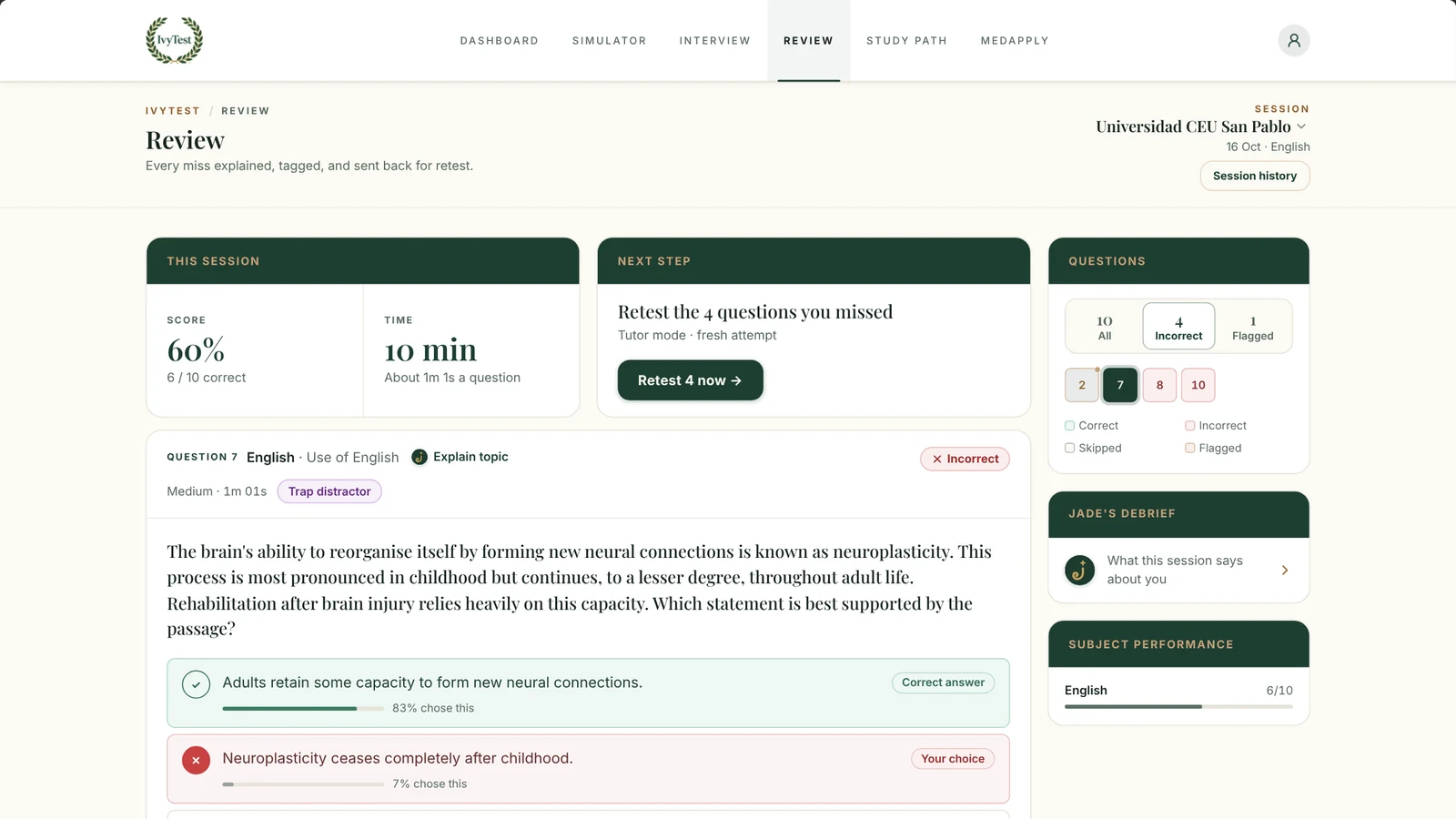
Yes. The IvyTest simulator runs practice in the confirmed format (single-best-answer items, +1/0/0 marking, Biology and Chemistry reported both separately and as the combined 35% block) in timed, tutor and review modes, with a free diagnostic available without payment. Where CEU publishes no figure, the simulator is explicit about which parameter is an assumption rather than silently adopting one.
No. CEU San Pablo's own admission FAQ says it publishes neither past papers nor a syllabus ("no tenemos publicado ni exámenes de años anteriores ni temario"), only that the content is the national first-year Bachillerato course. So there is no official sample test or PDF to download. The practice questions on this page are IvyTest's own, written to that level, and the closest thing to the real paper is a first sitting.
There are three sittings for September 2027 entry, each on campus at Montepríncipe or online: 16 October 2026 (18:00 to 20:30), 16 January 2027 and 10 April 2027 (both 10:00 to 13:00). Applications run from 9 September to 8 October 2026, 20 October 2026 to 8 January 2027 and 19 January to 1 April 2027; admissions and waiting lists come out on 28 October, 28 January and 22 April.
Two multiple-choice papers on the national first-year Bachillerato course: a knowledge test in Biology and Chemistry, worth 35% of the admission score, and an English test, worth 5%. Each question has one correct answer and a wrong one costs nothing. CEU's 2027-28 exam instructions allow a calculator on campus and a scientific one (not a phone) online, where books and papers such as periodic tables are banned. CEU publishes no question count and no topic list.
CEU San Pablo publishes none. Places go by rank on the admission score: 60% first-year Bachillerato average, 35% knowledge test and 5% English test, plus up to 2 additional points (for schooling at a CEU school, family at CEU or a disability, among others). PAU grades do not count, and the bilingual group also needs at least 7 in the English test. A cutoff quoted elsewhere is not CEU's figure.
One date per sitting: admissions and waiting lists come out on 28 October 2026, 28 January 2027 and 22 April 2027. Admitted candidates get an email and have 5 working days to pay the place reservation, or the place passes to the next person on the waiting list. CEU also publishes its waiting list as a PDF of anonymous codes, one list per group: the one of 9 September 2026 held 467 candidates for the Spanish group and 85 for the bilingual one.
For 2026/27 entrants the first year costs €24,500 in the Spanish or the bilingual group: a €3,300 place reservation paid once, €1,700 enrolment and 60 credits at €325 (€19,500); then €23,700 in year 2 and €22,800 a year after that. Prices for 2027 entrants are not out yet, and each exam sitting has its own fee. Up to 10 CEU Merit Program Medicina scholarships cover 100% of tuition for the best access marks of 8.5 or more.
Access by Bachillerato plus the PAU, a CFGS, an equivalent foreign system or a degree other than Medicine. Candidates by the first three routes upload ID and first-year grades and sit the exam; a Spanish-system place becomes final with the PAU in June, and foreign systems add the credencial de homologación and an equivalence report. Non-health graduates (1 place) sit it too, their degree average replacing the Bachillerato 60%; health-science graduates (6 places) and transfer students do not. The bilingual group adds 7 in English and B2 Spanish.
At Campus Montepríncipe, Av. de Montepríncipe s/n, 28668 Boadilla del Monte, on the western edge of Madrid, served by bus lines 571, 573 and 574 and Metro Ligero line 3; the in-person exam is sat there too. The campus has its own simulation university hospital, and from year 3 students train in linked hospitals such as HM Hospitales in Madrid, Hospital Rey Juan Carlos and Hospital Universitario Vithas Pardo-Aravaca.
Six years and 360 ECTS under the 2025 plan: 90 basic, 195 compulsory, 6 optional, 61 of clinical placements and an 8-ECTS final project. Year 1 is Cell Biology, General and Metabolic Biochemistry, General Histology, General Physiology, General Anatomy, Embryology, Medical Physics, Integrated Medicine I and two humanities courses; year 3 brings pathology, pharmacology and the first placement; year 6 is mostly Clinical Placements IV (40 ECTS). MIR preparation runs from year 4.
Yes, without the exam. For 2027 entry the transfer route opens in January 2027 (11 January in the admission PDF, 8 January on the admissions page); documents are due by 4 June and admissions come out from 17 June. You send an updated transcript, your study plan with credits, the subject programmes and a CV. At least 30 credits must be recognised and at most 144, with no subject failed at its fourth sitting; the provisional report costs €150, then €40 per credit recognised.
IvyTest publishes no reviews of its own. The closest thing CEU publishes is its 2025 survey of the 2022-23 graduates: 50 of 147 answered, 92% of those seeking work had a job, all of them related to the degree, they rated the degree 7.96 and the study plan 7.54, and 86% would take the same degree at CEU again. CEU also says it was in the MIR top 10 by results in 2024, and that QS by Subject 2026 placed CEU Universities 765th in the world in Medicine; QS's own Medicine table shows CEU Universities, the CEU group rather than San Pablo alone, in the 701-850 band.
CEU San Pablo openly publishes a teaching guide (guía docente), linked from the study plan, for each subject taught so far under the 2025 plan (years 1 and 2, bar one subject; the 2013 plan being phased out has one for every subject): learning outcomes, syllabus, assessment and reading list. Notes on sites such as Wuolah come from other students, not the University, and IvyTest has not checked them. The admission exam needs none of it: it tests first-year Bachillerato Biology, Chemistry and English.
It is the Faculty's page of practical information for enrolled students rather than applicants, and it links three documents: the first-year enrolment guide (Guía de Matriculación para alumnos de Primer Curso; for 2026-2027, enrolment opened online on 19 May), the academic calendar 2026-2027 (the year began on 3 September 2026) and the rules for requesting credit recognition. The admission exam itself is covered by the admission PDF and the admissions page.
Yes: r/CEUSanPablo, where Universidad CEU San Pablo applicants ask each other about the CEU San Pablo Medicine Admission Test and share how their preparation is going. It is run by the IvyTest team. Dates, rules and results come only from the university's own pages, listed under Official sources on this page.
Verification
Official sources
- Proceso de admisión Grado en Medicina, CURSO 2027-2028 (actualizado septiembre 2026): sittings, application windows, results dates, 60/35/5, additional points, bilingual 7/10 plus B2 Spanish, the transfer route, and the FAQChecked: 7 October 2026
Universidad CEU San Pablo
- Admission process for Medicine (English-language admissions page, still showing the 2025/26 sittings and their 10:00-13:00 schedule)Checked: 7 October 2026
Universidad CEU San Pablo
- Checked: 7 October 2026
- Grado en Medicina programme page: 200 places; start September 2027 ('Inicio Septiembre 2027'); Spanish and bilingual (Spanish-English) modalities; Top 10 in the MIR by results in 2024; linked hospitalsChecked: 7 October 2026
Universidad CEU San Pablo
- Undergraduate course fees 2026-27: Degree in Medicine, €3,300 reservation, €1,700 enrolment, €325 per creditChecked: 7 October 2026
Universidad CEU San Pablo
- Instrucciones-Examen-Medicina.pdf: 2027-28 platform and proctoring instructions; a calculator allowed (scientific, not a phone, online), no books or periodic tablesChecked: 7 October 2026
Universidad CEU San Pablo
- Currículo de Biología, Geología y Ciencias Ambientales y de Física y Química, 1º de Bachillerato: Decreto 64/2022 (Comunidad de Madrid) and Real Decreto 243/2022 (BOE)Checked: 5 October 2026
Comunidad de Madrid / Boletín Oficial del Estado
- Admisión Grado en Medicina (Spanish admissions page): the 2027-entry timetables (16 October 2026, 18:00 to 20:30; 16 January and 10 April 2027, 10:00 to 13:00), the four access groups and their datesChecked: 7 October 2026
Universidad CEU San Pablo
- Grado en Medicina: plan de estudios (2025 plan, subjects and ECTS by year; guías docentes for years 1 and 2 so far, and for every subject of the 2013 plan being phased out)Checked: 7 October 2026
Universidad CEU San Pablo
- Traslado de expediente y reconocimiento de créditos: 30 to 144 credits recognised, €150 provisional report, €40 per recognised creditChecked: 7 October 2026
Universidad CEU San Pablo
- Bases de las becas CEU Merit Program Medicina, curso 2026-2027: up to 10 scholarships, 100% of tuition, access mark of 8.5 or moreChecked: 7 October 2026
Universidad CEU San Pablo
- Encuesta de inserción laboral y satisfacción 2025, Grado en Medicina (graduates of 2022-23)Checked: 7 October 2026
Universidad CEU San Pablo
- Rankings: QS World University Rankings by Subject 2026, Medicine (CEU Universities)Checked: 7 October 2026
Universidad CEU San Pablo
- Conoce la Facultad de Medicina: Campus de Montepríncipe, address and how to get thereChecked: 7 October 2026
Universidad CEU San Pablo
- Información útil, Facultad de Medicina: the first-year enrolment guide (Guía de Matriculación 2026-2027), the academic calendar 2026-2027 and the rules for requesting credit recognitionChecked: 7 October 2026
Universidad CEU San Pablo
- QS World University Rankings by Subject 2026: Medicine, Spain (CEU Universities 701-850)Checked: 12 October 2026
QS Quacquarelli Symonds
- Medical Act 1983, section 21B: registration with a relevant European qualification, without the knowledge test, for applications made since IP completion day (Brexit)Checked: 12 October 2026
legislation.gov.uk (The National Archives)
- Directive 2005/36/EC on the recognition of professional qualifications, consolidated text of 29 October 2025, Annex V point 5.1.1 (Spain: Título de Licenciado en Medicina y Cirugía, Licenciado en Medicina or Graduado/a en Medicina, no accompanying certificate)Checked: 12 October 2026
Publications Office of the European Union (EUR-Lex)
- Evidence of qualifications from SpainChecked: 12 October 2026
General Medical Council (GMC)
Last reviewed by IvyTest editorial team: 12 October 2026. Admission rules change every cycle — always confirm against the official Universidad CEU San Pablo call for applications before acting on a deadline.
Find out how ready you are for the CEU San Pablo test.
The diagnostic takes one sitting and reports Biology, Chemistry and English separately, then combines the two sciences the way CEU's 35% weighting actually does. No payment, no commitment.