Part I · Scientific Thinking & Literacy
Chapter 3 — Visual Thinking
Visual Thinking on the HUMAT is not a school-art exercise. It is a timed pattern-recognition section that rewards disciplined scanning, controlled elimination, and careful attention to orientation.
Look at the image of this three-dimensional object shown below. It is made of four stars on each side of the line, and every star is numbered from 1 to 4. Which one of the shapes is the mirror image of the original shape?
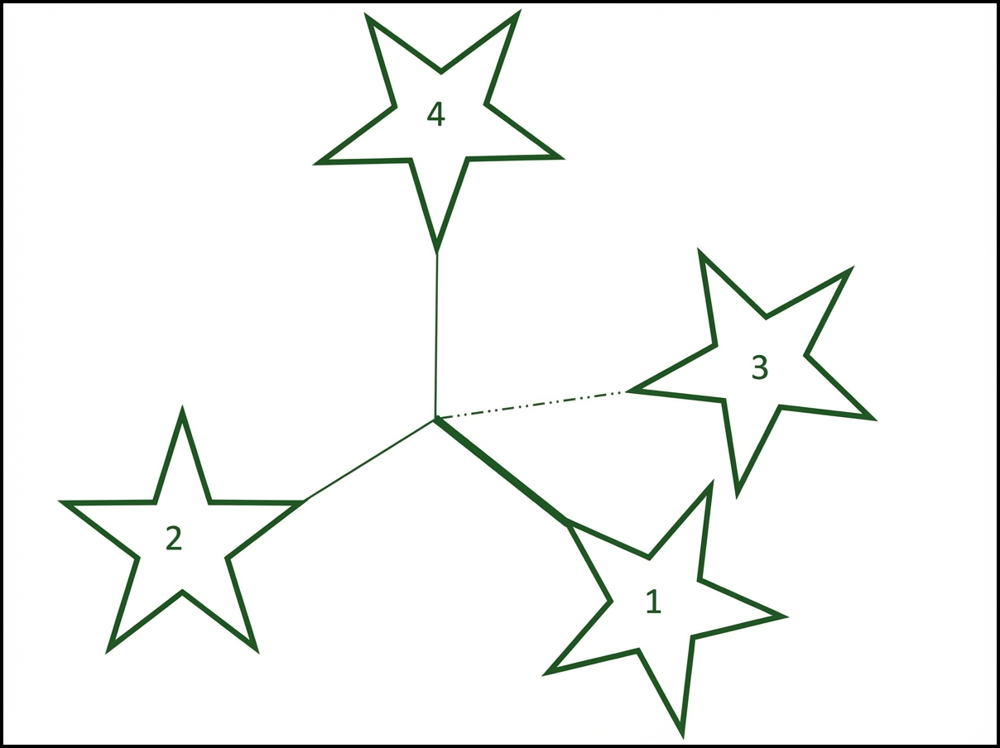
Do not compare the whole object at once. In mirror-image questions, the fastest method is to choose one unmistakable feature and ask where it must move. Here, the correct rule is: left and right reverse; top and bottom do not.
The four answer options and the full step-by-step elimination are on the next page of the guide.
- distinguish mirror images, water images, rotations, and folds without mixing the transformations;
- track one decisive visual feature instead of comparing whole figures at once;
- test cube and net questions using opposite faces, adjacency, and order around a vertex;
- avoid the most common HUMAT traps in visual items, especially hidden reversals, viewpoint errors, and NOT stems.
Recognize Mirror Images
Mirror image: left and right switch, while top and bottom stay fixed.
Water image: top and bottom switch, while left and right stay fixed.
On HUMAT, the trap is simple: candidates remember that “something flips” but forget which axis changes. Before checking the options, say the rule to yourself in words.
They want you to compare images too broadly, rotate when you should reflect, forget the viewing perspective, or rush past a NOT/EXCEPT instruction. Visual Thinking punishes loose attention much more than weak content knowledge. Your goal is to verify one feature at a time and let the wrong options collapse quickly.
A symbol is reflected in a vertical mirror. Which change must occur?
- Top and bottom reverse
- Left and right reverse ✓
- The figure rotates by 90°
- Both left-right and top-bottom reverse
Answer: B. A vertical mirror swaps left and right only. A describes a water image. C confuses reflection with rotation. D would amount to a double transformation, not a single mirror image.
This is a two-page sample from Chapter 3. The full guide runs 330 pages across both the Medicine and MEDTEC tracks.